
Flashback Friday.
Behold, the taken-for-granted, unexceptional:
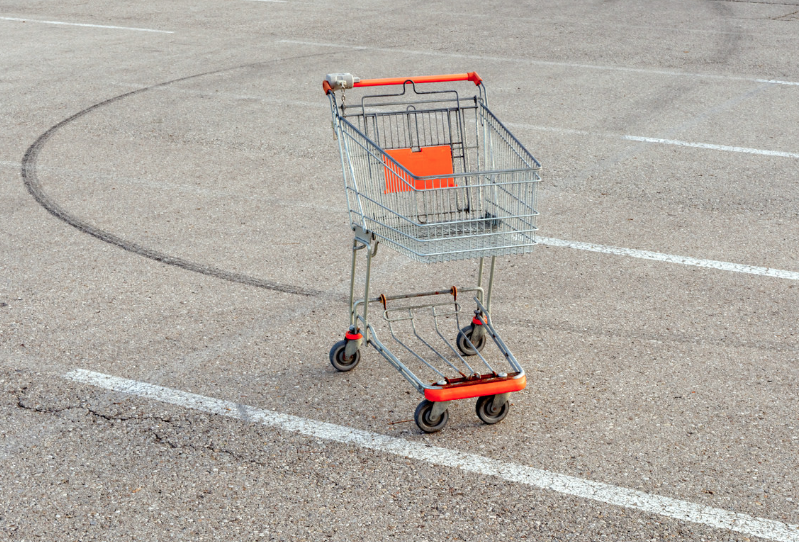
Cropped version of image by XoMEox, Flickr Creative Commons
Until last week I had never truly thought about shopping carts. I mean, I occasionally notice one stranded in an unexpected place, and as a kid I loved the occasional chance I had to push one a bit and then jump on and race down an aisle. But I read Cheap: The High Cost of Discount Culture by Ellen Ruppel Shell, and it turns out that the story of the shopping cart is fascinating!
Way back in the day, stores weren’t like they were today. You went in and there was a long counter and you had the clerk show you the wares. If you’ve read some Jane Austen or Laura Ingalls Wilder, you’ve undoubtedly come across a scene where a clerk is showing someone bolts of cloth. That’s how things worked: almost everything was behind the counter; you told the clerk what you were interested in and they showed you your options. You haggled over the price, decided on a nice gingham, the clerk wrapped it for you, and off you went. Most retail outlets worked more or less along these lines (think of a butcher, for instance).
But if you were a shop owner interested in keeping prices down, this situation might be less than ideal. It required a lot of clerks, and experienced clerks who knew all the goods and could be trusted to set an acceptably profitable price for them, too.
Eventually retailers, including F.W. Woolworth, tried putting more products out on display in the store so customers could help themselves. Some customers liked the ability to pick items off the shelves directly, but more importantly, you didn’t need as many clerks, and certainly not such highly-paid ones, if their job was mostly reduced to ringing up the purchases at the register.
Of course, this presents a new problem: how are customers going to carry all their purchases around the store while they make their selections? Well, a basket they could carry over an arm would work. But these baskets had a downside: they didn’t hold much and they quickly got heavy.
As Shell notes, in 1937 a man from my home state of Oklahoma, Sylvan Goldman, came up with a solution. He owned the Humpty-Dumpty grocery store chain (I still remember Humpty-Dumpty!). He and a mechanic he hired came up with a cart on which two shopping baskets could be suspended. And thus the shopping cart — or, as Goldman named it, the “folding basket carrier” — was born. As Goldman suspected, people bought more when they didn’t have to carry a heavy basket on their arm. The folding basket carrier was advertised as a solution to the burden of shopping:
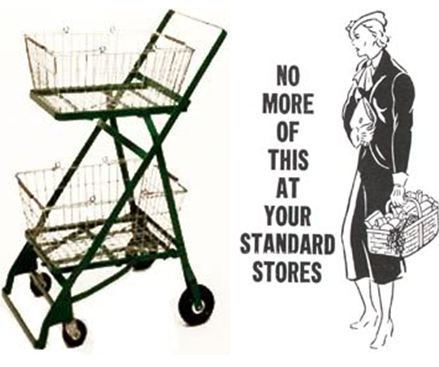
The only problem was…people didn’t like the new contraptions. From a 1977 interview (via):
I went into our largest store, there wasn’t a soul using a basket carrier, and we had an attractive girl by the entrance that had a basket carrier and two baskets in it, one on the top and one on the bottom, and asked them to please take this cart to do your shopping with. And the housewive’s, most of them decided, “No more carts for me. I have been pushing enough baby carriages. I don’t want to push anymore.” And the men would say, “You mean with my big strong arms I can’t carry a darn little basket like that?” And he wouldn’t touch it. It was a complete flop.
Goldman eventually had to hire attractive models to walk around the store pushing the carts to make shopping carts seem like an acceptable or even fashionable item to use.
Over time the basic design was changed to have a single basket, with a flat shelf on the bottom for large items. The baskets could also then “nest” inside each other (instead of being folded up individually), reducing the amount of space they required for storage.
The Baby Boom ushered in the final major design change, a seat for kids.
Notice in the image above how small the cart was compared to what we’re used to today. I remember as a kid going to the local grocery store, and the carts were quite small; eventually a big warehouse-type grocery store came to the nearest city and their baskets seemed gigantic in comparison. Because obviously, if people will buy more if they have a cart instead of a full arm-carried basket, they’ll buy even more if they have a bigger cart — not just because there’s more room, but because it seems like less stuff if it’s in a bigger cart. Restaurants discovered the same principle — people will want bigger portions if you give them bigger plates because it visually looks like less food and so they don’t feel like they’re over-eating.
Without enormous carts, Big Box discounters and wholesale club stores couldn’t exist. You can’t carry a box of 50 packages of Ramen noodles, 36 rolls of toilet paper, a box of 3 gallons of milk, enough soup for the entire winter, and a DVD player you just found on sale around without a huge cart.
So there you have it: labor de-skilling + marketing – stigma of feminine association + Baby Boom + profits based on increased purchasing of ever-cheaper stuff = the modern shopping cart!
I love it when I learn totally new stuff.
Originally posted in 2009.
Gwen Sharp is an associate professor of sociology at Nevada State College. You can follow her on Twitter at @gwensharpnv.
Comments 102
heather leila — December 15, 2009
In Mozambique (and I imagine many places in Africa), stores are still set up that way, with a big counter and clerks. The wall behind the counter was filled with products. The store's floor was filled with giant bags of flour and rice. You told them what you wanted and they got it for you and made a pile on the counter in front of you. Usually such stores were owned by Indian-Mozambicans. Except we didn't haggle, the prices were on the wall. You only haggled in the market, where things were cheaper, but not as nice.
betsy — December 15, 2009
How interesting - the increasingly popular Express Cart (http://bit.ly/7rU2I0) seems to echo the original shopping cart design (popular at least in suburban Northern Virginia).
Philip Cohen — December 15, 2009
A great story. Another important element is steel production capacity and technology. If you map the timing of this over the mass production of steel in the U.S. you see it was made possible by cheaper steel. The people who made shopping carts were companies looking for things to do with steel. One was the late American Voting Machine, which went through a shopping cart phase before turning to coin-operated lockers and subdivision mailboxes as American Locker. (Now, of course, the new carts are plastic, coin-operated lockers are a terrorism threat, and American Locker stock is cheap.)
ani — December 15, 2009
i noticed in London that the shopping carts are smaller, and people generally buy less at grocery stores. the food comes in smaller packages, too.
i think another reason for the American shopping style would have to be cars. you can't buy a lot if you are walking home or taking the bus.
underbelly — December 15, 2009
interesting. I'm also guessing that the rise of the shopping cart coincides withe the rise of consumerism.
larry — December 15, 2009
I don't know about the rest of the country, but in L.A. we have men in little trucks who prowl neighborhoods to reclaim abandoned carts (they have gone from steel to plastic to cut expenses since so many of them are stolen).
Several stores in my neighborhood have experimented with wifi devices. One upscale store had an lcd screen in the cart that you could query for the location of items. Another one locked its brakes if it got too far from the store, presumably out of range of some wifi device.
Another thing I've seen is carts combined with toy cars that carry a shopper's children.
And of course every square inch of a supermarket is covered with advertising these days: The carts, the floors, the TV screens at the checkout stands, the little plastic separators you use on the conveyor belt at the checkout stand.
Of course, as the carts get wider, store aisles get narrower and are intentionally blocked with floor displays so shoppers can only pass one at a time.
Favorite moment: Some shoppers make their carts even wider by putting aluminum six-packs of pop on the rim of the cart instead of inside. I once saw one of these folks puncture several cans on something. It was messy. And I hope they learned their lesson.
Noelley B — December 15, 2009
Like betsy in Virginia, I've noticed that most grocery stores here in Seattle have the small, two basket sized carts available. I feel like this is a fairly recent improvement, as in the last few years or so, but that could be because I've started shopping at higher end grocery stores. Backlash over the obesity epidemic? Everyone wants to feel trim in public these days.
MissK — December 15, 2009
Watch this! http://www.youtube.com/watch?v=M66ZU2PCIcM
IDEO redesigns the shopping cart on Nightline. I'm certain there's a longer video of this...really fascinating design process.
Penny — December 15, 2009
In 2005, over 24,000 kids were treated in emergency rooms for shopping-cart injuries. Some cart designs are bigger tipping hazards than others. Very frequently, larger, newer carts will be safer, but you also have to look at the angles--avoid using carts where the child will be riding forward of the wheels (farther from the center of the cart's base). Notice next time you're in the store how balanced and stable your cart is, and whether the strap and clasp are present and functional.
http://www.aap.org/advocacy/releases/aug06shoppingcart.htm
Justa — December 15, 2009
I think the capacity of grocery carts changing over time also probably has a lot to do with the increasing ubiquity of preservatives in our food. I do small-batch shopping because I tend to buy fresh foods that go bad before too long, so if I get more than I can carry out of the store, I'm pretty much guaranteed to be wasting some. Before the era of unnaturally extended shelf lives, this was something that everyone had to take into consideration to some degree.
Orientalista — December 15, 2009
We don't have time to go grocery shopping 3 or 4 times a week because of how far the grocery store is. When I was living in New York or abroad I could pick up what I needed for that night's dinner on my way home from work, when abroad there were several places in between the bus and my house with fresh produce. If I was making dinner and realized I needed something I just ran out, 5 minutes, and got it.
Now I'm living back in non-city America and finding it very hard to adjust. Shopping takes an hour at the very least with the bus there and back, so I don't have time to do it everyday or more than once a week. In between work and home there's nothing unless I wanted to buy chips. I still use a basket though, because I don't want to buy more than I can carry home on the bus.
If our communities weren't zoned like this, with residential miles from commercial, we could easily shop 3 times a week with a little basket.
maria — December 15, 2009
i literally cringed at "...I have been pushing enough baby carriages. I don’t want to push anymore.”
Justa — December 15, 2009
oh, i forgot to mention, i noticed the other day that the shopping carts in a nearby grocery have cupholders on them.
Liz — December 15, 2009
One grocery store I frequent has the smaller two layer carts pictured in this post. I have to hunt for them though, they only have a few around.
amy — December 16, 2009
My local Walmart doesn't have hand baskets at all -- only big shopping carts. I only shop there when I absolutely have to, and it annoys me that I have to use a cart when I only want 6 or 7 things (too much to carry by hand, but just right for a hand basket). I assume they do this to encourage people to buy as much as possible.
I'd love to buy fresh groceries every couple of days, but then I'd have to drive a lot more than I do. Zoning in this country really is ridiculous -- houses far away from stores, terrible public transportation (we don't have any public transport in my city), few bike lanes or pedestrian-friendly crossings over highways. Not to mention, in my city the drivers are actively hostile to bikers and pedestrians, so you're really taking your life in your hands if you don't travel everywhere in a car.
aneka — December 16, 2009
Such great invention by american commericialism. Now you do not have to carry those baskets around in these huge mall where the products are packet in piles, waiting for the yank to stroll in and pick up whatever he or she can afford. It is a celebration of waste and greed.
LP — December 24, 2009
As a kid I was quite impressed with the statue of Mr. Goldman pushing a shopping cart @ The Museum of Science (Then called Omniplex) in OKC. It was encouraging to see that one could be deemed statue worthy for something as eventually unremarkable as the shopping cart. Then again, I didn't have a real understanding of how lacking OK is on the cultural achievement front.
Jamnturtl — April 10, 2015
A favorite silly book: The Stray Shopping Carts of Eastern North America: A Guide to Field Identification by Julian Montague.
http://www.montagueprojects.com/#/the-stray-shopping-cart-project/
Kimberly Hooker Etter Steury — April 24, 2015
The story evolves and continues with Versacart, creators of the first two-tier shopping cart that was re-introduced in 2000. First cart mimic'd Goldman's cart, but from there the proprietary designs and functions have just blossomed. www.versacart.com
Taylor Bishop — December 20, 2018
Thanks for the interesting article about shopping carts. It's kind of interesting to learn that people would buy more if they had a larger cart. I'm kind of interested to learn if this could also be with the case with carts that can be folded or changed in size if necessary.
patronsurvey.com — November 20, 2019
By shopping at the Publix grocery store, we get a chance to win $1000 Gift Card by submitting our honest feedback towards the store. Get a receipt code and enter it on the official site of publixsurvey.com to finish further steps.
Most of the shopping sites, stores, restaurant surveys are ready to take feedback on this survey blog
Anna Marie Wier — August 20, 2020
Approximately when and/or why id so many riding shopping carts become so necessary?
Mason24 — April 9, 2021
If you have visited Just Save Foods recently, give your feedback at Just Save Foods Customer Survey.
Mason24 — April 9, 2021
This article is to simplify your task for entering Just Foods Customer Feedback
homedepotcomsurveyss.com — May 24, 2022
Great content loved the story of the shopping cart. Offering a chance to win $5000 from Homedepot by taking the HD store Survey. Visit homedepot.com/survey for submit the feedback about Homedepot store.
Pinker — March 14, 2024
In the past, most retail stores operated on a counter service heardle model, where customers would request items from a clerk behind the counter.
Eveline Anders — July 7, 2024
The history of the shopping cart, from Sylvan Goldman's innovative "folding basket carrier" to its evolution bad time simulator and impact on retail, illuminates a profound transformation in consumer convenience and shopping habits that continues to shape modern retail environments.
taylo elle — July 10, 2024
thanks for sharing! I love it !
BedWars — September 5, 2024
Teams in this game are placed on individual islands with beds they need to defend. In BedWars, the objective is to protect your bed from being destroyed while attempting to eliminate the beds of other teams. Resources like iron, gold, and emeralds are used to buy blocks, weapons, and armor. A destroyed bed prevents respawning, making defense crucial. The last team with their bed intact or the last player standing wins.
Rafael Keating — January 17, 2025
The story of shopping has evolved significantly over time, shifting from small, local markets to massive retail chains and online platforms. In the past, shopping meant traveling to a store, interacting with salespeople, and physically examining products. Today, with the rise of e-commerce, the experience is more digital and convenient, offering consumers the freedom to shop from the comfort of their homes. Some people may prefer heading to a physical store such as Home Depot, especially if they're looking to explore specific items. Depending on what you're looking for, you might want to consider what the home depot schedule today could offer in terms of promotions or availability. It’s always a good idea to keep an eye on possible store timings to make sure you don’t miss out.
leopards — March 27, 2025
https://leopardtrackings.pk/ thanks for the info
mnp tracking — September 30, 2025
Really interesting read on how shopping carts changed retail behavior. For anyone looking to track parcels in Pakistan, I use https://mnptracking.com.pk/
to check delivery status easily.
Activate Smart SIM — February 19, 2026
Smart Sim Registration. The Philippines government requires Smart SIM
jany — July 19, 2026
So after reading your article, I’m going to invest some time in a blog post commenting.
queen — July 19, 2026
So after reading your article, I’m going to invest some time in a blog post commenting.
https://petbreeds.net/
Bandle — August 29, 2026
i love it
hamy — September 9, 2026
Great article! I especially liked the section about choosing the right pet for your lifestyle. It’s really helpful for new pet owners. I also found some useful pet-care information on Pet Lovia that complements this topic.
queen — September 9, 2026
Great article! I especially liked the section about choosing the right pet for your lifestyle. It’s really helpful for new pet owners. I also found some useful pet-care information on Pet Lovia that complements this topic.
https://petlovia.com/