Search results for The

This week Hurricane Florence is making landfall in the southeastern United States. Sociologists know that the impact of natural disasters isn’t equally distributed and often follows other patterns of inequality. Some people cannot flee, and those who do often don’t go very far from their homes in the evacuation area, but moving back after a storm hits is often a multi-step process while people wait out repairs.

We often hear that climate change is making these problems worse, but it can be hard for people to grasp the size of the threat. When we study social change, it is useful to think about alternatives to the world that is—to view a different future and ask what social forces can make that future possible. Simulation studies are especially helpful for this, because they can give us a glimpse of how things may turn out under different conditions and make that thinking a little easier.

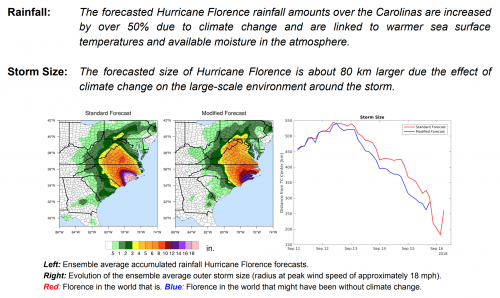
This is why I was struck by a map created by researchers in the Climate Extremes Modeling Group at Stony Brook University. In their report, the first of its kind, Kevin Reed, Alyssa Stansfield, Michael Wehner, and Colin Zarzycki mapped the forecast for Hurricane Florence and placed it side-by-side with a second forecast that adjusted air temperature, specific humidity, and sea surface temperature to conditions without the effects of human induced climate change. It’s still a hurricane, but the difference in the size and severity is striking:
Reports like this are an important reminder that the effects of climate change are here, not off in the future. It is also interesting to think about how reports like these could change the way we talk about all kinds of social issues. Sociologists know that narratives are powerful tools that can change minds, and projects like this show us where simulation can make for more powerful storytelling for advocacy and social change.

Evan Stewart is an assistant professor of sociology at University of Massachusetts Boston. You can follow his work at his website, or on BlueSky.
Originally Posted at TSP Discoveries

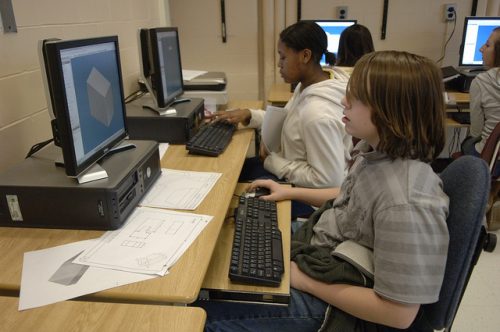
In a scene familiar to today’s teachers, several students in the classroom are glued to their screens: one is posting to social media, one is playing a computer game, and another is hacking their way past the school’s firewall with skills they perfected from years on the Internet. Are these students wasting class time or honing the skills that will make them a future tech millionaire?

Photo Credit: Ben+Sam, Flickr CC

Recent research in American Journal of Sociology from Matthew Rafalow finds that teachers answer that question differently based on the social class and race makeup of the school. Schools that serve primarily white, more privileged students see “digital play” such as video games, social media, and website or video production as building digital competencies that are central to success, while schools that serve larger Latino or Asian populations view digital play as irrelevant or a distraction from learning.

Based on observations of three technology-rich Bay Area middle schools, Rafalow examined whether the skills students develop through digital play are considered cultural capital — skills, habits, and dispositions that that can be traded for success in school and work. Although digital play can lead to skills like finding information online, communicating with others, and producing digital media, classed and raced stereotypes about educational needs and future work prospects affect whether teachers recognize those skills in their students. In other words, Rafalow examined whether teachers reward, ignore, or punish students for digital play in the classroom.

Rafalow found three distinct approaches across the schools. At the first school — a public middle school that largely serves middle-class Asian students — teachers viewed digital play as threatening to their traditional educational practices because it distracted students from “real” learning. Further, teachers believed students comfortable with digital skills could hack standardized tests that had been given electronically.

Photo Credit: US Department of Education, Flickr CC

At the second school — a public middle school that largely serves working-class Latino students — teachers discounted any skills that students brought into the classroom through their years of digital play. Instead, teachers thought introducing their students to website design and programming was a more important part of preparing them for 21st century working-class jobs.

In contrast, at the third school — a private, largely white middle school — teachers praised skills students developed through digital play as crucial to job success and built a curriculum that further encouraged expression and experimentation online.

The ways teachers in this study approached digital play provide a clear example of how raced and classed expectations for students’ futures determine the range of appropriate classroom behavior.

Jean Marie Maier is a graduate student in sociology at the University of Minnesota. She completed the Cultural Studies of Sport in Education MA program at the University of California, Berkeley, and looks forward to continuing research on the intersections of education, gender, and sport. Jean Marie has also worked as a Fulbright English Teaching Assistant in Gumi, South Korea and as a research intern at the American Association of University Women. She holds a BA in Political Science from Davidson College.

Originally Posted at Social Studies Minnesota

Photo Credit: Colby Cosh, Flickr CC

Everyone needs a break from the news now and then, but some people tune out all the time. Civic engagement is changing, and “fake news” is a growing concern, and so it is important to understand why some people stay away from important sources of information about society. As a journalism studies scholar with an interest in public opinion, Dr. Benjamin Toff recently published a study in Journal of Communication about “news avoiders”—people who seek out news less than once per month.

The study interviewed 43 people who said they use the news less than once per month. Interviewers found three folk theories that respondents used to explain how and why they avoid the news:

“News finds me.” Many avoiders, particularly those who were also social media users, described a feeling that news is “all around them.” Given the emergence of social and digital media in the past couple of decades, certain avoiders feel they don’t need to take an active effort to read the paper or watch the evening news because all the news they need can be found whenever they log on to Facebook or another social media network.

“The information is out there.” Some news avoiders deliberately keep themselves off social media but have confidence that, if they want to find news or information, that the information is “out there.” They describe the internet as vast and useful, and say that any information they might need is “only a Google search away.” These people feel like they can go get news anytime they want to.

“I don’t know what to believe.” A third folk theory came from avoiders who felt frustration about finding reliable sources and sorting through all of the information that’s out there. For example, while it’s possible to type a basic phrase into a Google search and see what comes up, these news avoiders talked about how difficult it would be to sort through the information they might find. The mere fact that information exists does not necessarily help people make sense of it or find the facts.

The study has three major implications. First, not all news avoiders are the same. We need to take these different concerns into account to better understand why people tune out. Second, improving media literacy requires helping people develop tools for evaluating the reliability of a range of media choices, not just encouraging a general skepticism of all news that many of these avoiders have already internalized. Finally, many avoiders are also politically disengaged, and they see little value to news in part because they have difficulty connecting it to the issues they see as most important in their own lives. This third concern may also reflect real deficiencies with the supply of news itself.

Allison J. Steinke is a Ph.D. student at the Hubbard School of Journalism and Mass Communication studying social and mobile media, journalism, and social justice with an emphasis on the anti-human trafficking movement. Follow her work on Academia or ResearchGate.

Religious freedom and discrimination are back in the national spotlight, from this year’s Masterpiece Cakeshop case in the Supreme Court to Jeff Sessions’ new Religious Liberty Task Force. These cases are controversial because they raise questions about the limits of freedom—do people with sincere religious beliefs (often conservative Christians) have a right to opt out of providing goods and services they do not support? Or, is that just plain discrimination?

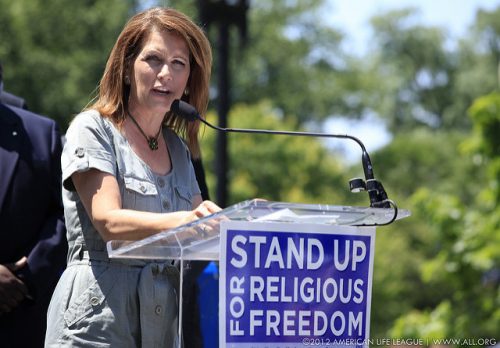
Michelle Bachmann at a rally for religious freedom (Photo Credit: A.L.L., Flickr CC)

Debates about religious freedom often jump to legal arguments, but there is also a sociological angle on these controversies: who experiences bias and who perceives bias? For example, my research at the American Mosaic Project found that Atheists and Muslims face the strongest animus in the US, at almost twice the rate of conservative Christians. Trends in hiring discrimination tend to follow a similar pattern. Yet many of these recent religious freedom cases focus on conservative Christians alleging discrimination. Does perceived bias run the other way?

Sociologist John W. Hawthorne recently shared some interesting research from the annual conference of the Association for the Sociology of Religion. His surveys of evangelical clergy found older clergy members tended to agree that society regularly discriminates against people with Christian beliefs, while younger clergy were more likely to disagree. I went back to data from the American Mosaic Project to see if a similar pattern shows up for members of these religious denominations.

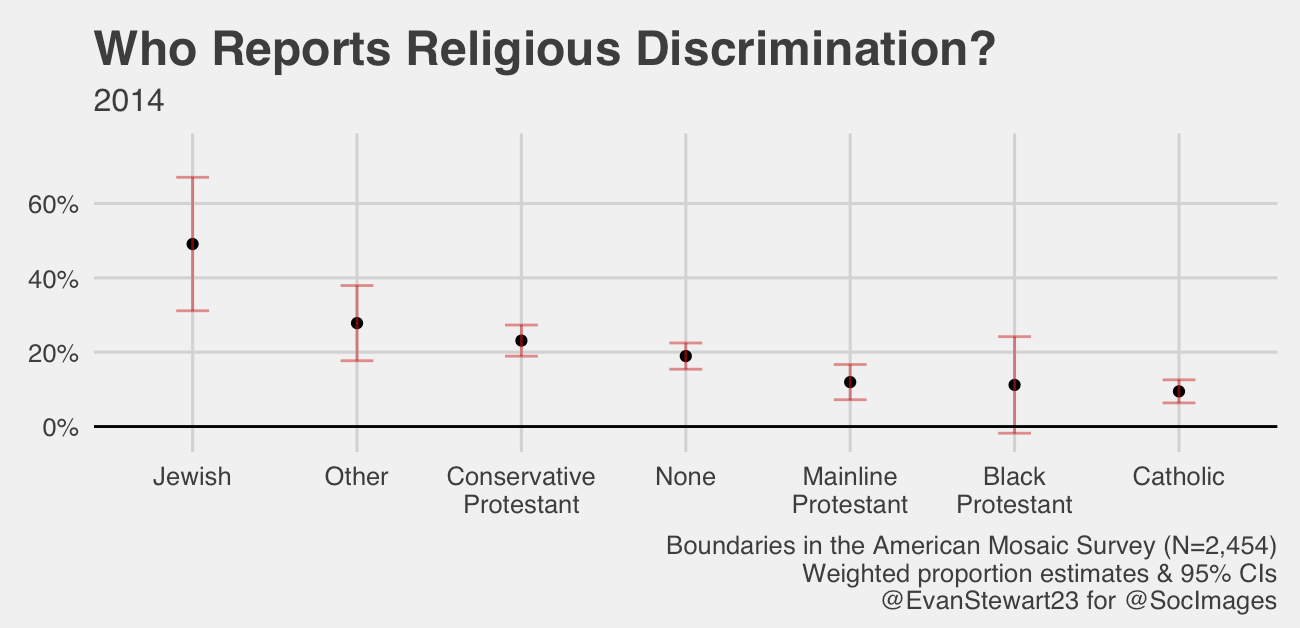
In this survey, respondents answered a simple yes or no question about whether they had ever experienced discrimination because of their religion. The chart below breaks down the percentage of responses who said they did by major denomination groups. It is important to remember that many minority religious groups in the US are actually quite small, so getting useful information requires putting many groups into a big “other” category and using confidence intervals to show uncertainty in our estimates.

(Click to Enlarge)

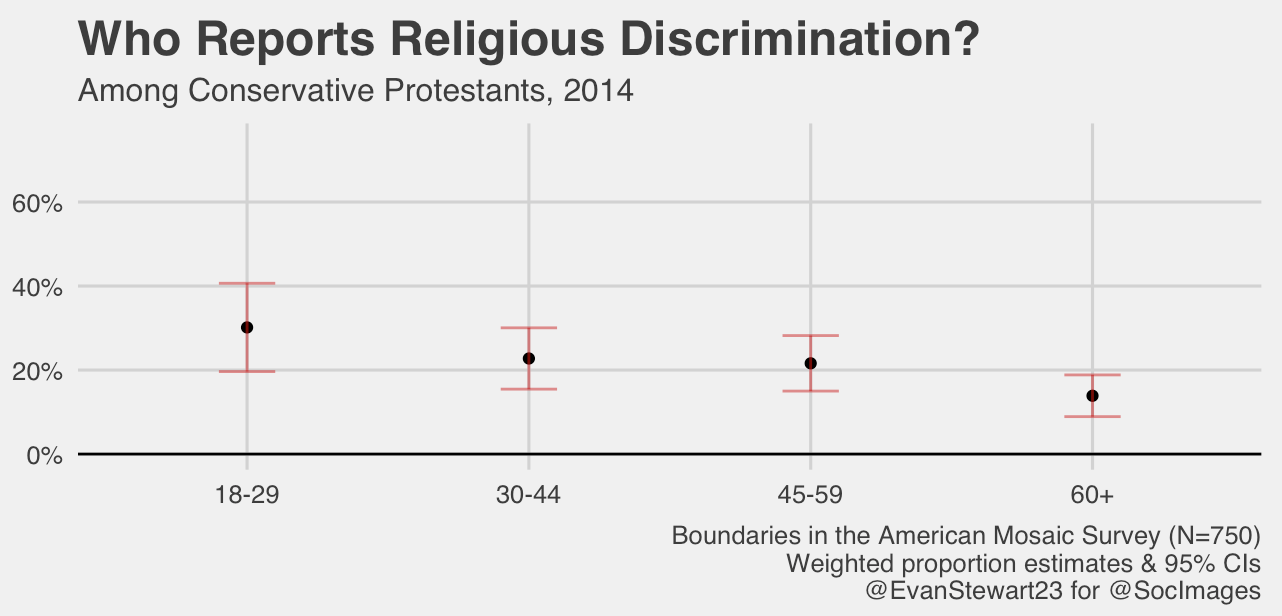
Conservative Protestants are different from other Protestant groups, with about 23%  reporting that they have experienced religious discrimination. This proportion is fairly high, third in line after respondents who are Jewish or belong to other religious minority groups. They even nudged out people with no religious affiliation. What about age brackets?

(Click to Enlarge)

This is different from John Hawthorne’s finding. Younger members of conservative Protestant groups reported experiencing discrimination at higher rates than older members. This is just a quick look, but we can speculate about an explanation. Younger conservative Protestants and evangelicals live in a very secular generation, and probably perceive tension and conflict outside the church. Younger clergy, on the other hand, probably have a different perspective on the changing role of churches in society.

The big sociological questions for the religious freedom debate are how these views persist and how they may skew our interpretation of trends in actual discriminatory behavior.

Evan Stewart is an assistant professor of sociology at University of Massachusetts Boston. You can follow his work at his website, or on BlueSky.
This week a host of digital platforms gave Alex Jones’ programming the boot. Conspiracy theories have big consequences in a polarized political world, because they can amplify basic human skepticism about political institutions into absurd, and sometimes violent, belief systems.

But the language of mainstream politics can often work the same way when leaders use short, pithy phrases to signal all kinds of beliefs. From “mistakes were made” to the “food stamp president” slur, careful choices about framing can cover up an issue or conjure up stereotypes to swing voters.

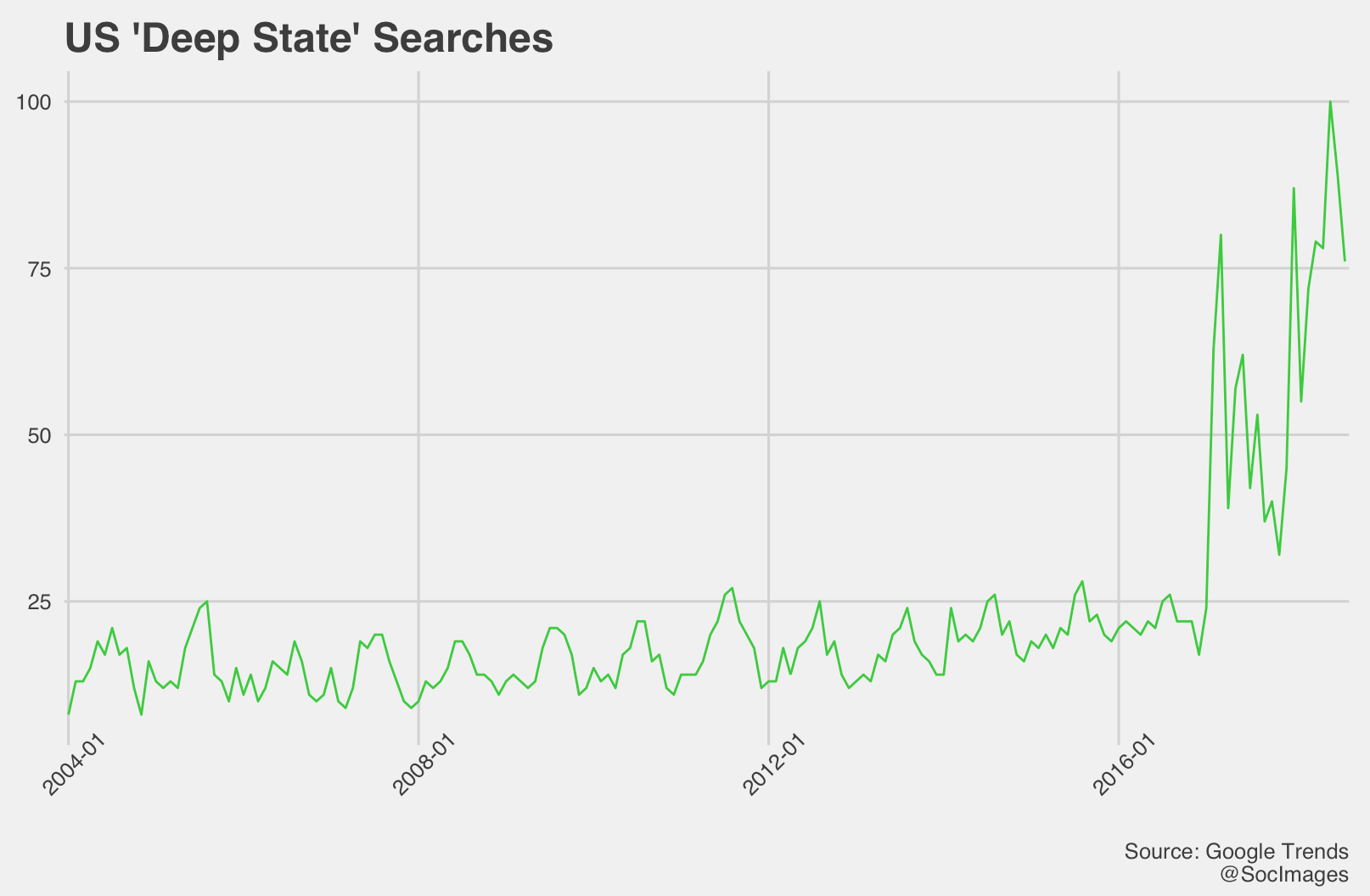
In the past two years, you may have noticed a new term entering the American political lexicon: the “deep state.” Used to refer to insider groups of political specialists (especially in government agencies like the FBI or in the media), “deep state” conjures up images of a shadowy network of political power brokers who operate outside of elected office. The term has really caught on—search data from Google Trends shows a huge spike in “deep state” searches since 2016.

(Click to Enlarge)

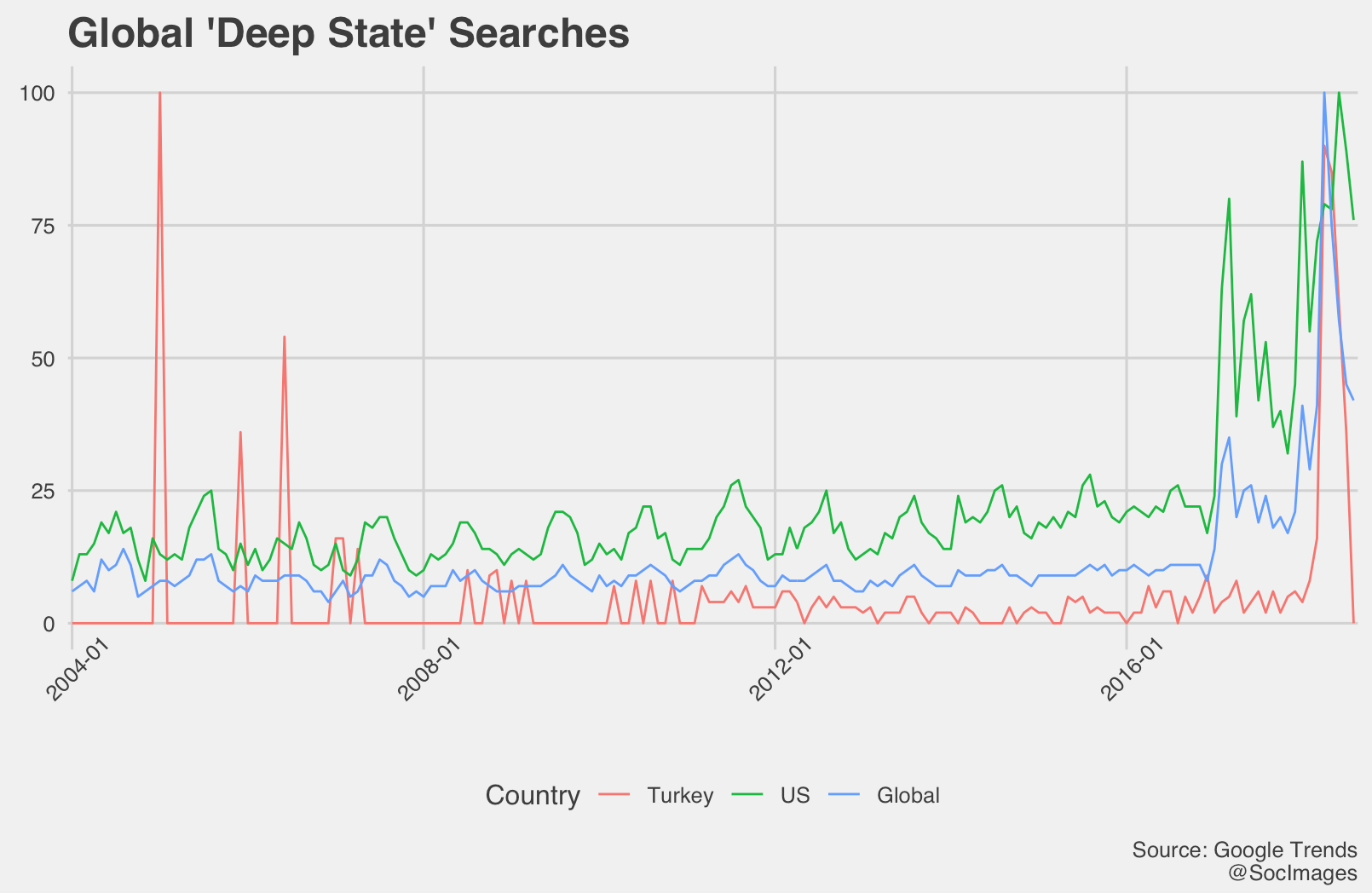
Deep state talk catches my interest because I have heard it before. For years now, politicians in Turkey have raised allegations about secretive “deep state” organizations plotting to overthrow the government. While Turkey has had coups in the past, these kinds of accusations are also one way that leadership has been able to justify cracking down on political opposition. Sure enough, trends also show deep state searches spiked in Turkey about ten years before the US (I also added the global trend for context).

(Click to Enlarge)

This data doesn’t show a direct connection between the Turkish and American cases. It does show us that new political ideas don’t necessarily spring out from nowhere. For example, work by sociologists like Chris Bail shows how ideas from the fringes of the political world can make their way into the mainstream, especially if they rely on emotionally-charged messaging. As political consulting and strategy goes global, it is important to pay attention to how these ideas play out in other times and places when we see them emerging in the United States.

Evan Stewart is an assistant professor of sociology at University of Massachusetts Boston. You can follow his work at his website, or on BlueSky.
People talk. Their interactions become habits, habits become routines, and routines become rules. Sociologists call this emergent behavior, and sometimes it happens so slowly we don’t even notice it until we look back and think “where did that come from?”  Emergent behavior can be quirky and fun (think of Taco Friday at the office or “on Wednesdays we wear pink“), but sometimes it can also be far more serious or more troubling.

The challenge is that new technology makes these interactions happen much faster, on a much larger scale, and with less editing—often with odd results. Check out this TED talk—The Nightmare Videos of Children’s YouTube— for a good illustration of the dark side of emergent behavior when algorithms accelerate and exploit social interactions online.


Evan Stewart is an assistant professor of sociology at University of Massachusetts Boston. You can follow his work at his website, or on BlueSky.
The blog turns eleven today!

We started a second decade bringing you even more sociology, both serious and silly. Readers’ favorite posts covered everything from big ideas in current events like the normalization of extremism and conspiracy theories to the panic over Tide Pods, the sociology of Spotify, emojis, and a list of great social science podcasts.

We also launched a running post series called “What’s Trending?”—a data visualization project on what’s up, what’s down, and what sociologists have to say about it. Check out where people are getting the news, how people feel about gun control, and why STI diagnoses are on the rise.

And I can’t forget our stellar guest posts! So much great work came across my desk this year, like supernatural sociology, digital drag, and bro-hugs. Not to mention fascinating takes on filtered news, how social class can choose your college major, and, of course, beautiful reflections honoring what Anthony Bourdain’s work meant for many of us. If you’re a scholar, instructor, or student in sociology or a related field, you can send us guest posts, or just say hello at the ASA annual meeting next month!

This birthday marks almost a year since I took over editorial responsibilities at SI from founder Lisa Wade, and running this blog is a blast. A big thank you to Lisa and to all of our readers, old and new!

P.S. Do you use SocImages in the classroom? Are you looking for new ways to get news about your research out into the world? If you are a faculty member who likes the work, you can bring SI to your department!

Evan Stewart is an assistant professor of sociology at University of Massachusetts Boston. You can follow his work at his website, or on BlueSky.
By now, you’ve probably heard about the family separation and detention policies at the U.S. border. The facts are horrifying.

Recent media coverage has led to a flurry of outrage and debate about the origins of this policy. It is a lot to take in, but this case also got me thinking about an important lesson from sociology for following politics in 2018: we’re not powerless in the face of “fake news.”

Photo Credit: Fibonacci Blue, Flickr CC

Political sociologists talk a lot about framing—the way movements and leaders select different interpretations of an issue to define and promote their position. Frames are powerful interpretive tools, and sociologists have shown how framing matters for everything from welfare reform and nuclear power advocacy to pro-life and labor movements.

One of the big assumptions in framing theory is that leaders coordinate. There might be competition to establish a message at first, but actors on the same side have to get together fairly quickly to present a clean, easy to understand “package” of ideas to people in order to make political change.

The trick is that it is easy to get cynical about framing, to think that only powerful people get to define the terms of debate. We assume that a slick, well-funded media campaign will win out, and any counter-frames will get pushed to the side. But the recent uproar over boarder separation policies shows how framing can be a very messy process. Over just a few days, these are a few of the frames coming from administration officials and border authorities:

We don’t know how this issue is going to turn out, but many of these frames have been met with skepticism, more outrage, and plenty of counter-evidence. Calling out these frames alone is not enough; it will take mobilization, activism, lobbying, and legislation to change these policies. Nevertheless, this is an important reminder that framing is a social process, and, especially in an age of social media, it is easier than ever to disrupt a political narrative before it has the chance to get organized.

Evan Stewart is an assistant professor of sociology at University of Massachusetts Boston. You can follow his work at his website, or on BlueSky.