Search results for The

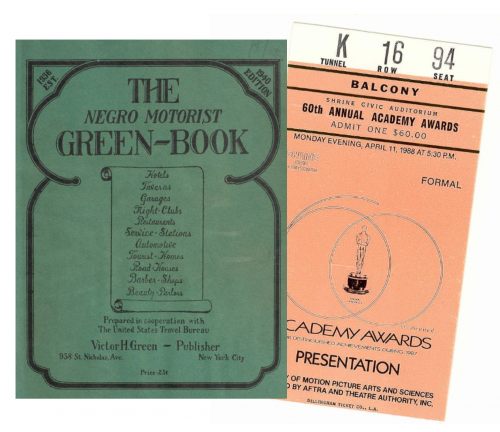
Last month, Green Book won Best Picture at the 91st Academy Awards. The movie tells the based-on-a-true-story of Tony Lip, a white working-class bouncer from the Bronx, who is hired to drive world-class classical pianist Dr. Don Shirley on a tour of performances in the early-1960s Deep South. Shirley and Lip butt heads over their differences, encounter Jim Crow-era racism, and, ultimately, form an unlikely friendship. With period-perfect art direction and top-notch actors in Mahershala Ali and Viggo Mortensen, the movie is competently-crafted and performed fairly well at the box office.

Still, the movie has also been controversial for at least two reasons. First, many critics have pointed out that the movie paints a too simple account of racism and racial inequality and positions them as problem in a long ago past. New York Times movie critic Wesley Morris has called Green Book the latest in a long line of “racial reconciliation fantasy” films that have gone on to be honored at the Oscars.

But Green Book stands out for another reason. It’s an unlikely movie to win the Best Picture because, well, it’s just not very good.
Source: Wikimedia Commons

Sociologists have long been interested in how Hollywood movies represent society and which types of movies the Academy does and doesn’t reward. Matthew Hughey, for example, has noted the overwhelming whiteness of Oscar award winners at the Oscars, despite the Oscars A2020 initiative aimed at improving the diversity of the Academy by 2020. But, as Maryann Erigha shows, the limited number of people of color winning at the Oscars reflects, in part, the broader under-representation and exclusion of people of color in Hollywood.

Apart from race, past research by Gabriel Rossman and Oliver Schilke has found that the Oscars tend to favor certain genres like dramas, period pieces, and movies about media workers (e.g., artists, journalists, musicians). Most winners are released in the final few months of the year and have actors or directors with multiple prior nominations. According to these considerations, Green Book had a lot going for it. Released during the holiday season, it is a historical movie about a musician, co-starring a prior Oscar winner and a prior multiple time Oscar nominee. Sounds like perfect Oscar bait.

And, yet, quality matters, too. It’s supposed to be the Best Picture after all. The problem is what makes a movie “good” is both socially-constructed and a matter of opinion. Most studies that examine questions related to movies measure quality using the average of film critics’ reviews. Sites like Metacritic compile these reviews and produce composite scores on a scale from 0 (the worst reviewed movie) to 100 (the best reviewed movie). Of course, critics’ preferences sometimes diverge from popular tastes (see: the ongoing box office success of the Transformers movies, despite being vigorously panned by critics). Still, movies with higher Metacritic scores tend to do better at the box office, holding all else constant.

If more critically-acclaimed movies do better at the box office, how does quality (or at least the average of critical opinion) translate into Academy Awards? It is certainly true that Oscar nominees tend to have higher Metacritic scores than the wider population of award-eligible movies. But the nominees are certainly not just a list of the most critically-acclaimed movies of the year. Among the films eligible for this year’s awards, movies like The Rider, Cold War, Eight Grade, The Death of Stalin, and even Paddington 2 all had higher Metacritic scores than most of the Best Picture nominees. So, while nominated movies tend to be better than most movies, they are not necessarily the “best” in the eyes of the critics.

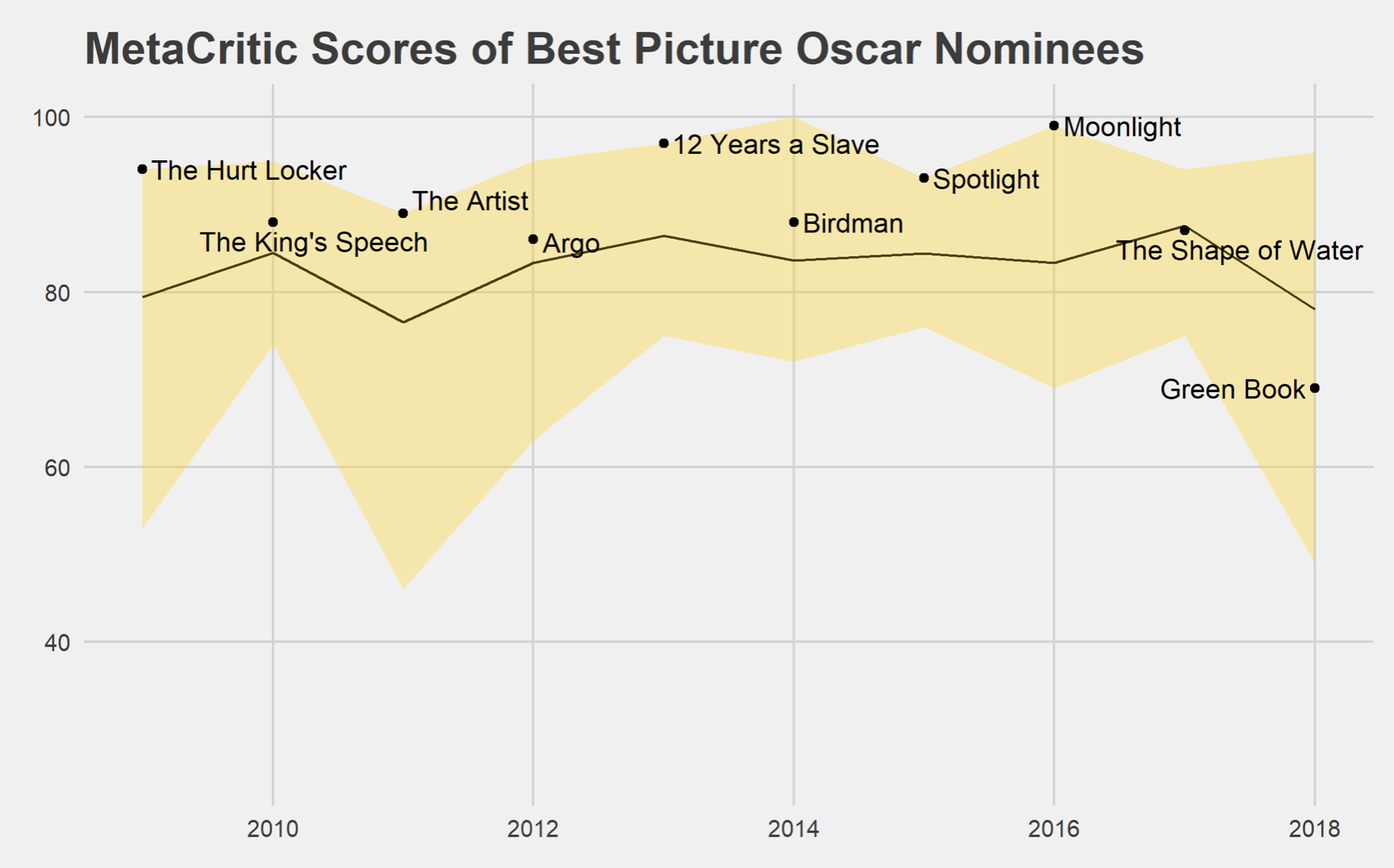
Even among the nominees, it is not the case that the most critically-acclaimed movie always wins. In the plot below, I chart the range of Metacritic scores of the Oscars nominees since the Academy Awards reinvented the category in 2009 (by expanding the number of nominees and changing the voting method). The top of the golden area represents the highest-rated movie in the pool of nominees and the bottom represents the worst-rated film. The line captures the average of the pool of nominees and the dots point out each year’s winner.
Click to Enlarge

As we can see, the most critically-acclaimed movie doesn’t always win, but the Best Picture is usually above the average of the pool of nominees. What makes Green Book really unusual as a Best Picture winner is that it’s well below the average of this year’s pool and the worst winner since 2009. Moreover, according to MetaCritic (and LA Times’ film critic Justin Chang), Green Book is the worst winner since Crash in 2005.

Green Book’s Best Picture win has led to some renewed calls to reconsider the Academy’s ranked choice voting system in which voters indicate the order of preferences rather than voting for a single movie. The irony is that when Moonlight, a highly critically-acclaimed movie with an all-black cast, won in 2016, that win was seen as a victory made possible by ranked choice voting. Now, in 2019, we have a racially-controversial and unusually weak Best Picture winner that took home the award because it appears to have been the “least disliked” movie in the pool.

The debate over ranked choice voting for the Academy Awards may ultimately end in further voting rule changes. Until then, we should regard a relatively weak movie like Green Book winning Best Picture as the exception to the rule.   

Andrew M. Lindner is an Associate Professor at Skidmore College. His research interests include media sociology, political sociology, and sociology of sport.
Those Fyre Festival documentaries were wild, weren’t they? Both movies highlighted fans’ collective glee watching the fakery play out from afar, as people with astounding amounts of disposable income fell prey to the festival’s poor execution. Who would buy all that hype, right?

The demand for exclusivity that fueled the festival is anything but fake. From Becker’s Art Worlds to Bourdieu’s Distinction, sociologists have long studied how culture industries and social capital create the tastes of the upper class. “Influencers” aren’t new, but social media makes it easier than ever to see them operate, and viral stories of high class hoaxes show this process in action.

Two great examples are these recent pranks parodying fine dining and fashion. Using a savvy social media presence, both teams were able to get a (fake) restaurant and a (fake) model a ton of buzz.

The interesting thing about these vides is how some of the humor rings hollow. It can be funny to see people chasing the next big trend get duped, but the fields they are mocking thrive on this exact kind of creativity and salesmanship. Taking the perspective of researchers like Bourdieu and others reminds us that taste is not objective, and it isn’t naturally tied to any basic level of effort or craft. At the end of the day, these pranksters still put together a “creative” look and restaurant experience, and so it is hard to tell whether they are making an effective parody, or just exploring and studying the basic rules of the game in the culture industry. Still, these videos are a fun excuse to think about how what it takes to cultivate “cool.”

Evan Stewart is an assistant professor of sociology at University of Massachusetts Boston. You can follow his work at his website, or on BlueSky.

As fun as it has been to watch former Starbucks CEO Howard Schultz announce a possible presidential bid and get ratioed on Twitter, his candidacy also says a lot about our deeper assumptions on wealth and politics.

Source: urbanartcore.eu, Flickr CC

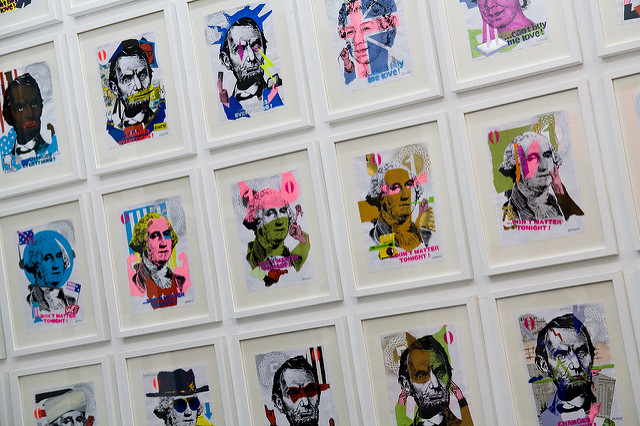
From Citizen’s United to classic sociological works like Who Rules America, we know that wealthy interests have long influenced U.S. politics. This influence doesn’t just happen behind the scenes, though. It also shapes our thinking about who is qualified to run the show. Thorstein Veblen’s “conspicuous consumption” and Max Weber’s “Protestant ethic” both point out the public work that wealth does when people use it as a shortcut to indicate either merit or morals. Candidates like Donald Trump use these assumptions effectively by arguing that business savvy shows their qualification for public service.

Over on Montclair SocioBlog, Jay Livingston took a look at Schultz’s old school language on being a “person of means,” rather than a billionaire. This euphemism was especially interesting to me, because it shows how candidates with wealth also try to have it both ways. Schultz’s implicit argument is not that different from Trump’s: his wealth and business success make him qualified to run on a platform of fiscal responsibility and independence from party ideology. But in a changing political climate where some say “every billionaire is a policy failure,” drawing attention to this wealth can also be a political liability.

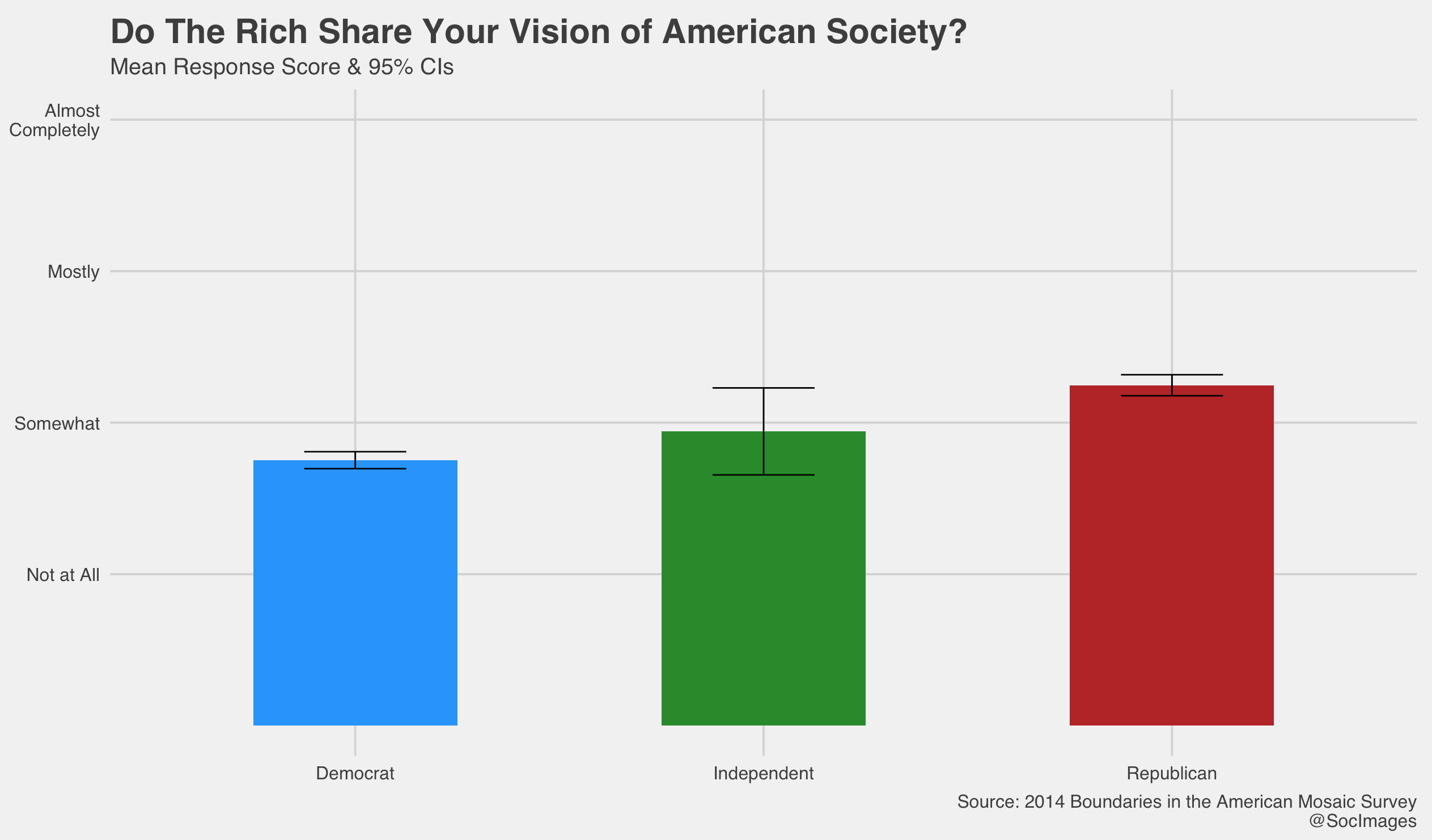
So, do people actually trust the rich to govern? A quick look at some survey data suggests there’s a pretty sizable partisan gap here. The American Mosaic Project asks people whether they think others from a variety of social groups share their vision of American society. This general question can tell us a lot about which groups people think are “like them,” a good proxy for trust and tolerance.

Click to Enlarge

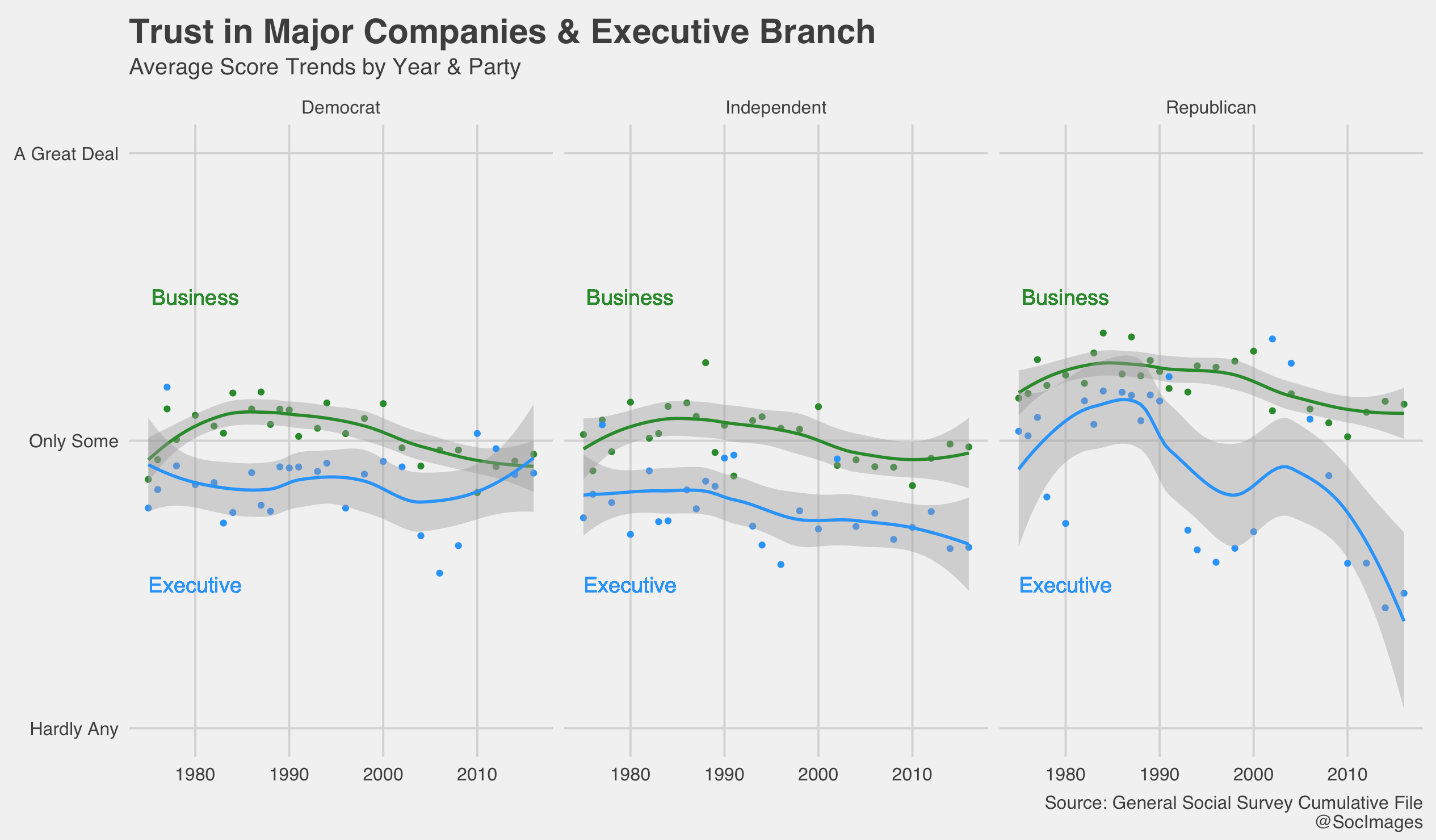
In this sample from 2014, Republicans had a higher average affinity with the rich than Democrats. We can also look the question a different way in the General Social Survey, which has been asking people about their trust in the Executive Branch of government and in major corporations for years.

Click to Enlarge

Here again, these trends show elevated trust for in big business among Republicans, along with much more fickle attitudes toward the Executive Branch depending on who is in power. While people tend to trust business more than the government here, these quick snapshots also suggest that stronger trust in business and wealth tacks pretty closely to typical party politics. With more candidates on the left starting to question why we trust the rich to govern, this relationship might get stronger and keep wealthy independent candidates stuck in the middle. Successful business leaders might seem like good candidates for government, but they also need to do their market research first.

Evan Stewart is an assistant professor of sociology at University of Massachusetts Boston. You can follow his work at his website, or on BlueSky.

In February of 1926, Carter G. Woodson helped establish “Negro History Week” to educate teachers, students, and community members about the accomplishments and experiences of Blacks in the United States. A native of Virginia, and the son of formerly enslaved parents, Woodson earned a PhD in history from Harvard University, and dedicated much of his life to writing and teaching about information largely omitted from textbooks and other historical accounts. Although Woodson died in 1950, his legacy continues, as “Negro History Week” eventually became “Black History Month” in 1976.

Nearly a century later, Black History is still at risk of erasure, especially in (once) geographically isolated areas, like Appalachia. The standard narrative that Scots-Irish “settled” Appalachia starting in the 18th century hides the fact that there were often violent interactions between European immigrants and indigenous people in the region. Even in the 1960s when authors like Michael Harrington and Harry Caudill reported on Appalachian mountain folk, the people were depicted as Scots-Irish descendants, known for being poor, lazy, and backward, representations that are reinforced in contemporary accounts of the region, such as J. D. Vance’s wildly popular memoir Hillbilly Elegy.

Source: Wikimedia Commons

Accounts like these offer stereotypical understandings of poor Appalachian whites, and at the same time, they ignore the presence and experiences of Blacks in the region. Work by social scientists William Turner and Edward Cabell, as well as “Affrilachia” poet Frank X. Walker, and historian Elizabeth Catte attempts to remedy this problem, but the dominant narrative of the region centers still on poor whites and their lives.

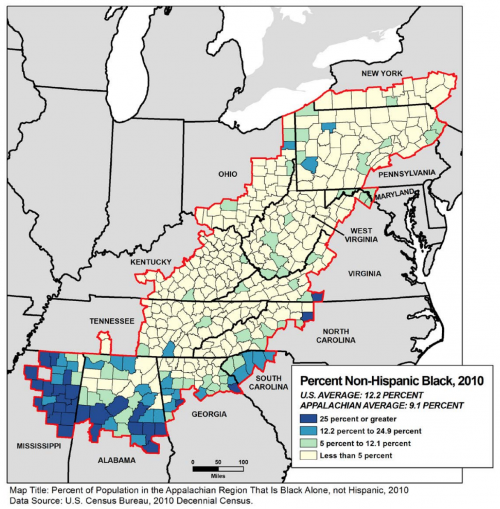
Work I have been doing documenting the life experiences of Leslie [“Les”] Whittington, a native of Western North Carolina and a descendent of a formerly enslaved people, has opened my eyes to a historical narrative I never fully knew. African Americans, for instance, accounted for approximately 10% of the Appalachian region’s population by 1860, and many were enslaved, including Les’ grandfather, John Myra Stepp. Yet, their stories are glaringly missing from the dominant narrative of the region.

Source: Appalachian Regional Commission Census Data Overview

So too are the stories of Blacks living in Appalachia today. Even though the number of African American residents has increased in some parts of  Appalachia, while the white population has decreased, little is formally documented about their lives. That absence has led scholar William Turner, to refer to Blacks in Appalachia as a “racial minority within a cultural minority.” Not only does erasing African Americans from the past and present of Appalachia provide an inaccurate view of the region, but it also minimizes the suffering of poor Blacks, who relative to their white counterparts, are and have been the poorest of an impoverished population.

Woodson established “Negro History Week” to document and share the history of Blacks in the United States, recognizing that, “If a race has no history, it has no worthwhile tradition, it becomes a negligible factor in the thought of the world, and it stands in danger of being exterminated.” The history of African Americans in the Appalachian region is largely absent from the area’s official record, and without making it part of the dominant narrative, we risk losing that history.

Jacqueline Clark, PhD is a professor of sociology at Ripon College. Her teaching and research interests include social inequalities, the sociology of health and illness, and the sociology of jobs and work. 

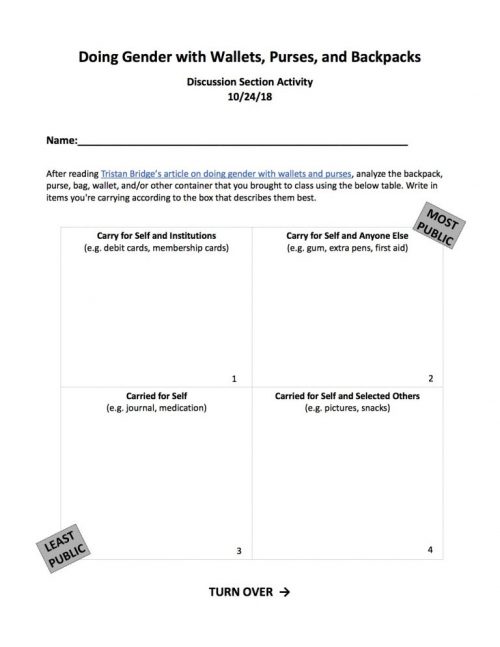
I’ve always loved Tristan Bridges’ Sociological Images piece about how we can readily see the ways that we “do gender” by analyzing what we carry around with us every day. Bridges focuses on wallets and purses, telling the story of a transgender women who struggled to learn the norms of purse-carrying during the process of socially transitioning to being recognized as a woman – remembering to bring it, knowing what to put in it, how to carry it, etc.  Aside from the fact that wallets and purses themselves are gendered, Bridges shows how what we put in those wallets and purses is also gendered. I’ve found the four-by-four schema presented in the piece to be a great model for getting students to analyze the contents of their own wallets and purses and to reflect on the ways that gender norms influence their choices.

Photo by Nels Highberg, Flickr CC

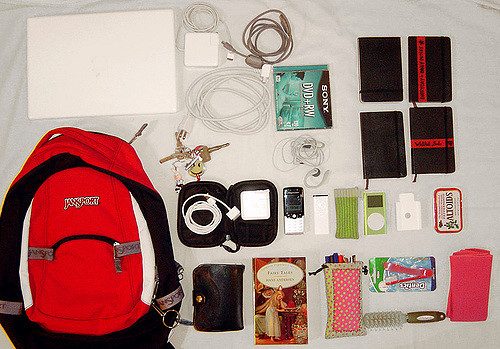
In this activity, I build directly from Bridges’ piece to get students thinking about whether and how gender norms influence the kinds of things they carry around with them. While Bridges focuses on wallets and purses, I’ve found that students are most likely to be carrying backpacks. So I complicated Bridges’ piece a bit to get students thinking about not only how wallets and purses are gendered, but also how what might seem like a gender-neutral bag – backpacks – may or may not conform to some of the same gendered norms found among wallet and purse carriers.

Photo by Julia P, Flickr CC
Photo by Jess C, Flickr CC

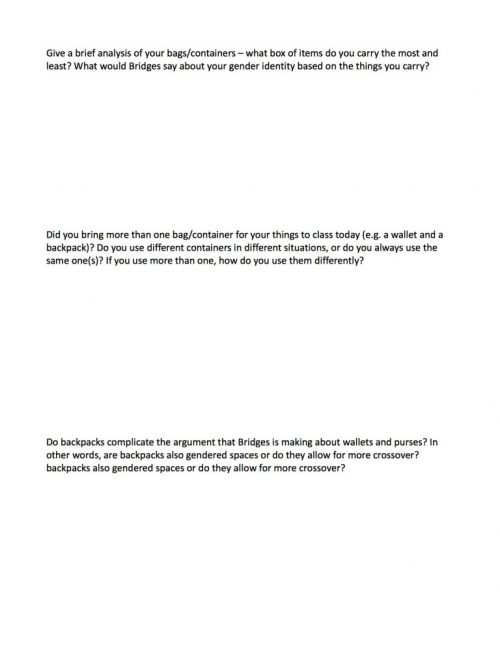
I’ve used this activity in an Introduction to Gender Studies class and an Introduction to Sociology class. It’s worked great in both contexts. I usually run this activity during a week/day that’s devoted to understanding concepts like socialization and the social construction of gender. I have students read the Bridges piece, either as part of the week’s readings or as part of the activity itself, and then hand them the attached handout with a four-by-four schema and some discussion questions. Then we talk as a class about their analysis. Students enjoy the interactive and tactile aspect of the activity (I ask them to dig through their bags), and it gets them talking about sociological concepts like gender norms, socialization, and “doing gender.”

Activity Materials

Doing Gender with Backpacks – Handout Lab 8

Originally Posted at Teaching TSP

Jacqui Frost is a PhD candidate in sociology at the University of Minnesota. Her research interests include non-religion and religion, culture, and civic engagement, and her dissertation project is an ethnographic study of a non-religious community.

When I teach social statistics, I often show students how small changes in measurement or analysis can make a big difference in the way we understand the world. Recently, I have been surprised by some anger and cynicism that comes up when we talk about this. Often at least one student will ask, “does it even matter if you can just rig the results to say whatever you want them to say?”

I can’t blame them. Controversy about manufactured disagreement on climate change, hoax studies, or the rise of fake news and “both side-ism” in our politics can make it seem like everyone is cooking the books to get results that make them happy. The social world is complicated, but it is our job to work through that complexity and map it out clearly, not to throw up our hands and say we can’t do anything about it. It’s like this optical illusion:

The shape isn’t just a circle or a square. We can’t even really say that it is both, because the real shape itself is complicated. But we can describe the way it is built to explain why it looks like a circle and a square from different angles. The same thing can happen when we talk about debates in social science.

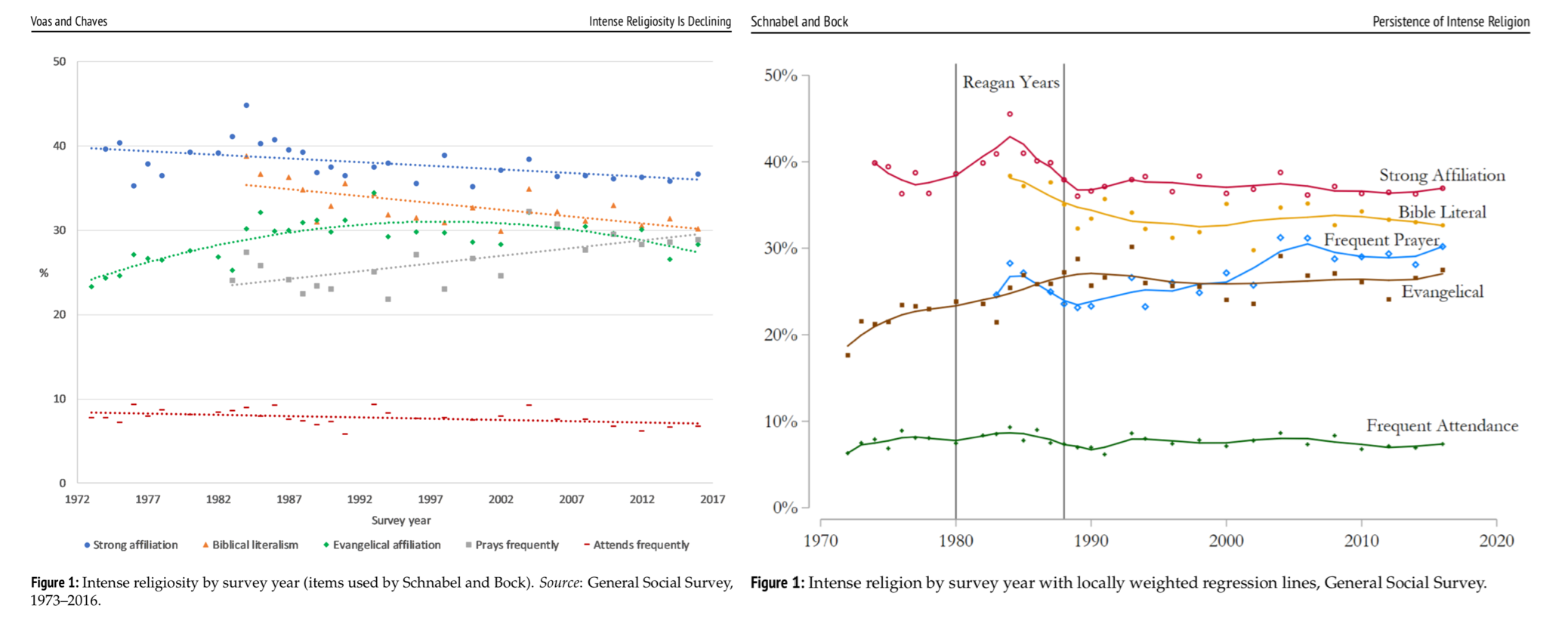
A fun example of this popped up recently in the sociology of religion. In 2016, David Voas and Mark Chaves published an article in the American Journal of Sociology about how rates of religious commitment in the United States are slowly declining. In 2017, Landon Schnabel and Sean Bock published an article in Sociological Science responding to this conclusion, arguing that most of the religious decline was among moderate religious respondents—people with very strong religious commitments seemed to be holding steady. Just recently, both teams of authors have published additional comments about this debate (here and here), analyzing the same data from the General Social Survey.

So, who is right?

Unlike some recent headlines about this debate, the answer about religious decline isn’t just “maybe, maybe not.” Just like the circle/square illusion, we can show why these teams get different results with the same data.

Parallel Figures from Voas & Chaves (2018) and Schnabel & Bock (2018) (Click to Enlarge)

When we put the charts together, you can see how Voas and Chaves fit straight and smoothly curved lines to trends across waves in the GSS. This creates the downward-sloping pattern that fits their conclusions about slow religious decline over time. Schnabel and Bock don’t think a single straight line can accurately capture these trends, because the U.S. saw a unique peak in religious commitment that happened during the Regan years and may have receded more quickly. Their smoothing technique (LOESS smoothing) captures this peak and a quick decline afterwards, and doing so flattens out the rest of the trends after that period.

The most important lesson from these charts is that they don’t totally get rid of the ambiguity about religious change. Rather than just ending the debate or rehashing it endlessly, this work helps us see how it might be more helpful to ask different questions about the historical background of the case. I like this example because it shows us how disagreement among experts can be an invitation to dig into the details, rather than a sign we should just agree to disagree. Research methods matter, and sometimes they can help us more clearly explain why we see the world so differently.

Evan Stewart is an assistant professor of sociology at University of Massachusetts Boston. You can follow his work at his website, or on BlueSky.

At the start of a new year, our thoughts often turn to self-improvement. People make all kinds of resolutions to live healthier, happier, more engaged lives…at least until the middle of February.

Sociological thinking often gets skeptical of this work. Sure, it is great to set personal goals, but fixating on personal problems can also make us blame ourselves for larger social and cultural factors that make it hard to meet those goals. You can buy a new trendy Bullet Journal and fill it with to-do lists, but that alone probably won’t beat a whole culture of burnout.

I get a kick out of imagining a new wave of snarky sociological self-help. The headlines would be fantastic.

  • I lost 20 pounds on this new hot diet: not having to live in a food desert!
  • Trouble in the bedroom? Your problems may be political!
  • And, of course, the classic:

This year I found a book that gets as close the dream genre as ever. After multiple nods from the Ezra Klein Show and buzz from Silicon Valley, I picked up James P. Carse’s Finite and Infinite Games (1986) for a holiday read. The first sentence of the second section sums it up:

No one can play a game alone. One cannot be human by oneself. There is no selfhood where there is no community. We do not relate to others as the persons we are; we are who we are in relating to others. Pp. 37

That line didn’t sound like the typical self-focused pop philosophy, and it kicked off a lot more sociology than I was expecting. Carse’s book focuses on “finite games” as social interactions that are meant to come to a clearly defined end and “infinite games” where the aim is simply to keep playing with other people. Along the way, he riffs on some major sociological themes like role theory, and there’s even an appearance from Veblen. Much of the argument boils down to the classic structure and agency debate in sociology—new situations often give us both strict social rules to follow in finite games and resources that invite creative improvisation in infinite games. Recognizing both kinds of games in life draws our attention to social structures and opens up the possibility to turn off autopilot once in a while.

It isn’t a perfect read, but I appreciated seeing a book with a popular following putting these kinds of ideas in the spotlight, especially because economists and psychologists often get more of the credit in popular nonfiction. Maybe we can replace the resolutions with a few more good reads. Can you think of other examples of self-help sociology?

Evan Stewart is an assistant professor of sociology at University of Massachusetts Boston. You can follow his work at his website, or on BlueSky.

For years now, expecting parents have been popping balloons and cutting colorful cakes to announce the sex of their babies. These “gender reveal parties” can be a fun new take on the baby shower, but they also show just how much we invest in the gender identities of children. In a world where gender inequality persists and gender identities can be in flux, cultural traditions like this can lock people into rigid thinking that separates boys and girls.

Photo Credit: Peter Mai, Flickr CC

Of course, point this out at the wrong time and you’ll usually get accused of raining on the parade. It’s just a cake after all, right? The tricky part is that social scientists often show how identities can turn into ideologies that have real stakes for human behavior.

For a dramatic example, last week the world got footage of the gender reveal party that sparked a massive 2017 wildfire in Arizona. These parents wanted to go big to announce their new baby boy—so big that it warranted explosions in the middle of dry grasslands.

It’s not that gender stereotyping directly caused this fire—even if we didn’t have a rigid gender binary, people would still start disasters with a stray campfire or sparkler. This case is still useful for thinking about gender, though, because what we celebrate and how we celebrate it shows a lot about where people learn to place their interest and effort. We don’t have massive parties for baby’s first steps or first conversation, and I can’t think of a time when a First Communion needed 800 fire fighters to come clean up afterwards.


Evan Stewart is an assistant professor of sociology at University of Massachusetts Boston. You can follow his work at his website, or on BlueSky.