Search results for The

There is a tendency in Western culture to envision white people are more modern and progressive than people of color who are seen as more traditional, even tied to ancient ways of life (see this post and its links).  This tendency is illustrated in Mattel’s new Japanese Ken and Barbie dolls, released this year:

When was the last time you saw a Japanese person dressed like this?  Regarding Ken, Dolls of Color put it:

Right, because an Asian Ken can’t be wearing jeans and a tshirt? Or a tuxedo if one must get fancy? An Asian Ken must be some kind of exotic fantasy and not just that cool dude next door? Right.

We’ll know that we respect people of color as people when we start portraying them as people instead of exotic objects or historical artifacts.

UPDATE: Of course, as several commenters have pointed out, these costumes aren’t at all historically accurate.  Instead they exoticize a stereotyped notion of the traditional Japanese person.

Via Racialicious.

Lisa Wade, PhD is an Associate Professor at Tulane University. She is the author of American Hookup, a book about college sexual culture; a textbook about gender; and a forthcoming introductory text: Terrible Magnificent Sociology. You can follow her on Twitter and Instagram.
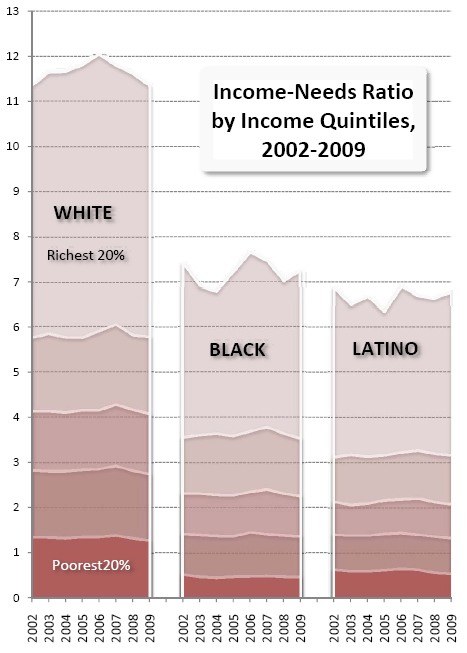
Yesterday I posted the news that the percent of Americans in poverty reached nearly 15% in 2009.  Philip Cohen, at Family Inequality, used the same Census data to give us an idea of how both wealth and poverty are distributed across U.S. racial groups.  We know that Blacks, Latinos, American Indians and some, but not all, Asian sub-groups are poorer, on average, than Whites.  Cohen offers us a different way of looking at this, however, by plotting the income-to-needs ratio for Whites, Blacks, and Latinos over the last 8 years.

That income-need ratio is, by definition, 1.0 at the poverty line, and numbers above that are multiples of needs, so 3.0 is income of 3-times the poverty line.

That ratio sits along the vertical axis, with time at the horizontal:

This, Cohen explains, “…allows us to see the size of the White advantage…”  He continues:

So, for example, the richest 5th of Whites are above 11-times the poverty line, while the poorest 5th of Whites are (on average) just above the poverty line. In contrast, the richest 5th of Blacks and Latinos are around 7-times the poverty line, and 40% of both groups are below 1.5-times the poverty line.

It’s not simply, then, that Blacks and Latinos are disproportionately poor.  Their poor are also poorer than the poor Whites and their rich are less rich than rich Whites.

Lisa Wade, PhD is an Associate Professor at Tulane University. She is the author of American Hookup, a book about college sexual culture; a textbook about gender; and a forthcoming introductory text: Terrible Magnificent Sociology. You can follow her on Twitter and Instagram.
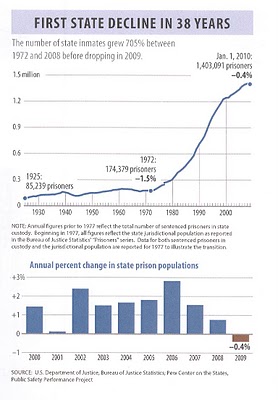
One in every 31 American adults is under control of the correctional system.   The U.S. imprisonment rate is astronomical; it is six times that of many European countries.  This rather new reality is directly the product of the American war on drugs initiated by Reagan in the ’80s.

The Pew Center on the United States reports that the 1.4 million strong state prison population dropped in 2009, the first decrease since 1972.

Professor Chris Uggen, at Public Criminology, summarizes the causes identified by the report:

Pew attributes the drop to greater diversion of low-level offenders and probation and parole violators from prison; stronger community supervision and re-entry programs; and, a quicker release of low-risk inmates who complete risk reduction programs. State budget problems have likely played an important role in accelerating each of these trends.

The decrease is certainly better than an increase, but Uggen notes that it is quite small.  The prison population dropped by only 0.4%, or 5,739 inmates.  Further, the decrease in the state prison population was outpaced by the increase in the federal prison population, which went up by 6, 838 inmates.  Even so, Uggen argues, this is significant: “…any change in direction is meaningful after four decades of unabated growth.”

Lisa Wade, PhD is an Associate Professor at Tulane University. She is the author of American Hookup, a book about college sexual culture; a textbook about gender; and a forthcoming introductory text: Terrible Magnificent Sociology. You can follow her on Twitter and Instagram.
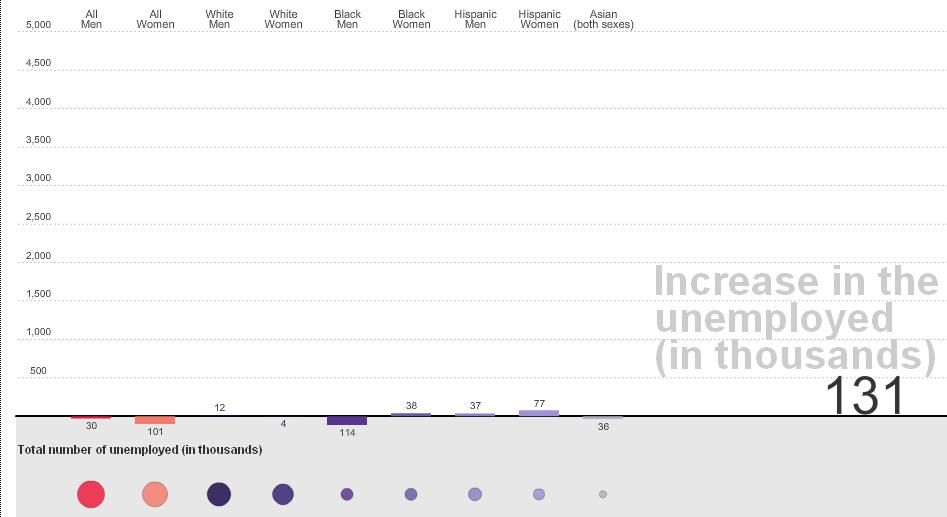
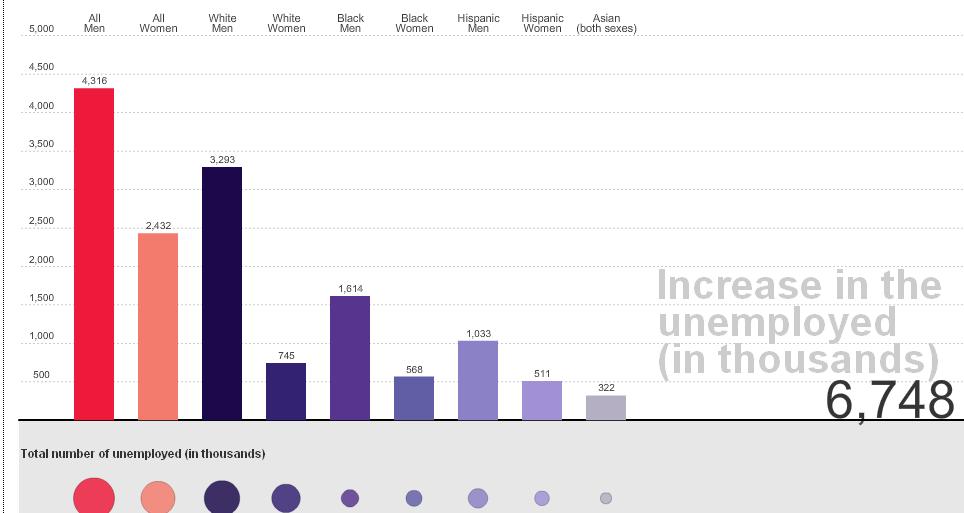
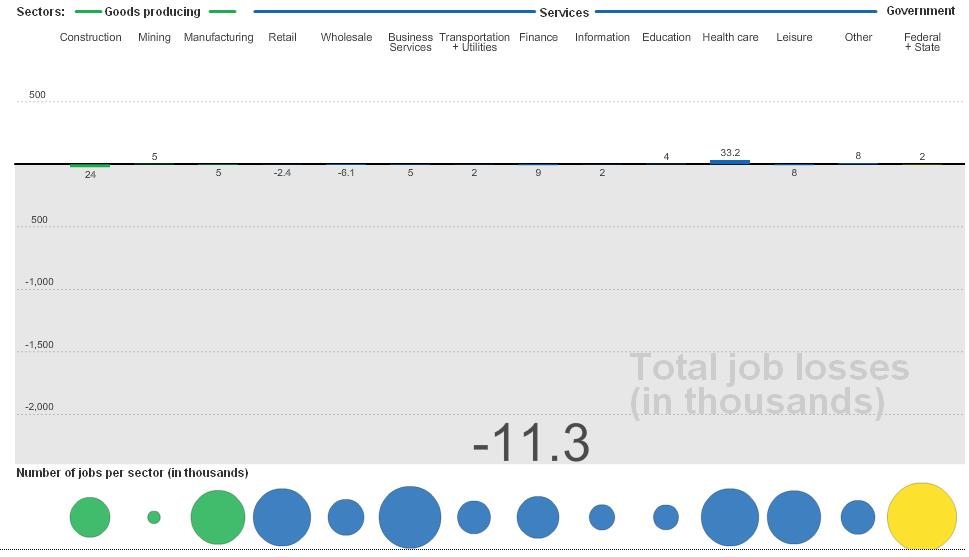
Rachel sent in a link to a post about the recession by Tim Cavanaugh at Reason that led me to an interactive graphic at the Wall Street Journal that lets you track job loss by either sector or by race/ethnicity and sex from December 2007 to August 2010.

Here is the race/ethnicity and sex data for January 2008 (for reasons I cannot understand, Asians are not separated out by sex, and as usual, American Indians aren’t included):

And here’s the breakdown for January 2010:

Unfortunately, the numbers aren’t weighted by the number of total workers per category, so we don’t have any way to know how these raw numbers translate into percentages of workers losing their jobs.

By economic sector, for January ’08:

January ’10:

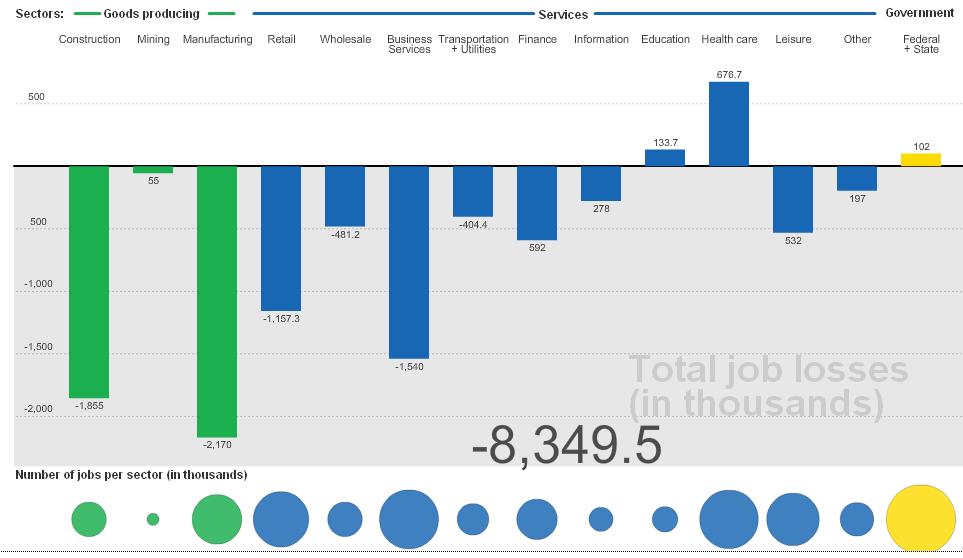
[On a nitpicky note, the sector graphs show job losses in negative numbers, which would work if it showed total change in # of jobs. But I think we’d be thrilled if we had -8… thousand job losses, as the graph is labeled. Just a small sloppy labeling issue.]

As the data show, and as we’ve discussed before, the economic recession has disproportionately affected men. But Cavanaugh cautions that it might be a little soon to declare men an at-risk species or lament the bad luck of being born male. Presumably, if men’s over-representation in construction, for instance, has meant they suffered more than women from the real estate bust, if you felt like it you could turn it around and argue that perhaps they disproportionately benefited from the boom that preceded it. Additionally the employment sectors are pretty broad; “retail” or “finance” will include some specific occupations that are fairly gender balanced, some that are dominated by men, and some dominated by women. And overall loss in retail jobs doesn’t tell us if the losses are spread equally across occupations within the sector.

Should we care about the suffering of men and their families in the recession? Of course. And to the degree that men are disproportionately represented in occupations that are prone to boom/bust cycles, we’re likely to continue to see greater volatility in their employment rates than women’s, sometimes to their advantage, sometimes not. But we might want to be a little careful and look at some more in-depth data before we declare, as some commentators seem to want to do, that women have basically escaped the recession. If nothing else, men and women aren’t islands; lots of us share household expenses, and a woman whose husband loses his job but keeps her own doesn’t exactly avoid any negative consequences of the recession.

Related posts: more comparisons of joblessness, race and recession, unemployment and education level, not everyone suffers during a recession, the gender employment gap,

Notions of how to properly raise children change over time and vary across cultures. In early America, children were necessary labor for struggling farmers trying to survive off the land. They were put to work as soon as they were able, apprenticing their parents and older siblings. After the Industrial Revolution, children went to work in factories; this seemed perfectly normal, considering that they had worked on farms for decades to contribute to the economic well-being of their families.

Today, we think that children should not work, but instead should have a “childhood” full of innocence, play, and imagination. This creates new burdens on parents who can no longer simply have their children work alongside them, but must actively cultivate the ability for their children to do what we believe children are supposed to be doing. This has led to what some sociologists have called “intensive mothering” (as it is usually mothers who do it): constant emotional availability and monitoring of their children’s psychological states, endless activity provision, and high investment in their children’s intellectual development.

Indeed, today some argue that failing to nurture children on every dimension of human capacity or, even, to just let them be, borders on neglect. While others argue that this is a new era of “helicopter parenting” in which parents monitor and control everything in their child’s life because they simply can’t look away or let go.

University of Notre Dame Sociology Professor Jessica Collett drew our attention to a set of cartoons illustrating this new contest over proper parenting at Free Range Kids.  The first, by Bill Bramhall, suggests that letting children roam free puts them at risk of homelessness. In it, two homeless-looking men sit on a park bench watching children play by themselves. One says, “My mother took me to the park and left me there, too.”

The second, by artist Richard Estell, is in direct response to the first, arguing that parents are acting out of fear and that over-supervised children are more likely to experience mental and physical health problems. The men read newspapers with headlines that read “Parents see only danger” and “Helicopter parents’ kids depressed.”

What we have here, then, is a new social contest.  Changes in ideas about who children are (kids vs. small adults), why people have them (as a personal indulgence or an additional laborer), and what good parenting looks like (intensive or functional) has created a new type of parenting.

As this new type has become the dominant idea of what good parenting looks like, a backlash has evolved that critiques it.  And thus we have an excellent example of historical change and the social construction of social problems.

Lisa Wade, PhD is an Associate Professor at Tulane University. She is the author of American Hookup, a book about college sexual culture; a textbook about gender; and a forthcoming introductory text: Terrible Magnificent Sociology. You can follow her on Twitter and Instagram.
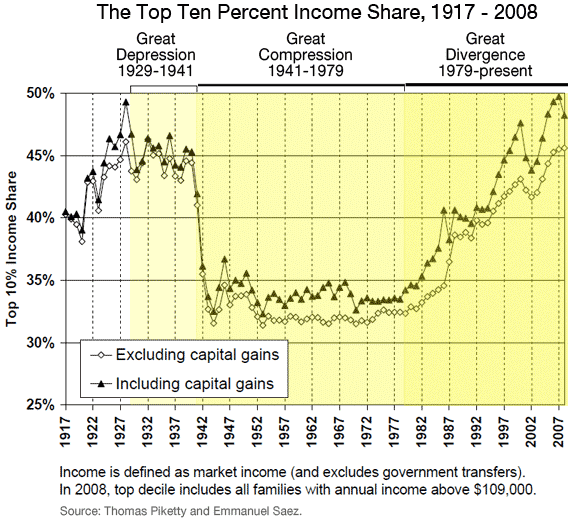
I’m back! I was in the middle of moving and just overwhelmed with everything. Anyway. Talking Points Memo posted a link to an article at Slate about income inequality in the U.S., and particularly the increasing proportion of total U.S. income earned by the very rich. Timothy Noah refers to the “great compression” as a time period when income concentration among top earners dropped significantly, and argues that in the past three decades we’ve seen a “great divergence,” with increasing income inequality hitting levels not seen since the Great Depression:

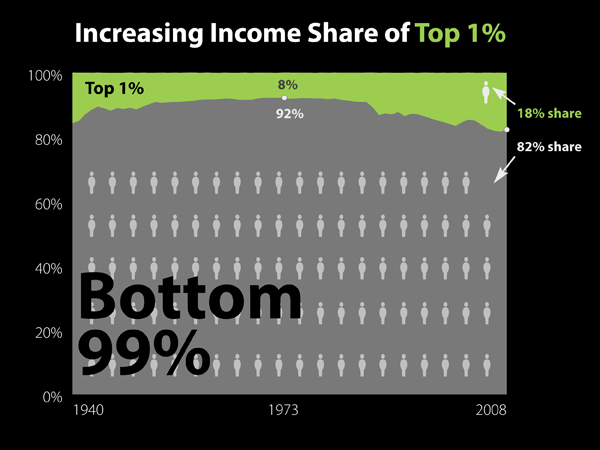
A slideshow accompanies the article, providing more info on the changes Noah discusses. A few examples (the slideshow provides the data source used to create each image):

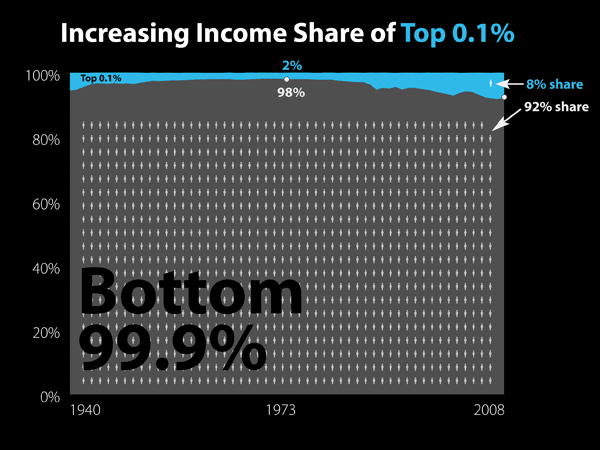
Even among the very rich, we see increasing divergence, with the super-ultra rich, the top 0.1% of earners, now making 8% of all U.S. income:

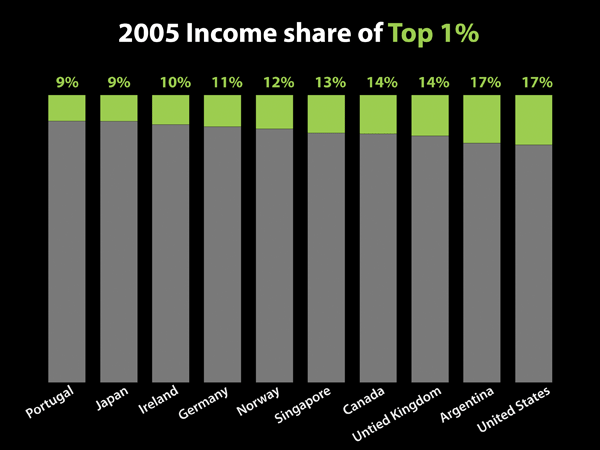
A comparison to some other countries (I don’t know why these specific nations were chosen for the comparison):

Keep in mind, this data includes only income. Wealth — the worth of all assets, including retirement and savings accounts, stocks, homes, cars, and anything else of value — is much more unequally distributed.

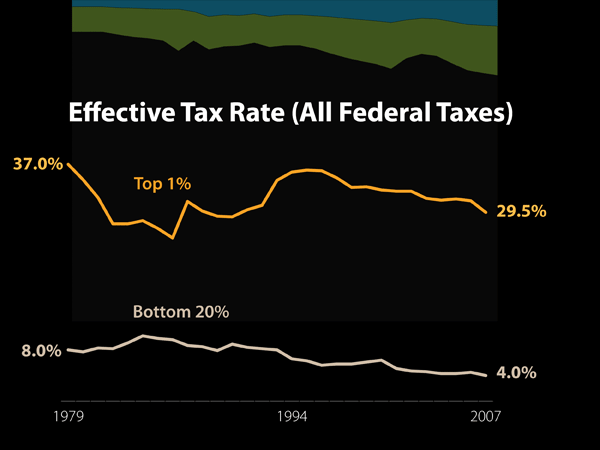
Congress is about to be embroiled in a major debate about whether to extend the tax cuts on high incomes; as both sides weigh in, here’s some context to keep in mind:

The effective tax rate is what people actually pay, as opposed to what their tax rate theoretically is. While we’ve certainly seen a large drop since the late ’70s, Noah argues that, compared to other economic changes, the effective tax rate hasn’t affected the rise in income inequality much. It plays a role, yes, but changing the tax rate on the very rich doesn’t affect the overall distribution of income a huge amount, in part because the effective rate, what people end up actually paying, generally ends up being smaller than what they theoretically owe based on the stated tax rate, once you take into account deductions, write-offs, loopholes, and so on.

So…happy post-Labor Day!

Rachel O., writing from New Zealand, sent in an interesting example of gendered energy drinks.  Other than their being gendered, I thought there were two things worth noting.

First, the only difference between the male and female version of the drink (other than the marketing, which is downright diametrical) is the number of calories.  The female version, Angel, is low calorie; the male version, Demon, is not.  So dieting, an imperative towards thinness, and femininity (not to mention innocence) are all lumped together in the marketing of the product.

Demon (don’t click… loud, scary music):

Angel (safe to click):

The second thing I thought was interesting about these two drinks was that it took a lot of digging to find evidence that they were made by the same company (though I finally found it here).  As far as I can tell, neither website admits the existence of the other.  This is a really strong separation of the two products, as if femininity and masculinity threaten to spoil each other, it’s best to keep them as far away from one another as possible.  God forbid we know that the makers of the aggressive Demon drink sissy it up to also make the sweet, low cal Angel drink.  Best to keep our masculinity and femininity pure.

This reminds me of the fact that Dove and Axe are owned by the same company.  The two products are sold with divergent marketing campaigns — the former claims to empower women, the latter produces some of the most sexist advertising on TV — but they are both part of Unilever.  Only our ignorance of this fact makes Dove’s marketing strategy seem earnest.

Lisa Wade, PhD is an Associate Professor at Tulane University. She is the author of American Hookup, a book about college sexual culture; a textbook about gender; and a forthcoming introductory text: Terrible Magnificent Sociology. You can follow her on Twitter and Instagram.
During the 19th the United States received many new residents from China.  Sometimes they came voluntarily; sometimes they were imported forcibly.  The term “Shanghaied” originally described the forced stealing of Chinese men to come work in America.  Many of them worked on the transcontinental railroad, built between 1863 and 1869.  Ninety percent of the workers on the central Pacific track, for example, were Chinese.

After the railroad was completed, however, many Chinese went to work in industries in which they competed with white American workers, especially mining, and they became scapegoats for white unemployment.  For some examples of anti-Asian propaganda, see our collection of “yellow peril” posters and cartoons.

Animosity towards the Chinese culminated in the Chinese Exclusion Act of 1882.  The Act meant that Chinese in America, most of whom were adult men, had little hope of reuniting with their families if they stayed in the U.S.; it also allowed the U.S. to deny re-entry if a Chinese person already in the U.S. left the country; and it excluded the Chinese in America from getting U.S. citizenship.

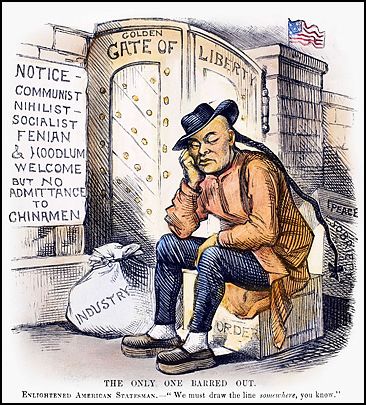
The Chinese Exclusion Act is an ugly moment in U.S. history that was supported by many Americans.  But this support wasn’t universal.  The political cartoon below attacks the Act.  “No admittance to Chinamen,” it reads.  But “communist nihilist-socialist fenian & hoodlum [are] welcome.”  The punchline reads, sarcastically, “We must draw the line somewhere, you know.”

(Image from Time.)

The Fenian, by the way, were Irish political groups, suggesting that the embrace of one minority group did not necessarily translate into the embrace of others.   Or maybe the cartoon was meant to go the other way: “If we’re going to exclude the Chinese, let’s exclude others as well.”

UPDATE: Loki offered the following helpful correction to my description of the word “Shanghaid”:

A bit of disagreement: The verb to Shanghai someone was more often used with respect to the practice of crimps or other people to use force, intimidation or outright kidnapping to man merchant ships during the 18th century.

I’m not about to claim that there weren’t cases of people from Shanghai being forcibly relocated to the US to work on the railroad – but the term refers to one of the abuses of common sailors that was considered usual practice in the age of sail.

Wikipedia article here, for some background of the maritime history of the term: http://en.wikipedia.org/wiki/Shanghaiing

Lisa Wade, PhD is an Associate Professor at Tulane University. She is the author of American Hookup, a book about college sexual culture; a textbook about gender; and a forthcoming introductory text: Terrible Magnificent Sociology. You can follow her on Twitter and Instagram.