
Did you know that the U.S. has a higher imprisonment rate than even Russia? And the U.S. imprisonment rate is about six times that of many European countries.

(This first figure was made by Kieran Healy.)
When and how did this happen? It started in the 1980s with Reagan’s “war on drugs.” The figure below shows the increase in the incarceration rate beginning in the 1980s (# of people out of 100,000).
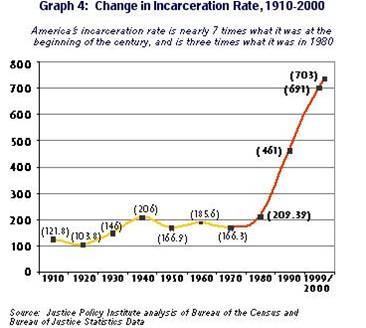
So our imprisonment rate is the result of imprisoning people who break drug laws, NOT violent criminals or even people who commit property crimes. The increase is largely due to more aggressive policing of drug law violations.
And, as you can see in the figure below, the aggressive policing of drug law violations can be found disproportionately in black neighborhoods. (White and black people take drugs at a very similar rate, but black neighborhoods are more heavily policing and drugs more common among blacks than white have carried heavier sentences — i.e., crack versus cocaine until recently). This figure shows that the increase in the incarceration rate is mostly an increase in the black incarceration rate. 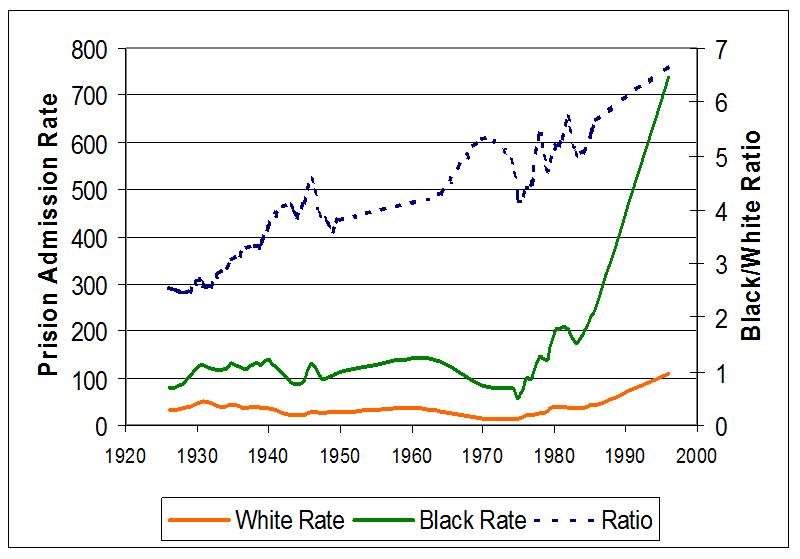
Thanks to the amazing Pam Oliver for reminding me that this last graph comes from her work on the incarceration rate (found here).
Comments 13
Umlud — July 27, 2008
This also has major impacts outside neighborhood arrest rates. Over at Dispatches from the Culture Wars, Ed Brayton recently wrote two stories (links below) about how the War on Drugs is having deleterious consequences not originally intended, the first on deer hunting (and by extension, one could argue, on hemp production) and the second on medical marijuana provision to minors.
http://scienceblogs.com/dispatches/2008/07/were_the_government_we_can_be.php
http://scienceblogs.com/dispatches/2008/07/more_drug_law_insanity.php
Pamela Oliver — July 28, 2008
Hi Lisa, that last graph looks like one of mine (and older version), and you appear to have forgotten to put the source up. The source is calculations by Pamela Oliver from two data sets, the NPS and the NCRP. --Pam
OP Minded — July 28, 2008
... and total violent crime rates have plummeted during that time as well.
http://www.ojp.usdoj.gov/bjs/glance/cv2.htm
Irene — October 30, 2008
Loic Wacquant (sociologist at berkeley) has actually written about this subject.. his book is called punishing the poor and analyses exactly these kinds of data. If I understood him correctly, he is making the case that the imprisonment is increasingly replacing social benefits/security as a way to keep the poor in check. I'd check it out, it's good and illuminating stuff.
Infofact — January 31, 2013
The last graph is very interesting. Usually the unusually high black incarceration rate is blamed on racism yet it's quite revealing to see it was much lower in 1930 than in the late 90's!
Rodriguez — January 15, 2026
Reading imprisonment trends feels like navigating geometry dash meltdown, challenging patterns, unexpected obstacles, and reflexive learning required.
Dale Phillip — August 24, 2026
The historical trends here are really interesting, especially the sharp rise in U.S. incarceration beginning in the 1980s. The comparison between drug-law enforcement, policing patterns, and racial disparities also shows why imprisonment rates can’t be understood simply by looking at crime numbers alone.