Search results for The

U.S. unemployment numbers only begin to describe how U.S. workers have suffered in this recession.  The Pew Research Center has some additional data on this experience.

Twenty-six percent of full-time workers who became re-employed currently only work part-time.  Thirteen percent moved from part-time to full time work.  So, among the employed, there are 13 percent fewer full-time workers.
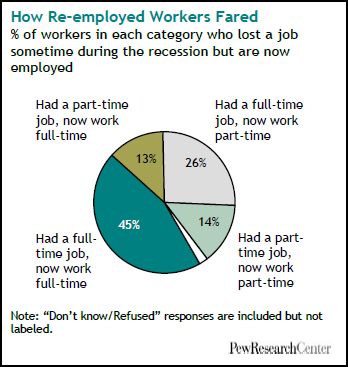
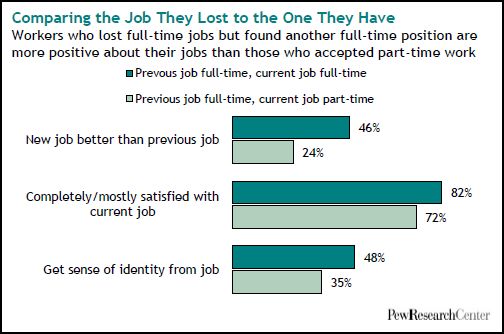
Americans who lost their jobs and became re-employed during this recession say that they’re making about the same, that the benefits are about equal, and many like their new job better:

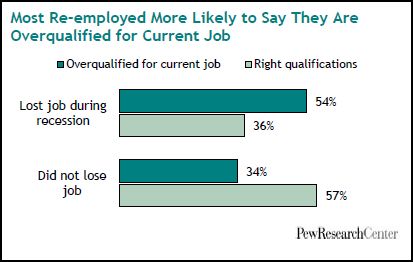
Still, the re-employed are more likely than the still-employed to say that they are overqualified for their current job:
People that moved from full- to part-time work are significantly less likely to be satisfied with their new position:
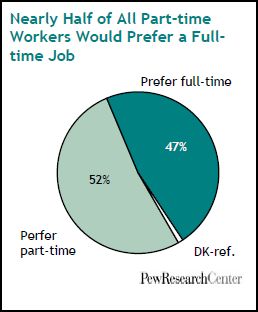
Forty-seven percent of part-time workers would like a full-time job:
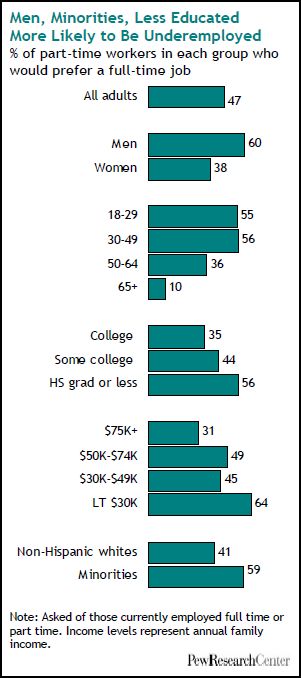
The term “underemployed” refers to this 47 percent of the population.   Men, young people, the less educated, lower income, and non-whites are more likely to be underemployed:
Lisa Wade, PhD is an Associate Professor at Tulane University. She is the author of American Hookup, a book about college sexual culture; a textbook about gender; and a forthcoming introductory text: Terrible Magnificent Sociology. You can follow her on Twitter and Instagram.


Reel Injun, a new documentary about the portrayal of American Indians in U.S. movies, has been earning high praise and notice from bloggers and film critics. About the film:

Hollywood has made over 4000 films about Native people; over 100 years of movies defining how Indians are seen by the world...

Travelling through the heartland of America, Cree filmmaker Neil Diamond looks at how the myth of “the Injun” has influenced the world’s understanding – and misunderstanding – of Natives.

With candid interviews with directors, writers, actors and activists, including Clint Eastwood, Jim Jarmusch, Robbie Robertson, Sacheen Littlefeather, John Trudell and Russell Means, clips from hundreds of classic and recent films, including Stagecoach, Little Big Man, The Outlaw Josey Wales, One Flew Over the Cuckoo’s Nest, and Atanarjuat the Fast Runner, Reel Injun traces the evolution of cinema’s depiction of Native people from the silent film era to today.

I can’t wait to see it.

The trailer:

Lisa Wade, PhD is an Associate Professor at Tulane University. She is the author of American Hookup, a book about college sexual culture; a textbook about gender; and a forthcoming introductory text: Terrible Magnificent Sociology. You can follow her on Twitter and Instagram.


French sociologist Pierre Bourdieu is famous for helping us understand how economic elites reproduce their own wealth across generations.  It takes money to make money, and that is certainly true.  But as Bourdieu noticed, it wasn’t just money.  Upper-class people had entire ways of living that excluded people without money and people who were newly rich.  They knew the right people (and knew them in common), the right things (e.g., how to talk about yachts), and the right way to act (e.g., which fork to use first).  Other people’s ignorance of these things exposes them to the elite as “not our kind of people.” Even when the elite aren’t biased towards their own on purpose, they’re still more likely to hire the guy who can chat about the most lauded vintage that year, and their children are more likely to marry the children of others who summered alongside them, and so on.  All of these little things — mannerisms, interests, languages, sartorial choices — send messages that distinguish the elite from the non-elite, preserving the group as distinctly advantaged.

In other words, Countess Luann is right:

Thanks to RGR for linking to this video in our recent birthday post for Pierre!  More Bourdieu-ian posts: taste, dumb vs. smart books, and the Evangelican habitus.

Lisa Wade, PhD is an Associate Professor at Tulane University. She is the author of American Hookup, a book about college sexual culture; a textbook about gender; and a forthcoming introductory text: Terrible Magnificent Sociology. You can follow her on Twitter and Instagram.
An article at Colorlines, and the accompanying video interview below, illustrates the way that employment policy virtually ensures that some people will remain excluded from the above-ground economy.  Fourteen months ago, the interviewee, Vincent, lost his job as a maintenance technician, just days before he would be eligible for unemployment, when his boss ran a criminal background check and discovered that Vincent had a 25-year-old record for breaking and entering.

Since then, he’s been unemployed.  When he applies for jobs, he’s frequently told that his application can’t be accepted because of  his criminal background. Accordingly, he is having a terribly difficult time finding a job.  “It’s real hurtful,” he says, “to know that your chances are so broke down to zero.”

Seventy-five percent of people who have left prison are currently unemployed.  When we see criminal recidivism, or the return to crime after release from prison, we should consider the possibility that we are essentially forcing people to turn to the “underground economy” by shutting them out of the “above ground” one.

Lisa Wade, PhD is an Associate Professor at Tulane University. She is the author of American Hookup, a book about college sexual culture; a textbook about gender; and a forthcoming introductory text: Terrible Magnificent Sociology. You can follow her on Twitter and Instagram.
In Buying In: What We Buy and Who We Are, Rob Walker discusses the “mysterious return of PBR.” When I was an undergrad in Oklahoma in the late ’90s, PBR had very distinct connotations: it was a crappy, cheap beer you only drank if you didn’t have the money to buy better beer.  I know this in large part because I had a number of friends who weren’t in college and lived on low incomes for various reasons, including some who were in bands and kept crappy day jobs just until they got their big record deal. [Just FYI: a punk-influenced song about Schrodinger’s cat can be quite catchy and informative, but it may not be the key to fame and fortune.]

I digress. The point is, they often drank PBR because it was cheap. As far as I could tell, they didn’t do so out of a sense that PBR was good or cool, but because they could buy larger quantities of it than other beer (I was never a beer drinker, so I wasn’t directly engaged in the decision-making process about which brand to buy). It was the beer version of ramen noodles: not necessarily exciting, but it’ll suffice if it’s all you can buy. And at various times I would overhear other people make nasty comments about PBR. It, and its drinkers, were, to put it bluntly, considered trashy by a lot of people.

But as Walker describes, PBR has become hip in a lot of places. Walker describes its resurgence since about 2002, when sales, which had dropped precipitously over the last twenty years, suddenly rose 5%. Portland, OR, seems to be the epicenter of the rediscovery of PBR, though it soon spread to other cities, with trendy bars adding it to their menu.

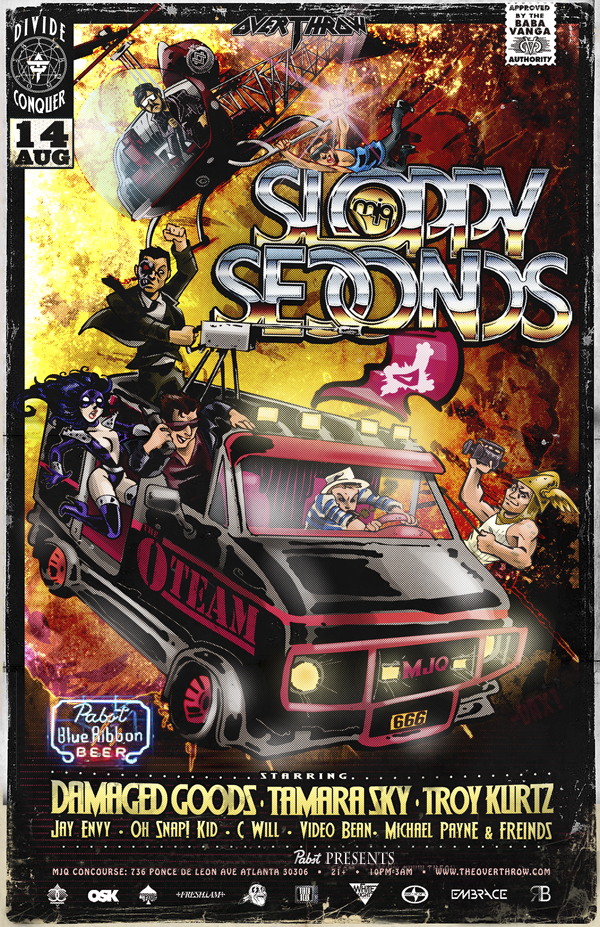
PBR, surprised by this, set about finding out what was going on. They eventually decided that PBR had become a “protest brand,” the non-hyped underdog beer that hipsters chose because it was non-mainstream and wasn’t constantly pushed at them by a PR machine. As a result, PBR rejected a lot of standard marketing tactics (though they did pay to have the beer placed in the 2009 movie Whip It, among others). Instead, they chose to focus on sponsoring events that the new customer base attended or participated in, but in a relatively quiet, non-intrusive way. Here’s a post for an event PBR is sponsoring this Saturday in Atlanta:

Part of PBR’s image, and attraction to people who consider themselves outsiders, is its association with what Walker calls a “blue-collar, honest-workingman, vaguely anticapitalist image” (p. 113). It’s old-school, blue-collar, salt-of-the-earth beer from the days of Milwaukee’s manufacturing and beer-producing glory. When you buy PBR, it lists a P.O. Box in Milwaukee, and the website lists Milwaukee at the bottom of the page.

Except…not so much. PBR is no longer headquartered in Milwaukee. In 1985 PBR was purchased by a man who was buying up a lot of low-market-share beer companies. He moved the headquarters to San Antonio (in May of this year he announced he sold PBR to another company; the headquarters are now in a suburb of Chicago). The move put about 250 people in Milwaukee out of work, including a lot of the blue-collar workers the beer is associated with.

On top of that, PBR doesn’t actually make beer anymore. Miller brews beer for the company, which then packages it in PBR cans. PBR is no longer a producer of beer; it’s a name and logo attached to beer made by a company many of the people drinking PBR would probably dislike.

On the one hand, PBR is a case that shows how consumers make decisions and can affect the marketplace independent of advertising campaigns; PBR certainly wasn’t spending a lot of money trying to woo this new demographic and didn’t initially know quite what to make of it. A group of consumers identified with PBR. That is, they saw the company as like them. They dislike in-your-face marketing, the feeling that companies are trying to manipulate them. They’re outsiders who see themselves as dissenters from a lot of mainstream culture. And PBR fits well with this identity; it’s the underdog, old-school beer company that isn’t actively trying to win over consumers. No TV commercials, no PBR babes in bikinis giving away free samples at bars. And it has working-class cachet.

But much of this is symbolic. Buying PBR makes money for Miller, a company that uses the loud marketing techniques hipsters express disdain for. At this point, you could argue that PBR is simply a beer fashion label. And while it might have associations with the working-class, the process of outsourcing its beer to Miller and moving headquarters to a different state left quite a few members of that class out of work. Walker argues that this indicates a new form of solidarity with blue-collar workers. It isn’t about making sure you’re buying from companies that pay a living wage or fighting for better working conditions. Symbolic solidarity — paying a nod to the working class by buying products (beer, clothing, etc.) — is often seen as sufficient. By drinking PBR you’re identifying with blue-collar workers in spirit, if not in any specific, concrete way.

PBR capitalizes on the perceptions of the brand while engaging in or working companies who engage in many of the practices that those who repopularized it were rejecting when they switched to PBR in the first place.

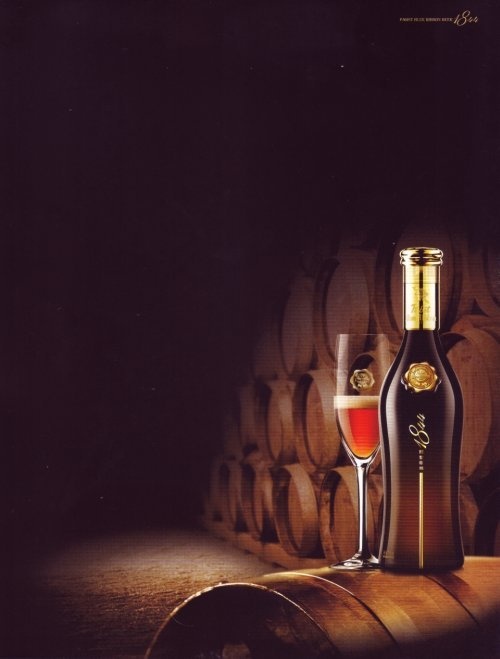
And, just to add one more twist to the story…in China, PBR sells a specialty beer called Blue Ribbon 1844:

How much does the beer sold by the cheap, working-class company cost in China? Why, $44 a bottle. A PBR executive who oversees the Asian market explains, “There’s the nouveau riche, and in China, perception is everything—look at me, I’m rich.” Not exactly the bike-messenger hipster crowd.

So there you go…the long, bizarre, contradictory story of PBR.

————————–

UPDATE: I got an email from an employee of PBR, who says this in defense of the brand:

I just want clear up a huge misunderstanding…We actually are independent American Company, not owned by Miller Brewing. Pabst itself contracts out all its production to other breweries, and has become, in effect, a “virtual brewery.” This keeps our beer fresh and saves us the cost of shipping large distances. It saves the earth, and helps us keep cost low. Many brand do this, also a few micro brands, you be surprised. We are 100% American Company. We also have NOTHING to do with the China Brand. They are a totally separate company just to let  you know.

I thought it was only fair to share his viewpoint. However, I don’t know that there’s really a misunderstanding there. I know PBR isn’t owned by Miller, but rather that the company outsources production of their beer, and I *think* my discussion made that distinction. I apologize if anyone was confused by that. As for my assertion that buying PBR makes money for Miller, it’s not because Miller directly owns them, but because they get money for the outsourcing, which common sense indicates they profit from or they wouldn’t keep doing it.

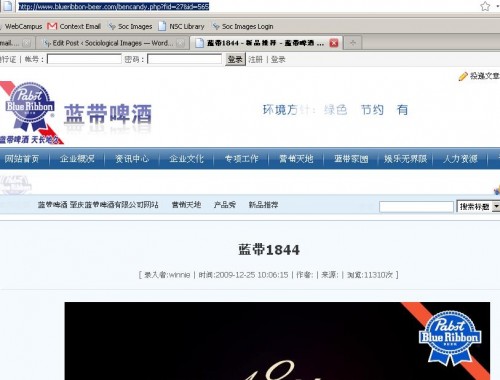
I’m more skeptical about the claim that PBR has nothing to do with the China beer. The Chinese website for the beer has the regular PBR logo prominently displayed on both the site itself and the poster for the beer:

Gwen Sharp is an associate professor of sociology at Nevada State College. You can follow her on Twitter at @gwensharpnv.

Monica Y. sent a collection of vintage ads and cartoons illustrating how soap and cleanliness has been used as a metaphor for colonization.  The first two ads show how soap manufacturers and colonialists alike colluded in suggesting that the colonized were unclean/uncivilized and needed to be cleansed/enlightened.

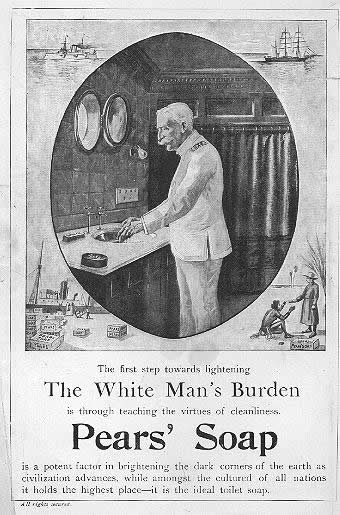
This first ad for Pears’ Soap reads:

The first step towards lightening The White Man’s Burden is through teaching the virtues of cleanliness.  Pears’ Soap is a potent factor in brightening the dark corners of the earth as civilization advances while amongst the cultured of all nations it holds the highest place — it is the ideal toilet soap.

The phrase “White Man’s Burden” refers to the colonial-era idea that white men were burdened with bringing civilization to the uncivilized.  See our post on a modern-day Pamper’s commercial invoking a white woman’s burden for another example.

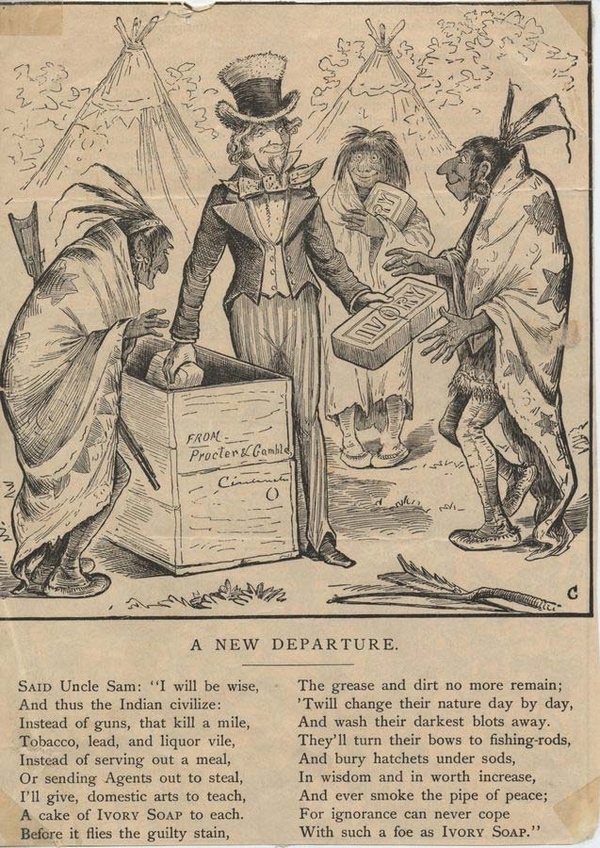
This ad for Ivory soap depicts Uncle Sam (I think) passing out soap to American Indians (in blankets, no less) (text transcribed below):

Text:

A NEW DEPARTURE
SAID Uncle Sam: “I will be wise,
And thus the Indian civilize:
Instead of guns, that kill a mile,
Tobacco, lead, and liquor vile,
Instead of serving out a meal,
Or sending Agents out to steal,
I’ll give, domestic arts to teach,
A cake of IVORY SOAP to each.
Before it flies the guilty stain,

The grease and dirt no more remain;
‘Twill change their nature day by day,
And wash their darkest blots away.
They’re turn their bows to fishing-rods,
And bury hatchets under sods,
In wisdom and in worth increase,
And ever smoke the pipe of peace;
For ignorance can never cope
With such a foe as IVORY SOAP.”

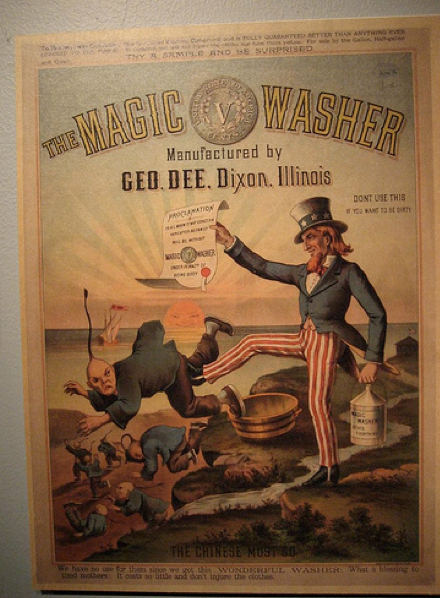
This political cartoon, circa 1886, uses the metaphor of washing to describe the cleansing of the Chinese from the U.S.  At the bottom it reads, “The Chinese must go.”

See also our set of vintage ads selling soap with depictions of African Americans as dirty.

Lisa Wade, PhD is an Associate Professor at Tulane University. She is the author of American Hookup, a book about college sexual culture; a textbook about gender; and a forthcoming introductory text: Terrible Magnificent Sociology. You can follow her on Twitter and Instagram.
Cross-posted at Jezebel.

With the exception of the t-shirt (which only masquerades as gender neutral), in the U.S. clothes are designed for women or men, but never both.  Department stores and retail stores (unless they sell only men’s or women’s clothing) have separate men’s and women’s sections in the store.  There is no option to buy clothes, one must buy women’s or men’s clothes.

This is even true for children’s clothes. One might make the argument that adult males and females have different bodies (an argument I might argue with), but we can’t say that pre-pubertal children do.  Nevertheless, the cultural rules that require boys and men to dress differently than girls and women make such a clothing line seem impossible.

Well, Evie sent in an example of a UK clothing company trying to do the impossible.  The company, Polarn O. Pyret, explains:

Our unisex collection (UNI) consists of clothing that is based on situation and function rather than on gender. As a clothing manufacturer, we want to make it our responsibility to offer an alternative to clothing that is based on gender. There is really no reason to design different models and fits for small boys and girls since there is no great difference in the way their bodies are shaped. We have taken an overall approach to unisex clothing, and consider not only color but also pattern and fit.

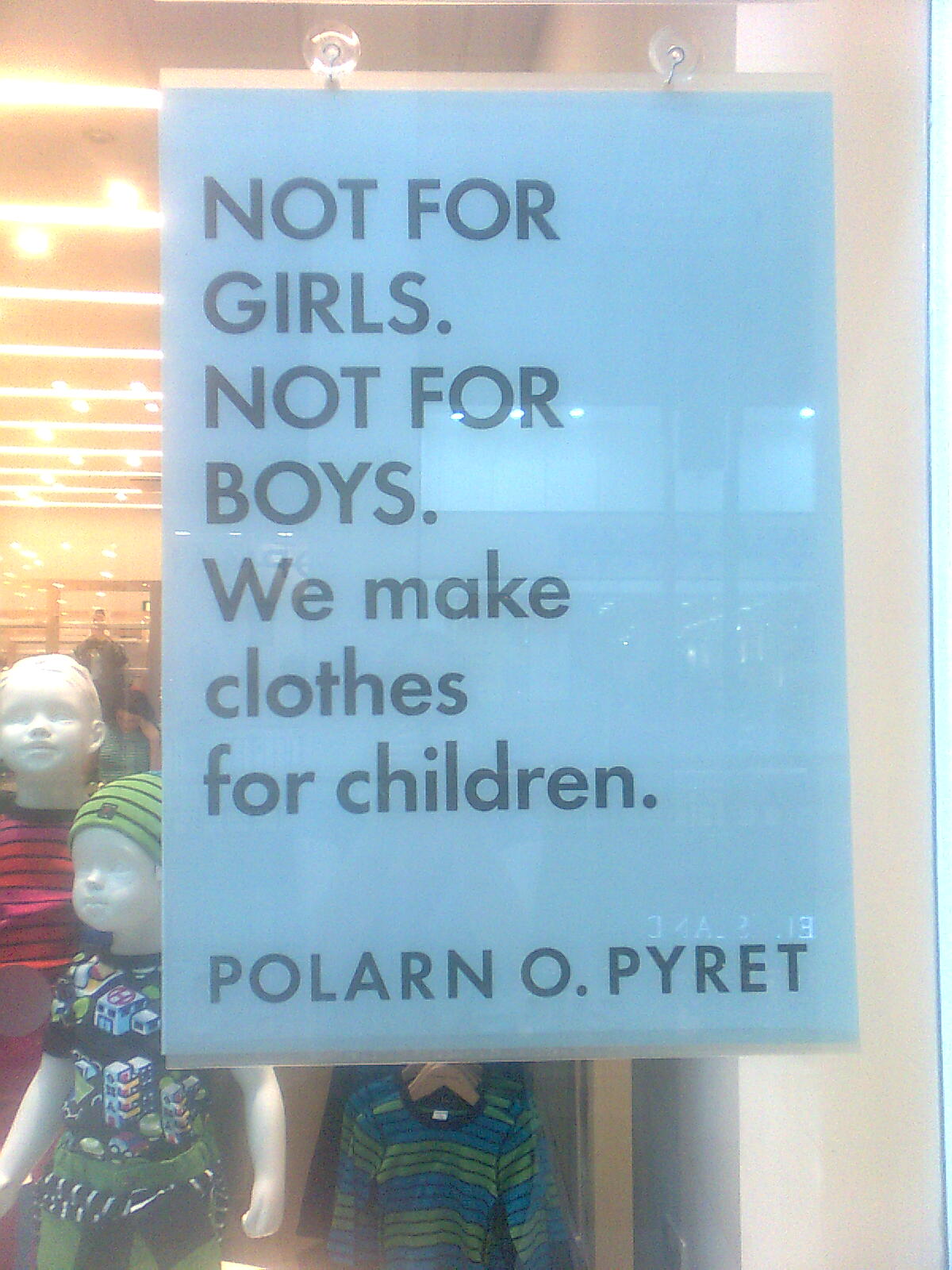
Evie’s attention was drawn by this ad in a store window:

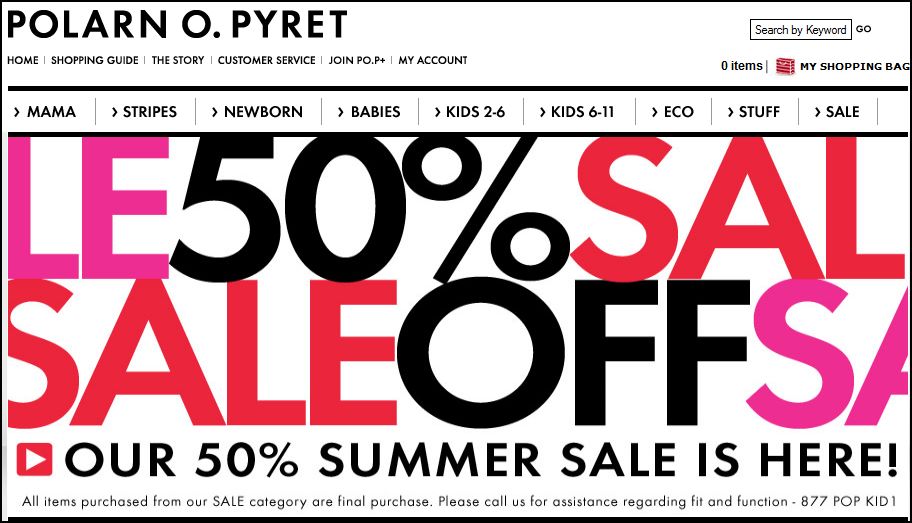
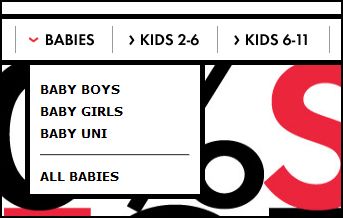
Their website, you’ll notice, doesn’t have the regular “girls” and “boys” section seen ubiquitously:

This company is nice evidence that the-way-it-is isn’t the-way-it-has-to-be.

UPDATE: Mary and Cheryl pointed out that, if you click on “babies” or either of the “kids” tabs, you get the option of “boys,” “girls,” or “uni” (unisex) lines.  So the company isn’t making a principled stand here.  They’re still willing to take the money of parents who want to dress their kids in gendered clothes, but they are offering an alternative for those parents who don’t.  It’s pretty telling that even this strategy — offering a unisex line alongside girls and boys lines — is so rare.

Lisa Wade, PhD is an Associate Professor at Tulane University. She is the author of American Hookup, a book about college sexual culture; a textbook about gender; and a forthcoming introductory text: Terrible Magnificent Sociology. You can follow her on Twitter and Instagram.
Cross posted at BlogHer.

Michaela M. alerted us to the news that Essence, the iconic fashion and lifestyle magazine for Black women, has hired an Australian-born, White woman, Elliana Placas, as its new Fashion Director.  Disappointed, former Essence fashion editor, Michaela Angela Davis, wrote:

If there were balance in the industry; if we didn’t have a history of being ignored and disrespected; if more mainstream fashion media included people of color before the ONE magazine dedicated to black women ‘diversified’, it would feel different.

In this 3-minute clip, Davis explains her position to Anderson Cooper:

The controversy over her hire is an example of a more widespread question about representation. Most agree that the presence of Black politicians, actors, models, teachers, professors, authors, and athletes (to name a few) is a good thing for Black people. It’s good, presumably, for two reasons. First, their presence in these roles normalizes Black achievement, beauty, intelligence, etc. The election of Barack Obama, for example, shows us that being Black and being the President of the United States are not mutually exclusive. The success of Tyra Banks and Alek Wek, similarly, upsets the notion that Black women aren’t beautiful.  It is good for all of us to be exposed to evidence that upsets negative stereotypes about Black people, stereotypes that all of us, no matter our color, unconsciously internalize to some degree (test your unconscious preferences here).

But there is a second reason why we often believe that representation is good. It is often presumed that people advocate for their own. Having a Black woman as Fashion Director, it is hoped, will mean that the content of the magazine will be empowering to Black women. That is, that the Director will be sensitive to the historic and ongoing racist idealization of white femininity that makes Black women’s bodies, hair, facial features, and skin color seem to need fixing.  Even if her racial politics are sound (and this is always a serious worry), she certainly does not have the experiences that Black woman in the U.S. often share nor, necessarily, the deep connection to the Black population that will make this a driving concern.

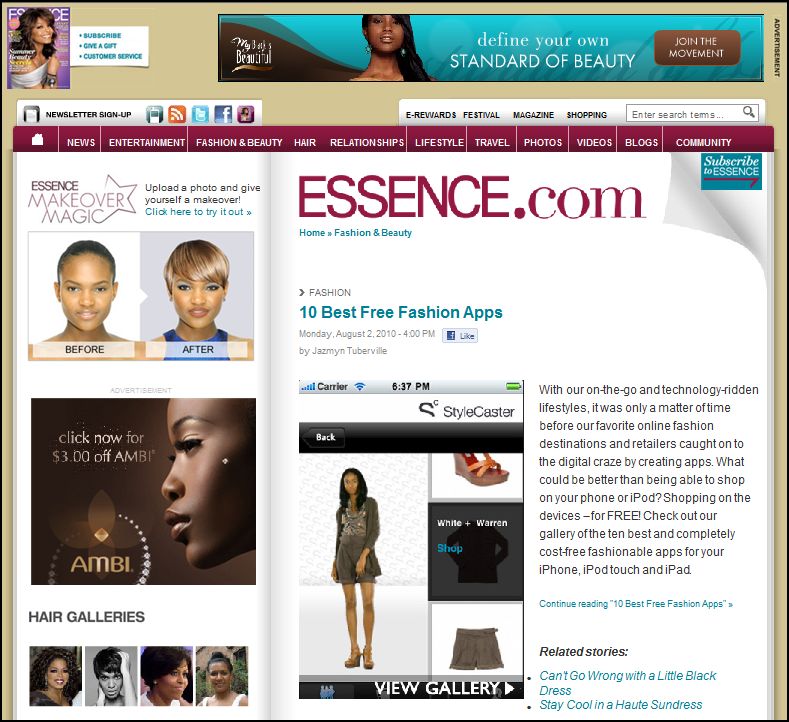
Essence‘s current Fashion and Beauty page with it’s August 2010 cover, featuring Janet Jackson, in the upper left corner:

The hiring of Placas is disappointing in the sense that it is a lost opportunity to put a Black woman in a position of power.  If, however, Placas is going to have this job, people concerned about the empowerment of Black women need to turn to evaluating her product.  The worry caused by her appointment is an opportunity to insist that Essence do right by Black women.  That is, Essence should be a refuge from racism.  One that, hopefully, does not subject Black women to the same sexism as White women in the name of equality.  Light skin does not preclude Placas from being able to do this, just as dark skin does not protect a person from internalizing and perpetuating colorism.

Ultimately, while having a darker-skinned, Black-identified person in the role of Fashion Director would be good, the production of a magazine that empowers Black women is also very important and this is something that Placas may be able to do.  It is up to us to insist that she does.

Lisa Wade, PhD is an Associate Professor at Tulane University. She is the author of American Hookup, a book about college sexual culture; a textbook about gender; and a forthcoming introductory text: Terrible Magnificent Sociology. You can follow her on Twitter and Instagram.