

Last week I posted about some potential problems of “awareness branding,” when products are marketed by promising to make a donation to breast cancer research, or wilderness restoration, or something of the sort. Greg P. then sent me a link to a video on RSA Comment where economist/philosopher Slavoj Zizek argues against a reliance on private charity, and particularly ethical consumption, as a solution to global problems. He suggests that, say, buying fair-trade coffee at Starbucks is unlikely to relieve inequities that are directly related to global capitalism (of which Starbucks is a part and beneficiary), and may in fact reinforce them by making individuals in more privileged nations feel like they’ve done something to address the problem, thus relieving them of any obligation to look more deeply into the problem:
Search results for The

How ironic that so many women are telling men to “man up.” Enjoy:
Thanks Dmitriy T.M.
Lisa Wade, PhD is an Associate Professor at Tulane University. She is the author of American Hookup, a book about college sexual culture; a textbook about gender; and a forthcoming introductory text: Terrible Magnificent Sociology. You can follow her on Twitter and Instagram.
Zoë sent us this video in which Erin Gibson satirizes the “sexy ____” costume trend for women so common this time of year:
Angela Zhang sent in a Heineken commercial that helpfully illustrates the common depiction of sex and dating as a game or hunt, and alcohol as a tool in that hunt. In the commercial, men are predators in a sexual “jungle,” and attractive women are their “prey.” The true champion in this hunt will not just manage to get his prey — he’ll get her to “surrender” to him voluntarily:
It’s not the first time Heineken has presented itself as a useful tool for your dating life. Also check out this video on women in beer ads. Of course, other times beer ads conflate women’s bodies with beer itself. Or liquor as the response to the loss of patriarchal power. And hey, guys, if you fail in your hunt, don’t worry — it turns out alcohol is better than relationships with women anyway!
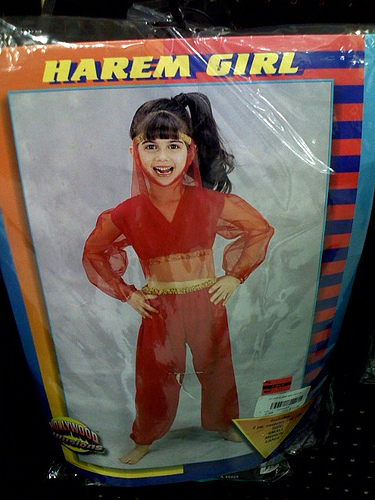
Sent in by Peter via Ms. blog.
Lisa Wade, PhD is an Associate Professor at Tulane University. She is the author of American Hookup, a book about college sexual culture; a textbook about gender; and a forthcoming introductory text: Terrible Magnificent Sociology. You can follow her on Twitter and Instagram.
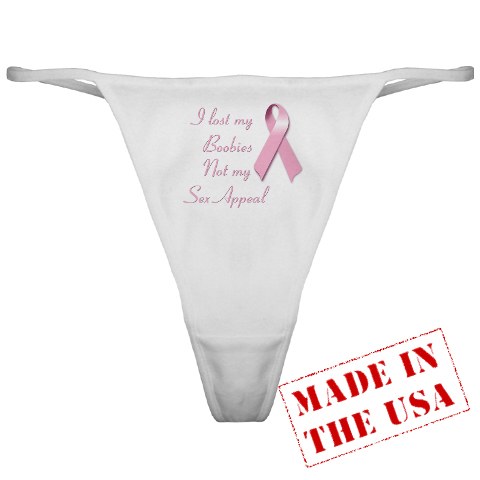
October is National Breast Cancer Awareness Month. Accordingly, during October we come across more than the normal number of pink-ribbon-adorned items that variously give a portion of proceeds to breast cancer research, remind women to conduct breast exams, contain supportive messages for breast cancer survivors, or just sort of, you know, support the existence of boobs and oppose cancer. For instance, Alicia, the moderator of Think Before You Pink, found this thong
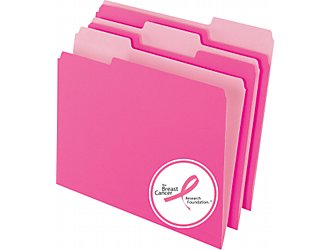
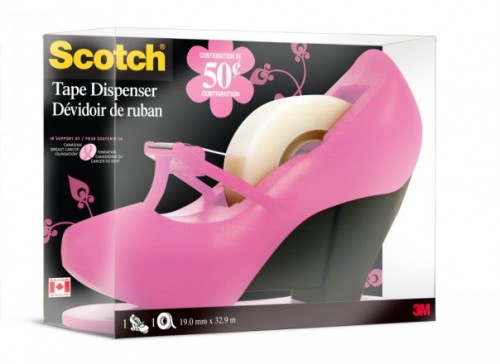
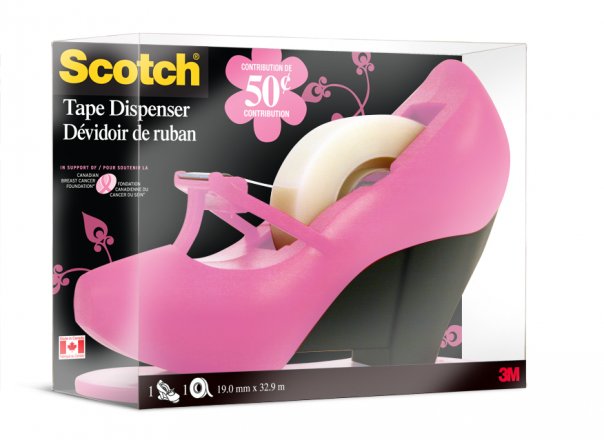
And Renée Yoxon noticed that Staples, among other office-supply stores, has a lot of pink ribbon products for sale, including pink-ribbon paper, file folder, calculators, daily planners, pens, and, in Canada, a tape dispenser from 3M shaped like a high-heeled shoe:

We’ve posted on the whole issue of breast cancer awareness branding before. And one response that always comes up is, basically, yes, companies may be using breast cancer as a marketing tool to increase sales, but if by doing so they also donate money for breast cancer research or prevention, who cares? By buying pink-ribbon address labels, money goes to fight breast cancer that probably wouldn’t have been donated otherwise, so the net effect is good, right?
In his book Buying In: What We Buy and Who We Are, Rob Walker suggests perhaps not. He summarizes a number of studies that found that “doing good in one area of life provided a rationale to worry less about such things in another” (p. 222). Specifically, feeling they had contributed in some way (by imagining they had agreed to volunteer at a community organization) significantly increased subjects’ preference for “luxury” items. It appears that feeling we have done a good deed makes us feel like we deserve rewards in other arenas, or at least frees us to make decisions we might otherwise be a bit embarrassed about.
Walker connects this research to the wide array of companies that either create a particular product that is slightly more eco- or labor-friendly than their regular line or that donate a tiny portion of profits to a charity of some sort. He suggests that the ability to easily “do good” through consumption — that is, I can choose the pink-ribbon file folders and feel good about myself for being a good citizen — may contribute some money to a particular charity, but may ultimately lead us to be less concerned about the impacts of our other consumption choices. As Walker summarizes the effect,
These various efforts each add just enough options to the miles of retail shelves to give us all an ethical fix — to do our one good shopping deed. Then we can push our basket a little farther down the aisle, letting other rationales take over: Here’s a bargain, here’s a great product…and here, yes, here is something ethical. I’ll take one of those, too. (p. 223)
From this perspective, this type of branding may benefit companies not just by making it more likely we’ll buy the specific product they’ve attached a pink (or red, or yellow, or whatever color) ribbon to, but by satisfying our need to feel like we’re aware, concerned consumers, and thus making us less likely to question the production practices of the other items we’re choosing among.
Adrienne at Native Appropriations reports that this year Harvard University fraternity Sigma Chi threw a Columbus Day “bros and hos” party titled “Conquistabros and Navajos.” Get it?
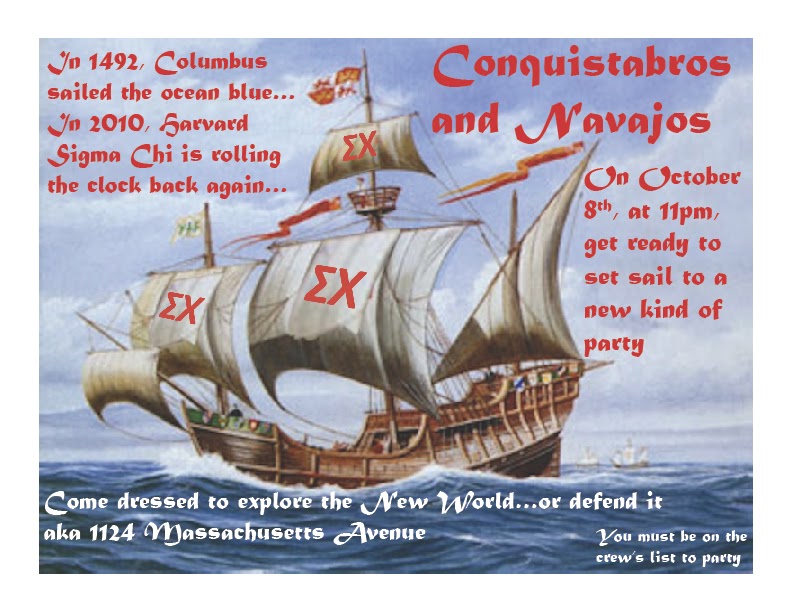
Perhaps it’s too much to expect student in the Ivy League to be sensitive, but Harvard students are supposed to be smart, right? Not so much. Adrienne points out their bizarre illogic: how exactly does it make sense to have a party that mingles Navajos (from the American Southwest) with pilgrims (who lived in the American Northeast) and Conquistadors (who arrived after, not with Columbus) and cowboys (who, as we know them, would come hundreds of years later)?
And while we’re at it, why not expect them to be sensitive. Adrienne reminds us, again, patiently…
1. Glorifying and making light of the atrocities committed by the “explorers” of the Americas is just as bad as glorifying the Nazis and the Holocaust, and not something to be taken lightly.
2. The theme is using a generic stereotype of an Indigenous person (in this case “Navajo”) to represent thousands of tribes and communities throughout the Americas, each with their own unique culture and history. The Indigenous groups who encountered the conquistadors are not remotely the same as Navajos in the southwest, and by lumping them together, the party contributes to continued stereotyping of Native peoples as one monolithic group — consisting of hollywood stereotypes of war paint, feathers, and buckskin.
3. Encouraging party goers to “dress up” as American Indians and Indigenous Peoples puts Native people in the category of a fantasy character — something that no longer exists, or never did. Columbus, Conquistadors, and Pilgrims are all situated in the past, but Native peoples are still here, are still alive, and still Native (and yes, cowboys are still alive, but they are not systematically oppressed and facing continued colonialism). It is also condoning dressing up in racial drag, and I would bet Sigma Chi might get in a little trouble if they hosted a blackface party.
But no one would do that, would they?
Lisa Wade, PhD is an Associate Professor at Tulane University. She is the author of American Hookup, a book about college sexual culture; a textbook about gender; and a forthcoming introductory text: Terrible Magnificent Sociology. You can follow her on Twitter and Instagram.

In this 12-minute RSA Animate video, Education Professor Sir Ken Robinson explains why we need to change the way we educate new generations. Children, he says, “…are living in the most intensely stimulating period in the history of the earth.” Yet we are still educating them according to a model invented during the industrial revolution that emphasizes conformity, standardization, and coming up with the “right” answer. Today the future is coming faster and faster and we need to teach children to be able to thrive in change and uncertainty. Watch the video for his thoughts on what to do next (and what Oklahoma has to do with it):
Thanks to education activist and friend, Diallo Shabazz, for the link!
Lisa Wade, PhD is an Associate Professor at Tulane University. She is the author of American Hookup, a book about college sexual culture; a textbook about gender; and a forthcoming introductory text: Terrible Magnificent Sociology. You can follow her on Twitter and Instagram.
How ironic that so many women are telling men to “man up.” Enjoy:
Thanks Dmitriy T.M.
Lisa Wade, PhD is an Associate Professor at Tulane University. She is the author of American Hookup, a book about college sexual culture; a textbook about gender; and a forthcoming introductory text: Terrible Magnificent Sociology. You can follow her on Twitter and Instagram.
Zoë sent us this video in which Erin Gibson satirizes the “sexy ____” costume trend for women so common this time of year:
Angela Zhang sent in a Heineken commercial that helpfully illustrates the common depiction of sex and dating as a game or hunt, and alcohol as a tool in that hunt. In the commercial, men are predators in a sexual “jungle,” and attractive women are their “prey.” The true champion in this hunt will not just manage to get his prey — he’ll get her to “surrender” to him voluntarily:
It’s not the first time Heineken has presented itself as a useful tool for your dating life. Also check out this video on women in beer ads. Of course, other times beer ads conflate women’s bodies with beer itself. Or liquor as the response to the loss of patriarchal power. And hey, guys, if you fail in your hunt, don’t worry — it turns out alcohol is better than relationships with women anyway!
Sent in by Peter via Ms. blog.
Lisa Wade, PhD is an Associate Professor at Tulane University. She is the author of American Hookup, a book about college sexual culture; a textbook about gender; and a forthcoming introductory text: Terrible Magnificent Sociology. You can follow her on Twitter and Instagram.
October is National Breast Cancer Awareness Month. Accordingly, during October we come across more than the normal number of pink-ribbon-adorned items that variously give a portion of proceeds to breast cancer research, remind women to conduct breast exams, contain supportive messages for breast cancer survivors, or just sort of, you know, support the existence of boobs and oppose cancer. For instance, Alicia, the moderator of Think Before You Pink, found this thong
And Renée Yoxon noticed that Staples, among other office-supply stores, has a lot of pink ribbon products for sale, including pink-ribbon paper, file folder, calculators, daily planners, pens, and, in Canada, a tape dispenser from 3M shaped like a high-heeled shoe:
We’ve posted on the whole issue of breast cancer awareness branding before. And one response that always comes up is, basically, yes, companies may be using breast cancer as a marketing tool to increase sales, but if by doing so they also donate money for breast cancer research or prevention, who cares? By buying pink-ribbon address labels, money goes to fight breast cancer that probably wouldn’t have been donated otherwise, so the net effect is good, right?
In his book Buying In: What We Buy and Who We Are, Rob Walker suggests perhaps not. He summarizes a number of studies that found that “doing good in one area of life provided a rationale to worry less about such things in another” (p. 222). Specifically, feeling they had contributed in some way (by imagining they had agreed to volunteer at a community organization) significantly increased subjects’ preference for “luxury” items. It appears that feeling we have done a good deed makes us feel like we deserve rewards in other arenas, or at least frees us to make decisions we might otherwise be a bit embarrassed about.
Walker connects this research to the wide array of companies that either create a particular product that is slightly more eco- or labor-friendly than their regular line or that donate a tiny portion of profits to a charity of some sort. He suggests that the ability to easily “do good” through consumption — that is, I can choose the pink-ribbon file folders and feel good about myself for being a good citizen — may contribute some money to a particular charity, but may ultimately lead us to be less concerned about the impacts of our other consumption choices. As Walker summarizes the effect,
These various efforts each add just enough options to the miles of retail shelves to give us all an ethical fix — to do our one good shopping deed. Then we can push our basket a little farther down the aisle, letting other rationales take over: Here’s a bargain, here’s a great product…and here, yes, here is something ethical. I’ll take one of those, too. (p. 223)
From this perspective, this type of branding may benefit companies not just by making it more likely we’ll buy the specific product they’ve attached a pink (or red, or yellow, or whatever color) ribbon to, but by satisfying our need to feel like we’re aware, concerned consumers, and thus making us less likely to question the production practices of the other items we’re choosing among.
Adrienne at Native Appropriations reports that this year Harvard University fraternity Sigma Chi threw a Columbus Day “bros and hos” party titled “Conquistabros and Navajos.” Get it?
Perhaps it’s too much to expect student in the Ivy League to be sensitive, but Harvard students are supposed to be smart, right? Not so much. Adrienne points out their bizarre illogic: how exactly does it make sense to have a party that mingles Navajos (from the American Southwest) with pilgrims (who lived in the American Northeast) and Conquistadors (who arrived after, not with Columbus) and cowboys (who, as we know them, would come hundreds of years later)?
And while we’re at it, why not expect them to be sensitive. Adrienne reminds us, again, patiently…
1. Glorifying and making light of the atrocities committed by the “explorers” of the Americas is just as bad as glorifying the Nazis and the Holocaust, and not something to be taken lightly.
2. The theme is using a generic stereotype of an Indigenous person (in this case “Navajo”) to represent thousands of tribes and communities throughout the Americas, each with their own unique culture and history. The Indigenous groups who encountered the conquistadors are not remotely the same as Navajos in the southwest, and by lumping them together, the party contributes to continued stereotyping of Native peoples as one monolithic group — consisting of hollywood stereotypes of war paint, feathers, and buckskin.
3. Encouraging party goers to “dress up” as American Indians and Indigenous Peoples puts Native people in the category of a fantasy character — something that no longer exists, or never did. Columbus, Conquistadors, and Pilgrims are all situated in the past, but Native peoples are still here, are still alive, and still Native (and yes, cowboys are still alive, but they are not systematically oppressed and facing continued colonialism). It is also condoning dressing up in racial drag, and I would bet Sigma Chi might get in a little trouble if they hosted a blackface party.
But no one would do that, would they?
Lisa Wade, PhD is an Associate Professor at Tulane University. She is the author of American Hookup, a book about college sexual culture; a textbook about gender; and a forthcoming introductory text: Terrible Magnificent Sociology. You can follow her on Twitter and Instagram.
In this 12-minute RSA Animate video, Education Professor Sir Ken Robinson explains why we need to change the way we educate new generations. Children, he says, “…are living in the most intensely stimulating period in the history of the earth.” Yet we are still educating them according to a model invented during the industrial revolution that emphasizes conformity, standardization, and coming up with the “right” answer. Today the future is coming faster and faster and we need to teach children to be able to thrive in change and uncertainty. Watch the video for his thoughts on what to do next (and what Oklahoma has to do with it):
Thanks to education activist and friend, Diallo Shabazz, for the link!
Lisa Wade, PhD is an Associate Professor at Tulane University. She is the author of American Hookup, a book about college sexual culture; a textbook about gender; and a forthcoming introductory text: Terrible Magnificent Sociology. You can follow her on Twitter and Instagram.