Search results for The

This 8-minute video from Powering A Nation documents the fight of Kindra Arnesen to save her family and her Gulf Shores community. It’s a stirring portrait of how one family has been affected by the oil spill and is trying to fight back:

Via NPR.

Lisa Wade, PhD is an Associate Professor at Tulane University. She is the author of American Hookup, a book about college sexual culture; a textbook about gender; and a forthcoming introductory text: Terrible Magnificent Sociology. You can follow her on Twitter and Instagram.

Presumably many of you have heard about the controversy that has arisen about a conversation between Laura Schlessinger (aka Dr. Laura) and a female African American caller. Corina C. sent in some links to posts on the topic. Trigger warning for harsh, racist language.

Here’s a recording of the conversation (found at Media Matters) in which Schlessinger responds to the caller’s concerns about comments from her White husband’s friends and relatives by suggesting she is “hypersensitive” and isn’t in a position to be concerned about comments she considered racist because “Turn on HBO, listen to a black comic, and all you hear is nigger, nigger, nigger”:

Selected parts of the transcript:

CALLER: I was a little caught back by the N-word that you spewed out, I have to be honest with you. But my point is, race relations —

SCHLESSINGER: Oh, then I guess you don’t watch HBO or listen to any black comedians.

SCHLESSINGER: Yeah. We’ve got a black man as president, and we have more complaining about racism than ever. I mean, I think that’s hilarious.

SCHLESSINGER: Chip on your shoulder. I can’t do much about that.

CALLER: It’s not like that.

SCHLESSINGER: Yeah. I think you have too much sensitivity —

CALLER: So it’s OK to say “nigger”?

SCHLESSINGER: — and not enough sense of humor.

SCHLESSINGER: …You know what? If you’re that hypersensitive about color and don’t have a sense of humor, don’t marry out of your race. If you’re going to marry out of your race, people are going to say, “OK, what do blacks think? What do whites think? What do Jews think? What do Catholics think?”…And what I just heard from Jade is a lot of what I hear from black-think — and it’s really distressting [sic] and disturbing. And to put it in its context, she said the N-word, and I said, on HBO, listening to black comics, you hear “nigger, nigger, nigger.” I didn’t call anybody a nigger. Nice try, Jade. Actually, sucky try. Need a sense of humor, sense of humor — and answer the question. When somebody says, “What do blacks think?” say, “This is what I think. This is what I read that if you take a poll the majority of blacks think this.” Answer the question and discuss the issue…Ah — hypersensitivity, OK, which is being bred by black activists. I really thought that once we had a black president, the attempt to demonize whites hating blacks would stop, but it seems to have grown, and I don’t get it.

There are a number of things going on here. In Racism without Racists: Color-Blind Racism and the Persistence of Racial Inequality in the United States, Eduardo Bonilla-Silva discusses the various ways that Whites, in particular, downplay racial discrimination through a number of rhetorical and discursive strategies, several of which Schlessinger draws on in this exchange. For instance, she naturalizes the behavior the caller is concerned about: if you marry someone of another race, you just have to accept that their friends and family are going to consider you a representative of your entire race and constantly interact with you through the lens of your racial/ethnic background. That’s just to be expected, and if it starts to bother you, you’re “hypersensitive.” In fact, you ought to be sure and constantly educate yourself about all social trends as they relate to African Americans, so that if someone has any questions about what “Blacks think,” you can quickly tell them.

Think about the level of mental energy that is being expected here. Schlessinger is saying that it is the responsibility of minorities to know what members of their race/ethnicity think, in the aggregate, about whatever topic anybody else might want to know. I, as a White woman, am not expected to be able to provide, at the drop of a hat, data on Whites’ opinions about anything. (Though I do find that people who find out I’m a sociologist often think I must have insight into every aspect of social life, leading to questions such as, “My sister-in-law likes to _____. What do you think causes that?” or “So what do you think _____ will be like in 50 years?”, neither of which I am usually prepared to address in the middle of getting some potato salad at a picnic or buying a soda at the gas station.) The underlying argument here is that it is minorities’ responsibility to patiently educate Whites about things related to non-Whites, and an unwillingness to take on that role is evidence that you have a “chip on your shoulder.”

Another frame Schlessinger draws on is the minimization of racism: we have a Black president now, so racism’s totally over. What’s your problem?

Schlessinger is also holding all members of a racial group responsible for the actions of any of them. She argues that the routines of some Black comedians invalidates this individual African American woman’s right to be upset by racialized language in any context. It doesn’t matter whether this woman approves of the comedians’ comments — or has ever heard any of them; all African Americans are treated as an undifferentiated group, and the behavior of some revokes the rights of any others to bring up issues they find problematic.

In an interview with The Hollywood Reporter, Schlessinger hints at another rhetorical strategy, the “some of my best friends are _____ and thus I can’t possibly be racially prejudiced” argument:

I went out to dinner with three friends after Larry King. One of my friends who is gay is sitting there with another friend who is black, and he looks up and says, “I wonder what the media would do with this? You’re with a black guy and a gay guy.” We laughed, because we all understand what this is really about — censoring a point of view.

So there you have it: a round-up of ways to frame non-Whites as overly sensitive and unilaterally responsible for improving race relations.

UPDATE: The comments section is closed. There were still a lot of people commenting, but much of it had descended into name-calling and accusations, and I can’t keep up with all of them to catch the truly offensive ones. I may reopen comments in 48 hours after a cooling-off period.

Plans to build an Islamic community center near the site of Ground Zero, the site of the destroyed World Trade Center towers in Manhattan, have stirred up the political right who have dubbed it the Ground Zero Mosque.  The proposed site (A) is about two blocks from where the twin towers once stood (B):

Objection to the project is based on a false conflation of the attacks with Islam.  Bin Laden drew on Islam to mobilize support for the attack, but this in no way makes the attacks Islamic.  Many Muslims died in the attacks and Muslims around the world condemn them.  When Scott Roeder murdered George Tiller for performing abortions, we didn’t call that a Christian attack.  It is prejudicial to paint entire groups based on the actions of a few.

Notice, however, how this ad opposing the community center identifies all Muslims (“they”) as America’s enemy (found here).  The ad’s narrator explains, “They declared war against us” and “to celebrate that murder of 3,000 Americans, they want to build a monstrous, 13-story mosque at Ground Zero…”  Trigger warning for those sensitive to images of the 911 attacks:

The campaign against the community center, then, is a good example of our refusal to notice that many Americans are Muslims and that not all Muslims are America’s enemy.

It also misunderstands life in that region of the city.  The ad names says that the site of the World Trade Center is “sacred” and Sarah Palin says that it is “hallowed ground.”  To that, Daryl Lang took it upon himself to photograph some of the Manhattan corners and storefronts that were the same distance from Ground Zero as the proposed center.  “Look at the photos,” he writes, “This neighborhood is not hallowed… The blocks around Ground Zero are like every other hard-working neighborhood in New York, where Muslims are just another thread of the city fabric.”

Thanks to Dmitriy T.M. for sending the link to Daryl Lang’s photos!

Lisa Wade, PhD is an Associate Professor at Tulane University. She is the author of American Hookup, a book about college sexual culture; a textbook about gender; and a forthcoming introductory text: Terrible Magnificent Sociology. You can follow her on Twitter and Instagram.
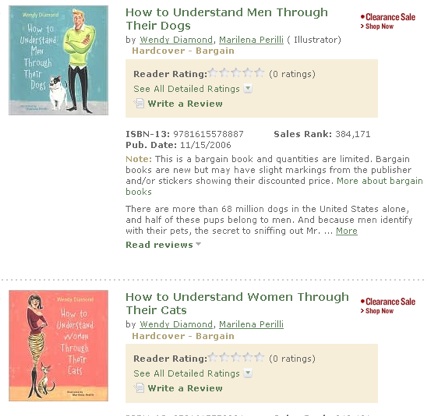
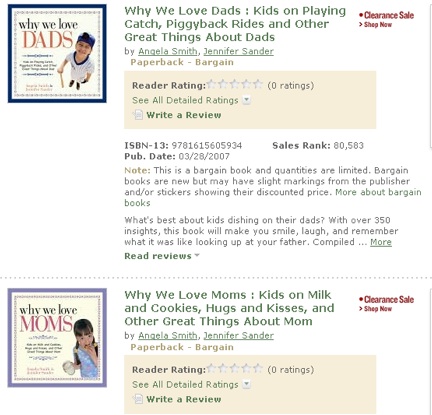
Nicole S. sent us screenshots of two sets of books she saw for sale online at Barnes & Noble. They provide us with some very important information about how men and women differ, as well as the types of things/activities/emotions that have been masculinized or feminized. Not sure if you’re speaking to a man or a woman? Check to see what pet they have with them:

And don’t be fooled into thinking parents are interchangeable. They serve very different roles. Dads are for playing with. Moms need to stay in the house and bake while you’re out playing catch with Dad, and then console you when you get hit in the face with the baseball:

I would provide some more sociological analysis here, but I’m distressed to realize I’m not fitting into appropriate gender roles, so I need to run to the animal shelter and trade in my dogs for a couple more cats to go with the one I ended up with when an ex-boyfriend abandoned her, which he must have done after realizing owning her was feminizing him.

As for understanding me through my cat, the other day I was ignoring her while I read a book so she came up and bit me on the nose hard enough to draw blood, so apparently I’m either a masochist or an aggressive self-involved brat, depending on whether you judge me by my cat, or by what I put up with from her.

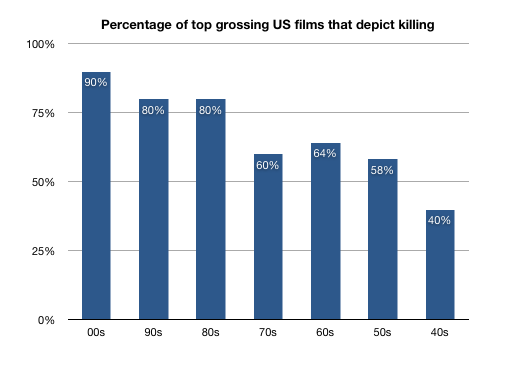
Using the top grossing films between 1940 and now, John Graham-Cumming has documented a rise in the percent of movies that include murder (of people or animals that can talk).  Here’s the data going from today (on the left) to the 1940s (on the right):

Shall we speculate explanations for the rise in lethal violence?

Lisa Wade, PhD is an Associate Professor at Tulane University. She is the author of American Hookup, a book about college sexual culture; a textbook about gender; and a forthcoming introductory text: Terrible Magnificent Sociology. You can follow her on Twitter and Instagram.
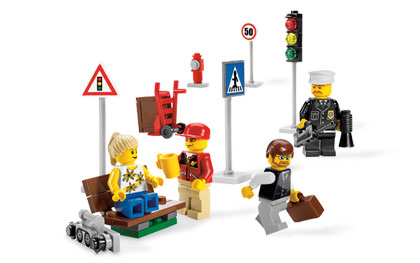
Carol C. sent in another example of the male = active, female = passive dichotomy, this time from Lego. They have a line called Lego City, which contains four figures and various accessories:

While you can obviously pose the characters however you want, Lego’s description of the set clearly assumes men are in more active, with specific work-related roles:

Meet the residents of LEGO® City!

LEGO® City is one busy place! As the girl listens to the radio on the park bench, the nearby policeman directs cars at the traffic light, the delivery boy hurries with an important package on his cart, and the businessman heads to his next meeting. Includes minifigures, street signs, accessories and more!

The men have jobs and things they are going to do. The girl — the only one here not in a uniform — sits on a bench.

Though she’s listening to the radio (on a boombox from, like, 1989), and possibly being hit on by the delivery boy, so maybe those are supposed to count as being active.

Last semester my colleague, Mary Christianakis, assigned her students a mash up.  The idea was to take two forms of art (loosely defined) and combine them to inspire, instead of state, a critical perspective.  Below is one of the exemplars, by her student, Samantha Figueroa.  It combines scenes from Pocahontas with a spoken word poem, Slip of the Tongue, by Adriel Luis.


Nice work, Samantha!

Lisa Wade, PhD is an Associate Professor at Tulane University. She is the author of American Hookup, a book about college sexual culture; a textbook about gender; and a forthcoming introductory text: Terrible Magnificent Sociology. You can follow her on Twitter and Instagram.
In the game of Monopoly, as the title implies, the object is to get as much money as possible, ideally bankrupting all the other players until you are the only player left.  The game, then, socializes children into a particular version of economic interaction, one quite compatible with capitalism as we know it.

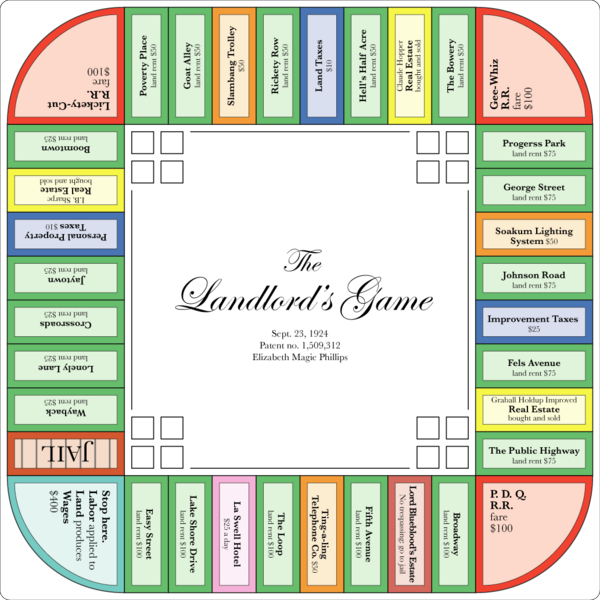
The idea that Monopoly is a socializing agent is brought into stark relief by The Landlord’s Game (from which, it is believed, Monopoly was derived).

Patented by Elizabeth Magie in 1904, the object of this game was to illustrate the economic inequality inherent in the renter/owner relationship.  From Wikipedia:

Magie based the game on the economic principles of Georgism, a system proposed by Henry George, with the object of demonstrating how rents enrich property owners and impoverish tenants. She knew that some people could find it hard to understand why this happened and what might be done about it, and she thought that if Georgist ideas were put into the concrete form of a game, they might be easier to demonstrate.

The game was manufactured beginning in 1910.  In 1935 the patent was ultimately purchased, ironically, by Parker Brothers; they wanted to buy the patents of all competing economy-based board games so as to have a monopoly on the genre.

Lisa Wade, PhD is an Associate Professor at Tulane University. She is the author of American Hookup, a book about college sexual culture; a textbook about gender; and a forthcoming introductory text: Terrible Magnificent Sociology. You can follow her on Twitter and Instagram.