Search results for The

Julie M. came across a bow and arrow set for sale at a Wholesale Sports store in Nanaimo, British Columbia, Canada. The set is called the “Lil’ Sioux.” Notice any oddness about the description?

It’s the Lil’ Sioux…and also the “Sherwood Forester” set. What’s Sherwood Forest? Why, where Robin Hood and his Merry Men hung out. Because when you’re appropriating Native American cultures, you might as well conflate them with mythologized, and possibly entirely fictional, noble outlaws from another continent.

But given the popularity of “Native American” fashions these days, I guess it shows restraint that the kid isn’t wearing a feathered headdress.

Gwen Sharp is an associate professor of sociology at Nevada State College. You can follow her on Twitter at @gwensharpnv.
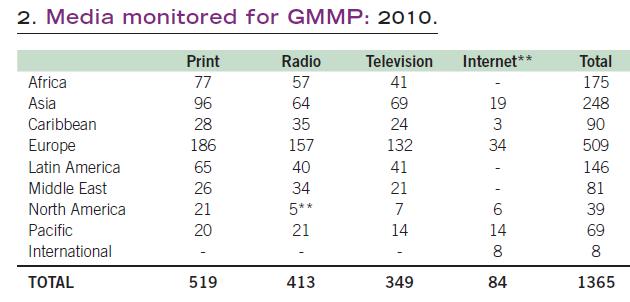
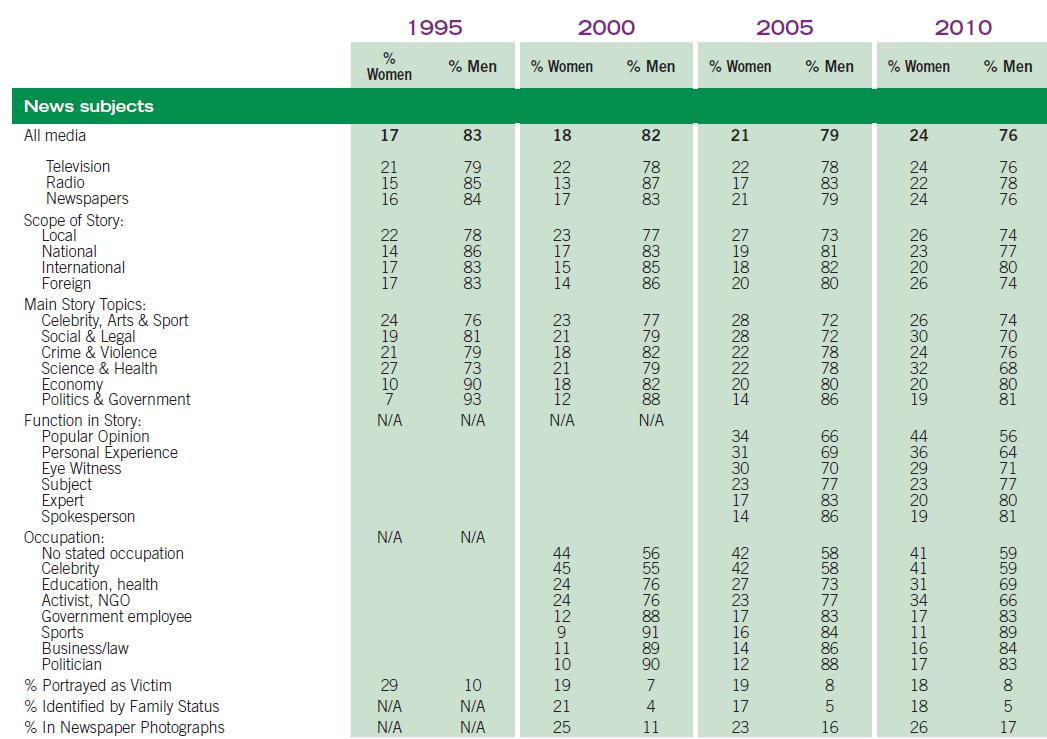
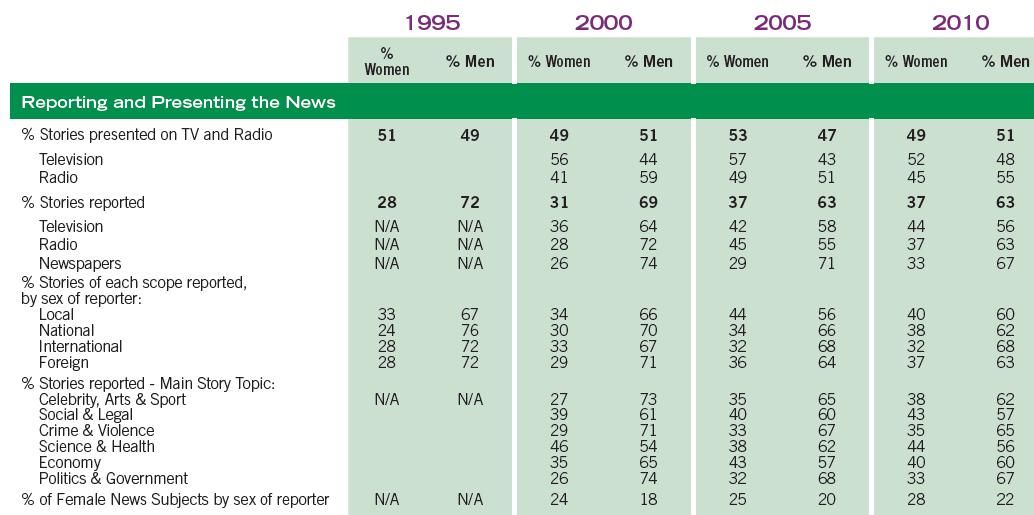
Flavia Dzodan, of Red Light Politics, sent in a link to the Global Media Monitoring Project’s new report, Who Makes the News? The document looks at the gender imbalance in news production, based on an analysis of 1,281 newspapers, TV, and radio stations in 108 countries on November 10, 2009.The results indicate that women are still under-represented as news subjects, and that stories about women often reinforce stereotypes (focusing on women in family roles, using women for “ordinary person” quotes rather than experts, emphasizing women in stories about criminal victimization, birth control, and so on but not economic policy or politics, etc.).

A note on the methodology:

The research covered 16,734 news items, 20769 news personnel (announcers, presenters and reporters), and 35,543 total news subjects, that is people interviewed in the news and those who the news is about.

Internet sources were analyzed separately.

Overall, the analysis shows that both local and international news show a world in which men are highly over-represented as subjects, though women are more likely to be represented as victims, to have their family status mentioned, or to be in newspaper photos:

Interestingly, those reporting the news are more gender balanced, indicating that having more women producing the news doesn’t lead to an automatic reduction in under-representation of women in the news:

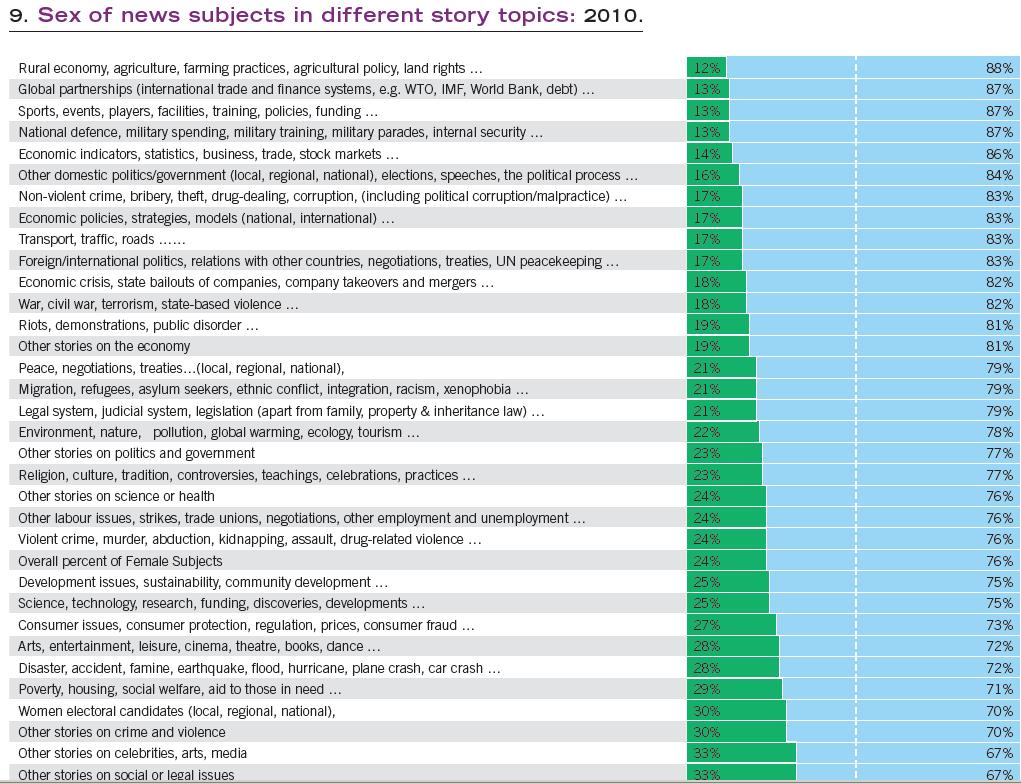
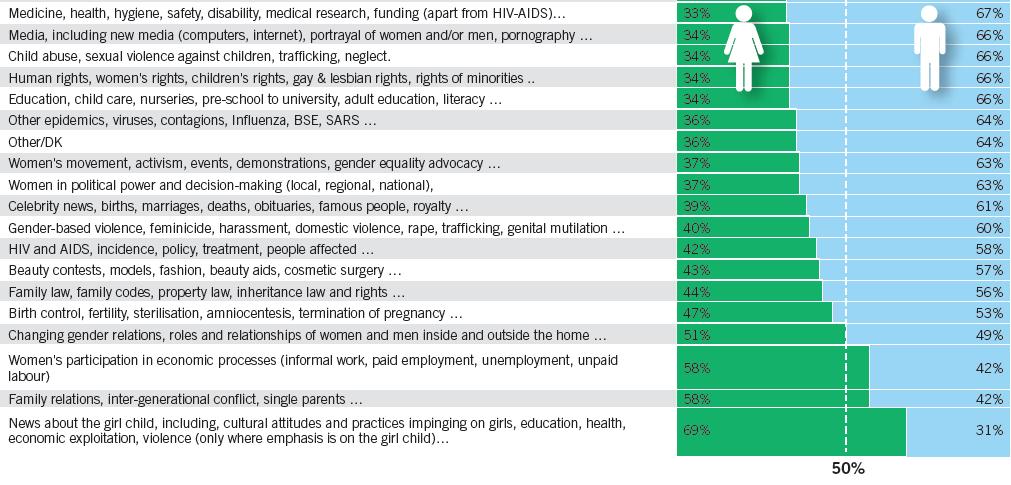
The representation of women as news subjects differs widely by category of news, from 12% of subjects in stories about agriculture to 58% in stories about family relations or single parenting (and 69% in a category they called the “girl-child,” stories about cultural practices impinging on or harming specifically female children, as opposed to children in general):

I’ll put the rest after the jump since there are quite a few images.

more...

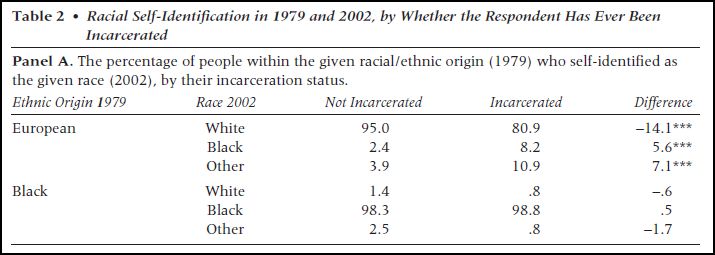
We know that U.S. stereotypes associate black people, especially black men, with criminality (for examples, see our posts on who looks suspicious, racial profiling, and race-sensitive trigger fingers).  But a new study by sociologists Aliya Saperstein and Andrew Penner shows that being convicted of a crime sometimes shifts people’s racial self-perceptions in related directions.  Saperstein and Penner compared the self-identification of people in 1979 and 2002.  Reflecting the social construction of race, it is typical for there to be some mis-matches between people’s reported race at different times; but the researchers discovered that the experience of being incarcerated shaped if and how one’s racial identification changed.

The Table below compares the self-reported race in 1979 (far left column) with the self reported race in 2002 (next left column).  The third and fourth columns show the reported race of people in 2002 who were not incarcerated and incarcerated, respectively.  We see that, among people who were not incarcerated, 5% of the people who identified as “European” in 1979 identified as “Black” or some other race in 2002.  Among people who were incarcerated, however, we see a much greater defection from whiteness; only 81% of those who identified as white in 1979 still did so in 2002.

Saperstein and Penner argue that this shows that “…penal institutions play an important role in racializing Americans…”  The experience of being incarcerated somehow makes people, even people who feel white, feel somehow less white.

Via Contexts Discoveries.  For great examples of the social construction of race, start with this simple lesson, then see these great posts: black and white twins! wha’!?, Obama looks just like his white grandfather, history and race in the U.S. census, claiming whiteness in court, judging racial phenotypes in China, and figuring out “Creole”.

Lisa Wade, PhD is an Associate Professor at Tulane University. She is the author of American Hookup, a book about college sexual culture; a textbook about gender; and a forthcoming introductory text: Terrible Magnificent Sociology. You can follow her on Twitter and Instagram.

Today is the last day of Oktoberfest in Munich; this has meant a lot of slide shows of people drinking from giant beers steins on the wiesn.  I noticed that the slide show at Boston.com included a disproportionate number of images of young women in (often boob-poppin’) Dirndls.  Men were about as likely to be young as they were to be older, exhibiting interesting character, and more likely to be shown in functional roles.  Women, then, were included primarily as eye candy for a (presumably heterosexual and) male gaze.

Five photos of young girls in Dirndls, two photos of young men in Lederhosen, two photos of older men in Lederhosen, one mixed-sex picture of middle- and older-life characters (the only one that includes a picture of a woman who might be over 25), three photos of men at work, and two photos of women at work (including the only photo of a woman who is not dressed up to be conventionally attractive).


For a slide show without the objectification, see Time.

—————————

UPDATE! Alan Taylor, the editor of the slide show at Boston.com, wrote in with some perspective:

Hi there, just a note from the editor of the blog post in question. First, I’m happy to see the discussion here, believe it or not subjects like this are often in mind when compiling my photo stories.

This seems like fair criticism, and I’m not being defensive. What I will offer is last year’s entry for comparison and contrast: http://www.boston.com/bigpicture/2009/09/oktoberfest_2009.html – not nearly as many “boob-poppin’” dirndls there.

As an editor I am limited by the photos available to me, and their quality. In this case, for example, there may have been a decent photograph of an older woman in a strong functional role, but maybe it was poorly lit or repetitive just not up to par, and was left out. I compile entries three times a week on varied subjects that endup being 30 to 40 photos total, starting with anywhere from 100 to 300 to begin with. The selection process is long, subjective, and can certainly be viewed as flawed from many points of view.

If you think the blog is intentionally objectifying, I invite you to look through my archives: http://www.boston.com/bigpicture/2010/09/ and judge for yourself. I can also be reached by email at ataylor@boston.com

Thanks for the discussion,
-Alan Taylor

Lisa Wade, PhD is an Associate Professor at Tulane University. She is the author of American Hookup, a book about college sexual culture; a textbook about gender; and a forthcoming introductory text: Terrible Magnificent Sociology. You can follow her on Twitter and Instagram.

This 23-minute documentary, The Colony, explores Chinese immigration to Senegal. The immigrants are drawn to Africa by the promise of lucrative entrepreneurship and they are changing the economic landscape, to the pleasure and displeasure of locals.

At Al Jazeera.

Lisa Wade, PhD is an Associate Professor at Tulane University. She is the author of American Hookup, a book about college sexual culture; a textbook about gender; and a forthcoming introductory text: Terrible Magnificent Sociology. You can follow her on Twitter and Instagram.

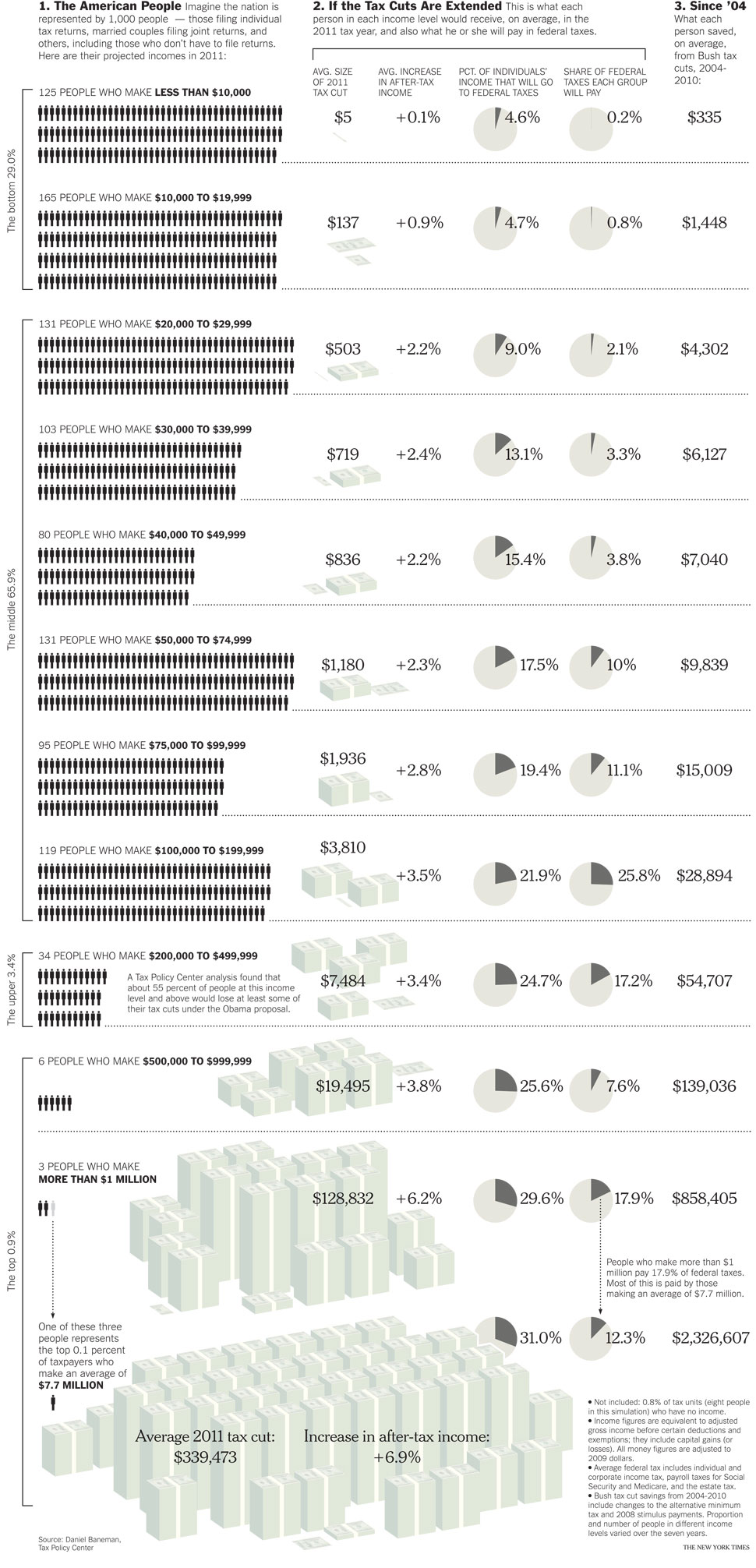
American politicians are currently wrangling over whether to extend the Bush tax cuts of 2001 and 2003. Word on the street is that extending these cuts will cost the U.S. treasury $2.7 trillion over the next ten years.  A graphic from the New York Times shows how much people with different incomes benefited from these tax cuts. If you look at the far right column you’ll see the average number of dollars left in people’s pockets between 2004 and 2010; the dollar amount rises from the poorest 29% of Americans (top with $355) to the richest 1% (bottom with $2,326,607).

Click over for a larger image; via BoingBoing.

—————————

Lisa Wade is a professor of sociology at Occidental College. You can follow her on Twitter and Facebook.

Cross-posted at Jezebel.

Alicia S. sent in an image of the poster for the movie Life as We Know It, featuring Katherine Heigl and Josh Duhamel. Heigl appears to be in her familiar role as responsible, career-oriented, but uptight and ultimately unfulfilled woman who falls for an irresponsible or immature guy. In the movie, the two main characters end up raising a child together after the death of the baby’s parents. The poster pretty much sums up the messages you’re going to get about gender:

Want more? Here’s the trailer:

So women are responsible — they can even get themselves dressed — and nurturing while men are childish boors. Alicia says,

While Heigl is presented as a warm, caring motherly figure, her male costar is likened to a baby: immature and irresponsible, just another child in the family. He reflects the stereotype represented in so many romantic comedies and Monday night sitcoms alike that men are messy, careless, and juvenile.

They’re repeatedly presented as messy, careless, and juvenile…and yet still ultimately get the mature, caring, nurturing, attractive woman.

These stereotypes are offensive to women and men. Women are supposed to settle — to fall in love with the equivalent of a child, and to find that endearing, as opposed to insulting or creepy. That means, of course, she’ll have to be primarily responsible for childcare and running the household, since you can’t trust an immature, careless person to do important things (think of every sitcom or commercial that shows a hapless man messing everything up when he’s left to care for the house on his own).

And men are depicted as ridiculous oafs. I’m always surprised that more men aren’t offended by this representation of manhood: men as incompetent pigs who treat women badly (setting up another date in front of his current one at the beginning of the trailer) who can barely take care of themselves, much less anyone else. Of course, the stereotype does have benefits from those men willing to draw on it: if you are incapable of taking care of children and doing housework without causing a major disaster, you’re relieved from those tasks, or your partner has to fight constantly to get you to do them. So while the gender stereotypes on display here are insulting to both men and women, they reinforce a gendered division of parenting labor that justifies putting the burden of that labor on women rather than men.

At Family Inequality, Philip Cohen argues that the rising cost of higher education may be directly related to the cost of homes. In the figure below, he shows that housing prices and college tuition have risen in tandem, at least until recently:

Cohen doesn’t chalk this up to simple inflation influencing both trends. Instead, he argues…

…the connection between home wealth and college attendance was sometimes direct, as when experts advised parents to use home equity loans to send their kids to college (advice you don’t hear so much these days). But even without home equity loans, the wealth stored in middle-class homes — for most such families their largest asset — underwrote millions of college educations.  I guess you could say the federal policies promoting homeownership were big boons for the higher education industry, not just the GIs and mostly-white suburbanites who landed inside the picket fences.

That is, rising home prices meant that people who could afford those homes could pay more for their children’s college educations.  The price of college, then, could afford to increase without pricing out all those middle- and upper-class families.

Cohen asks for ideas about what will happen now that home prices have dipped and the cost of higher education continues to rise.

Lisa Wade, PhD is an Associate Professor at Tulane University. She is the author of American Hookup, a book about college sexual culture; a textbook about gender; and a forthcoming introductory text: Terrible Magnificent Sociology. You can follow her on Twitter and Instagram.