Search results for The

I’ve argued that the visual aids used in computer programs designed to help us learn new languages are ethnocentric, generic, and uninformative.  Since then, I have been working on an alternative to these images, compiling a database of culturally organized images called the Culturally Authentic Pictorial Lexicon (CAPL).

What strikes me as both a student and a professor of language and culture is that the visual world differs so greatly across cultures and even minor differences are telling in how we organize and perceive our world. Color is one of the easiest ways to find differences in cultures. I have previously discussed the linguistic and cognitive differences of color, but now I want to show some simple examples of color in culture through analysis of various postal systems.

In China, the postal system uses a deep hunter green:

(source)

 In Japan, it is a bright red, much like England.

England:

(source)

Japan:

(source)

 In Germany, it is a bright yellow (think DHL):

(source)

In Russia, it is a lighter but similar shade of the deep postal blue in the U.S.

Russia:
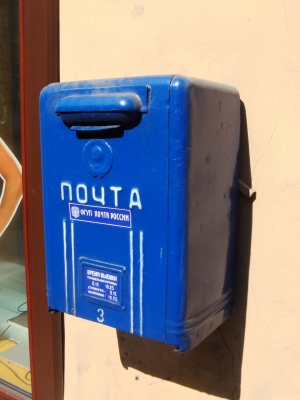
(source)

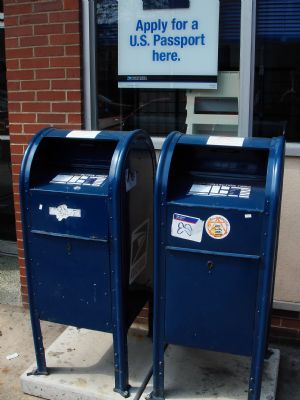
 The U.S.:

(source)

This example of postal systems is an easy way to illustrate how color becomes one of the central ways to communicate and, although the same message is shared across cultures, the path to that message varies through color.

Michael Shaughnessy is an Associate Professor of German and Chair of Modern Languages at Washington & Jefferson College.  In addition to German language, literature, and culture, he has a professional interest in educational technology, especially the authenticity of multimedia imagery.  His book German Pittsburgh (Arcadia Publishing) highlights the contributions of German speaking immigrants to our area.


Feminist Frequency’s Anita Sarkeesian is back with another trope. In this one she covers the “evil demon seductress.” Sarkeesian argues that the trope reproduces the stereotype that women use their sexuality to manipulate men. This encourages us to always view their sexual expression with suspicion such that we deny women authentic sexualities.

Thanks to Anita for linking to our post about the femme fatal praying mantis.

Lisa Wade, PhD is an Associate Professor at Tulane University. She is the author of American Hookup, a book about college sexual culture; a textbook about gender; and a forthcoming introductory text: Terrible Magnificent Sociology. You can follow her on Twitter and Instagram.


Discussing media attention to Donald Trump, Jay Smooth (Ill Doctrine) describes what sociologists call agenda setting.  The phrase refers to the media’s ability to shape what we think about (and what we don’t think about), if not what to think about it.  That is, the media can’t necessarily tell us what to think, but it can certainly keep some issues on-the-agenda while leaving others invisible to us.

In this case, Smooth points out, the media’s coverage of Trump led to public interest in him; that public interest waned as soon as Trump was out of the news.

See also Agenda Setting and Obama’s Socialist Leanings and Media Reaction to Janet Jackson’s “Wardrobe Malfunction.”

Lisa Wade, PhD is an Associate Professor at Tulane University. She is the author of American Hookup, a book about college sexual culture; a textbook about gender; and a forthcoming introductory text: Terrible Magnificent Sociology. You can follow her on Twitter and Instagram.

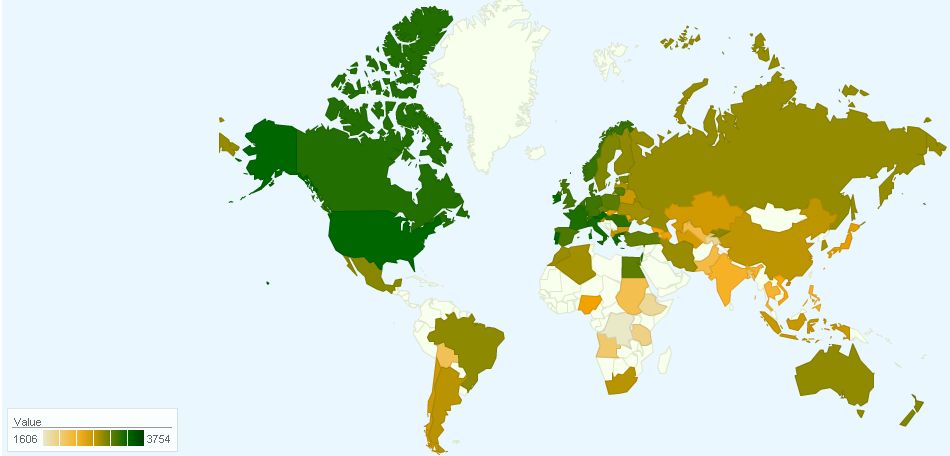
I bumped up against two pieces of information today regarding caloric intake. I can’t confirm either, but I found both quite interesting. First, State Info features a map showing the average number of calories consumed each day in different countries across the globe. In the U.S., for example, the average is 3,754, in Argentina it is 2,959, in China it is 2,940, and in Congo it is 1,606.  Citizens of some countries, then, eat more than twice as many calories as citizens of others.

The fact that the average in almost every country exceeds the 2,000 calorie goal suggested by the U.S. Food and Drug Administration is fascinating in itself.

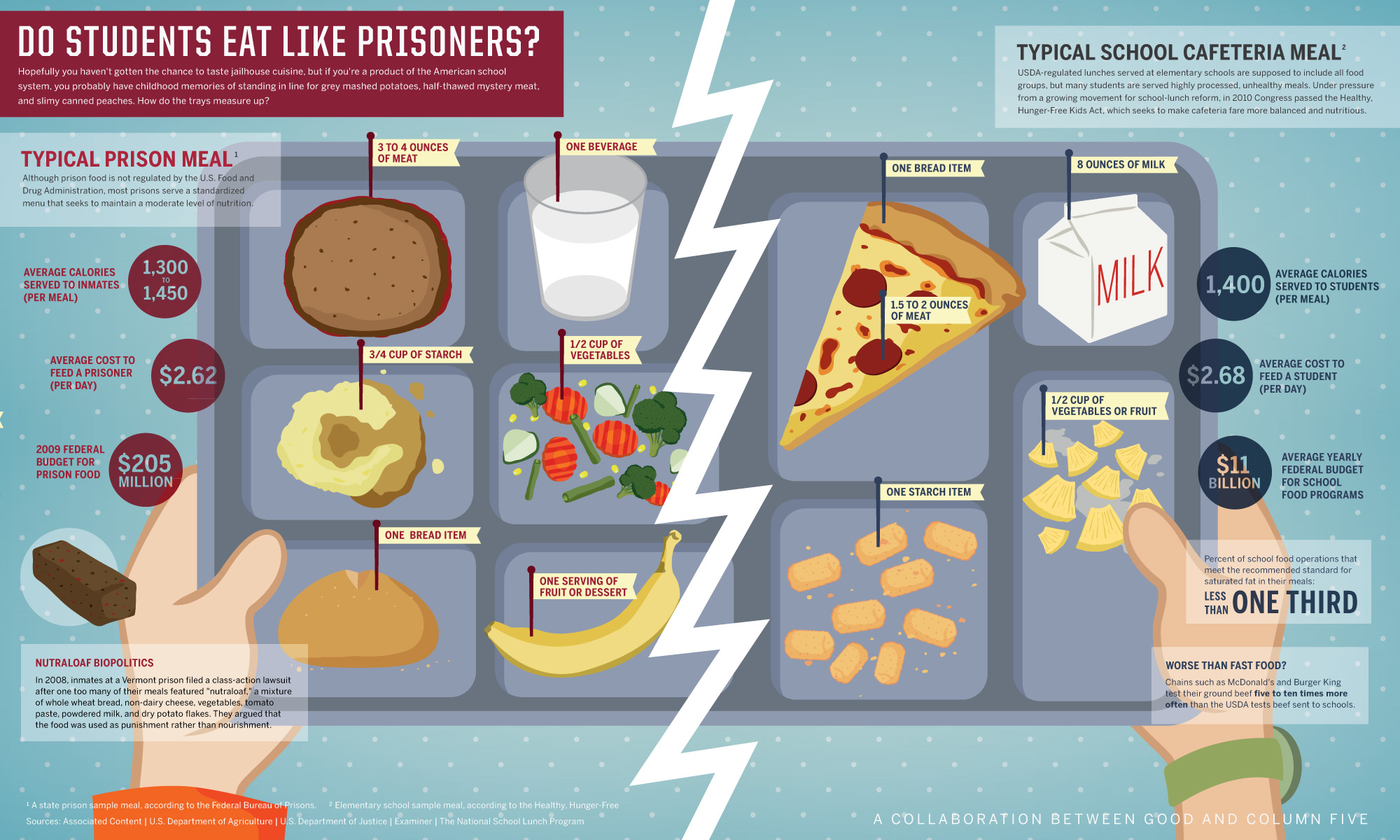
I was surprised at the average number of calories consumed in the U.S., where I live.  But then I came across the second graphic at GOOD which purports to reveal the number of calories and distribution of food types in the average school lunch and prison meal.  The comparison between the two is interesting enough, but I was struck by just how high the numbers were.  An average of 1,400 calories in your typical school lunch may very well indeed translate into over 3,000 calories a day.

Lisa Wade, PhD is an Associate Professor at Tulane University. She is the author of American Hookup, a book about college sexual culture; a textbook about gender; and a forthcoming introductory text: Terrible Magnificent Sociology. You can follow her on Twitter and Instagram.


In this 16-minute video Professor of Political Science Wendy Brown does a clear and concise job of outlining eight frightening changes that privatization will bring to higher education. The talk is part of a six-part “Save the University” teach-in at UC Berkeley.

Via John McMahon at Facile Gestures.

Lisa Wade, PhD is an Associate Professor at Tulane University. She is the author of American Hookup, a book about college sexual culture; a textbook about gender; and a forthcoming introductory text: Terrible Magnificent Sociology. You can follow her on Twitter and Instagram.


In this 11 minute animated talk, Matthew Taylor argues that scientific study of humans in the tradition of the Enlightenment has taught us, ironically, that Enlightenment values alone cannot be trusted to usher humanity into a better future.

Lisa Wade, PhD is an Associate Professor at Tulane University. She is the author of American Hookup, a book about college sexual culture; a textbook about gender; and a forthcoming introductory text: Terrible Magnificent Sociology. You can follow her on Twitter and Instagram.


I know a Googler.  Never to let a fleeting inquiry go unGoogled, he recently wondered who was the voice of Hulu.  It turns out to be a man named Dave Fennoy.  Fennoy is a wildly successful voice actor, doing work for McDonalds, KFC, and Chrysler.  He’s also black.  In the 1-1/2 minute clip below, he talks about being teased as a kid for “talk[ing] like a white boy” and how this caused him “identity problems.”  Later he attended Howard University, where he re-thought what it meant to be black, rejecting the idea that he was supposed to talk in any which way. He doesn’t talk about how his success in The Industry (as we call it in Los Angeles) is related to his sound, though I wish he had:

—————————

Lisa Wade is a professor of sociology at Occidental College. You can follow her on Twitter and Facebook.

Cross-posted at OWNI.


Our BoingBoing friend, Cory Doctorow, has a great Ted Talk in which he gives an inspired and radical solution to the lack of privacy on the internet. To begin, he notes that Facebook, as just one example, doesn’t just allow, but incites disclosure by rewarding it, but only intermittently (a la B.F. Skinner and the Skinner box).

Meanwhile, parents try to protect children from disclosure and exposure with surveillance tools that block and report content.  This, Doctorow argues provocatively, only trains kids to accept surveillance as normal and unproblematic.  Instead of spying on our kids, he suggests, we should be teaching them to manipulate and avert involuntary disclosure, such that they grow up learning to question instead of accept the use and abuse of their personal information.

Lisa Wade, PhD is an Associate Professor at Tulane University. She is the author of American Hookup, a book about college sexual culture; a textbook about gender; and a forthcoming introductory text: Terrible Magnificent Sociology. You can follow her on Twitter and Instagram.