Search results for The

Cross-posted at Jezebel.

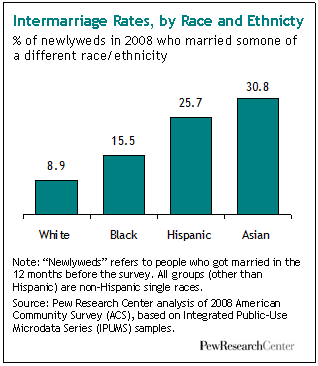
Drawing on data from the Pew Research Center, I recently wrote a post showing that inter-racial and -ethnic marriages are on the rise.  Not all groups, however, intermarry at the same rate.  Asians are more likely than Hispanics, Blacks, and Whites to marry someone of a different race or ethnicity.  Whites are the least likely to do so:
Gender matters too.  Whereas White and Hispanic men and women tend to outmarry at about the same rate, the outmarriage rates for Blacks and Asians are dramatically different.
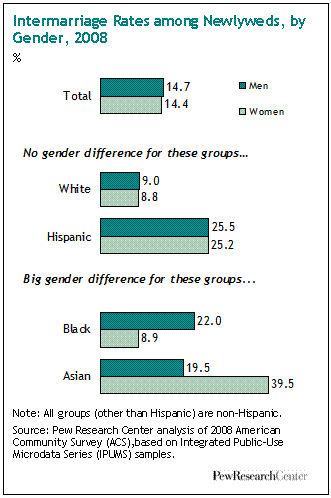
The gendered rates of outmarriage likely reflect the way in which we gender race and racialize gender.  I’ve written about this in a previous post:

Consider: according to American cultural stereotypes, black people, both men and women, are more masculine than white people. Black men are seen as, somehow, more masculine than white men: they are, stereotypically, more aggressive, more violent, larger, more sexual, and more athletic. Black women, too, as seen as more masculine than white women: they are louder, bossier, more opinionated and, like men, more sexual and more athletic.

Likewise, Asian people are feminized.  Both Asian men and women are seen as somehow smaller, more passive, the women sweeter, the men less virile.

These are cultural stereotypes derived from the particular history of the U.S.  White elites masculinized Black women in order to justify their hard labor during slavery.  The idea that Black men were hypermasculine emerged after emancipation; the idea that Black men were sexually-vicious brutes was used by some Whites to terrorize Black men into continued subservience.

Asians were feminized after the completion of the transcontinental railroad.  The Chinese immigrants who had labored on the railroad, now out of work, found niches in feminized occupations in the mostly-lady-free American West.  They became cooks, tailors, and launderers, and domestic servants.  The gendered nature of their work contributed to their feminization.

So, race and gender intersect in history, and today, in ways that shape sexual desire and supposed romantic compatibility.  If men are supposed to be sexy by virtue of their masculinity and women sexy by virtue of their femininity, then Black men and Asian women will be seen as more sexually attractive, and as more ideal marital partners, than Asian men and Black women.

Lisa Wade, PhD is an Associate Professor at Tulane University. She is the author of American Hookup, a book about college sexual culture; a textbook about gender; and a forthcoming introductory text: Terrible Magnificent Sociology. You can follow her on Twitter and Instagram.
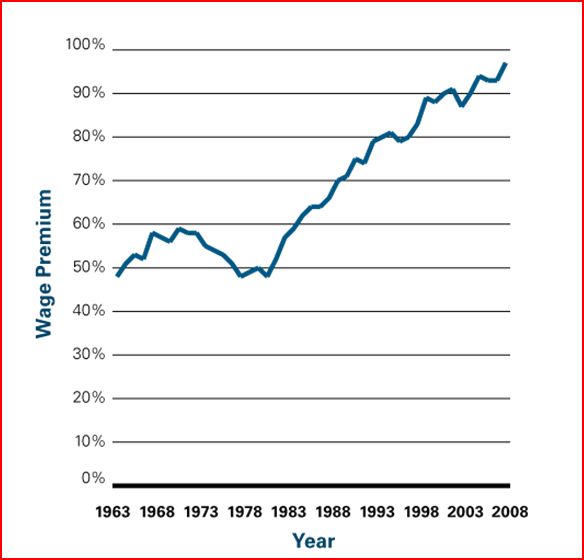
If you are privileged enough to be graduating from college this season, know that your degree translates into a higher degree of privilege now than at any time in the past.  In fact, graduates today will out earn non-graduates by nearly 100%, a number that has doubled in the last 50 years or so.

Chart borrowed from Made in America.

Lisa Wade, PhD is an Associate Professor at Tulane University. She is the author of American Hookup, a book about college sexual culture; a textbook about gender; and a forthcoming introductory text: Terrible Magnificent Sociology. You can follow her on Twitter and Instagram.
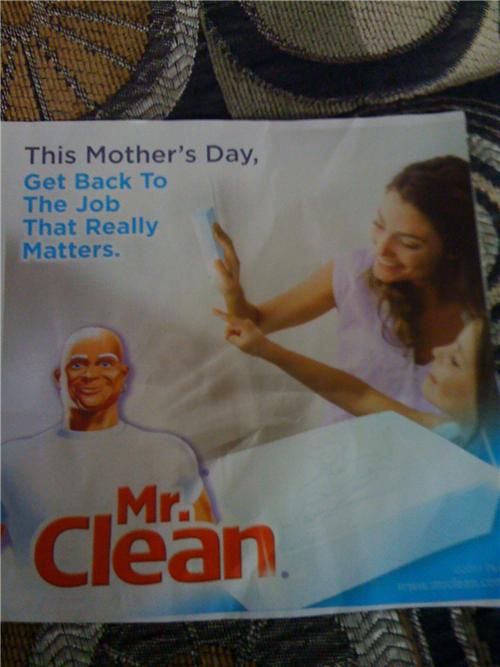
Chana M. sent in a Mother’s-Day-themed ad for Mr. Clean, found at The Daily What:

A couple of commenters at The Daily What have suggested that the ad was meant to imply that Mr. Clean lets you get done with housework faster so you can spend time with your kid, and not that the cleaning itself is what “really matters.” Let’s all hope so.

Leaving the meaning aside, notice how excited the kid is to point out something that needs scrubbing with the magical Mr. Clean bar. Clearly, part of the “job that really matters” is socializing girls into the gendered division of household labor, and to take joy in housework. Cleaning is awesome, and cleaning products are your friends! Happy Mother’s Day to all!

Stephen W. sent in this clip of an Iowa news story about interspecies mothering. Always cute, of course. But the narration towards the end contributes to the social construction of mothers as born-to-nurture-and-nurture-only.

The narrator asks: “Why would an animal show such grace?”  And the answer is “obvious.”  He continues:

For most mothers, it’s just what they do. An instinct so deeply wired into them, that often all they know is to love and care for life.

So “most” mothers “just” mother.  They do so instinctively.  “All they know” is mothering.  In fact, hang onto your kiddies people because they might just mother your kids too!

Interesting how this narrative leaves invisible all of the female animals that kill and eat other animals, including other animals’ babies.

Lisa Wade, PhD is an Associate Professor at Tulane University. She is the author of American Hookup, a book about college sexual culture; a textbook about gender; and a forthcoming introductory text: Terrible Magnificent Sociology. You can follow her on Twitter and Instagram.

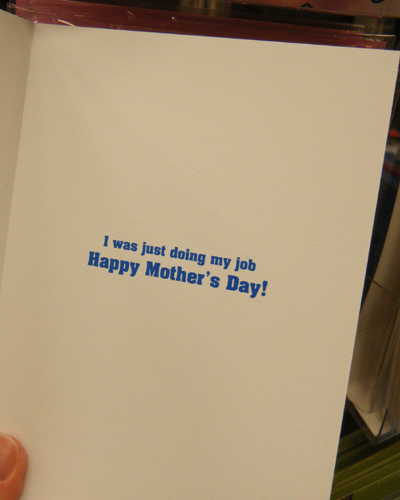
Christine B. sent along this Mother’s Day card:

It captures the normative idea that boys are naturally naughty (“I was just doing my job”).  It also normalizes the notion that moms will be driven crazy by their sons, but accept their misbehavior as inevitable, even lovable.

(By the way, I know I can’t see the child’s face; it could be a girl.  Reading the cues — short hair, blue and green colors — and the cultural context, I figure it’s supposed to be a boy.)

Lisa Wade, PhD is an Associate Professor at Tulane University. She is the author of American Hookup, a book about college sexual culture; a textbook about gender; and a forthcoming introductory text: Terrible Magnificent Sociology. You can follow her on Twitter and Instagram.
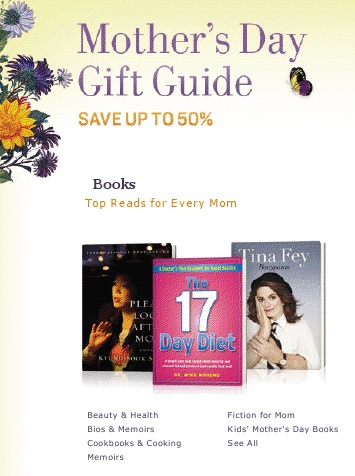
Meems, who blogs at The Inbetweenie, recently received an email from Barnes & Noble with suggested books for Mother’s Day gifts. She was distressed to notice that the most prominently-placed book, listed under the “top reads for every mom” category, was a diet book:

Yes, a diet book is an appropriate gift for every mother.

Meems says she can’t imagine giving her mother a dieting book for Mother’s Day. I have had the misfortune to witness this type of gift-giving, since my mom gained a significant amount of weight when she was pregnant with my two sisters and never lost it. She didn’t like the way she looked and was often trying out various diets or exercise routines. And every so often someone would give her a weight-loss-related gift for her birthday or Christmas. I presume they thought they were being nice — she’s always on diets and wants to lose weight, why not give her something to help? But she found it incredibly embarrassing, since it reinforced that other people agreed that her weight was unacceptable and meant her weight often became the subject of open discussion among everyone there. It also meant if she tried whatever it was and didn’t lose a lot of weight, she had the normal feelings of failure plus the fear that the person who gave her the gift would be disappointed in her.

Weight-loss related items are, generally, problematic gift ideas. They put the recipient into the position of having to acknowledge in front of anyone watching them open the gift that their weight is considered unacceptable, and that the person giving the gift agrees with that. Even if a person wants to lose weight and is actively trying to do so, they may not wish to have their weight brought up unexpectedly and opened up for public discussion.

If you are stumped on what to get your mother for Mother’s Day (assuming you get anything at all), if my own upbringing is any guide I can tell you with absolute certainty that moms love receiving a pet goat for Mother’s Day.*

* Soc Images does not actually advocate giving live animals as surprise gifts.

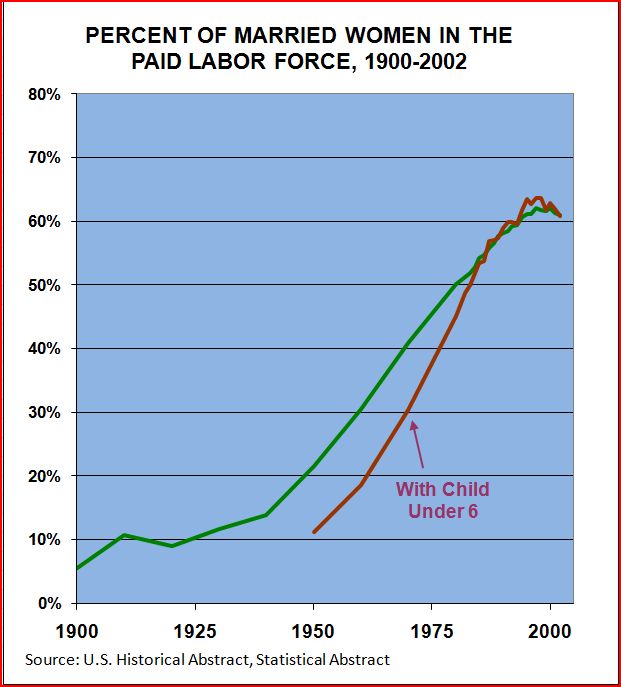
Claude Fischer, at Made in America, argues that the biggest change of the last 50 years is the increase in the number of mothers in the workforce.  From the beginning of last century till now, that rate has accelerated precipitously:

While some women have always worked (at unpaid housework and childcare, selling goods made at home, or in paid jobs), most women now work outside of the home for pay.  So long “traditional” family.  Why the change?  Fischer explains:

First, work changed to offer more jobs to women. Farming declined sharply; industrial jobs peaked and then declined. Brawn became less important; precise skills, learning, and personal service became more important. The new economy generated millions of white-collar and “pink-collar” jobs that seemed “suited” to women. That cannot be the full story, of course; women also took over many jobs that had once been men’s, such as teaching and secretarial work.

Second, mothers responded to those job opportunities. Some took jobs because the extra income could help families buy cars, homes, furnishings, and so on. Some took jobs because the family needed their income to make up for husbands’ stagnating wages (a noteworthy trend after the 1970s). And some took jobs because they sought personal fulfillment in the world of work.

And married working mothers changed the economy as well.  Once it became commonplace for families to have two incomes, houses, cars, and other goods could be more expensive.  Things women had done for free — everything from making soap and clothes, to growing and preparing food, and cleaning one’s own home — could be commodified.  Commodification, the process of newly buying and selling something that had not previously been bought and sold, made for even more jobs, and more workers, and so the story continues…

Lisa Wade, PhD is an Associate Professor at Tulane University. She is the author of American Hookup, a book about college sexual culture; a textbook about gender; and a forthcoming introductory text: Terrible Magnificent Sociology. You can follow her on Twitter and Instagram.

I saw this commercial at least a dozen times before I noticed the erasure of any clue that the man’s wife had a career or anything at all to do with herself, other than follow her man. After all, if my partner up and moved to Istanbul, I could just up and go. Couldn’t all wives? What’s the chance that we’re doing anything important, after all?

Lisa Wade, PhD is an Associate Professor at Tulane University. She is the author of American Hookup, a book about college sexual culture; a textbook about gender; and a forthcoming introductory text: Terrible Magnificent Sociology. You can follow her on Twitter and Instagram.