Search results for The

Melissa H.J., Lizzy F., Dmitriy T.M., Kari B., Kalani R., Lisa C., and Anna C. all sent us links about the recent blog post at Psychology Today that many of you have probably already heard about, since it caused quite the outcry. The article, by evolutionary psychologist Satoshi Kanazawa, apparently went through multiple title revisions, starting out as “Black Women Are Ugly,” changing to “Why Are Black Women Less Physically Attractive Than Other Women?”, and eventually becoming “Why Are Black Women Rated Less Physically Attractive Than Other Women, But Black Men Are Rated Better Looking Than Other Men?”, before being removed from the Psychology Today website altogether. However, as we know, nothing on the internet is ever really gone, and images of the original post are widely available. I’m using one from BuzzFeed.

Kanazawa apparently specializes in claiming that there are clear, definite, “objective” differences in attractiveness (and also intelligence, and also everything else important) between different races. Also, you can tell who is a criminal and who isn’t just by the way they look (an article illustrated with an image of O.J. Simpson) and, as an added bonus, “virtually all ‘stereotypes’ are empirically true”. We know this is objective because there are graph-y science things, with numbers:

To summarize his point: Women are more attractive than men. And when one of his Add Health interviewers measures a study participant’s attractiveness on a 5-point scale, this is “objective.”  Because they are researchers, and therefore anything they say is objective. And according to objective measurements, Black women aren’t attractive at all. In fact, they’re “far less attractive” than other groups of women. See?
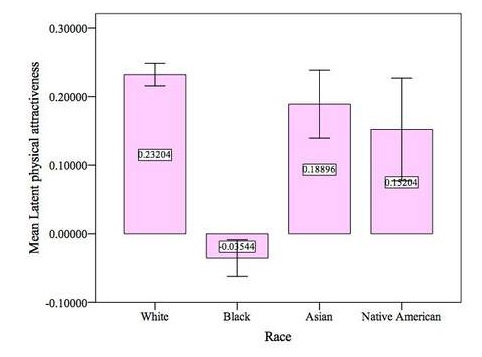
It turns out White women are most attractive. Man! Who would have thought?

There are a lot of other gems, such as the fact that Black women, though objectively less attractive, bizarrely rate themselves subjectively more attractive. It’s like they don’t know they’re ugly!

I’m sick of this article and will leave it to you to click over and read the whole thing if you feel so inclined. Let’s just summarize some of the major issues, and then all move on with our lives:

First, he treats race like a real, biological, meaningful entity. But race is socially constructed; there is no clear biological dividing line that would allow us to put every person on the planet into racial categories, since societies differ in the racial categories they recognize and “race” doesn’t map along unique sets of genes — there is more genetic variation among members of a so-called race as there are between members of different races.

Aside from that, the idea of measuring beauty objectively, completely separated from all cultural influence, is problematic, especially when you start looking at differences by race/ethnicity. In The Beauty Bias: The Injustice of Appearance in Life and Law, Deborah Rhode discusses how perceptions of attractiveness have varied over time and across cultures and discusses the global history of slavery, colonialism, and race-based systems of domination that make it impossible to separate out our perceptions of what is beautiful and sexually appealing from historical ideologies that insisted that non-White peoples were unattractive (unless in an exotic way, when that was useful, and also, the Irish were hideous despite being European). Joane Nagel’s book Race, Ethnicity, and Sexuality: Intimate Intersection, Forbidden Frontiers is another good source on this topic.

It is simply impossible to separate out even scientists’ ratings of attractiveness from the cultural context, one in which supposedly “Caucasian” features and light skin are repeatedly held up as the ideal of attractiveness (so even famous non-White people often find themselves lightened in media images) while dark skinned people are constructed as unattractive or even scary.

Given that history, it’s not shocking that White women would be rated most attractive and Black women least. What’s shocking is that a scholar at the London School of Economics would think you could uncritically accept those rankings as proof of objective reality, rather than the outcome of constant, long-standing cultural messages about attractiveness that resulted from efforts to legitimize and justify social and political inequalities.

UPDATE: Reader JA provided a link to another post at Psychology Today in which researchers looked at the data Kanazawa used and question his analysis and results.

UPDATE 2: The comments section has largely devolved into a flame war with lots of insults flying around, so I’m closing comments since I won’t be around to moderate them for the next week. I will go in and clean out the comments threads when I get a chance.

Esther C., Erin R., and Scott P. sent in an interesting video, “Sexy Girls Have It Easy,” showing woman testing how her physical appearance affects whether she can get free things. She asks for a number of free things — ice cream, baked goods, a cab ride, carousel rides, and so on — while dressed in two ways to see if she is treated differently when she conforms more closely to standards of feminine beauty:

Documentary : Sexy Girls Have It Easy from Examples of Film & TV work on Vimeo.

It’s a non-scientific test, obviously, since she doesn’t ask the exact same people for free things dressed each way. Some commenters at Vimeo argue that she acts more confident and positive when she’s dressed up, and thus people are reacting to her attitude, not her appearance. Yet, even if this is true, we can’t necessarily separate our perceptions of someone’s confidence from their appearance, which may influence whether we interpret behavior as “confident” or as “pushy.”

Thoughts?

While the last fifty years have been characterized by increasing freedoms for women, this has not been true for men to the same degree.  Women have entered masculine arenas throughout society, from where they work to what they wear, but men have not been freed to pursue feminine interests.  Men still face teasing, ridicule, stigma, or even violence for daring to do “girly” things.  Being a dancer or an elementary school teacher comes with raised eyebrows, askew glances, and questions as to one’s sexual orientation; enjoying “chick flicks” or preferring Cosmos to Coronas likely attracts teasing; and wearing a dress or high heels is essentially tolerated only on Halloween.

So girly things are still a no man’s land.

Unless.

Unless a very high status man — a man whose masculinity is undeniable, a leader among men — explores that land and plants a man flag.  If a man is so manly as to have begun to define manliness itself, then that man can change the very definition, thereby de-feminizing, and therefore de-stigmatizing an activity.  What once would have been cause for ridicule suddenly becomes unremarkable, i.e., man-approved.

Marco Roso, of DIS Magazine, sent me an example of such a transformation: the alice band.  Known to Americans as headbands,” an alice band is a loop or horseshoe-shaped hair accessory designed to push hair back away from the face.  It is a distinctly feminine accessory.  Or at least it was.  European footballers have begun wearing them to keep their hair back while playing.  While  a man lower on the masculine social hierarchy may have been teased relentlessly for donning such a girl-associated item, these high-status, wildly-admired men seem to be changing the social construction of the alice band.

Lisa Wade, PhD is an Associate Professor at Tulane University. She is the author of American Hookup, a book about college sexual culture; a textbook about gender; and a forthcoming introductory text: Terrible Magnificent Sociology. You can follow her on Twitter and Instagram.

Poet and musician Gil Scott-Heron died Friday. I thought you might enjoy this video, sent to me by my friend Pete, of clips from YouTube set to Scott-Heron’s most famous piece, “The Revolution Will Not Be Televised”:

NOTE: For the record, reader Azizi believes that this video, and my posting of it, trivializes Scott-Heron’s point. Azizi points us to an interview with Scott-Herson posted at Racialicious.

I have posted before about the ways those who handle the dead may try to humanize themselves so as to avoid the stigmas often associated with their jobs. Individuals who have jobs that require them to touch or be around dead bodies often find they are negatively stereotyped as creepy, gross, or as taking advantage of families in times of pain. They engage in various strategies to try to resist those stereotypes, including redefining the job and attempting to present it as something valuable and respectable (a “funeral director,” after all, sounds much nicer and more professional that “undertaker” or “mortician”).

In my previous post I discussed the Men of Mortuaries calendar, which presented shirtless male funeral directors in hunky poses. Now we have an example of women doing something similar. Christie W. sent in a link to the Funeral Divas website, which clearly tries to present women working in the funeral industry in a positive light:

From the site’s homepage:

A Funeral Diva is a strong, confident and successful woman who works in the funeral industry. She is not ashamed of her career! She is proud to serve hurting families!

So here, women who work in the funeral industry are hip, fun, successful career women — not creepy people who like being around dead bodies, and not individuals who profit from families’ grief.

Of course, in addition to presenting female funeral directors positively, the site also attempts to support women working in a field that has been male-dominated since preparing and burying our dead moved from an informal family activity to a formal business. However, women’s presence in this industry is growing. In 2008, the New York Times reported that women made up 35% of mortuary school students in 1995, while in 2007 60% were female; at some schools women make up nearly 75% of the student body. Interestingly, the article focuses on how the funeral industry has changed to include more concern for handling grieving individuals and, thus, the increased need for “the caring factor” — which presumably makes women seem like a better fit for the job, as they are assumed to be for other types of jobs that require lots of nurturing and emotional work.

Despite this, an article in the Christian Science Monitor discusses the barriers women in the industry continue to face. This year, New York’s Attorney General filed a lawsuit against one mortuary school, the Simmons Institute of Funeral Services, and its CEO, alleging repeated sexual harassment of female student and discrimination against pregnant women, a violation of Title IX.

So women in the funeral industry have to contend with the general negative stigma associated with their job, as well as the usual issues faced by women entering a previously male-dominated field. Funeral Divas is an interesting attempt to address both of these sets of problems at once.

Trigger warning for those sensitive to war, suicide, domestic violence, or people suffering from war-related ptsd.

Generations of U.S. children have played with the iconic little green army men.  Along with other war toys, they contribute to the socialization of some young boys into the idea that war is an exciting and heroic adventure.

(source)

An artist at the Dorothy Collective decided to reconfigure the little green army men so that they would tell the less glamorous stories.  Inspired by an article about the suffering of a Colorado Springs-based battalion, she created these little green army men:

They’re a heart-wrenching commentary about the grown up realities of war and the socialization of children into the fantasy.  Thanks to Hope H. for the tip.

Lisa Wade, PhD is an Associate Professor at Tulane University. She is the author of American Hookup, a book about college sexual culture; a textbook about gender; and a forthcoming introductory text: Terrible Magnificent Sociology. You can follow her on Twitter and Instagram.

Earlier this month, The New York Times and Foreign Policy both reported on the United Nations population forecast for the next 100 years. According to the report, rather than hitting 9 billion at mid-century and then leveling off, the world’s population is likely to climb to 10 million and keep going. The cause: a fertility boom in the global south –– Africa, Asia, Latin America. Such growth, according to the report, if unchecked, will have dire consequences on a world already facing shortages of food, available water and other life-giving resources.

In reporting the story, both the Times and Foreign Policy used pictures of women and their children, but the way they used the pictures was somewhat chilling. For example, the Times ran a photo of several women of color under the heading: “Coming to a Planet Near You: 3 Billion More Mouths to Feed.”

Additionally, Foreign Policy ran a photo under the sub-headline: “Why ignoring family planning overseas was the worst foreign-policy mistake of the century.” It featured a picture of dark-skinned women with a child.

These photos, paired with the headlines and the dire predictions in the stories of what’s to come should the global south’s fertility boom remain unchecked, tap into anxieties about women’s bodies and link the coming doom and gloom directly to them. The Times headline, warning of “3 billion more mouths to feed,” is combined with seven new mothers in Manila; positioned in a long row, they crowd the frame of the photograph as they are imagined to crowd the planet.  While the Foreign Policy sub-headline inspires fear, saying that allowing the burgeoning birth rate was  the “worst… mistake of the century.”  Its photo features two women and a child in the foreground.  In both cases the focus on women makes it seem as if men have no role in reproduction at all.

Whether they meant it or not, such a juxtaposition does little more than demonize women –– particularly poor women from developing countries –– as directly responsible for the problem of overpopulation and its solution. While the commentaries herald funding for family planning and education –- both great ideas –– they contain no conversation about economic systems that create or maintain poverty in certain parts of the world; how patriarchy and systems of male-centered power prevent women from being able to control their own reproduction; and how international development money too often comes with strings attached that restrict government resources for education and health care, especially for women, who too often are the ones who bear the hardest brunt of poverty and the greatest social opprobrium.

Here’s what an alternative might look like:  GOOD Magazine discussed the U.N. report and the coming population boom. Its focus: How responsible living in the United States and other wealthy countries can help ensure food for all. The photo that ran with the commentary: a photo of the planet Earth.

Barbara Yuki Schwartz is a doctoral student in the Theology, History and Ethics program at Garrett-Evangelical Theological Seminary in Evanston, Ill.  She studies postcolonial and poststruturalist theory, political theory and theology, trauma studies, and is interested in how body, community and psychic life intersect and influence theology and liturgy. She blogs regularly at Dialogic Magazine.

Cross-posted at Jezebel and AOL’s Black Voices.

In a new book called “The Protest Psychosis: How Schizophrenia became a Black Disease,” psychiatrist and cultural critic Jonathan Metzl draws on a variety of sources — patient records, psychiatric studies, racialized drug advertisements, and popular metaphors for madness — to contend that schizophrenia transformed from being a mostly white, middle-class affliction in the 1950s, to one that identified with blackness, volatility, and civil strife at the height of the Civil Rights movement.

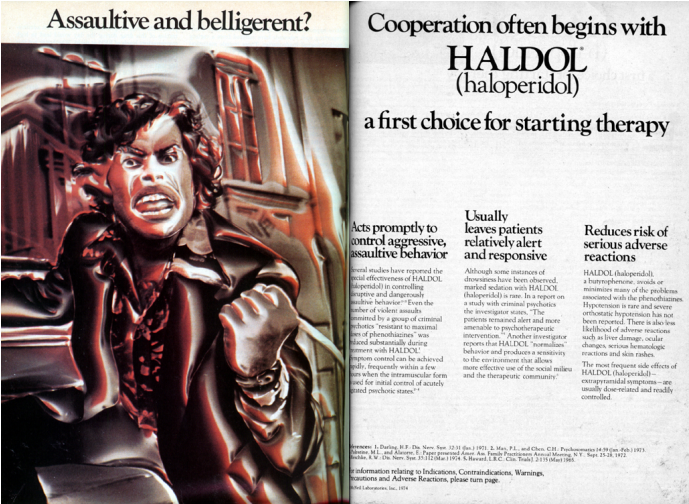
The racialized resonance between emerging definitions of schizophrenia and anxieties about black protest seem clear in pharmaceutical advertisements and essays appearing in leading American psychiatric journals during the 1960s and 70s.  For instance, the advertisement for the major tranquilizer Haldol that ran in the Archives of General Psychiatry shows an angry, hostile African American man with a clenched, inverted, Black Power fist.

The deranged black figure literally shakes his fist at the assumed physician viewer, while in the background a burning, urban landscape appears to directly reference the type of civil strive that alarmed many in the “establishment” at that time.  The ad compels psychiatrists to conflate black anger as a form of threatening psychosis and mental illness.  Indeed the ad seems to play off presumed fears of assaultive and belligerent black men.

As the urban background suggests, this fear extended beyond individual safety to social unrest.  In a 1969 essay titled “The Protest Psychosis,” after which Metzl’s book is named, psychiatrists postulated that the growing racial disharmony in the US at the height of the Civil Rights Movement, reflected a new manifestation of psychotic behaviors and delusions afflicting America’s black lower class.  Accordingly, “paranoid delusions that one is being constantly victimized” drew some men to fixate on misguided ventures to overthrow the establishment.  Luckily, pharmaceutical companies proposed that chemical interventions could directly pacify the masculinzed, black threat depicted in advertisements like the above.  “Assaultive and belligerent?” it asks.  “Cooperation often begins with Haldol.”

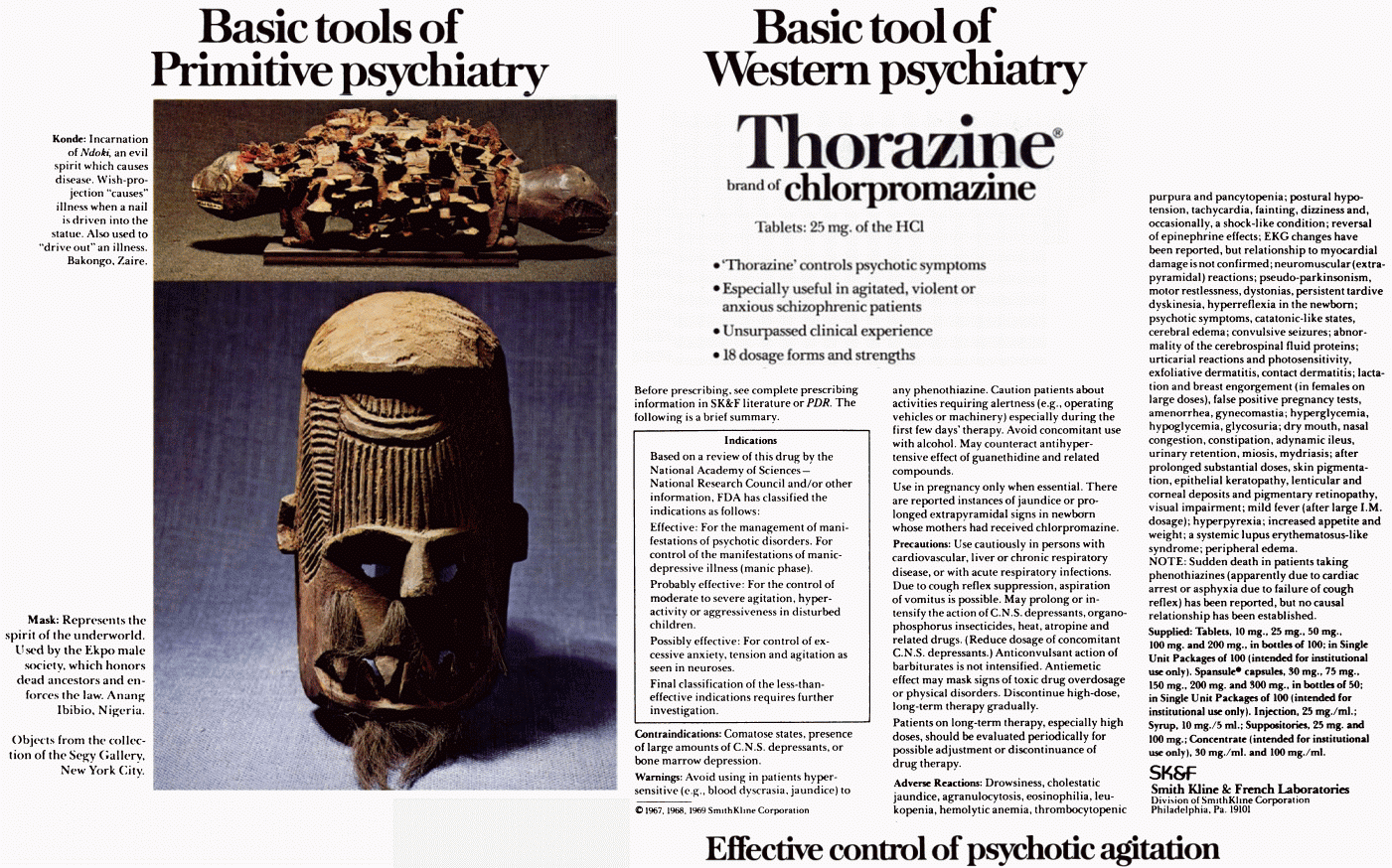
Moreover, ads for Thorazine and Stelazine during this period often conjured up images of the “unruly” and “primitive” precisely at a time when the demographic composition of this diagnosis was dramatically shifting from a mostly white clientele, to a group of predominately black, confined, mental patients.  It is telling that within this context, the makers of Thorazine would choose to portray the drug’s supposed specificity to schizophrenia in their advertisements by displaying a variety of war staffs, walking sticks, and other phallic artifacts from African descent.

The below ad for Thorazine, for example, exclaims western medicine’s superiority in treating mental illness with modern pharmaceuticals, by contrasting the primitive tools used by less enlightened cultures.

Notably, these claims of superiority and medical efficacy drew from a particular set of pejorative ideas of the “primitive” that were already well established within some sectors of psychiatry that equated mental illness with primitive, animalistic and regressive impulses.   As Metzl contends in his book:

…pharmaceutical advertisements shamelessly called on these long-held racist tropes to promote the message that social “problems” raised by angry black men could be treated at the clinical level, with antipsychotic medications.

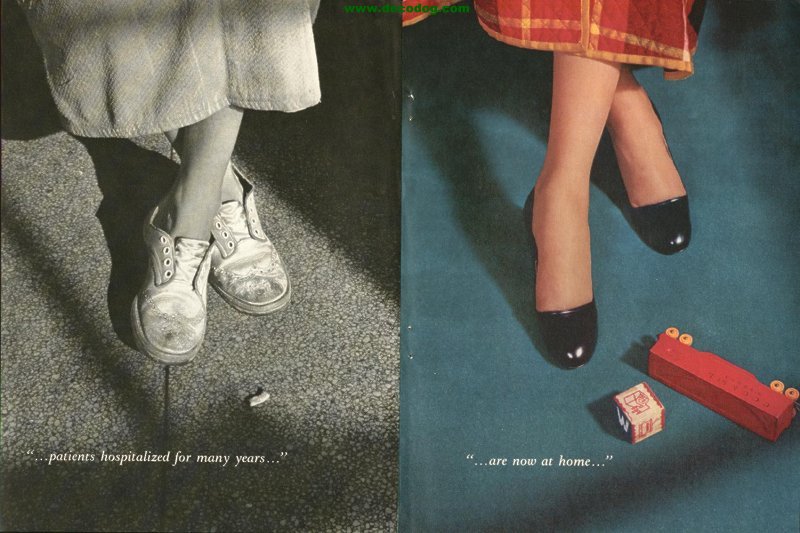
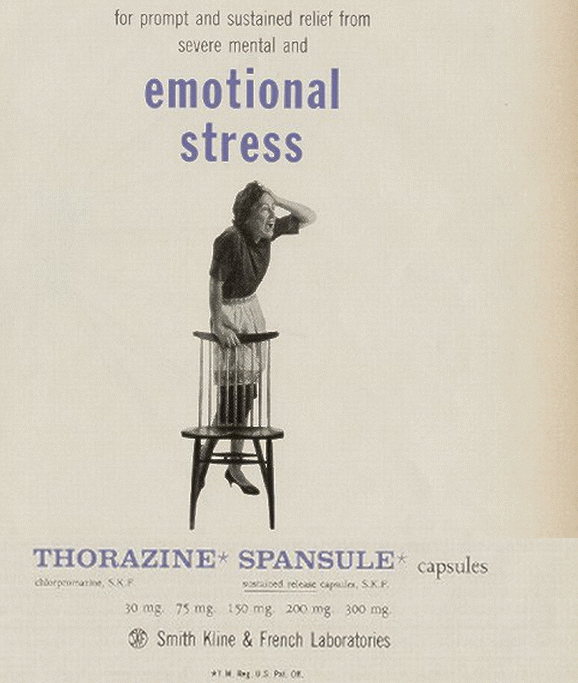
These adds are in sharp contrast to previous marketing campaigns that framed schizophrenia in the 1950s as a mental condition affecting mostly middle class patients, and especially women.  Also shown below, ideas of schizophrenia were at that time an amorphous collection of psychotic and neurotic symptoms that were thought to afflict many women who struggled to accept the routines of domesticity.

While schizophrenia is certainly a real, frightening, debilitating disease, Metzl reminds us that cultural assumptions of the “other” shape how psychiatry understands and treats the condition.

————————

Arturo Baiocchi is a doctoral student in Minnesota interested in issues of mental health, race, and inequality.  He is writing his dissertation on how young adults leaving the foster care system understand their mental health needs.  He is also a frequent contributor to various Society Pages podcasts and wanted to post something related to a recent interview he did about the racialization of mental illness.

If you would like to write a post for Sociological Images, please see our Guidelines for Guest Bloggers.