Search results for The

Cross-posted at Montclair SocioBlog.

People who design men’s rooms seem to have the working assumption that men are sexist pigs.  Those urinals that seem to mimic sex (in Lisa’s pimp-my-urinal post here) illustrate the sexist part – ideas that are important mostly outside the men’s room.  But inside the men’s room, it’s the pig half of the phrase that’s important.  Men can be slobs, especially at the urinal.

At airports, for example, jet lagged travelers, men at least, tended to be, how shall we put it, careless? aimless?

What to do?

Americans tend to frame problems in moralistic terms. If something is wrong, drug use for example, punish the wrongdoers.  And if that doesn’t work, make the penalties even harsher.  Applied to the problem of spillage and splash in the men’s room, we might expect to see signs warning: “No Spillage or Spraying.  Penalty up to $500 fine.”

The Dutch have a more practical approach, more focused on solving a problem than on punishing evil.  The Dutch also have a reputation for cleanliness.  Years ago, when the men’s rooms at the Amsterdam airport were looking and smelling like, well, like men’s rooms, Schilpol Schiphol, the company that runs the Amsterdam airport, looked into the problem. And the problem was  that most men weren’t looking.  They simply didn’t watch where they were going.  So Schiphol came up with a simple and non-punitive solution: a fly to draw the user’s attention.

Flickr creative commons Vincent Lau.

The idea was that men would aim for the fly – the stream would go from one fly to another (I’m sure this pun doesn’t work in Dutch) – and the men’s room would stay cleaner.

It worked.  A study by Schiphol’s social science team found that fly urinals had an 80% reduction in spillage.  Some years after that, JFK hired Schiphol to run the International Arrivals Building there.  So now at JFK too, the urinals have the target flies.  At the Newark airport, I saw urinals with a cartoon-like bee (a realistic bee might have might have triggered a counterproductive startle and flinch).

More recently, urinal targets have gotten even more playful.  For the Europeans, there’s soccer.
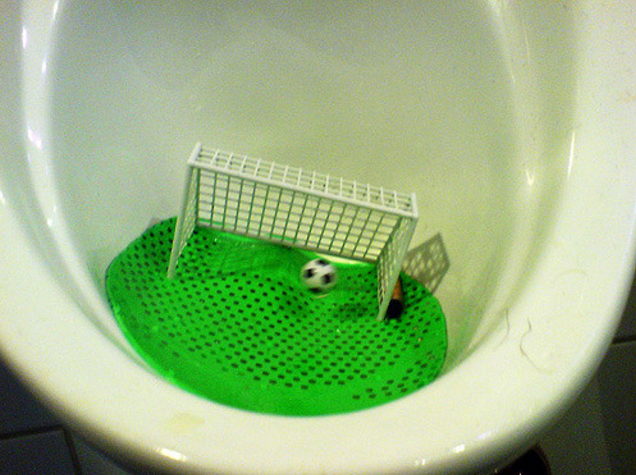
Flickr creative commons John Cooper.

Good, clean fun.

Jay Livingston is the chair of the Sociology Department at Montclair State University. You can follow him at Montclair SocioBlog or on Twitter.

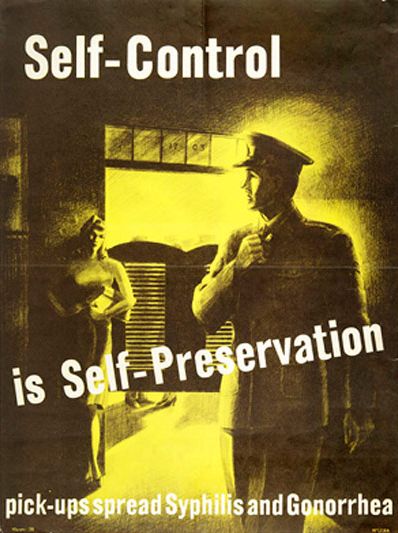
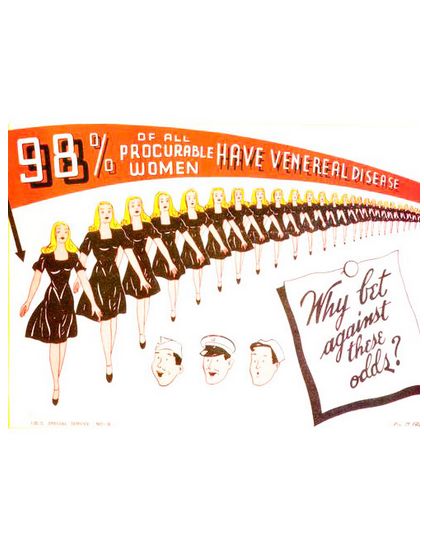
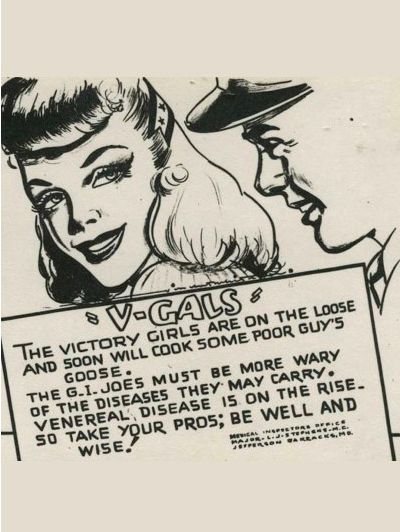
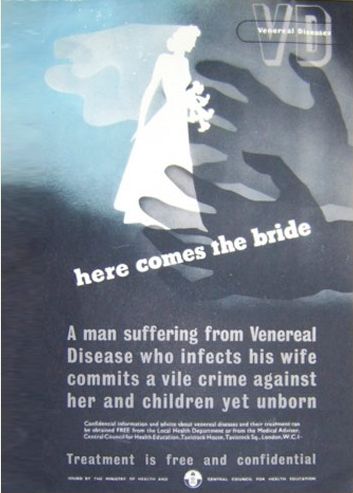
We’ve posted previously about the ways in which World War II posters aimed at U.S. soldiers warned against “venereal disease” (what we now know as sexually transmitted infections) by personifying them as dangerous, diseased women.  Molly W. and Jessica H. have shown us to a new source of propaganda posters, so now seems as good a time to revisit the phenomenon.  In our previous post, I articulated the problem as follows:

Remember, venereal disease is NOT a woman. It’s bacteria or virus that passes between women and men. Women do not give it to men. Women and men pass it to each other. When venereal disease is personified as a woman, it makes women the diseased, guilty party and men the vulnerable, innocent party.

This first poster is an excellent example.  In it, the woman is synonymous with death:

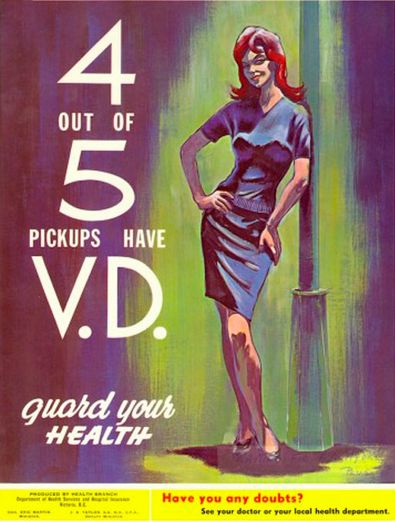
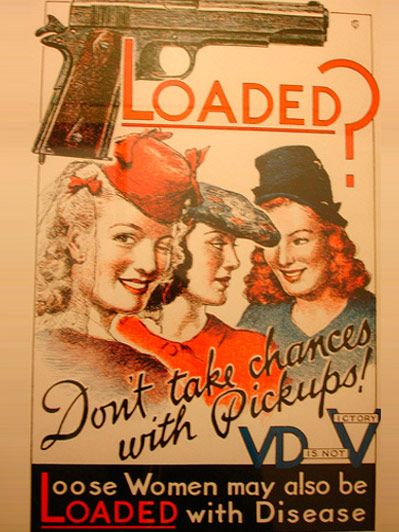
In other posters, women are simply seen as the diseased party.  Concern that a soldier might pass disease to “pick ups” and “prostitutes” is unspoken.  This is funny, given that the reason for this propaganda was sky-high rates of VD among soldiers.


So “pick ups” and “prostitutes” were seen as vectors of disease.  They were the guilty party.  In contrast, wives are portrayed as innocent.  Another example of the dividing of women into virgins and whores:


Lisa Wade, PhD is an Associate Professor at Tulane University. She is the author of American Hookup, a book about college sexual culture; a textbook about gender; and a forthcoming introductory text: Terrible Magnificent Sociology. You can follow her on Twitter and Instagram.

Abby Kinchy (and Assistant Professor at Rensselaer Polytechnic Institute) and Emily Birch  sent us another example of the pressure put on female athletes to be not just amazing at their sports, but attractive while doing it. The New York Times ran an article about changes in the Badminton World Federation’s required dress code for players. The BWF issued guidelines that sought to “ensure attractive presentation” at tournaments. They also insisted on reinforcing gender differences; women players “must wear skirts or dresses.” The policy, initially intended to be implemented by May 1st, said it was acceptable to wear shorts or tracksuit pants under a skirt “where cultural or religious sensitivities require legs to be covered.” However, the guidelines stressed that it was not acceptable to wear a sheer skirt over the shorts or pants, and was absolutely unacceptable to wear shorts or pants alone.

The dress code was roundly criticized as a sexist marketing ploy that might hamper some players’ performance. While the Iranian players would be able to continue wearing their long pants, they would have to wear a skirt over them — which, as the NYT article points out, could be cumbersome and restrictive, putting some players in the position of having to accept potentially negative effects on their performance in return for being allowed to wear shorts or pants.

The BWF argued that this was for women’s players’ own good, since it would bring more attention to the sport, pointing out that they recently increased the prize money for women’s tournaments to be equal to men’s and added women’s competitions to be sure men and women have the same options for participation. The argument seemed to be that they are trying to make women’s badminton more popular, and thus the least the women can do is play their part — which means not just being excellent players, but looking more attractive to viewers.

However, as some players and other critics pointed out, the concern with using dress code to enhance the popularity of the sport seemed to fall disproportionately on women, and seemed to focus primarily on making women conform to ideals of femininity:

Interest is declining, Rangsikitpho said, adding that some women compete in oversize shorts and long pants and appear “baggy, almost like men.”

[From NYT.]

The dress code for men, on the other hand, simply requires “proper attire.”

After all the criticism, the BWF delayed implementation of the rules for a month to provide time for more discussion. Finally, in late May, they put off implementation indefinitely.

Though the dress code is on hold for the moment, it’s a great example of the way that concerns about appearance may trump functionality when it comes to women’s sports. In addition, it shows how a particular version of femininity — one that involves showing significant amounts of skin and that accepts skirts and dresses as default women’s clothing — is elevated as the ideal presentation. The fact that many badminton players have cultural or religious reasons to want (or have) to wear pants to play doesn’t require rethinking standards of femininity, but only a work-around that still upholds the ideal by requiring a skirt over pants.

Gwen Sharp is an associate professor of sociology at Nevada State College. You can follow her on Twitter at @gwensharpnv.

In response to my post yesterday about tourism ads presenting local (often, though not always, non-White) residents of vacation hotspots as tourist attractions and amenities for relatively privileged travelers to enjoy, Lauren J. sent in a Heineken ad that pokes fun at the expectations visitors to Jamaica often have about how Jamaicans would act, and how local residents may feel obliged to play along and give tourists (with their cash) the “authentic” experience they desire:

In the contemporary Western world, naked and near-naked bodies are revealed everywhere.  But most of the bodies we see are those of models and actors, carefully cultivated, chosen, and digitally altered to look a particular way.  Except, artist Clarity Haynes notes, the “before” pictures in advertisements for diet plans and cosmetic surgeries.  She writes:

“Before” pictures pop up constantly on our computers and in magazines, as part of the daily landscape of imagery. These “before” pictures, meant to shock and scare, show bodies that are presented as needing urgent correction and control, through weight loss or plastic surgery.

In an effort to reclaim these “before” bodies, Haynes has lovingly painted a range of female bodies.  The Breast Portrait Project, she continues:

…is about finding dignity and beauty in the physical characteristics of the body that our popular culture often ridicules and heaps with shame, and in the process allowing the models who participate to feel pride in their particular selves — and by extension, the viewers of the work as well, regardless of their gender.


Visit Hayne’s gallery.  And, for more normalizing of normal bodies, see these selections of breasts,  bellies, and vulvas.

Lisa Wade, PhD is an Associate Professor at Tulane University. She is the author of American Hookup, a book about college sexual culture; a textbook about gender; and a forthcoming introductory text: Terrible Magnificent Sociology. You can follow her on Twitter and Instagram.

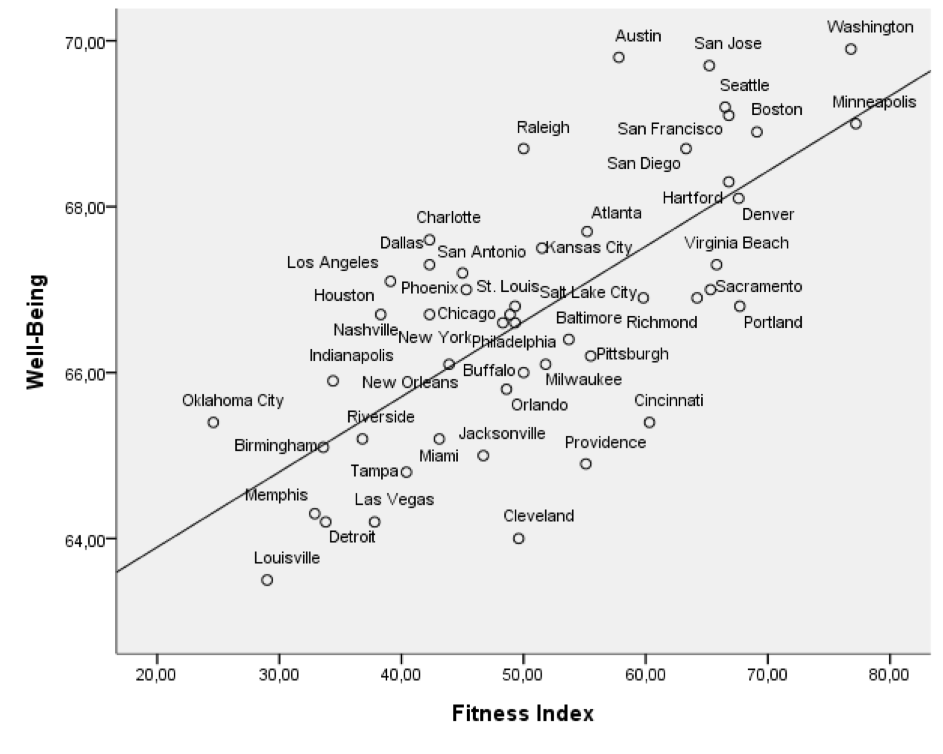
Sociologists have shown that rates of “obesity” correlate with economic class. That is, the poorer you are the more likely it is that you will be overweight.  This is, in part, because healthy, low-calorie food tends to be more expensive that calorie rich, nutrient poor food; and also because poor neighborhoods have fewer grocery stores, forcing the poor, especially if they don’t have cars, to shop for groceries at corner stores, gas stations, and fast food restaurants.  When there are so many other things to worry about, like not going hungry, food quality is not prioritized.  Level of fitness, then, correlates with social class (and the time and money it affords you) and the things that correlate with social class, like level of education.

The American College of Sports Medicine has released data showing these correlations, if measured at the level of U.S. metro areas, as reported at The Atlantic and sent along by Tracie Hitter, a doctoral student at New Mexico State University.  First, fitness level is correlated with average income in these areas:

Second, fitness level correlates with average level of education (here called “human capital”):

And fitness level correlates with overall well-being, a measure related to both fitness and socioeconomic class:

Here are some selected metro areas plotted in relation to one another:

Lisa Wade, PhD is an Associate Professor at Tulane University. She is the author of American Hookup, a book about college sexual culture; a textbook about gender; and a forthcoming introductory text: Terrible Magnificent Sociology. You can follow her on Twitter and Instagram.

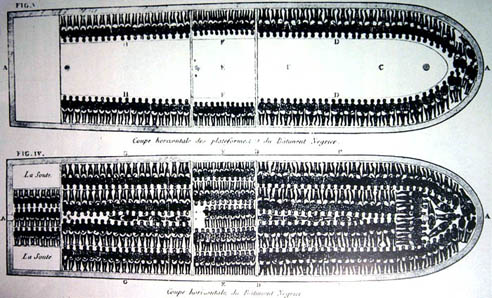
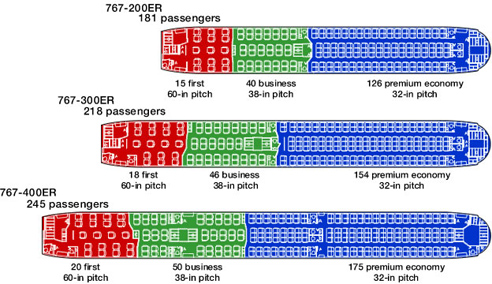
Just as “I’m not a racist, but…” is a sure sign that someone is about to say something racist, an essay that begins “I don’t want to trivialize the inhumane horrors that African slaves endured on slave ships destined for the Americas. But…” is certain to do just that.  Indeed, Steven Heller at Imprint began his post this way, going on to suggest that the design of modern airplanes “resemble[s]” that of slave ships.  As evidence, he recalls his own discomfort in coach and compares drawings of slave ships and blueprints of airplanes.

Heller prefaced his observations with a disclaimer because he knew comparing modern air travel to the slave trade was sketchy.  And it is, indeed, sketchy. The descendants of slaves live life with the knowledge that their ancestors were stolen, shackled, beaten, and denied their very humanity; at least they survived the trip across the Atlantic.  Nope, not like air travel one bit.

So, yes, it’s lovely to be clever, but it’s also lovely to be thoughtful and sensitive.  In this case, Heller’s desire to be the former won out over the latter.  Or perhaps he never really thought that anyone would seriously be upset by the comparison.  It’s obviously tongue-in-cheek right?  I mean, slavery has been over for, like, ever.  Or maybe he forgot that descendants of slaves read the freakin’ internet just like everyone else.

Who knows.  In any case, it’s a great example of the trivializing of the histories and traumas of a marginalized population.

Thanks to Dolores R. for the tip.

Lisa Wade, PhD is an Associate Professor at Tulane University. She is the author of American Hookup, a book about college sexual culture; a textbook about gender; and a forthcoming introductory text: Terrible Magnificent Sociology. You can follow her on Twitter and Instagram.

In recent years, as states around the country have been faced with the worst budget deficits on record, funding for many social service programs has been slashed or cut entirely. A new report from the NAACP demonstrates that during these budget clashes, funding for prisons has won out over spending for education. The report argues that these “misplaced priorities” are ultimately destructive.  Expanding prisons at this point does little to reduce crime and by spending these limited budget dollars on prisons rather than education, we are condemning the next generation of kids in poor neighborhoods to this same cycle of poor education, high crime rates, and mass incarceration.

However, the NAACP report only describes the first half of the problem—the failures of schools and the expansive role of the criminal justice system. The other half of the story is the legacy of these failures—strikingly low levels of education among those who wind up in our nation’s prisons—and the fact that corrections departments today are doing a worse job than ever in providing education inside of prisons as a way out of the revolving door of corrections.

This is important because we know that over 90 percent of inmates are at some point released and roughly half of them will return to prison within the next 3 years. Slashing prison education funding may provide a very small benefit to the current budget, but it also helps to fuel the growth in prisons that has suffocated education funding in the first place.

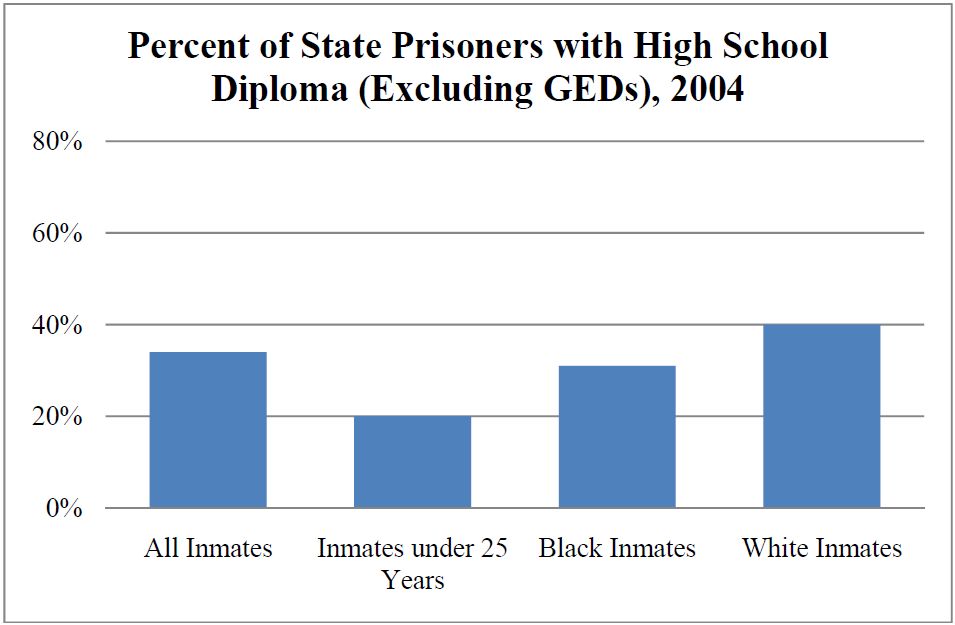
It is simple to document the dire educational needs of prisoners.  According to the 2004 Survey of Inmates in State and Federal Correctional Facilities, over 60 percent of state inmates never made it past 11th grade in school.  Among young inmates under 25 years of age, only 20 percent have completed high school.  If G.E.D.’s are included in this measure, only 66 percent of inmates 25 years or older have completed their basic education, compared to 85 percent of adults in the non-institutionalized population.

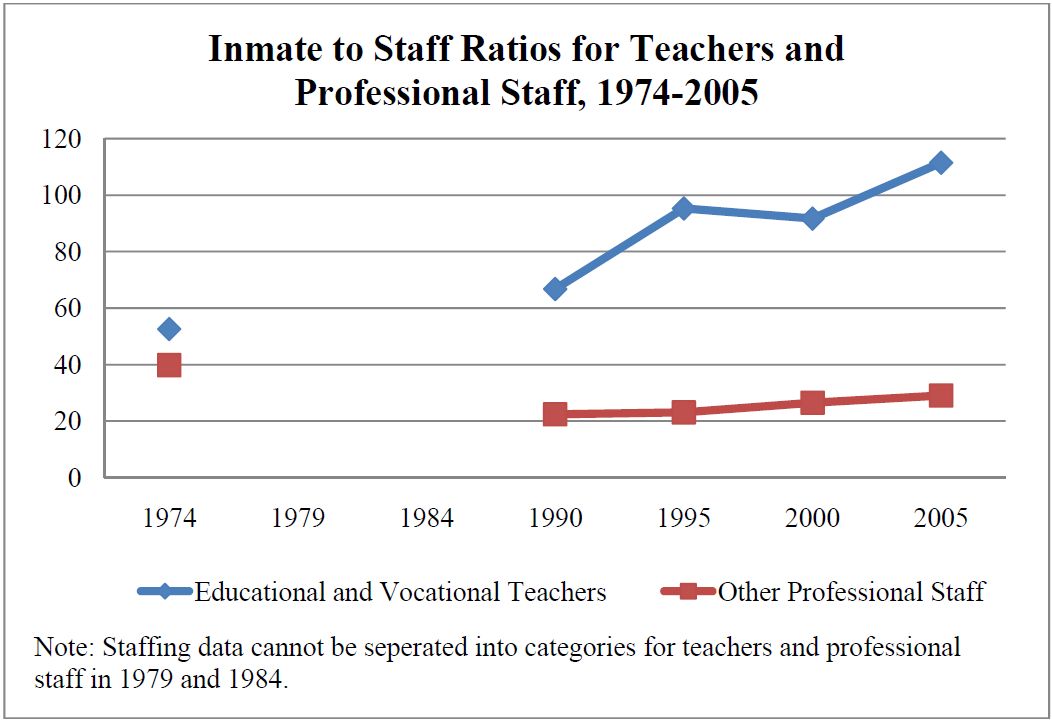
Sadly, the programs that serve these inmates’ needs have been on the chopping block for years.  In work recently published in Law & Society Review, I show that the ratio of inmates to teachers for academic and vocational education in prisons nationwide has more than doubled since the 1970s, growing from 53 inmates per teacher in 1974 to 112 inmates per teacher in 2005. Much of this change occurred in the most recent decade: in 1990, the ratio was only 67 inmates per teacher.

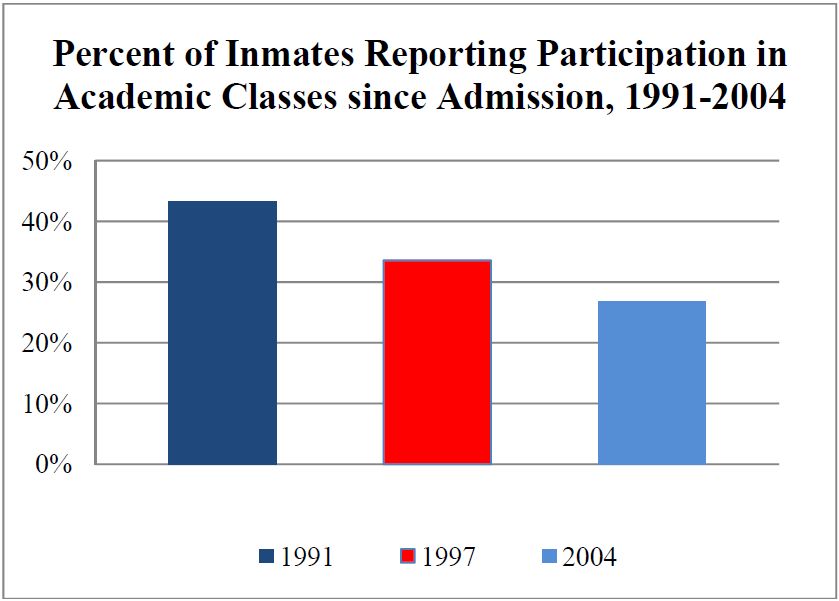
These declines in staffing investments are clearly translating into declining participation in prison education programs. Between 1991 and 2004, the percent of inmates reporting past or current participation in academic classes dropped precipitously from 43 percent to 27 percent.  If the rate of high school attendance had dropped by almost 50% in the span of a decade and a half, pundits would be railing against state legislators.  But since this happened behind prison walls, there has been very little awareness (let alone outrage) about these changes.

This strategy is a flawed attempt to cut costs since we know that education is one of the more successful ways to reduce recidivism.  In study after study, inmates who participate in educational programming are less likely to commit new crimes after release and to be re-incarcerated. This is in part because basic academic education and vocational training makes it more possible for ex-felons to find the kind of employment opportunities that forestall re-incarceration.

In recent years, this disinvestment in prison education has been even more brutal. In California, state lawmakers have taken $250 million away from rehabilitation programs in the last two years and are planning to cut another $150 million in the coming year. These losses in funding translate into a third of the adult programming budget. These cuts are an ironic move after Governor Schwarzenegger’s 2004 decision to change the name of the state agency from the “Department of Corrections” to the “Department of Corrections and Rehabilitation”.

Although some states have begun looking into ways to reduce correctional populations as a more sustainable way to manage costs, in the next few years, we can expect to see even more slashes to prison education funding.  Ultimately, this strategy is likely only to cut a small percentage of states’ immediate costs and will increase the need for incarceration spending in the near future.

—————————

Michelle Phelps is a Ph.D. candidate in Sociology and Social Policy at Princeton University.  Her work focuses on the punitive turn in the criminal justice system, examining how the daily operations of prisons changed (and remained the same) during the massive recent shift in the rhetoric and politics of punishment.  Her dissertation project is on the rise of probation supervision and you can find her new blog on the strange media surrounding probation at Probation Research.

If you would like to write a post for Sociological Images, please see our Guidelines for Guest Bloggers.