Search results for The

Cross-posted at Montclair Socioblog.

Peter Berger* takes issue with the phrase “on the wrong side of history.”  Mostly, he takes issue with those who use that phrase. Specifically, he refers to proponents of gay marriage who claim that the Defense of Marriage Act is “on the wrong side of history” (or in Berger’s acronym, OTWSOH) The trouble with this statement, Berger says, is that “we cannot know who or what is on the right side.”

Berger is correct (though he doesn’t offer much explanation) because the history that people are referring to hasn’t happened yet. The history of OTWSOH is the future, and we can’t know the future.  However — and here’s where Berger is wrong — we can make a pretty good guess about some things that will happen, at least in the short-run future. We can look at the trend — Americans becoming more accepting of gay marriage — and predict that the trend will continue, especially when we see that the young are more accepting than the old.
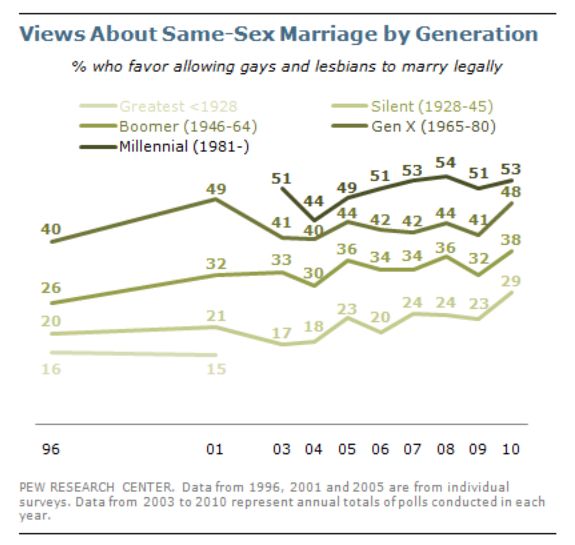
But beyond the short-run, who knows? It’s possible that the values, ideas, and even facts that are right today will, decades or centuries from now, be wrong.  So it may turn out that at some time in the future, people will think that gay marriage is a plague on civilization, that human slavery is a pretty good idea, that Shakespeare was a hack, and that Kevin Federline was a great musician.

The trouble with asking history, “Which side are you on?” is that history doesn’t end. It’s like the possibly true story of Henry Kissinger asking Chou En Lai about the implications of the French Revolution. Said the Chinese premier, “It’s too early to tell.”

At what point can we say, “This is it. Now we know which side history is on”?  We can’t, because when we wake up tomorrow, history will still be rolling on. Duncan Watts, in Everything Is Obvious… Once You Know the Answer, makes a similar point using the historical film “Butch Cassidy and the Sundance Kid.” The two robbers flee the US and go to Bolivia. Good idea? Since we know how the movie ends — that sepia freeze frame — we can safely say, “No, bad idea.”

But if we had stopped the movie twenty minutes earlier, it would have seemed like a good idea. The vindictive lawman and his posse were about to find and kill them. A few minutes later in the film, Bolivia seemed again like a bad idea – it was a miserable place. Then, when their robberies in Bolivia were easy and lucrative, it seemed again like a good idea. And then, they got killed. Butch was 42, Sundance 31.

But history is not a movie. It doesn’t end. So at least for the long run, the OTWSOH argument claims certainty  about what is at best speculation. It says, “We know what will happen, and we know that we are on the right side of history, and those who are not with us are on the wrong side of history.” Some religious folks make similar claims not about history but about God.  “We are on God’s side,” they say, “and those who disagree with us are against God.”  They tend to populate the political right.  The OTWSOH argument, Berger says, “comes more naturally to those on the left,” mostly because that is the side that is pushing for historical change.  The two sides are indulging in a similar fallacy — knowing the unknowable — a fallacy which, to those who don’t share their views, makes them appear similarly arrogant.

————————

* Yes, this is the same Peter Berger whose Social Construction of Reality (co-written with Thomas Luckman), published forty-five years ago, has an important place in sociology’s relatively short history.

HT: Gabriel Rossman
In my Sociology of Gender course I talk about how gender conformity isn’t simply a matter of socialization, but often a response to active policing by others.  Single women usually avoid having too many cats, for example, not only because they’ve been taught that too many cats sends the wrong signal, but because they may be called a “cat lady” by their friends (a joke-y slur suggesting that she is or will be a batty old spinster).  Or her best friend, with her best interests in mind, may discourage her from adopting another cat because she knows what people think of “cat ladies.”

People who find community in subcultures that are seen as “alternative” to the “mainstream” often feel like they are freed of such rules.  But these subcultures often simply have different rules that turn out to be equally restrictive and are just as rigidly policed.

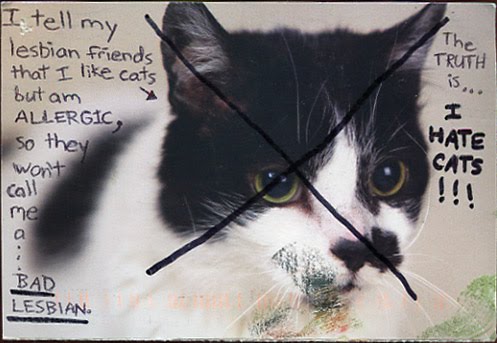
A recent submission to PostSecret, a site where people anonymously tell their secrets, reminded me of this.  In it a lesbian confesses that she hates cats.  Because of the stereotype that women love cats, the “cat lady” stigma may be lifted in lesbian communities.  This lesbian, however, doesn’t feel freed by the lifting of this rule, but instead burdened by its opposite: everyone has to like cats.  So she feels compelled to lie and say that she’s allergic.

Related, see our post on a confession, from another lesbian, about suppressing the fact that she’s really quite girly.

Lisa Wade, PhD is an Associate Professor at Tulane University. She is the author of American Hookup, a book about college sexual culture; a textbook about gender; and a forthcoming introductory text: Terrible Magnificent Sociology. You can follow her on Twitter and Instagram.

Cross-posted at Family Inequality.

Buy a McDonald’s Happy Meal and get a toy: OK, I didn’t expect it to be enlightening.

But to hear Kevin Newell, the company’s executive vice president and global chief brand officer, tell it, that’s exactly what it should be:

McDonald’s is committed to playing a positive role in children’s well-being. The Smurfs Happy Meal program delivers great quality food choices, fun toys and engaging digital content that reinforces important environmental messages.

Awesome. Granted, the last time I saw a Smurf, it was about 1978, and he looked like this:

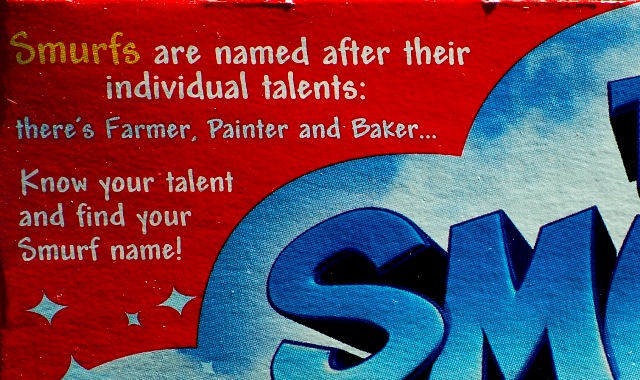
And I don’t recall being overly concerned with gendered toy representations at the time. Anyway, now I’m told by the Happy Meal box that, “Smurfs are named after their individual talents: there’s Farmer, Painter and Baker… Know your talent and find your Smurf name!”

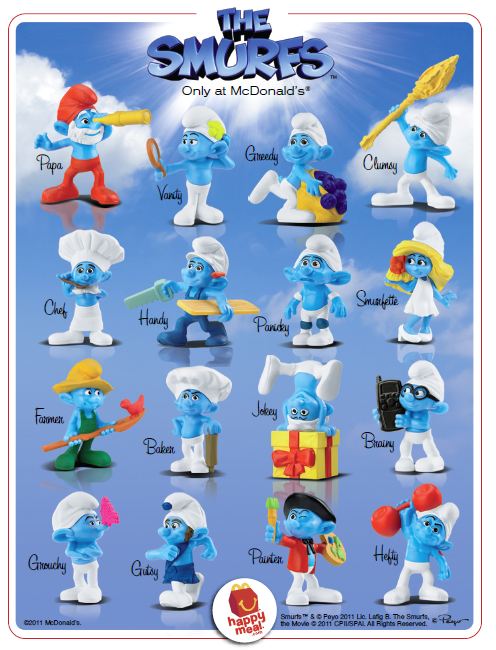
The girls both got male Smurf characters, which struck me as interesting, because the counter person had asked us if the Meals were for boys or girls. Then I looked at the characters on the box. Then I looked at the complete list of them on the website (see the poster version here):

Then I wondered what Smurfette’s “individual talent” was that got her — the only female Smurf – named “Smurfette.” And at that point, if it hadn’t been for all the fat and salt and sugar in my meal, I might have stopped enjoying it.

In context

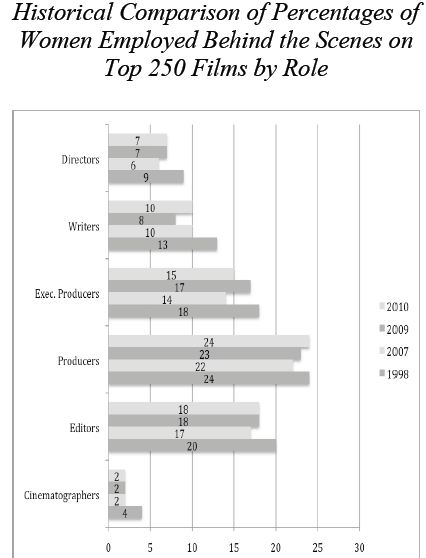
I’ve commented before on the gender segregation in film making. The gist of it is apparent in this graph from the Celluloid Ceiling report by the Center for the Study of Women in Television and Film. Not many women in charge:

But isn’t it improbable that a blockbuster kids’ movie, which grossed more than $75 million in its first two weeks, could be so blatantly sexist? There are a few women in the cast of the movie version of The Smurfs, but all the Smurfs are still male except Smurfette. Next thing you know they’re going to turn the only female character in this promotion — which, remember, plays a “positive role in children’s well-being” — into an adult sex symbol played by Katy Perry. You’re kidding.

Is sexist even a word anymore?

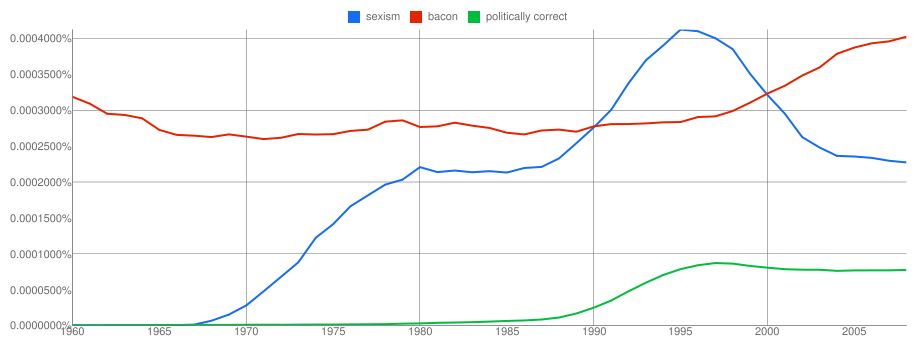
In fact, sexism used to be a very common word. According to the Google Ngrams database of millions of terms from their vast collection of digitized books in American English, “sexism” was even more common than “bacon” during the 1990s (you can play with this yourself here):

Unfortunately, in my opinion, sexism has retreated from the language, and kids’ stuff seems to be more shamelessly gendered than ever. I think this sad state of affairs is at least partly the result of what you see in that green line above — the backlash against feminism (and anti-racism) that made it seem more unpleasant or unwarranted to make a “big deal” out of sexism than to treat girls like this.

P.S. I haven’t seen the movie. Please tell me it has a hidden feminist message I haven’t heard about.


Katie L. sent along a fascinating Starbucks commercial. In it, a succession of workers grow, harvest, roast, taste, and prepare coffee from scratch for a hypothetical customer named “Sue.” At first glance, I thought that the commercial did a nice job of at least acknowledging their workers (if in an overly romanticized way), unlike some commercials for agricultural products that erase them.  But I thought again.  Because the entire commercial revolves around Sue, the inclusion of all the workers isn’t meant to focus our attention on them, it’s meant to highlight how much work goes into pleasing Sue.  We’re supposed to identify with Sue, not the series of workers.

This reminds me of a post about a “hand-rolled” tea sold at The Coffee Bean and Tea Leaf.  The consumer was supposed to be excited about the tea not because of its flavor, but because, as I wrote, “it takes a significant amount of human labor to “hand-roll” tea leaves into balls… What could be more luxurious than the casual-and-fleeting enjoyment of the hard-and-long labor of others? ”

This ad has a similar feel.  The workers are portrayed only in order to make the intended consumer feel special.  They work with Sue in mind, tending carefully to Sue’s future pleasure intently and with care.  They find satisfaction in Sue’s satisfaction.  Sue is everything.  Everyone is for Sue.

This tells us something interesting, no doubt, about American cultural values.

Lisa Wade, PhD is an Associate Professor at Tulane University. She is the author of American Hookup, a book about college sexual culture; a textbook about gender; and a forthcoming introductory text: Terrible Magnificent Sociology. You can follow her on Twitter and Instagram.

Cross-posted at North Atlantic Books Communities.

Edward Said famously argued that the West uses the East as an inverted mirror, imagining them to be everything the West is not.  In a book titled Orientalism, he showed us how this perceived binary separating the Semitic East and the Christian West has traditionally manifested itself in art through romanticized scenes of Eastern cultures presented as alien, exotic, and often dangerous.

European painters of the 19th century turned to backdrops of harems and baths to invoke an atmosphere of non-European hedonism and tantalizing intrigue. Ingre’s 1814 Grande Odalisque , for example, depicts a concubine languidly lounging about, lightly dusting herself with feathers as she peers over her shoulder at the viewer with absent eyes. The notions of hedonistic and indulgent sex are bolstered by hints to opium-induced pleasure offered by the pipe in the bottom right corner. Images like this prompted viewers to imagine the Middle East as a distant region of sex, inebriants, and exciting exotic experiences.

Orientalism continues to inflect popular culture, but because we see ourselves differently now, we see them differently as well.  The rise of Islamic fundamentalism in the East, and the corollary Islamophobia of the West has shifted the focus to violence coupled with religious fervor. Take for example an image from a February New York Times article entitled “Afghan Official Says Women’s Shelters are Corrupt.”

The story is about the Afghan government’s desire to take over all Western-established shelters which they claim are “more concerned with the budget than the women.” It’s an article about bettering women’s support, community and safe havens, an act many Westerners would deem progressive in a way they wouldn’t usually view the region. However, the photo that was chosen for this article offers all the classic stereotypes held about the Middle East by depicting entirely veiled women who are shut indoors surrounded only by symbols of religion. The viewer sees two women, in both a hijab and niqab, separated onto two beds with looks of utter despondency; one looks down at her hands while the other stares off into the space ahead of her. In the center of the room is a young girl, blurred by the long exposure of the camera which attempted to capture her in the act of seemingly fervent prayer. Behind the praying young woman is an even younger girl sitting on a bed with a baby on her lap. Rather than depicting the officials who are rallying for female empowerment and institutional improvement, the photo that was chosen paints an image of silenced religious females.

Often imagery is more powerful and memorable than words and in some cases the photographs chosen to accompany the news are less than representational of the story at hand. This instance is typical of the Western media’s predilection for reinforcing Western notions about the East through imagery, instead of finding common ground between two regions that many believe are naturally separated by ideology. Thus orientalism lives on, transformed from its roots but maintaining its destructive stereotypes.

Adam Schwartz is an undergraduate at University of California, Berkeley entering his final year in the Media Studies program. He is currently preparing to write his thesis analyzing the gender and racial implications of the American Apparel advertising campaigns. When he isn’t in school he can be found biking along the beautiful California coast or working for the Berkeley Student Cooperative.

Lisa Wade, PhD is an Associate Professor at Tulane University. She is the author of American Hookup, a book about college sexual culture; a textbook about gender; and a forthcoming introductory text: Terrible Magnificent Sociology. You can follow her on Twitter and Instagram.

The “Let’s Move” campaign is Michelle Obama’s initiative to curb the childhood obesity epidemic in the United States.  According to the campaign website, its goals include “creating a healthy start for children” by empowering their parents and caregivers, providing healthy food in schools, improving access to healthy, affordable foods, and increasing physical activity.  Here is an example of the kind of “social marketing” that the campaign is releasing:

This campaign video is particularly notable for 1) its raced, classed, and gendered assumptions about the responsibility for promoting physical activity among young people; 2) the way it emphasizes personal responsibility while ignoring structural determinants of health; and 3) its Foucauldian implications (for the real social science nerds out there).

First, the video portrays a middle-aged white mother (in the kitchen, no less) who encourages her daughter to get exercise by having her running around their (apparently large, middle-class suburban) home in order to find the $1 she asked for.  It ends by stating: “Moms everywhere are finding ways to keep kids healthy.”  Not only does this assume that “moms” (not “parents”) have responsibility for keeping their kids healthy through intensive mothering practices, it fails to account for the fact that the childhood obesity epidemic (itself a social construct in many ways) is greatly stratified by race and socio-economic status.  It is not clear to the viewer how they might encourage their children to exercise if they live, say, in a small apartment or a neighborhood without safe places for kids to play outside.

Second, a growing body of research points to the fact that structural-level inequalities, not individual-level health behaviors, account for the majority of poor health outcomes.  This research illuminates a disconnect in most health promotion initiatives — people have personal responsibility (engage in physical activity) for structural problems (poverty; the high price of nutritious food; safe, well-lit, violence-free places for kids to play).

Finally, the video illustrates what some social scientists have noted about new forms of power in modern public health practice — for example, health promotion campaigns such as this one can be thought of as the exercise of “biopower,” or Foucault’s term for the control of populations through the body: health professionals and/or the government are entitled by scientific knowledge/power to examine, intervene, and prescribe “healthy lifestyles.”  In this example, the campaign uses marketing strategies to remind the (very narrowly defined) audience of their duty to engage with dominant health messages and concerns (i.e., childhood obesity) through the control of bodies (that is, their children’s).

In the “Let’s move” campaign video, then, we see that (white, middle-class) moms have a responsibility for encouraging their children to get physical activity without an acknowledgement of the gendered expectations of caregiving, structural determinants of health that effect childhood obesity, and the implications of top-down control of the body.

————————

Christie Barcelos is a doctoral student in Public Health/Community Health Education at the University of Massachusetts Amherst where she studies social justice and health, critical pedagogy, and epistemology in health promotion.

If you would like to write a post for Sociological Images, please see our Guidelines for Guest Bloggers.

Cross-posted at Scientopia.

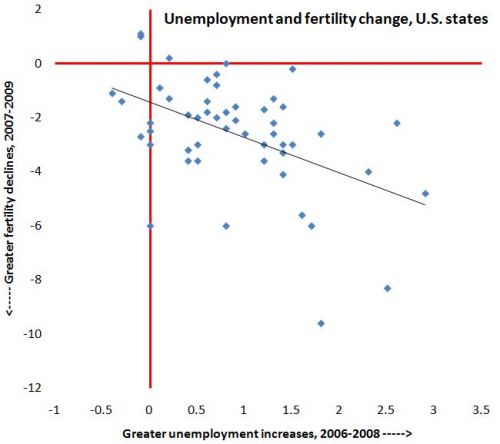
As demonstrated by some figures posted at Family Inequality, the U.S. birthrate has dropped during the recession:

But the birth rate hasn’t dropped for all American women equally.  Women who’ve already had two children were most likely to skip having a child during this period, and women who already had one child were more likely to delay or end childbearing than women with no children.   But women who already had three children were relatively ready to plow forward with a fourth, even more ready than childless women.

To make an even stronger case that the recession inhibited childbearing, Philip Cohen correlated birth data by state and state unemployment rates (both from the Bureau of Labor Statistics).  His figure shows that “fertility fell more where the recession hit harder”:

Great stuff, as always, from Family Inequality.

Lisa Wade, PhD is an Associate Professor at Tulane University. She is the author of American Hookup, a book about college sexual culture; a textbook about gender; and a forthcoming introductory text: Terrible Magnificent Sociology. You can follow her on Twitter and Instagram.

Cross-posted at Scientopia.

Sadie M. sent in an example of the reproduction of the idea that “Africa” is an arid, desolate place where nature still dominates civilization.  The snapshot Sadie sent in was of Nairobi.  Nairobi is the 12th largest city on the continent of Africa with a population of over 3 million in the city and its surrounding suburbs.  It is the capital of Kenya and an economic, political, and financial hub in the region.

This is Nairobi on Google maps:

This is what comes up if you Google image Nairobi:

Nairobi is also not a desert plain.  The name, in Maasai, translates into “the place of cool waters” and it is popularly known as “Green City in the Sun” (wikipedia).

Despite all of this, Sadie’s snapshot shows that an in flight magazine depicted Nairobi as a savanna full of elephants and bereft of people.  The other two destinations featured — New York and Sydney — are pictured as they are.

So there we have it: Another piece of advertising erasing the bustling, successful economies of Africa, and instead reproducing the idea that the entire continent is an uncivilized desert full of exotic animals.

See also: How Not to Write about Africa and The Single Story of “Africa.”

Lisa Wade, PhD is an Associate Professor at Tulane University. She is the author of American Hookup, a book about college sexual culture; a textbook about gender; and a forthcoming introductory text: Terrible Magnificent Sociology. You can follow her on Twitter and Instagram.