Search results for The

Time for another collection of gendered kids’ stuff!

First, the blog-o-sphere is all over this one already and apparently JC Penney has already pulled the t-shirt, reading “I’m to pretty to do homework so my brother has to do it for me.”  Really? I like how Jezebel framed the issue with a big “NO”:
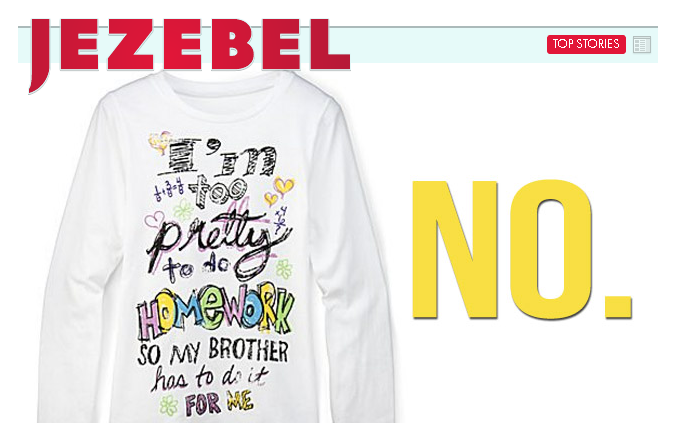
Thanks for Caroline Heldman, Tom Megginson, Mana T., Carmel L., Heidi S., Melissa B., Alli, and Ed A.-N. (on our Facebook page) for sending in that doozy.

Next, Jessica M. and Amanda G. each sent in a photo of gendered baby rattles, both in terms of the design (girls get a purse and diamond ring, boys get a hammer and saw) but also in the description — girls are “sweet,” boys are “busy”:


Don’t worry; once your daughter outgrows the diamond ring rattle, there are other products available to remind her that the most important thing in the world is to get a diamond ring, specifically in the form of an engagement ring. Liz saw this for sale in the toy section at Wal-Mart, which was a relief, because as she said, girls these days just “don’t have enough pressure to get hitched at age 8+”:

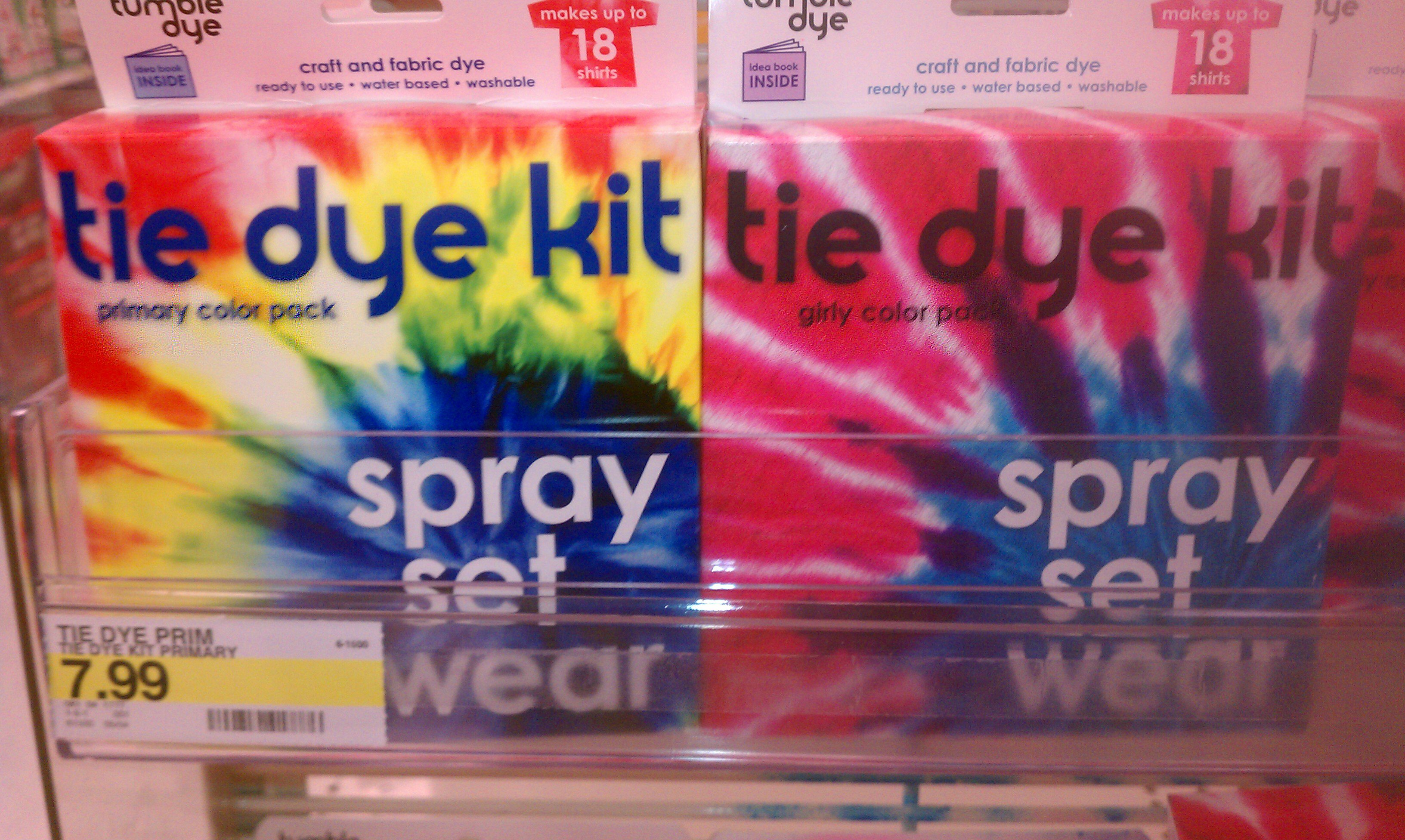
Hishaam S. noticed that Target had four tie-dye kits — camo, neon, primary, and girly:
Laura M. sent us an image Jenga Girl Talk Edition, originally posted by Elena Barbarich. The game (which comes in two versions, pastel blue and purple and “exclusive pink”) includes blocks with girl-specific questions to stimulate conversation, such as who you have a crush on and the truly brilliant “What is your favorite website?”

There are many versions of Jenga — Donkey Kong, the Nightmare before Christmas, Transformers, and so on — but there doesn’t appear to be a version specifically labeled for boys. [NOTE: Reader JF says there’s a board game called Girl Talk, so this is being cross-branded with it.]

Esther M.-E. noticed a recent Seventh Avenue catalog contains an example of the “masculinized things are for everyone, but feminized things are only for girls” cultural pattern. The catalog had two facing pages of bed sets, the one on the left called Air Guitar (featuring guitars on the sheets, in a blue room with a basketball on the floor) and the one on the right called Jungle Queen (in a pink room with a cat):

The description of the Air Guitar set, however, describes it as appropriation for boys or girls, while the Jungle Queen set doesn’t include the same language (and its very name specifically genders it):

Seventh Avenue, of course, is marketing in this manner — actively including girls in the product that might otherwise be defined as masculine while not doing the same for boys with the feminized product — because our cultural norms surrounding gender value the masculine over the feminine. Girls who like “boy” things are often seen as cool, sassy, even smart. Boys who like “girly” stuff, though, are not cool. Even if a boy asked for a pink animal-print bedroom set, his parents are less likely to support the choice than if a daughter chose a masculine-gendered item. Seventh Avenue is simply writing copy based on this larger cultural pattern, and in so doing, reinforcing it.

And now, something that just goes in the “wtf?” category, which I include here for no reason other than the pure surreality of its existence. J.O. was looking at the girls’ toys section at All Modern Baby, and among the Fashion and Beauty Fun there were several sets of rubber bands in various shapes, including…the Kama Sutra package, with four positions:


You won’t be surprised to learn they have been removed from the site, and I found a few other kid-related websites that had them listed as no longer available as well, though if you’re dying for a set, several non-child-oriented sites carry them. The perils of modern inventory management: you order a bunch of perfectly ordinary sets of silly bands, and among the space ship and animal shapes, no one catches that you’ve also posted a sex-themed version.
We have posted a number of times about the unequal effects of the current economic crisis: the worsening of the racial gap in homeownership, the more severely negative economic situation of African Americans and Latinos than of Whites, including among African American and White college graduates, higher unemployment for men than for women (this post also has a lot of info about race, sex, and job loss), the fact that older workers who lose their jobs remain unemployed longer than younger workers, that job losses have been accompanied by increased corporate profits, and that wealthier households have weathered the crisis better than less prosperous ones.

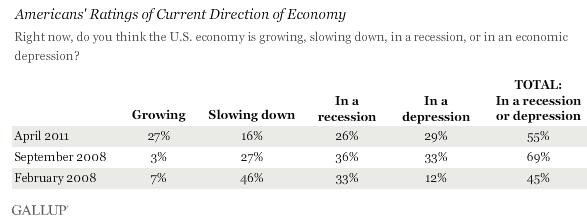
Dmitriy T.M. sent along an April 2011 Gallup poll that asked 1,013 Americans about their perceptions of the economy. Overall, results were more positive than when the same question was asked in September 2008, when the economic meltdown really became apparent. Though more than half of respondents said the U.S. is in either a recession or a depression, that’s down significantly from the 69% who said so in late 2008, while the 27% who said the economy is growing is an enormous jump compared to the mere 3% who thought it was in September 2008:

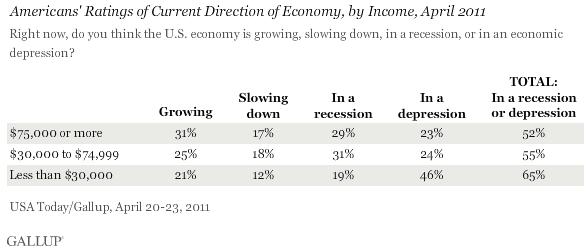
But perceptions of the economy differed significantly by income level. Nobody thought it was doing great; over half of every income group still thought the economy was in either a recession or a depression. However, those making less than $30,000 a year had a notably more negative outlook on the economy than those with higher incomes. Not only were they more likely to think the economy is doing poorly, but nearly half thought we’re experiencing a depression — twice as high as the proportion of those making $75,000/year who thought so:

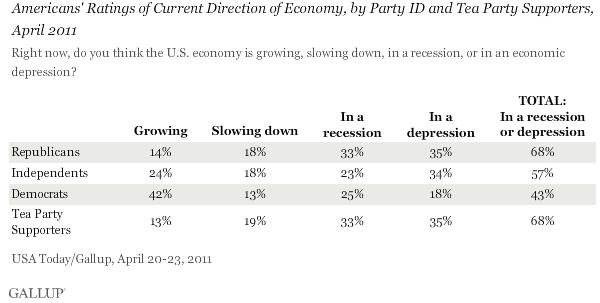
Interestingly, perceptions of the economy also varied widely by political affiliation, with Democrats feeling much more positive about the economy than any other group, and Republicans and Tea Party supports feeling markedly more negative:

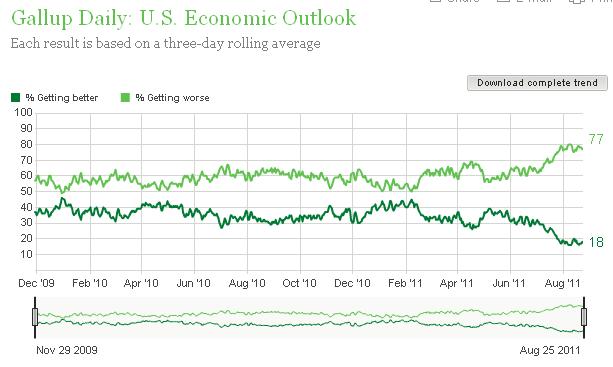
Meanwhile, the Gallup daily tracker poll on the state of the economy (which only shows overall results) shows a marked downturn in Americans’ perceptions of the economy throughout the summer of 2011, with 77% now reporting the economy is “getting worse”:

For more on the economic crisis and its uneven effects, see Philip Cohen’s post on race and job loss, differences in optimism about the future, unemployment by race/sex/education, occupation, median earnings, and race, and the geography of job loss.

The Demographics

During disasters, poor people, people of color, and the elderly die in disproportionate numbers (source), and Katrina was no exception. Many decisions were made in the days leading up to and shortly after Katrina that amplified loss of life for these groups. New Orleans is both a poor (23% poverty rate pre-Katrina – twice the national average) and segregated city, and these factors led to loss of life. First, an effective evacuation plan was not in place that accounted for the 112,000 poor, mostly black New Orleanians without cars. Additionally, the timing of the storm at the end of the month meant that those receiving public assistance were unusually cash-strapped. To make matters worse for poor people with children, school had just started so expenses for the month were higher than usual.

The immobile poor were disproportionately left behind and lost their lives. A comprehensive study of evacuees to Houston (who had stayed behind during the storm) found that 22% were physically unable to evacuate, 14% were physically disabled, 23% stayed in New Orleans to care for a physically disabled person, and 25% were suffering from a chronic disease (source). Also,

• 55% did not have a car or a way to evacuate
• 68% had neither money in the bank nor a useable credit card
• 57% had total household incomes of less than $20,000 in the prior year
• 76% had children under 18 with them in the shelter
• 77% had a high school education or less
• 93% were black
• 67% were employed full or part-time before the hurricane

Age was also a factor in fatalities. Nearly 40% of those who died in Katrina were elderly, and many more elderly individuals died from the stress of evacuation and home loss.

Government Response

Mayor Nagin received nearly $20 million to establish a workable evacuation plan in plenty of time for Katrina, but it’s questionable whether it was ever developed, and it was never disseminated. Two months before Katrina, Nagin spent money to produce and distribute DVDs in poorer neighborhoods to inform residents that they would be on their own if a storm hit because the city could not afford to evacuate them.  In the days before the storm, Nagin sent empty Amtrak trains out of the city, failed to mobilized available school and other buses, and waited an entire day to call for a mandatory evacuation so he could determine whether the City would face lawsuits from local businesses (source). All of these decisions were deadly.

The federal response was no better. The city was quiet after the storm whipped through late Sunday night/early Monday morning when President Bush announced that New Orleans had “dodged a bullet.” Within hours, three major levees breaches and over fifty minor breaches flooded the city. Despite Governor Blanco’s request for federal assistance on Saturday (two days before the storm made landfall) and concern from local media on Sunday (one day before the storm) that the levees wouldn’t hold, they breached on Monday morning with only two Federal Emergency Management Agency (FEMA) workers on the ground (see the timeline). It would take two days for 1,000 additional officials to arrive.

Once on the ground, FEMA slowed the evacuation with unworkable paperwork and certification requirements. Marc Cresswell, a medic from a private ambulance company, reported that “At one point I had 10 helicopters on the ground waiting to go, but FEMA kept stonewalling us with paperwork. Meanwhile, every 30 or 40 minutes someone was dying.” FEMA was also criticized for turning away personnel, vehicles, medical equipment, food and other supplies, and diesel fuel.

The 30,000 people who evacuated to the Superdome (per Nagin’s instructions) were stranded for a week. Those who evacuated to the Superdome experienced deplorable conditions – unbearable heat, darkness, the stench of sewage, and a lack of food and water. They were not allowed to leave, and, according to several evacuees I interviewed in Texas shortly after the storm, this led one man to take his life by jumping from a balcony. This death was one of only six deaths at the Superdome: one person overdosed and four others died of natural causes. Another 20,000 people gathered at the Convention Center for assistance, an evacuation site the federal government was unaware of until three days after the storm.

President Bush was otherwise occupied during this time. The day Katrina hit, he traveled to Arizona and California to promote his prescription drug plan, had birthday cake with John McCain, and attended a Padres game.

Panicked at the slow federal response, Governor Blanco sent an urgent request: “Mr. President, we need your help. We need everything you’ve got.” The president retired to bed that night without responding to Blanco. The next day, he sang songs with country singer Mark Willis and returned to Texas for the final night of his vacation. The President was so oblivious to the suffering in New Orleans that his staff made a video of news coverage four days after the storm to sensitize him. And, in response, President Bush’s team assembled a carefully crafted PR plan to blame local officials seven days into the ordeal while thousands of people were still stranded. Later that same day, President Bush made the infamous statement, “Brownie, you’re doing a heckuva job.”

Cross-posted at Caroline Heldman’s blog.

The political and engineering failures that caused the devastation in New Orleans were multiple and decades in the making. First, the storm surge was amplified by years of oil and natural gas companies degrading the integrity of the wetlands with pipelines, causing the land to sink at an alarming rate (source). The Mississippi river levee system was created in response to the sinking wetlands, but this system actually compounds the problem by preventing much of the river’s silt from being deposited in the ocean where it creates a natural buffer (source). Combined, these factors have eroded one million square acres of Bayou since 1930, bringing the coastline 30 miles closer to New Orleans and leaving only a 20 mile buffer from hurricanes (source). Every 2.7 miles of wetlands reduces storm surge by 1 foot, so Katrina surges of 10 – 20 feet in New Orleans would have been 0 – 9 feet with better oversight of corporations carving up the wetlands – not big enough to breach the levees (source).

Secondly, in 1968, The Army Corps of Engineers built the 76-mile Mississippi River Gulf Canal Outlet (MRGO), a canal that brings ships straight from the Gulf of Mexico to the New Orleans Industrial Canal (source). The MRGO was built right through the Ninth Ward, physically separating the Lower Ninth Ward from the city. The canal salinated and decimated Bayou Bienville, a freshwater swamp and natural storm buffer along the north end of the Ninth Ward.

A healthy Cypress swamp:

Flickr creative commons Thomas Gehrke.

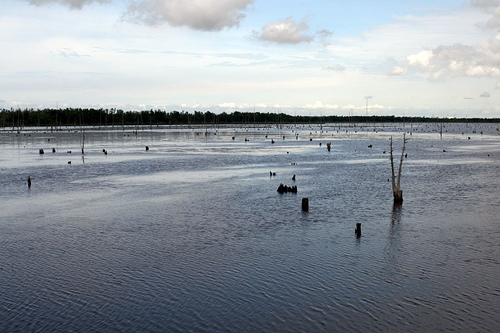
The Bayou Bienville Cypress swamp today:


The MRGO was nicknamed “Hurricane Highway” post-Katrina because it brought the storm surge directly to the Ninth Ward and St. Bernard Parish. To add insult to injury, the MRGO has been an economic boondoggle; used by an average of one ship per day since it was built (source). The Army Corps started filling in the canal in 2009 after a federal court decision showing that officials knew that creating the MRGO would doom the residents of St. Bernard Parish and the Lower Ninth Ward (source). The judge chided the Army Corps, noting that they “not only knew, but admitted by 1988, that the MRGO threatened human life… and yet it did not act in time to prevent the catastrophic disaster that ensued with the onslaught of Hurricane Katrina.”

The third preventable human aspect of Katrina was a network of levees suffering from poor design and disrepair from bureaucratic bickering; an 80% cut to levee repair funds under the Bush Administration and misspent money (source). After Katrina, the Corps admitted that “the hurricane protection system in New Orleans and southeast Louisiana was a system in name only,” “an inconsistent patchwork of protection, containing flaws in design and construction, and not built to handle a hurricane anywhere near the size of Katrina” (source). With a weak storm buffer, the storm surge pipeline of the MRGO, and a fatally flawed levee system, it’s no surprise that the greatest number of fatalities occurred in the Lower Ninth Ward and St. Bernard Parish (source).

This is an excerpt from a much longer account of the Hurricane Katrina disaster, published at Caroline Heldman’s blog.

Caroline Heldman is a professor of politics at Occidental College. You can follow her at her blog and on Twitter and Facebook.

Cross-posted at Caroline Heldman’s blog.

News media are comparing Hurricane Irene to Hurricane Katrina in ways that allow us to forget that Hurricane Katrina was a humanmade disaster, but in one way, these events are similar – prisoner evacuation. New Orleans officials chose not to evacuate 7,000 inmates, some of whom were trapped in flooded cells and later left on a bridge for days without food and water, as detailed in this post.  Officials in New York have made the same decision with Hurricane Irene.

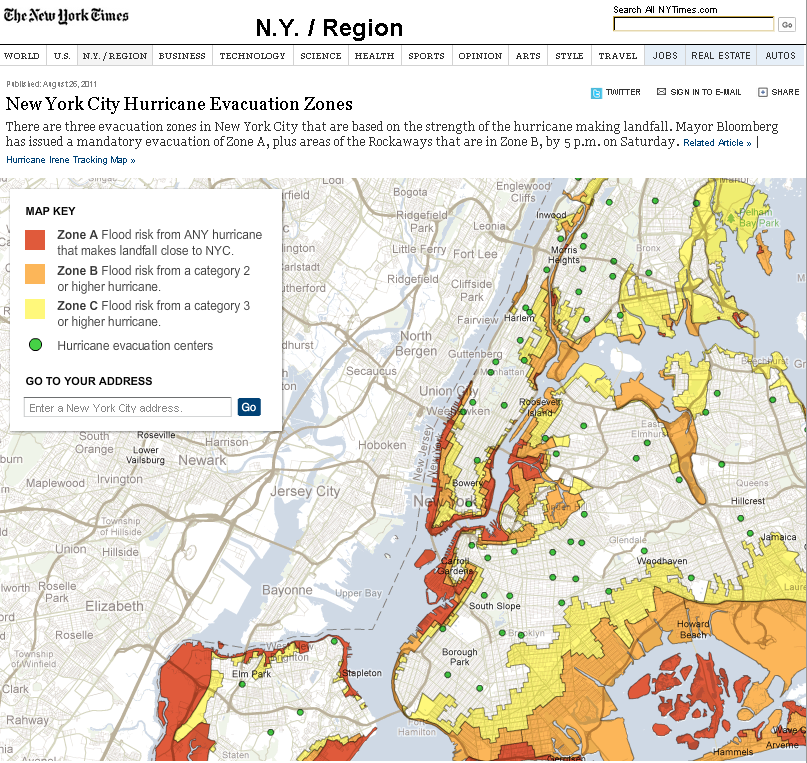
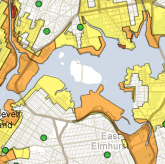
Elizabeth Furth, a former student who has participated in rebuilding efforts in New Orleans, sent in this map showing that Rikers Island is not part of the City’s evacuation plan:

Riker’s Island is the unzoned white blob in this close up:

Mayor Bloomberg announced that Riker’s Island would not be evacuated at a recent press conference, despite the fact that the island is surrounded by areas with the second highest evacuation rating (Zone B).  Other New York islands on the map are in Zone A (mandatory evacuation) or Zone B, but Riker’s has no evacuating rating, perhaps because the Department of Corrections doesn’t have an evacuation plan.  According to the New York Times blog, “no hypothetical evacuation plan for the roughly 12,000 inmates that the facility may house on a given day even exists. Contingencies do exist for smaller-scale relocations from one facility to another.”

Solitary Watch reports that Rikers Island was built on landfill, which is especially vulnerable to disasters. Rikers Island may weather Hurricane Irene without incident, but this disaster has again revealed how prisoners are considered disposable in times of crisis.


Of the many people who did not or could not evacuate New Orleans in the face of Hurricane Katrina, prisoners were especially helpless.  The American Civil Liberties Union gathered testimony from 400 of the 7,000 people locked up in New Orleans Prison at the time of Katrina, including approximately 100 juveniles.

Many reported being left in their cells while the water rose above their heads; being beaten and sprayed with mace once evacuated (to state maximum security prisons); and left on Interstate-10 in the hot sun for days without food or water. An entire building with about 600 prisoners was left behind in the evacuation process and weren’t rescued for days (source).

Most of the 7,000 prisoners had been charged with misdemeanor offenses and would have been released within a few weeks, even if convicted. But Governor Blanco effectively suspended habeas corpus (due process; right to a speedy trial) for six months, so some were incarcerated for over a year – doing “Katrina time.”  “The court system shut its doors, the police department fell into disarray, few prosecutors remained, and a handful of public defenders could not meet with, much less represent, the thousands detained” (source). Prison officials deny that anyone died in the crisis, despite several reports of deaths from both police officers and prisoners (source).

The Orleans Parish Prison continues to have civil rights concerns. In 2009, the Civil Rights Division of the Justice Department found that conditions at OPP violate inmates’ constitutional rights. The report found that prisoners experience violence from other prisoners, excessive force from guards, are not provided adequate medical services, and live in unsanitary conditions with pests.

This hour-long BBC video documents their experiences:

Cross-posted at Caroline Heldman’s blog.  

Caroline Heldman is a professor of politics at Occidental College. You can follow her at her blog and on Twitter and Facebook.

Cross-posted at Reports from the Economic Front.

The mainstream media works hard to convince us that Republicans and Democrats are locked in heated battle, with each side advocating dramatically different economic policies.  Although there are differences between the two sides, members of both parties generally share common ground in opposing any fundamental changes to the workings of our economy.

A recent International Monetary Fund report on the U.S. economy sheds light on why this is so.  The report includes the following four color-coded charts which compare economic recoveries (including our current one) according to various criteria (each recovery is along the left; criteria of recovery are along the top; red = weakest recoveries, green = strongest recoveries).

imf-us.jpg

As you can see from the red boxes in the first chart (the one titled “Real GDP and components”), our last two recoveries have been quite weak compared with previous recoveries in terms of growth in GDP, personal consumption, and investment in nonresidential structures.  This indicates a growing problem with our economic fundamentals.

The red boxes in the second chart (”Households and employment”) indicate that our last two recoveries have also not been kind to working people as measured by the growth in nonfarm payrolls, unemployment, and disposable income.

However, things look quite different in the last two charts. The green boxes in the third chart (”Business sector”) make clear that the last two expansions have generally been good for nonfinancial corporations.  And the dark green boxes in the fourth chart (”Financial”) highlight the enormous gains made by financial corporations in the last two expansions, and especially the current one.

The take-away from these charts is that business leaders experience our recent recoveries very differently than do the great majority of people.  Despite the fact that growing numbers of workers find it hard to distinguish our expansions from our recessions, business profits keep climbing.  And that is what matters to business. Not surprisingly, then, our corporate leaders are lobbying our political leaders hard not to change existing economic arrangements.  If some austerity is needed to maintain stability–so be it.  And, this lobbying has proven successful.

The connection between deteriorating economic and social conditions and high corporate profitability deserves careful study as does the question of whether this is a stable relationship. Regardless, these charts provide important insight into our national policy-making nexus.  As long as our large corporations are prospering we should not expect our political process to produce meaningful change.  The problem isnt a lack of good ideas for how to strengthen our economy and generate jobs, it is the lack of interest on the part of our elected leaders — on both sides of the aisle — to seriously consider them.  It appears that meaningful economic change will have to await either a further unraveling of our economic and social infrastructure or the rise of a powerful social movement with a new economic vision.

August 29th is the anniversary of the day that Hurricane Katrina devastated the Gulf Coast and side-swiped New Orleans, breaching the levees.  These posts are from our archives:

Devastation Then and Now

Racism in the Aftermath of the Storm

See also…

Lisa Wade, PhD is an Associate Professor at Tulane University. She is the author of American Hookup, a book about college sexual culture; a textbook about gender; and a forthcoming introductory text: Terrible Magnificent Sociology. You can follow her on Twitter and Instagram.