Search results for The

The World Health Organization (WHO) defines neurological disorders as physical diseases of the nervous system and psychiatric illnesses as disorders that manifest as abnormalities of thought, feeling, or behaviour. In fact, however, there are longstanding unresolved debates on the exact relationship between neurology and psychiatry, including whether there can be any clear division between the two fields.

Related to this, Brandy B. sent us a figure from the blog Neuroskeptic graphing the proportion of journal articles on various disorders included in The American Journal of Psychiatry versus the journal Neurology over the past 20 years. The image is interesting from a sociological standpoint in that, as Brandy writes, “it says far more about the sociology of these fields than about which disorders can be considered neurological or psychiatric.”
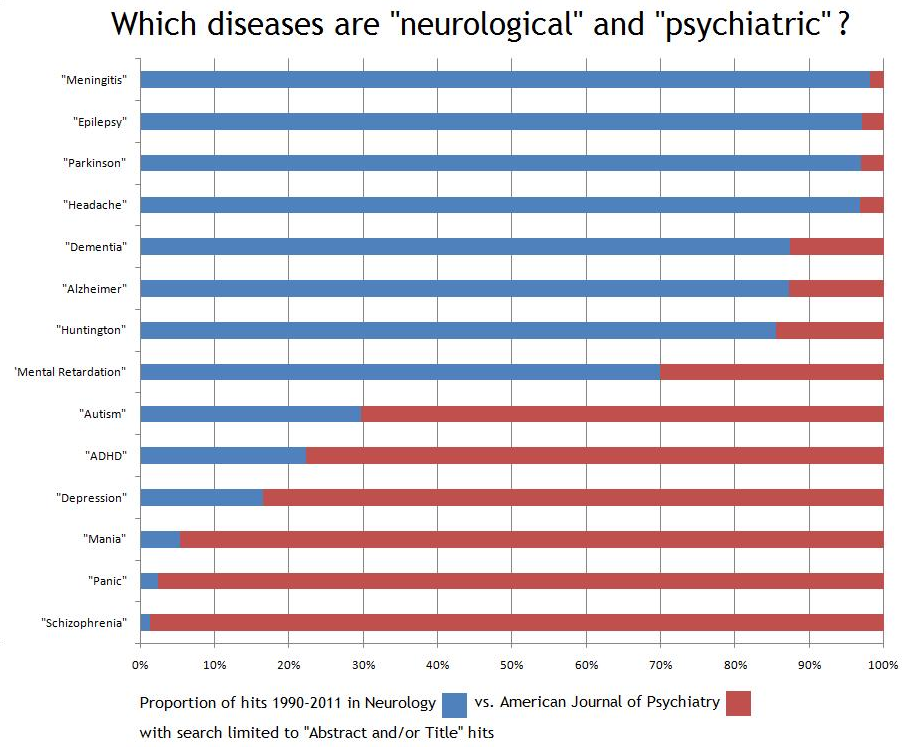
While debates regarding the neurological roots of psychiatric illnesses such as depression and schizophrenia are far from settled, the graph shows that the two disciplines have maintained varying levels of intellectual authority over different disorders. Some fall clearly into one domain or the other, while others are covered in both. Depression, for example, receives more attention than mania in Neurology, despite the fact that mania often occurs alongside depression as a symptom of bipolar disorder.

The information in this graph serves as a reminder that what gets published in academic journals, and the topics over which disciplines exercise authority, are the results of social processes. Disciplines are artificial categories of knowledge, solidified through the creation of institutional structures like university departments, degree programs, and academic journals. Psychiatry, for example, didn’t emerge as a discipline until the 19th century; this emergence was rooted in a social context in Western Europe where rising numbers of people were being institutionalized and attitudes regarding the treatment of mental illness were changing. By claiming membership in disciplines based on common academic backgrounds, research methodologies, and topics of study, scholars contribute to the reproduction of these disciplinary boundaries.

The peer-review process is one facet of this social reproduction of disciplinary boundaries that is particularly relevant to the image above. Research and papers that are submitted, accepted, and funded must appeal to reviewers and conform to the criteria set out by the journal or discipline within which researchers wish to publish. In the case of neurology and psychiatry, it appears based on this graph that the peer-review process may uphold disciplinary boundaries, as reviewers for each discipline’s journal appear to favour articles on certain disorders.

The divisions between neurology and psychiatry suggested in the image above stir up lots of interesting questions not only about what we consider to be “neurological” or “psychiatric”, but more generally about the social production of knowledge.

——————————

Hayley Price has a background in sociology, international development studies, and education. She recently completed her Masters degree in Sociology and Equity Studies in Education at the University of Toronto.

If you would like to write a post for Sociological Images, please see our Guidelines for Guest Bloggers.

When I was an undergrad, I remember being assigned the classic article “Body Ritual among the Nacirema,” by Horace Miner. The piece, published in 1956 in American Anthropologist, applies an anthropological lens to an odd culture singularly devoted to intense ritualistic “improvement” of the human body, which its members seemed to find disgusting in its natural state.

I thought of that article when Matt Cornell, of My Own Private Guantanamo, tweeted a link to the 1994 film Dunkles, Rätselhaftes Österreich, or Dark, Mysterious Austria (I’m not. The film, produced for Austria’s SBS-TV, pokes fun at the tone unfortunately common to many documentaries that attempt to explain the oh-so-bizarre customs and beliefs of non-Western societies. According to IMDb, “A team of the All African Television network wanders into the darkest regions of the Eastern Alps. They observe the habits and rituals of the natives and make not one, but two ethnological major break-through discoveries.”

At 5:40, we learn that the team has disproved the theory that Europeans are monogamous; starting at about 7:50, they describe the elaborate costumes and militaristic symbolism of clans of the Tyrol region of Austria; and at 15:00, there’s a great discussion of the curious obsession with “patently useless activities,” such as biking for no other purpose than biking itself:

Aside from the humorous commentary, it’s a great way of illustrating the sociological imagination,  which requires us to step out of our own culture and try to look at it through the eyes of an outsider — and, as C. Wright Mills put it, to recapture the ability to be astonished by what we normally take for granted.

The start of the Fall semester has inspired me to re-post this fascinating phenomenon we covered last year.

—————————

Rigby B. sent a link to the Just4Camp website to show us how care package products were gendered for “only” girls and boys. And, indeed, they were (screen shots below). But what is even more fascinating to me about this is the commodification of care.

The term “commodification” refers to the process by which something done for free becomes something done for money. Ever since the institutionalization of the wage, more and more things have become commodified. One particularly interesting category is care or what sociologists like to call “care work.”

Care work includes all of those tasks that involve nurturing and maintaining others: nursing, parenting, teaching, tending a home, etc. At one time in history, none of these things were paid jobs, but we have increasingly commodified them so that now paid nurses staff hospitals, home care workers take care of ailing elders, children spend the day in day care, professional teachers educate them, and housecleaners and gardeners can be paid to tend our homes and yards.

The care package is an example of care work.  I still remember getting care packages in college with my favorite home made cookies and other things my parents thought I would like or needed.  They take a lot of effort: thoughtfulness, shopping, baking, packaging, and mailing.  And, here, we have an example of the commodification of that effort.  The “care” in “care package” has been, well, outsourced.

Gendered care package ingredients:

For more on commodification, peruse our tag by that name.

Lisa Wade, PhD is an Associate Professor at Tulane University. She is the author of American Hookup, a book about college sexual culture; a textbook about gender; and a forthcoming introductory text: Terrible Magnificent Sociology. You can follow her on Twitter and Instagram.

At his great blog, Work that Matters, Tom Megginson highlighted a pretty stunning commercial.  In it, a woman in a dilapidated mansion looks disgustedly at a mildly repulsive carpet covering a giant room. She resigns herself to pulling it up, revealing a smooth hardwood floor beneath. And she hauls the mass of fibers to the street, only to return to a room newly covered again.

It’s a metaphor for the Sisyphean task of hair removal, of course. So what’s the solution? Well, it’s not rejecting the obviously unrealistic task of being female and hair-free. No. The solution is laser hair removal.

*I stole this fantastic title from Tom.

Lisa Wade, PhD is an Associate Professor at Tulane University. She is the author of American Hookup, a book about college sexual culture; a textbook about gender; and a forthcoming introductory text: Terrible Magnificent Sociology. You can follow her on Twitter and Instagram.

This video, made as part of a marketing campaign for a new shopping center in East London, is a fun overview of a century of some trends in clothing, music, and dance styles, all in 100 seconds. Enjoy!

Via The Hairpin.

Gwen Sharp is an associate professor of sociology at Nevada State College. You can follow her on Twitter at @gwensharpnv.

In a recent interview at The Consensual Project, I was asked if I’d ever seen any “…videos, images, or sound bites that have provided [me] with valuable sexual health information.” I recounted this experience:

There is one video I saw, when I was about 21, that stands out in my mind even today…  The filmmaker asked about 40 women to stand naked, side-by-side, on the edge of a stage.  The camera captured the appearance of their bodies from about the neck to the knees, no faces, just bodies. (I don’t know if it was ever publicly available, but if anyone can send it to me, I’d be thrilled.)

Think about how rarely you actually see a new (near-)naked body that is not a model or the equivalent (actress etc).  With new sexual partners, perhaps.  And if you’re straight, this is (probably mostly) going to be the body of the other sex.  At the gym perhaps?  But you’re not supposed to look, so you probably don’t look closely.  I realized when I saw this video (it probably lasted all of two minutes), that I had never really seen women’s bodies outside of the mass media. I didn’t know what women’s bodies looked like.  And I had been comparing my body to that of actresses and models.  I realized that day that things about my body that I thought were horrible deformities were completely normal.  Even though the bodies in that video were all different, they were also very similar, and my body looked just like theirs in some cumulative way.  From that point on, I knew I wasn’t gross.  A simple lesson.  And so important, but a really hard one to encounter in a powerful way.

I was reminded of this story when I saw a photograph by Spencer Tunick.  Tunick specializes is getting large numbers of naked people together, arranging them, and taking pictures.  Most of them seem more polished than raw, but this one, featured at BoingBoing, seems to reveal bodies in some of their variety and similarity simultaneously.  It’s worth a good long look at each body; each is a precious point of push back against mass media’s representation of the female form.

Lisa Wade, PhD is an Associate Professor at Tulane University. She is the author of American Hookup, a book about college sexual culture; a textbook about gender; and a forthcoming introductory text: Terrible Magnificent Sociology. You can follow her on Twitter and Instagram.

While America has taken great steps in recent decades toward gender equality, this progress seems lacking in politics. No elected legislative body in the U.S. has ever come close to being half female—the proportion we would expect if it were truly representative of the populace. R.W. Connell argues patriarchy is replicated and reinforced partially through our individual gender practices that cumulatively make social institutions operate.  In daily life, all men and women are socially pressured to embody the gender traits prescribed for their sex.

Kathleen Hall Jameson argues the ways we judge others’ masculine and feminine selves creates a double bind dilemma for women in leadership; a problem that is especially salient in politics, where winning is contingent upon candidates being both personally liked and thought of as competent leaders.  Men have no problem being respected both personally and as leaders because acting strong, confident, and in-charge is expected of both males and authority figures.  However, when women present themselves as leaders by acting dominant, they are likely to be judged as overly harsh, or even “bitchy.”  Yet when women act feminine, they are often judged as unfit for authority because they lack leadership qualities.  In electoral politics, it is very difficult for women to walk the tightrope between being a competent leader and also connecting with voters personally.

We can see the double-bind at work in Saturday Night Live’s now famous, or infamous, parodies of Hillary Clinton and Sarah Palin during the 2008 Presidential campaigns.  Tina Fey’s Grammy-winning depiction of Sarah Palin exaggerates femininity, often portraying the former Alaska governor as if she is competing in a beauty pageant.  Amy Poehler’s masculine portrayal of Hillary Clinton as overly-aggressive, combative, and filled with anger exemplifies the other side of the double bind dilemma.  One skit bringing these characters together to speak out against sexism in the campaign is especially revealing:

Fey presents Palin as accommodating, saying “I was so excited when I was told Senator Clinton and I would be addressing you tonight,” to which Poehler-as-Clinton uncooperatively says, “I was told I would be addressing you alone.” Similarly, a capitulating Palin says “Hillary and I don’t agree on everything,” to which Clinton combats “we don’t agree on anything.” Later in the skit, Poehler-as-Clinton takes firm policy stances while Fey-as-Palin gives ‘pageant’ answers. After Clinton speaks out against the Bush Doctrine, Fey as Palin claims “I don’t know what that is.” Clinton says “I believe diplomacy should be the cornerstone of any foreign policy;” Palin responds “and I can see Russia from my house.” In the SNL skit, Palin tells political pundits to quit using words “that diminish us like pretty, attractive, beautiful …” while Clinton interrupts, “harpy, shrew, boner-shrinker.” Throughout the skit Clinton becomes increasingly agitated and then rips apart the podium in anger. Poehler’s masculine portrayal becomes literal when she says “I invite the media to grow a pair, and if you can’t, I will lend you mine.”

The overly-effeminate portrayal of Palin reflects one side of the double-bind where many people judge feminine women as lacking the appropriate characteristics for leadership. On the other side of the double-bind, the unfeminine portrayal of Clinton illustrates how women who act powerful and confident are subject to character attacks. However, because leadership qualities are expected of men, male politicians are not subject to this critique when they act like leaders. For example, Poehler as Clinton describes her “road to the White House” as “I scratched, and I clawed,”—words with negative connotations which would never be used to describe competitive men with ambition.

While political comedy depicting our leaders as inept has been a mainstay of our electoral process since our country’s founding; we should be cognizant that parodies of female politicians often draw upon very real aspects of gender that make it difficult for women to achieve positions of leadership.

———-

Jason Eastman is an Assistant Professor of Sociology at Coastal Carolina University who researches how culture and identity influence social inequalities.

If you would like to write a post for Sociological Images, please see our Guidelines for Guest Bloggers.


Terri Oda, a PhD student in computer science, put together this fun and quick slideshow explaining why sex differences in math ability can’t explain why there are so few women in computer science. It’s great:

Found at Geek Feminism. Thanks to Peter S. for the submission!

Lisa Wade, PhD is an Associate Professor at Tulane University. She is the author of American Hookup, a book about college sexual culture; a textbook about gender; and a forthcoming introductory text: Terrible Magnificent Sociology. You can follow her on Twitter and Instagram.