Search results for The

Attention upper-middle class white women: help save poor Indian women from a life of forced prostitution, all from the comfort of your hammock! Simply purchase some comfy, trendy pants.

(Image from International Princess Project, the organization behind Punjammies)

Aliyah C. wrote to us about a series of photos on a website for a product called Punjammies. The images offer a stark illustration of the racial, classed, and gendered nature of many “development” initiatives.

According to their website, Punjammies claims to offer Indian women who have escaped forced prostitution a chance to rebuild their lives by providing them with the marketable skill of manufacturing clothing.

Images in the Punjammies catalogue make it clear who the target market is: They feature exclusively white women, luxuriously lounging about in Punjammies attire.

Meanwhile, images on the “About” page depict the women purportedly empowered by this operation, conducting manual labour to produce Punjammies products.

Consumerism-driven development initiatives like Punjammies fail to challenge the inherent inequalities at play in a situation where wealthy, white women in the developed world are seen as benevolent and charitable for making a purchase, while women in developing countries manufacturing the products are portrayed as beneficiaries. Furthermore, as Barbara Heron might argue, Punjammies is a prime example of how development initiatives often play into notions of white female subjectivity as compassionate and caring, dependent upon the Othering of women of colour in the south.  In fact, since colonialism, the advantages that accrue to those of us in developed countries have been linked to the disadvantages faced by the rest of the world. Our economies are not separate entities, they are intimately linked.

Reflecting upon images like these should remind us to remain critical of the ways in which “development” is marketed to us, and how it can perpetuate rather than challenge inequalities.


Reference: Heron, B. (2007). Desire for Development: Whiteness, Gender and the Helping Imperative. Waterloo: Wilfred Laurier University Press.

Hayley Price has a background in sociology, international development studies, and education. She recently completed her Masters degree in Sociology and Equity Studies in Education at the University of Toronto.

In honor of the American Sociological Association’s annual conference kicking off at Caesar’s Palace today — and because of my tweet about a Baudrillard-inspired drinking game — I am reposting this hilarious mistake on the part of the U.S. Postal Service.

———————————

A few years ago, my friend Brady introduced me to postmodernist theorist Jean Baudrillard’s arguments about hyperreality. Without getting into the details of semiotics or postmodernism, hyperreality refers to a situation where the signs (particularly media images) used to represent reality become more real to us than the original reality they were supposed to represent.

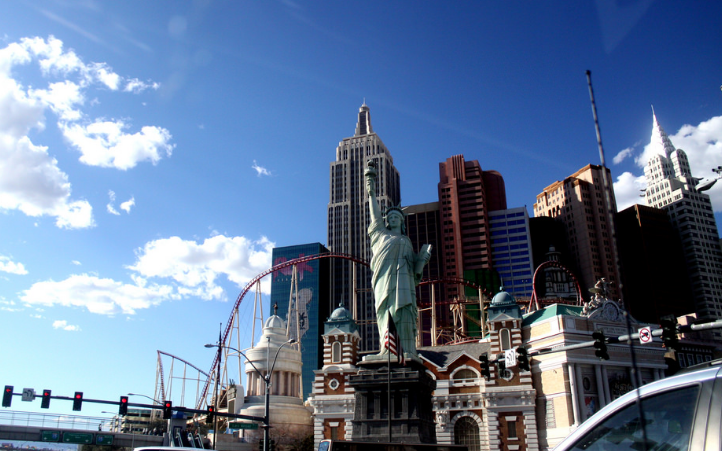
Soon after that, I was waiting to cross the street on the Strip here in Vegas and overheard a young woman remark to a friend that after visiting the New York-New York casino, she felt just like she’d actually been to New York. Her friend enthused, “I know! I don’t know why we’d ever even need to go there now! I feel like we’ve already seen it.”

I don’t know if Baudrillard discussed Las Vegas — Disneyland and L.A. were his favorite examples, from what I can tell — but you could certainly teach an entire class on hyperreality using Vegas as your case study.

Baudrillard came to mind when we read a BoingBoing article about a mistake from the U.S. Postal Service. The USPS recently released this stamp:

So, a stamp feature the Statue of Liberty. Nothing shocking there. Except…it turns out the image on the stamp isn’t based on the actual Statue of Liberty. A perceptive stamp collector realized that the image is actually of the replica of the Statue of Liberty that stands outside the New York-New York casino:

Flickr creative commons Gage Skidmore.

Close-ups reveal distinct differences between the original and the replica: the facial features are more defined on the replica, and the hair, the proportions of the arm, and folds of the clothing are different.

The U.S. Postal Service produced the stamp and released it along with information about the history of the actual Statue of Liberty. And thus we have a representation (the stamp) of a representation (the photo that served as the model for the stamp) of a representation (the replica statue in Las Vegas) of the original thing the Postal Service intended to portray…and no one there caught the slippage between the intended reality and the representation at any point in the production process.

I think Baudrillard would get a kick out of this.

For more on hyperreality, see Baudrillard’s book Simulacra and Simulation. Also, for more on Vegas and simulation, you might check out Norman Denzin’s article “Rain Man in Las Vegas,” in Symbolic Interaction v. 16, p. 65-78 (1993).

Gwen Sharp is an associate professor of sociology at Nevada State College. You can follow her on Twitter at @gwensharpnv.

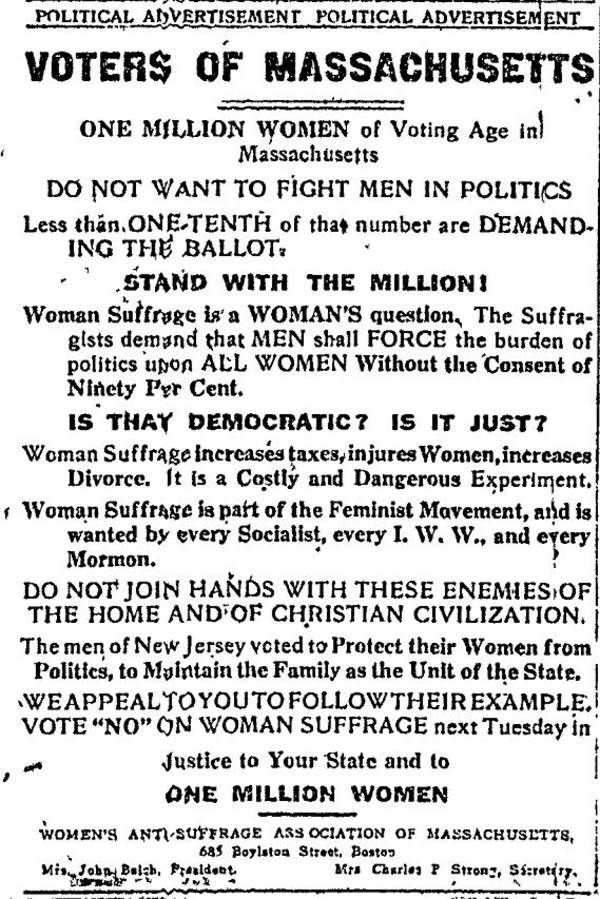
The vintage clipping below is a political advertisement from 1915 opposing women’s suffrage in Massachusetts. It claims that most women in the state do not want the vote, so if voting men gave women suffrage, they would be doing so against their will.  This, they claim, would be undemocratic.   This sounds ironic, but it makes sense in a world where men were suppose to be women’s political representatives.

The ad then goes on to try to demonize those women who do want the right to vote by associating them with other groups widely stigmatized at that time: feminists, of course, but also socialists, Mormons, and members of the I.W.W. The acronym stands for Industrial Workers of the World, an organization founded in 1905 as an alternative to the American Federation of Labor, reportedly consisting of anarchists, socialists, and union members (wiki).

Women in Massachusetts would be granted the right to vote on this day, August 18th, five years later, not by the residents of the state, but by Federal decree.

Via BoingBoing.

Lisa Wade, PhD is an Associate Professor at Tulane University. She is the author of American Hookup, a book about college sexual culture; a textbook about gender; and a forthcoming introductory text: Terrible Magnificent Sociology. You can follow her on Twitter and Instagram.


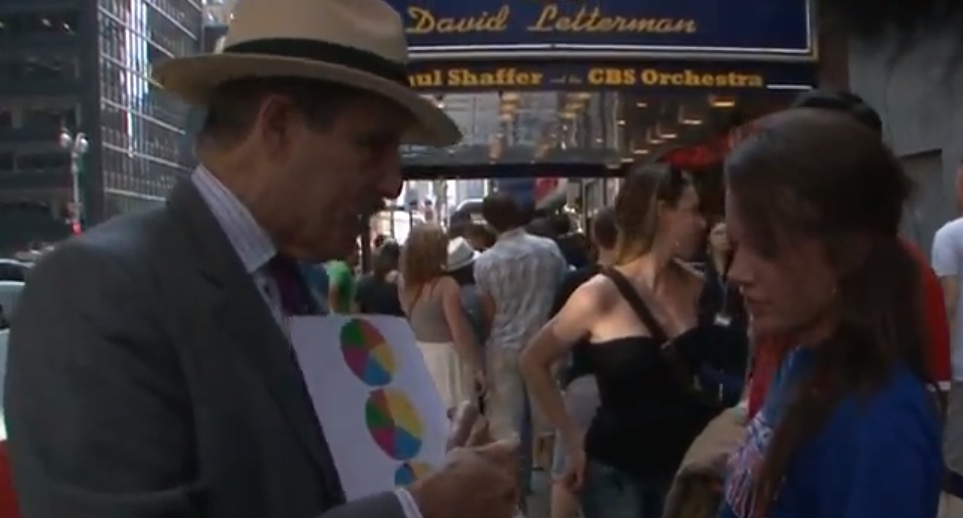
Katrin let us know about this great clip from PBS News Hour (and posted at Boing Boing) about inequality and Americans’ perceptions about how wealth is distributed in the U.S. It’s a great clip:

PBS posted the pie charts used in the video as well.

Erg. Ugh. Just…[cringe]. That is my reaction upon seeing a clip (first posted at Jezebel), sent in by Dmitriy T.M., of a segment from a recent episode of the reality show Bachelor Pad. The show is a spinoff of the popular shows The Bachelor and The Bachelorette, consisting initially of 20 former contestants from those two shows, one of whom is voted off by the rest of the cast each week. This week, the contestants indicated their votes for who should leave by getting to anonymously throw paint-filled “eggs” at others’ backs. But in case that wasn’t sufficiently humiliating, the host also had contestants throw eggs in response to the question “Who are you least attracted to?” Here’s the segment with the women:

It’s a depressing illustration of the current TV obsession with public humiliation and bullying as entertainment. It’s hard not to feel for Erica as she stands there feeling each successive hit, being publicly held up as the least desirable woman there. But her response is also revealing; it exemplifies the way women are encouraged to think of themselves as being in competition. At 2:54 Erica talks about the experience and the difficulty of having a body that, while appearing incredibly thin to me, in that environment qualifies as notably curvaceous.

But in her ability to defend herself and push back against the judgments of others, she falls back on a common strategy: not questioning the standards of beauty themselves, but simply trying to refocus them, in this case (at about 3:05) pointing to another woman who is “way bigger” and not “that pretty.” The result is to reaffirm both the idea that body size is an objective and essential measure of attractiveness (so being bigger automatically should make you less attractive than a smaller woman) and that women’s self-esteem and resistance to negative judgments of their own attractiveness must come at the expense of other women, with whom them are always, and inevitably, in competition.

Cross-posted at Montclair SocioBlog.

I am a Londoner. A proud East Londoner, hailing from the working class. And this past week has been one of the most difficult I’ve encountered since I moved to the US nearly ten years ago.  This weekend my hometown was attacked by rioters, just minutes away from my family’s homes and businesses, my high school and a million childhood and teenage memories.  I don’t think I can do justice describing the feeling of watching this unfold from so far away.  Needless to say, I wouldn’t wish the experience on anyone.  Thankfully, it would appear that most of the violence has subsided. In its place: a myriad of social commentaries on why this happened.  Not only from journalists, but from the everyman benefitting from the very same social media that helped rioters coordinate.  Indeed, many sociologists have aired their ideas on Facebook, blogs and even op-eds.

But perhaps in our rush to explain and apportion blame perhaps we all missed asking some important questions.  Why did we assume that the rioters are poor?  How do we really know the class background of the rioters?  Why did the media depict the rioters as underprivileged? And why did we accept this depiction unquestioningly?

The sociologist in me fantasizes of a post-riot 10 question survey to be distributed to all rioters immediately after completion of law breaking activities with questions including: what is your average household income, what is your and your parent’s highest level of education, what is your occupation, on a scale of one to ten just how angry with the government are you at this moment, ten being really jolly pissed off?


Short of such a research tool, how did we come up with generalizations of a group of people we really know little about, except for the fact that they all rioted?

As someone who has lived in both nations, I feel class is certainly a nuanced thing in Britain, much more so than in the US. But even with the subtleties of the British system you cannot simply see class.  And for the most part, all the information we initially had about rioters is what we saw on TV and in still photographs.

We just cannot tell.  If you thought you could tell, you’d be guessing, and you’d be basing your decision on ideas you have about the poor.  Some might point to history; past rioters have tended to be from the working classes. But this only offers us the ability to make a prediction. But, most commentaries did not acknowledge that they were predicting who was involved.  Some might argue that those wearing hoodies are poor, as the wearing of hoodies has become synonymous in the British press with certain low-income groups.  But people of all class groups own hoodies.  We also cannot surmise simply from a picture that the rioters were from the area they attacked and attempt to extrapolate social class from that location.  Indeed, early police reports indicate that in some cases there was organized travelling to targeted areas and in my home borough of Waltham Forest, initial records show that more than half of those arrested did not live there.  So how do we ascertain the social class of the rioters?  Their behavior?

Did we see violence, looting and vandalism and assume that this could only be the work of poor people, and passively accepted the media’s categorization of the perpetrators as such?  Or are we so blinded by our ideological beliefs, romanticizing the riots to be exactly what Marx warned us of that we bought this generalization? Or do we want so desperately to blame governmental cuts against the poor that we ignore the lack of solid evidence as to who these rioters really are?  Or did we simply map on our understanding of other riots, and assume that all rioters are the same?  I don’t have the answer to these questions, but think it is worth considering why we made the assumptions we did about the rioters when we had little to no data.

As I write this, on Friday 12th August, long after many of the commentaries have been published and opinions have been shared, news outlets are beginning to report the demographic information of the rioters who have appeared in court. (Go here and click on “Get the data”; sorry for the broken link earlier!)

Among those rioters who fit the stereotype  — alienated, poor youth — are those who do not fit this type at all. They have already been the subject of several headlines: teachers, an Olympic ambassador, a graphic designer, college graduates and a “millionaire’s daughter.”  The very fact that these “unusual suspects” have been singled out by the press demonstrates the power of this prejudice; we are shocked when it isn’t poor people rioting.  But why? Is it because deep down we believe that the poor are capable of violence, but the rich aren’t? Or is it because this riot is more complex than simply the rage of downtrodden people?

At this point, we are far from really knowing the class backgrounds of the rioters, especially since many people have not, and probably will not, be caught for their actions. We are still without reliable data to draw conclusions, just as we were earlier in the week when so many of us rushed to attribute this rioting to disenfranchised youth. I am not arguing that class won’t be an important factor in our understandings of these riots, and it may well be that these riots were mostly poor people. But my point is we cannot say with certainty at this moment in time that this is the case. And as an East End girl, I ask: what does it say about us, especially sociologists, that we were so willing to believe this about the poor without any solid data?

UPDATE: Kat provided a link to some data that wasn’t available when the post was being written. The Guardian mapped the home addresses of those arrested in the riots; the results indicate that they appear to have been disproportionately, though not solely, from areas that are poor — and getting poorer. Of those arrested, for instance, 41% came from the top 10% of areas when ranked by levels of deprivation.

Faye Allard is an Assistant Professor of Sociology at Montclair State University.  When not busy winning teaching awards, she is working on a book about the African American gender gap in high school educational achievement, called “Mind the Gap.”

In case you were wondering whether some people continue to conflate Blackness with criminality, listen to Historian David Starkey in this BBC interview about the London riots (key language transcribed below; start at 1min and stop at 2min for an idea). Trigger warning:

Transcript of selected phrases:

A particular sort of violent, destructive, nihilistic, gangster culture has become the fashion. And black and white, boy and girl, operate in this language together… A Jamaican patois that has intruded in England… literally a foreign country… It’s not skin color, it’s cultural…

Starkey has made a career saying offensive things; he appears to hate everyone except for white gay men (which is what he is).  So it’s no surprise that he is the one saying these things. Still, his long career as a cultural critic and pundit suggests that producers believe that there is a market for hateful language.  That market is likely composed of both people who find offense and draw attention to Starkey in order to oppose his views, and people who agree with him and are pleased to hear a famous PhD saying what they believe.

In a perfect world no one would say these types of things but, in a non-perfect world, perhaps it’s good that occasionally people do.  It’s an opportunity to have a conversation about our collective values.  Then again, this is easy for a white person to say.  As a committed anti-racist, these words are hard for me to hear. But they no doubt resonate painfully deep in the heart of many of the people targeted by this venom, another twist of the knife in a lifetime of personal and political wounds.

Thanks to Laura F., Ernie P., and Jari P. for suggesting we write about this.

Lisa Wade, PhD is an Associate Professor at Tulane University. She is the author of American Hookup, a book about college sexual culture; a textbook about gender; and a forthcoming introductory text: Terrible Magnificent Sociology. You can follow her on Twitter and Instagram.

Editor’s Note: Christie W.,  Michel E., Andrew S., and an anonymous reader asked us to write about the recent discussion of Thylane Loubry Blondeau.  We’re pleased to feature a guest blogger doing just that.

There is no shortage of sexualized images of girls in American culture.  Shows like TLC’s Toddlers and Tiaras frequently contain over-the-top sexualized portrayals of girls.  Images like these are undeniably sexualized.

However, these images of Thylane Loubry Blondeau, a 10-year-old French model making headlines this week, are creating controversy instead of condemnation.  Some argue that, unlike the child beauty queens, the photographs of Blondeau are art.  There is an interesting class effect here; unlike the hypersexualized girls on shows like Toddlers and Tiaras, the photos of Blondeau are high fashion, therefore high class, and therefore acceptable.

I’m no prude.  I think that children are – and have a right to be – sexual beings.  However, there is a difference between sexuality (feeling sexual) and sexualization (being seen as sexy). I (and many other like-minded feminists) believe that girls should be sexual; but, sexualization (and its concomitant focus on appearance instead of desire) is bad because it denies girls’ sexual subjectivity in favor of sexual objectification.

There is ample psychological research to support this notion that sexualization is bad.  An American Psychological Association Task Force on the Sexualization of Girls reported in 2007 that sexualization is linked with negative consequences such as disordered eating, low self-esteem, and deficits in cognitive and physical functioning.  These links have been identified in both girls and women – some as young as Blondeau.

Sexualized images like these are troublesome at the societal level as well.  They encourage others to view young girls as objects of sexiness.  Additionally, these images are hugely problematic for girls and women with body image issues.  The fashion industry already promotes the thin ideal.  These pictures of Blondeau push the envelope by explicitly promoting the prepubescent thin ideal, a body type that is wholly unattainable for women.  The normalization of beautifying a 10-year-old’s body type can have potentially disastrous consequences for women’s body image.

It is dangerous to assume that “high fashion” sexualization is “art” and therefore less of an issue than lower class sexualization.  I do not take the paternalistic view that girls should be “protected” against sexualization. Instead, we should work with girls (and boys) to discourage sexualization and to encourage strength, intelligence, and sexual agency.

Images from tvtropesJezebel, and Snob.

Sarah McKenney is a doctoral candidate in developmental psychology at the University of Texas at Austin where she studies gender development and the sexualization of girls.