Search results for The

Dmitriy T.M. sent in a New York Times slideshow of the contents of “MREs” from different countries.   MREs stands for “Meals Ready to Eat”; they are combat rations for soldiers. The rations are each some combination of comfort food, nutrition, and necessity.  And the different contents across countries reveal some interesting similarities and differences.

All MREs include some sort of meat, but the type and form of the meat vary, from meatballs to paté.  Meanwhile, almost all of the MREs include candy; it’s probably cheap, in the big scheme of things, to throw a few skittles, m&ms, or squares of chocolate, but what a treat it must be.  Likewise, the fruit-flavored beverages and tea must be a taste of home.  As for practicality, countries vary in whether they provide moist towelettes, toothpicks, tooth brushes.   Most offer matches; the U.S. includes toilet paper.

That said, the content of rations are also strikingly consistent.  I’ve love to see a flow chart tracing the development of MREs.  Were the logics for these rations developed in isolation?  Or were some countries influential over others?

These are my uneducated observations.  Feel free to offer more informed thoughts in the comments.

Lisa Wade, PhD is an Associate Professor at Tulane University. She is the author of American Hookup, a book about college sexual culture; a textbook about gender; and a forthcoming introductory text: Terrible Magnificent Sociology. You can follow her on Twitter and Instagram.
Comedians exercise a curious privilege, which allows them to peddle controversial conclusions and uncomfortable insights without suffering the usual scorn and admonishment that comes with challenging systems of power or bringing indelicate knowledge about the world to the surface. For instance, the suggestion that Americans are deeply divided by race and class usually causes people to fidget, yet Chris Rock was greeted with laughter and applause when he unabashedly criticized the racialized wealth gap in the United States. Similarly, Louis C.K. received a rousing applause when he discussed his privilege as a white male, and Hari Kondabolu made an entire room burst into laughter by exposing the nonsensical logic underlying stereotypes aimed at Mexican immigrants.

But comedy is just as likely to reinforce stereotypes as it is to criticize them. Consider Jeff Dunham’s act featuring his popular dummy, “Achmed the Dead Terrorist.” In the clip below, from a 2007 performance, Dunham draws upon a number of stereotypes of Arabs and Muslims, many of which have been around since well before the attacks on September 11th, 2001:

Dunham is not deploying social criticism, but is instead uncritically drawing on racist representations for laughs. Arabs and Muslims, like the Achmed character, are typically portrayed as religious fanatics. They are often depicted as irrationally angry, even as self-proclaimed terrorists. But if they are dangerous, they are dangerous buffoons and are often too incompetent to pull off their own deadly plots.

Comedians can be understood as articulators of knowledge about the world. They contribute to the persistence of stereotypes at times, but can also articulate convincing arguments against them. This holds for other types of comedic performance as well. Political cartoons, comedy sketches, and even situation comedies all peddle indelicate knowledge about the racialized Other. For instance, in “Ali-Baba Bound,” a Looney Tunes cartoon from 1940, Porky Pig runs up against Ali-Baba and his “Dirty Sleeves.” The humor is constructed around a basic scaffolding of the Arab as dirty and sneaky. They are too primitive to competently use rockets and must strap explosives to their heads:

The sneak attack on Pearl Harbor the following year ignited a discursive explosion surrounding the Japanese, those living in America and abroad; for a time Arabs and Muslims occupied a relatively small sliver of American concern. It is striking how eerily similar representations of Japanese persons were to those of Arabs and Muslims. However, fed by photographic evidence of the destruction of Pearl Harbor and the tangible realities associated with the American war machine, dominant representations of the treacherous Japanese Other went further and faster. Each representation of the “Jap” became more and more fanciful, each illustration seemingly emboldened by the last to push the caricature even further.

Celebrated children’s author Dr. Seuss published a cartoon only weeks before the United States would forcibly relocate 120,000 ethnic Japanese persons living in the United States to internment camps. The cartoon depicts a buck-toothed, fifth column of Japanese Americans lining up from Washington to California for their very own box of TNT. A man scales the rooftop of the explosives depot “waiting for the signal from home.”

Or consider a Looney Tunes cartoon from the period, “Tokio Jokio,” which similarly presents Japanese people with buck teeth and buffoonish behavior:

Whereas the Seuss cartoon presents extant fears about a treacherous Japanese enemy living among us, the Looney Tunes cartoon lampoons them as bumbling idiots. In the Seuss cartoon, their tribal-like loyalties to the Emperor mean they are capable of doing just about anything, but in the Looney Tunes cartoon they are too incompetent to prevent their own Fire Prevention Headquarters from burning to the ground. Such seemingly contradictory representations permeated the American imagination of the time, alternately stoking anxieties while assuring Americans of their national and even racial superiority.

These racist representations aimed at the Japanese were not buried by the detonation of two atomic bombs over Japanese cities; they have proven to be free-floating and transferable to our emergent enemies. Today, Arabs and Muslims are routinely depicted in comedy as incompetent. They are again the bumbling idiots, simultaneously too stupid to successfully perpetrate an attack and just stupid enough to commit truly heinous crimes. The imagined fifth column has become the terrorist sleeper cell. In 1942 we feared Japanese Americans were blindly loyal to “their” Emperor. Today we are bombarded with ideas about the tribal loyalties of American Muslims. So powerful are these loyalties, it is often suggested, Muslims would happily kill themselves to bring about the demise of Western civilization. The fanatical Middle Eastern suicide bomber is the new banzai charger and Japanese Kamikazi pilot.

A joke making the rounds of the internet goes something like this: “A friend of mine has started a new business. He’s manufacturing land mines that look like prayer mats. It’s doing well. He says prophets are going through the roof.” This joke, Dunham’s comedy sketch, and the Looney Tunes cartoons all mark historical moments when the racialized Other became so thoroughly demonized and devalued in the public consciousness, our undifferentiated “enemies” became so feared for their treachery and immorality, that it became possible to make light of hypothetical and real violence perpetrated against them. One might speculate that it is strangely intoxicating to spot the boogieman tripping on his shoelaces, embarrassing himself, or dying by his own venom. The Achmed character’s tired threat, “I kill you!” is funny, perhaps, because his voice cracks like a thirteen-year-old boy, and we are entertained by the irony that someone so evil could appear so weak.

This comedy, which uncritically trades in the negative stereotypes aimed at Arabs and Muslims and is able to make an audience laugh at references to suicide bombing, is only possible because Arabs and Muslims have been successfully demonized and devalued. Comedians write jokes to get laughs, but they also operate from a space which grants them temporary license to openly discuss controversial ideas. Comedians contribute to the discourse, just as readily they respond to it, and their sets are just as capable of exposing hidden discrimination as reinforcing it.

Lester Andrist is a Ph.D. candidate at the University of Maryland, College Park, specializing in the role of social capital and personal networks in finding jobs in India and Taiwan and cultural representations of groups in indefinite detention. He is a co-editor of the website The Sociological Cinema, where a longer version of this post first appeared.

Gwen Sharp is an associate professor of sociology at Nevada State College. You can follow her on Twitter at @gwensharpnv.


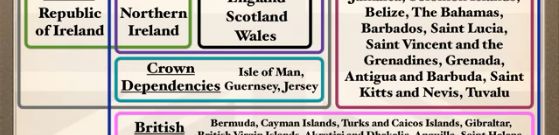
Are you confused about what “Great Britain” really is?  Do you become perplexed when asked to discern the difference between Britain, England, and the U.K.?  And what the heck is Wales!?  (Apologies to Wales.)  You are not alone!  CGP Grey offers an entertaining explanation that both clears up the questions, and makes us feel less stupid for not understanding them in the first place.  And you’ll learn some stunning facts about the residuals of empire.  Enjoy:

And if that wasn’t enough, here’s Grey’s historical rendering of how Scotland became a part of Great Britain.

Via Blame it on the Voices.

Lisa Wade, PhD is an Associate Professor at Tulane University. She is the author of American Hookup, a book about college sexual culture; a textbook about gender; and a forthcoming introductory text: Terrible Magnificent Sociology. You can follow her on Twitter and Instagram.


Renée Yoxon sent along a performance by Patina Miller singing Random Black Girl.  It’s about how new musicals all just so happen to include a soulful, sassy, big-voiced, big-bottomed black girl in the ensemble (I’m looking at you, Glee).

My favorite part is at 3:45.

—————————

Lisa Wade is a professor of sociology at Occidental College. You can follow her on Twitter and Facebook.

Cross-posted at Montclair SocioBlog.

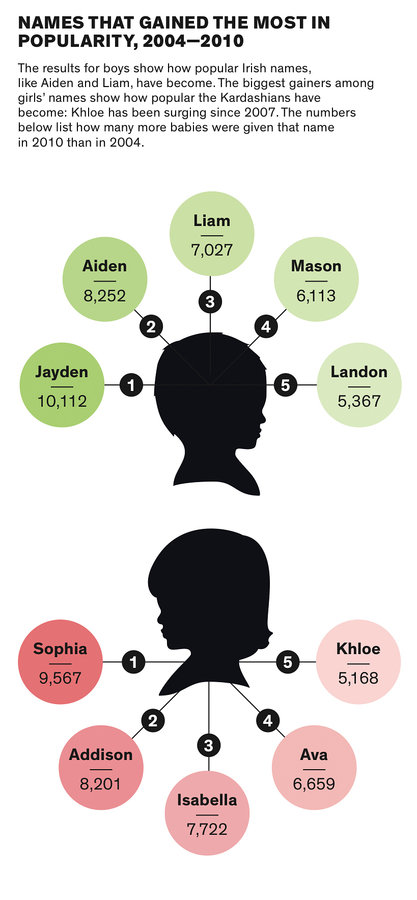
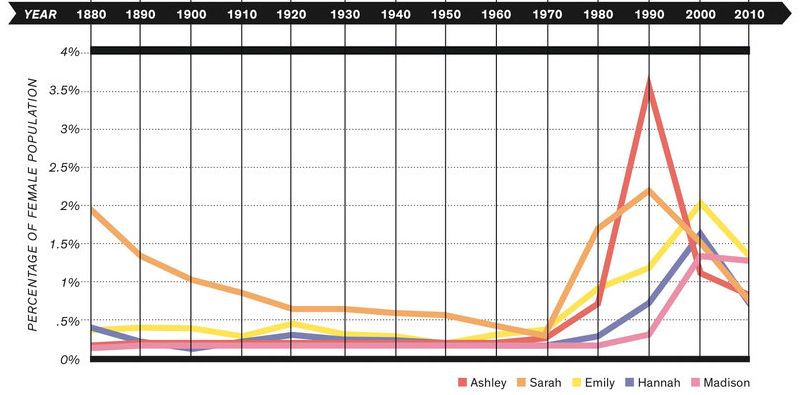
In Sunday’s Times, David Leonhardt, who usually patrols the economics beat, looks at fashions in baby names. His primary focus is the rapid decline in old-fashioned names for girls. The “nostalgia wave” of Emma, Grace, Ella, and other late-nineteenth-century names, he argues, is over.

Well, yes and no. Sarah and Emma may be in decline, but the big gainer among girls’ names is Sophia, an equally nostalgic name that was last popular at the turn of the twentieth century. Isabella, too, (third largest gain) follows the same trend line. Besides, the nostaligia for old names was selective. Emma and Grace may have come back, but many other old-fashioned names never became trendy. One hundred years ago and continuing through the 1920s, one of the most popular girls’ names in the US was Mildred. (You can trace the popularity baby names at the Census website.)

“The lack of recent Jane Austen movies has probably played a role,” says Leonhardt, though he’s probably joking. Not only is Emma still in the top five, but I suspect that films of that persuasion appealed more to the prejudices and sensibilities of post-childbearing women. But the media do have an impact. In Freakonomics, Levitt and Dubner showed how fashions in names often trickle down. The Sophias and Isabellas become stylish first among the upscale and educated; it may be several years, even decades, before they became more widely popular. But the media/celebrity channel can bypass that slow trickle. As Leonhardt says, how else to explain the boom in Khloe?

Similarly, Addison, the second biggest gainer, may have gotten a boost from the fictional doctor who rose from “Gray’s Anatomy” to her own “Private Practice.” In the first year of “Gray’s Anatomy, the name Addison zoomed from 106th place to 28th. The name is also just different enough from Madison, which had been in the top ten for nearly a decade. Its stylishness was fading fast among the fashion-conscious.

Madison herself owed her popularity to the media. She created a big “Splash” soon after the film came out. As Tom Hanks says in the scene below, “Madison’s not a name.” (Stop at the punchline at 3:23 — “Good thing we weren’t at 149th street.” Transcript after the jump).

At the time, the Hanks character was correct. Before “Splash” (1984) Madison was never in the top 1000. The next year, she was at 600. Now she has been in the top ten for nearly fifteen years, and at number two or three for half those years. (There have not yet been any Madisons in my classes. I suspect that will change soon.)

Boys’ names seem governed by somewhat different rules, with less overall variation, though recent trends are towards names with a final “n” (four out of the five big gainers in the chart above) and Biblical names.

In short, these recent changes in girls’ names aren’t about nostalgia.   Name trends are like fashion trends, they come and go. And, like fashion, name trends can be media driven, especially now that media can short-circuit the slower class diffusion process.

Transcript of the Splash joke after the jump:

more...

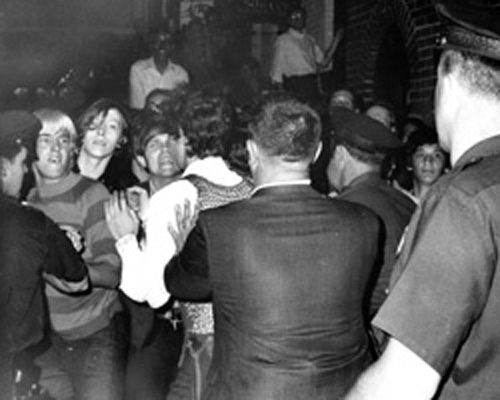
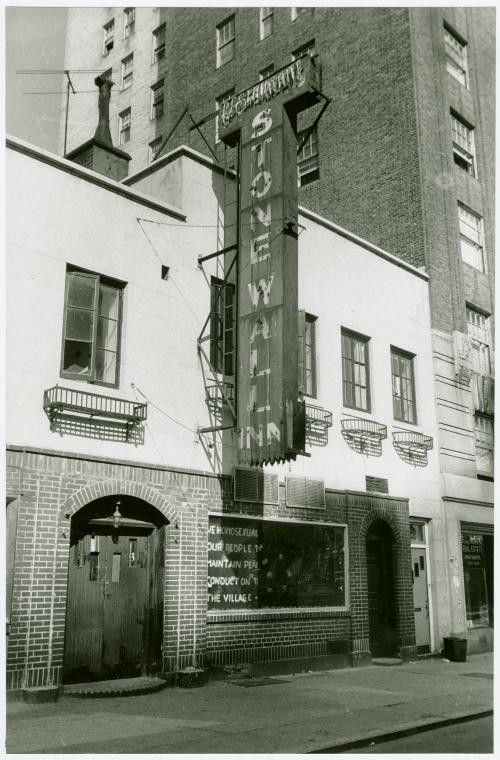
The Stonewall Inn is a bar in Greenwich Village in New York.  In the ’60s the bar was frequented by, among others, gay, lesbian, and transgender locals.  On June 28, 1969, in response to frequent harassment by police, the patrons rioted.  The description on Wikipedia, I must admit, is worth the read.  Suffice to say that the police were roundly trounced.  The riot is often cited as the birth of the LGBT rights movement.

This is purported to be the only photograph of the riot:

And this is a picture of the Inn, three months later, with a sign in the window that reads:

We homosexuals plead with our people to please help maintain peaceful and quiet conduct on the streets of the Village.

Images borrowed from Wikipedia.

Lisa Wade, PhD is an Associate Professor at Tulane University. She is the author of American Hookup, a book about college sexual culture; a textbook about gender; and a forthcoming introductory text: Terrible Magnificent Sociology. You can follow her on Twitter and Instagram.
Originally posted Feb. 11, 2009.  Reposted in honor of the anniversary of the Stonewall Riots.

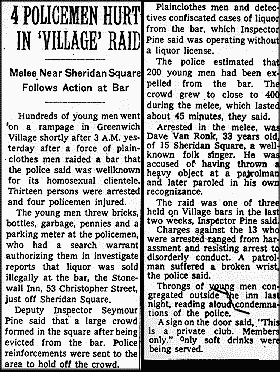
I found a collection of images relating to gay and lesbian studies put together at Columbia University, including this scan of a NYT article on what came to be known as the Stonewall Riots, when crowds reacted violently when police attempted to raid a club on June 28, 1969 (skirmishes continued for several days):

1times1a

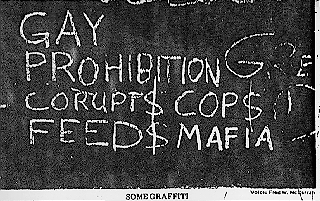
Graffiti from the Stonewall Riots (published in the Village Voice):

voice2

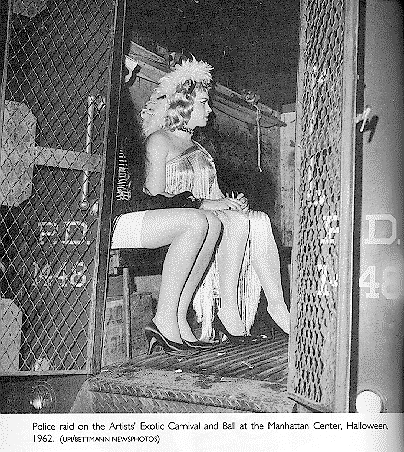
There are also some other good photos unrelated to Stonewall such as this one, from 1962, of entertainers at a drag club being hauled off by police after a raid:

1dub3

The database might be useful if you’re interested in what is generally seen as the start of the gay rights movement.


Last month I posted a video of Mike Rowe, from Dirty Jobs, testifying before Congress about the need to support training programs for the types of difficult, but essential, jobs he highlights on his show. Commenter Annabe let us know about Rowe’s TED talk, in which he discusses some of the lessons he’s learned from doing the show. It’s worth a watch: