Search results for The

Last week I went to see the last Harry Potter movie. I was a bit startled that the pre-movie commercials included this ad (thanks to Melissa H.-J., Tom Megginson, and carlafrantastic for the link!):

I was startled both because I hadn’t expected a Summer’s Eve ad at a Harry Potter showing (the 14-year-old boy I had taken with me seemed to desperately wish he could disapparate on out of there) and by the idea that the most powerful thing in the entire world is women’s vaginas — or, as Melissa points out, men’s desperate desire to get access to them through violence toward one another, with women passively waiting around to see who wins so they know who to have sex with.

And as Tom (who blogs at Work that Matters) says, if someone is going to show their vagina “a little love,” perhaps they would best do so by avoiding irritating, unnecessary products that can actually exacerbate problems like yeast infections.

Summer’s Eve also released several more “Hail to the V” ads (all posted at Gawker), sent in by Leila R., Jamie D., Joel T., YetAnotherGirl, Maeghan D., and Finette. The ads inform women that they need to carry wipes for their genitals with them at all times, because you need to clean yourself down there multiple times a day to avoid being gross; Summer’s Eve helpfully created ads targeting different ethnic groups to be sure everyone understands how important this issue is:

Here’s the African-American version:
[Video removed]
This Latina version:
[Video removed]
And the White version:
[Video removed]
Vertical smile? Are they serious with this? And as Finette says, “They’ve managed to combine ‘less than fresh down there’ vagina-shaming [omg, what subtle hints has your vagina been trying to get your attention with?!] with ethnic stereotypes! Awesome!”

UPDATE: After a lot of criticism, Summer’s Eve has pulled the ads and seems to have gotten them removed from YouTube, so none of the videos we initially posted are available any more. However, Laura S. found a clip from TYT Network discussing the ad campaign, so you can get an idea of what they were like. Thanks, Laura!

My wife introduced me to two television shows, both built on a similar premise but with radically different results.

First, check out this clip from Clean House, airing on the Style Network.

Now, compare that to this ad for Hoarders, airing on the A&E Network.

This is a wonderful example of medicalization. We have people engaging in almost the exact same behavior, but their actions are interpreted in two diametrically opposed ways. Clean House generally (though not exclusively) frames their subjects as having poor habits that, with a little tough love, can be corrected. Hoarders, on the other hand, frames their subjects as having serious mental illnesses. Indeed, they regularly bring in clinicians to treat their subjects. The former invokes judgment (note the eye-rolling and smirking in the first clip), while the latter invokes sympathy (hear the dire music).

Our behaviors do not come with meaning necessarily embedded in them. We have to made sense of them, and the way that we ultimately do so has consequences. We did this in the past with the behavior of children, particularly of little boys. Is Johnny being rambunctious? There once was a time when Johnny was sent to the principal’s office for a spanking, but today, he is much more likely to be diagnosed with ADHD and given a pill. As we medicalize more and more in our society, our acceptance of and reaction to our behaviors change.

————————

Bradley Koch, PhD, is an assistant professor of sociology at Georgia College. Brad primarily studies religion but is also interested in sexuality, stratification, teaching and learning, and higher ed. Brad muses, appropriately enough, at Brad’s Blog.


If you would like to write a post for Sociological Images, please see our Guidelines for Guest Bloggers.

Last week I posted the results of a survey that found that many beneficiaries of government programs don’t recognize themselves as participating in a federal program at all. For instance, 60% of respondents who have written off their mortgage interest on their taxes didn’t see that as a government benefit or themselves as program beneficiaries. Basically, programs and policies that are disproportionately used by the middle- and upper-classes are taken for granted. I wrote,

…allowing you to write off mortgage interest (but not rent), or charitable donations, or the money you put aside for a child’s education, are all forms of government programs, ones that benefit some more than others. But the “submerged” nature of these policies hides the degree to which the middle and upper classes use and benefit from federal programs.

Brian McCabe, over at FiveThirtyEight, recently wrote a post about who benefits from the mortgage interest tax deduction program, which remains enormously popular among the general public. McCabe says,

Commentators often talk about the mortgage interest deduction as a prized middle-class benefit that enables households to achieve the American dream of homeownership. But despite their strong support for the deduction, middle-class Americans are not the primary beneficiaries of this federal tax subsidy.

If you aren’t familiar with the program, basically when you’re doing your taxes, you are allowed to reduce your taxable income by subtracting the amount you paid in mortgage interest that year. Home ownership isn’t treated equally — the tax deduction is worth more as the price of the home, and thus the amount of interest paid, goes up. McCabe points out that in 2009, this program meant that the federal government took in about $80 billion less than it would have otherwise, making it one of the most expensive tax policies and the single most expensive deduction offered to homeowners (much more than deductions for putting in energy-efficient windows, etc.).

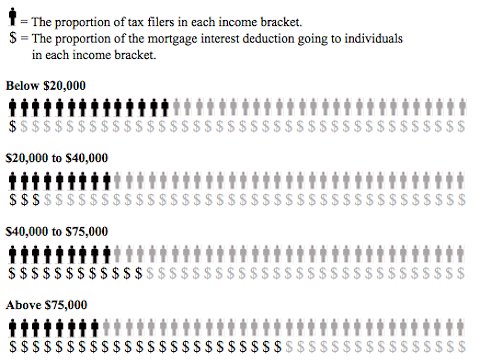
But this expensive program is disproportionately used by relatively wealthy individuals. For instance, about a quarter of taxpayers making $40,000 – 50,000 a year claim the deduction, while over 75% of those making above $100,000 a year do:

The differences in usage is partly because the wealthy are more likely to own* homes. In addition, those with lower incomes generally buy cheaper houses and often find that they reduce their taxable income so little by writing off the mortgage interest that they’re better off taking the standard tax deduction than to itemize.

Because wealthier individuals are more likely to use the program at all, and when they do, generally have more mortgage interest to deduct, the benefits of the program go disproportionately to those with higher incomes. This image shows the proportion of all tax filers that fall into each income category, and the proportion of the total tax deduction benefit that goes to each category:

This is similar to what we see with farm subsidies: while small- and mid-sized farms benefit, the money spent on the program disproportionately goes to the largest farms.  The mortgage interest deduction program is discussed as a method for helping the middle-class achieve the American Dream of homeownership. And certainly it does make home ownership more attractive to many middle- and lower-income individuals. But it overwhelmingly benefits upper-income home buyers, at a significant loss of tax income for the federal government.

* On a side note, I find it odd that we say someone “owns” their home when they owe a mortgage on it. The second I signed a mortgage last year, I entered the much-praised category of the home-owning citizen. Yet as my mortgage-hating farm family has made me very aware, I’m not even close to truly owning my home at this point; I’m more of a special category of rent-to-own resident whose landlord is the bank or mortgage company.

If you’re not writing a dissertation or taking care of twins, you might have heard that News of the World, a tabloid newspaper in the U.K., has been gathering news by illegally listening to people’s voicemail messages. News of the World is owned by Rupert Murdoch’s firm News Corporation, the second largest media company in the world. News Corporation also owns Fox. This is a great natural experiment testing the potential problems with media consolidation, the fact that more and more media outlets are owned by fewer and fewer companies.

So how does Fox report on this scandal? Rob Beschizza, writing for BoingBoing, highlighted a segment on Fox News in which the host and guest agree that “hacking scandals” are a “serious… problem” and imply that, in this instance, News of the World was the victim, not the perpetrator.  More, the guest “expert” is not a politician, scholar, or even a pundit, he’s actually a public relations professional who specializes in spinning scandals to obviate the negative consequences for corporations. Says James Fallows at The Atlantic:

He is Robert Dilenschneider, former head of Hill and Knowlton and now head of the Dilenschneider Group, who recently was featured in an interview, “How to Manage a PR Disaster.”

So Fox is having an expert on spin as a guest, who just so happens to spin the scandal about their parent corporation:

Partial transcript:

The NOTW is a hacking scandal, it can’t be denied. But the real issue is, why are so many people piling on at this point? We know it’s a hacking scandal, shouldn’t we get beyond it and deal with the issue of hacking? Citicorp has been hacked into, Bank of America has been hacked into, American Express has been hacked into, insurance companies have been hacked into, we’ve got a serious hacking problem in this country, and the government’s obviously been hacked into, 24,000 files.

The bigger issue is really hacking and how we as the public going to protect our privacy and deal with it. I would also say, by the way, Citigroup, great bank. Bank of America, great bank. Are they getting the same attention for hacking that took place less than a year ago, that News Corp is getting today?

Of course, as Beschizza at BoingBoing points out, Citigroup and Bank of America were hacked into, whereas News of the World did the hacking.  It’s also an interesting use of the word “hacking.”  Beschizza continues:

Though we all use the term “hacking” broadly, punching in a default PIN number isn’t quite the same thing as the skills required to hack into banks and governments. You can’t pretend these are the same class of problem, unless you’re happy being ignorant of the crisis management issues on which you are being presented as an expert.

Use of the term, then, makes the illegal activity seem more like the mischief of a techy teenager or the nefarious work of anti-establishmentarians, not the plain ol’ straightforwardly criminal behavior it is.

See also: Shameless promotion of the movie, Tinkerbell, at Good Morning America.

Lisa Wade, PhD is an Associate Professor at Tulane University. She is the author of American Hookup, a book about college sexual culture; a textbook about gender; and a forthcoming introductory text: Terrible Magnificent Sociology. You can follow her on Twitter and Instagram.

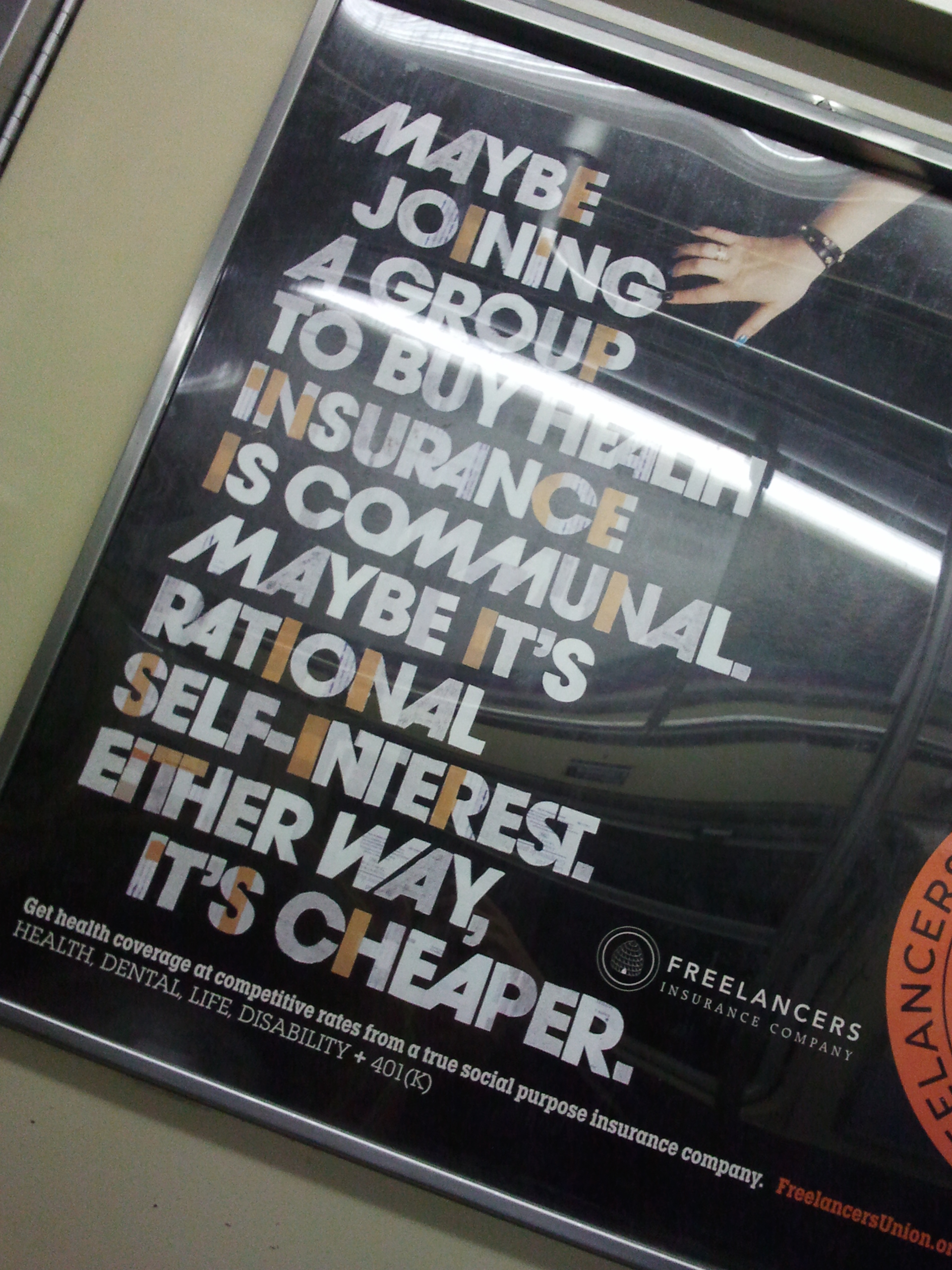
An anonymous reader snapped a photo of this ad for Freelancers Insurance Company in the NYC subway.  The ad reads: “Maybe joining a group to buy insurance is communal.  Maybe it’s rational self-interest.  Either way, it’s cheaper.” With the phrase “either way,” the ad draws on a common juxtaposition: the idea that putting the group first is equivalent to sacrificing your own interests.

Certainly in some cases it’s true that privileging the collective hurts the individual, but this certainly isn’t always true.  Yet Americans consistently receive the message that it is rational (i.e., maximizes our personal well-being) to put ourselves first.  A University of Minnesota campaign to encourage students to get the flu shot — “Do it for the herd”— is a nice counter-example.  In some other societies the idea that one should sacrifice the self for others, and even the idea that doing for others is good for you, is a more common cultural theme.

Lisa Wade, PhD is an Associate Professor at Tulane University. She is the author of American Hookup, a book about college sexual culture; a textbook about gender; and a forthcoming introductory text: Terrible Magnificent Sociology. You can follow her on Twitter and Instagram.

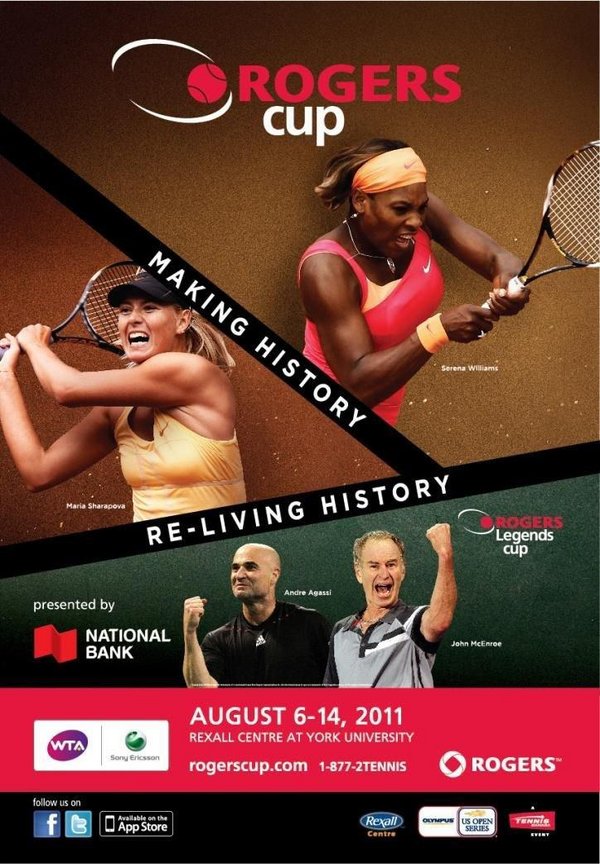
Lindsay C., Christie W., and Dolores R. sent in an ad for the Rogers Cup as well as the Rogers Legends Cup (a new event that isn’t specifically named in the ad) that succinctly sums up the tendency to downplay female athletes’ achievements and treat them as less serious athletes than men. You might come to watch the “ladies,” but it’s the men who are the legends you should really stick around to see (via Feministing):

After a number of complaints, Tennis Canada released an apology and a revised version of the ad (via The Maddow Blog):

Really, it’s possible to advertise both men’s and women’s events without appearing to belittle one of them. It’s not that hard.

Rising Immigration and Intermarriage

Today we see both increased immigration and rising rates of intermarriage. In 1960, less than 1% of U.S. marriages were interracial, but by 2008, this figure rose to 7.6%, meaning that 1 out of every 13 U.S. marriages was interracial. If we look at only new marriages that took place in 2008, the figure rises to 14.6%, translating to 1 out of every 7 American marriages.

The rising trend in intermarriage has resulted in a growing multiracial population. In 2010, 2.9% of Americans identified as multiracial. Demographers project that the multiracial population will continue to grow so that by 2050, 1 in 5 Americans could claim a multiracial background, and by 2100, the ratio could soar to 1 in three.

At first glance, these trends appear to signal that we’re moving into a “post-racial” era, in which race is declining in significance for all Americans. However, if we take a closer look at these trends, we find that they mask vast inter-group differences.

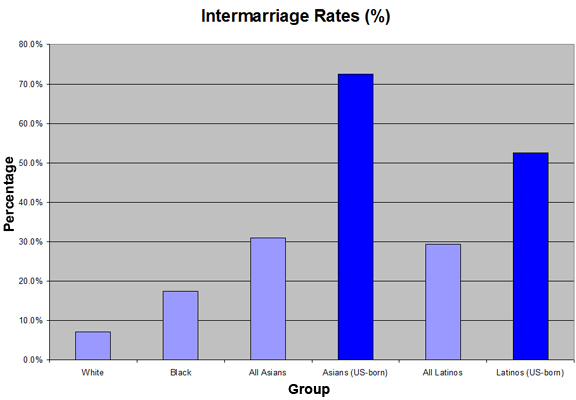
For instance, Asians and Latinos intermarry at much higher rates than blacks. About 30% of Asian and Latino marriages are interracial, but the corresponding figure for blacks is only 17%. However, if we include only U.S.-born Asians and Latinos, we find that intermarriage rates are much higher. Nearly, three-quarters (72%) of married, U.S.-born Asians, and over half (52%) of U.S.-born Latinos are interracially married, and most often, the intermarriage is with a white partner. While the intermarriage rate for blacks has risen steadily in the past five decades, it is still far below that of Asians and Latinos, especially those born in the United States.

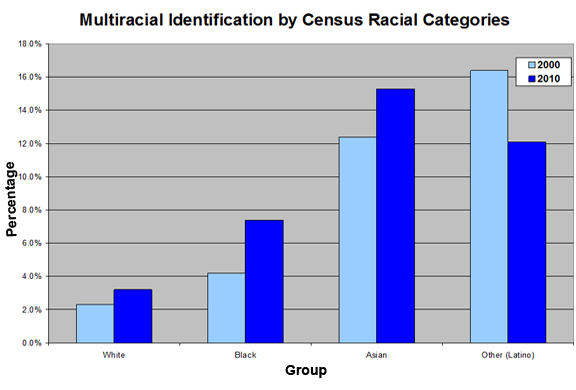
The pattern of multiracial identification is similar to that of intermarriage: Asians and Latinos report much higher rates of multiracial identification than blacks. In 2010, 15% of Asians and 12% of Latinos reported a multiracial identification. The corresponding figure for blacks is only 7 percent. Although the rate of multiracial reporting among blacks has risen since 2000, it increased from a very small base of only 4.2 percent.

The U.S. Census estimates that about 75-90% of black Americans are ancestrally multiracial, so it is perplexing that only 7% choose to identify as such. Clearly, genealogy alone does not dictate racial identification. Given that the “one-drop rule” of hypodescent* is no longer legally codified, why does the rate of multiracial reporting among blacks remain relatively low?

Patterns in Racial/Ethnic Identity

These are some of the vexing questions that we tackle in our book, The Diversity Paradox, drawing on analyses of 2000 Census data, 2007-2008 American Community Survey, as well as 82 in-depth interviews: 46 with multiracial adults and 36 with interracial couples with children.

Turning to the in-depth interviews with the interracial couples, we found that while all acknowledged their children’s multiracial or multiethnic backgrounds, the meaning of multiraciality differs remarkably for the children of Asian-white and Latino-white couples on the one hand, and the children of black-white couples on the other. For the Asian-white and Latino-white couples, they may go to great lengths to maintain distinctive elements of their Asian or Latino ethnic and cultural backgrounds, but they believe that as their children grow up, they will simply identify, and be identified as “American” or as “white,” using these terms interchangeably, and consequently conflating a national origin identity with a racial identity.

The Asian-white and Latino-white respondents also revealed that they can turn their ethnicities on and off whenever they choose, and, importantly, their choices are not contested by others. Our interview data reveal that the Asian and Latino ethnicities for multiracial Americans are what Herbert Gans and Mary Waters would describe as “symbolic”—meaning that they are voluntary, optional, and costless, as European ethnicity is for white Americans.

By contrast, none of the black-white couples identified their children as just white or American, nor did they claim that their children identify as such. While these couples recognize and celebrate the racial mixture of their children’s backgrounds, they unequivocally identify their children as black. When we asked why, they pointed out that nobody would take them seriously if they tried to identify their children as white, reflecting the constraints that black interracial couples feel when identifying their children. Moreover, black interracial couples do not identify their children as simply “American” because as native-born Americans, they feel that American is an implicit part of their identity.

The legacy of the one-drop-rule remains culturally intact, explaining why 75-90% of black Americans are ancestrally multiracial, yet only 7% choose to identify as such. It also explains why we, as Americans, are so attuned to identifying black ancestry in a way that we are not similarly attuned to identifying and constraining Asian and Latino ancestries.

On this note, it is also critical to underscore that a black racial identification also reflects agency and choice on the part of interracial couples and multiracial blacks. Given the legacy behind the one-drop rule and the meaning and consequences behind the historical practice of “passing as white,” choosing to identify one’s children as white may not only signify a rejection of the black community, but also a desire to be accepted by a group that has legally excluded and oppressed them in the past, a point underscored by Randall Kennedy.

Black Exceptionalism

But regardless of choice or constraint, the patterns of intermarriage and multiracial identification point to a pattern of “black exceptionalism.” Why does black exceptionalism persist, even amidst the country’s new racial/ethnic diversity? It persists because the legacy of slavery and the legacy of immigration are two competing yet strangely symbiotic legacies on which the United States was founded. If immigration represents the optimistic side of the country’s past and future, slavery and its aftermath is an indelible stain in our nation’s collective memory. The desire to overlook the legacy and slavery becomes a reason to reinforce the country’s immigrant origins.

That Asians and Latinos are largely immigrants (or the children of immigrants) means that their understanding of race and the color line are born out of an entirely different experience and narrative than that of African Americans. Hence, despite the increased diversity, race is not declining in significance, and we are far from a “post-racial” society. That we continue to find a pattern of black exceptionalism—even amidst the country’s new racial/ethnic diversity—points to the paradox of diversity in the 21st century.

——————-

* The one-drop rule was first implemented during the era of slavery so that any children born to a white male slaver owner and a black female slave would be legally identified as black, and, as a result, have no rights to property and other wealth holdings of their white father.

———————

Jennifer Lee is a sociologist at the University of California, Irvine, specializing in intersection of immigration and race and ethnicity. She wrote, with Frank Bean, a book called The Diversity Paradox, that examines patterns of intermarriage and multiracial identification among Asians, Latinos, and African Americans.  Lee wrote the following analysis of her research for Russell Sage. And we’re happy to post it here.

Trigger warning: this post contains examples of negative comments used in attempts to rhetorically negate the evidence of Ragen’s physical abilities, and they may be upsetting or triggering for some readers.

——————

Society hides people like me – fat, healthy people.  We don’t fit into the popular misconception that you can look at somebody and tell how healthy they are, we don’t make the diet industry any money, and we won’t just loathe ourselves like they want us to. I’ve found that when people are faced with a real live healthy fat person they often try to solve their cognitive dissonance. Sometimes they do this by just calling us liars, as in this comment from a total stranger on my blog:

5’4 and 280 pounds is not healthy and you’re just deluding yourself if you think it is. There is no way that you can work out the way you say you do and eat the way you say you do and still be that fat.  You are not healthy and you need to get real, stop gorging yourself and get to the gym.

Sometimes they use the VFHT (Vague Future Health Threat). This occurs when people try to convince me that it’s less likely that I’m fat and healthy and more likely that they are psychic and that my “fat will catch up with me someday.”  My fat’s already here.  What is there to catch up with me – my healthy eating?  My exercise?  My numbers, strength, stamina and flexibility in the top 5% of the country?  For the record I know plenty of old, healthy fat people, but even if I’m wrong I still feel that I’m making the right choice.

Finally, if you are a fat person who says you are healthy or physically active, you will frequently be asked to prove it.

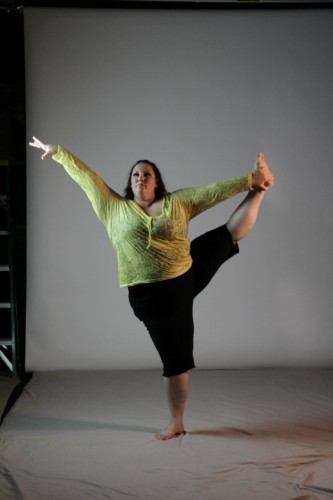
After working for a year to obtain a level of flexibility that I didn’t even have as a (relatively thin) kid, I was thrilled to accomplish this heel stretch:

[Photo by Richard Sabel]

Among the supportive comments were a group of very prolific writers who make a total of 127 comments in three hours.  One comment that was fairly representative of the group stated,

You are a stupid bitch.  You are a liar to say that you are fat and healthy, there’s no such thing. Nobody cares how flexible you are (this move isn’t even that hard) or how well you dance because you’re still a fucking fattass.  I bet your ankle shattered 5 seconds after this was taken.  If I see you in the street I will slap you across your triple chins you dumb fat bitch.

Someone posted information about me on a listserve of people who, at first, were being reasonable and curious. I was e-mailed and challenged to state my numbers to prove beyond doubt that I am, in fact, healthy.  I posted my cholesterol, triglycerides, blood pressure etc., all in the exceptionally healthy range. But, a random stranger on the internet asked, what could I do physically?

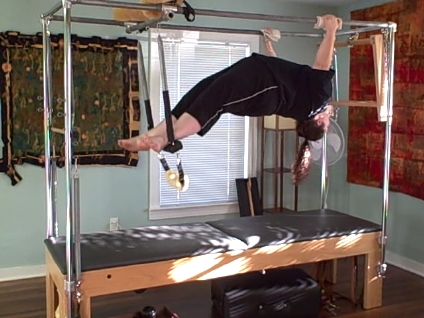
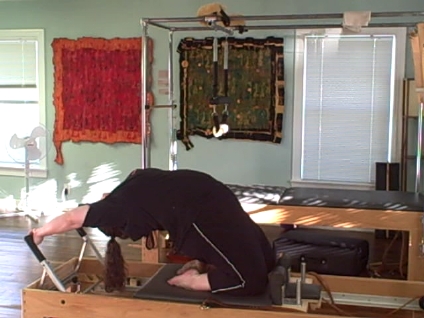
So I posted pictures of my strength and flexibility:

They said that holding that same 284 pound body (the one that surely shattered my ankle) up in an arch and doing suspended pull ups isn’t that hard.  They said I must be flexible because I’m all fat and no muscle. They asked why I didn’t show something more athletic.

After several other attempts to counter their arguments, I posted a video of me dancing:

They got mean. They called me a whale, they called me a hippo, they said that it doesn’t matter because I’m still fat.

Several things about this incident stand out to me. First, many of the people who posted weren’t satisfied with disagreeing with my Health at Every Size lifestyle or calling me a liar, but actually felt the need to diminish my accomplishments. I can only assume that they were trying to avoid some sort of cognitive dissonance. In addition, the comments reflect an intense desire to convince me that no amount of accomplishment is enough if I am fat — as if being fat is such an utter failure that it eclipses anything else that I could possibly accomplish. Their core belief is that accomplishments only count if you’re thin, so since I’m fat no amount of proving it will ever be enough.

At first I was shocked by these comments. But I wonder if they are simply the end result of the constant marketing messages that the diet industry makes billions of dollars imbedding into our collective consciousness: The idea that anyone who chooses to focus on healthy habits rather than having a smaller body must be stupid and should be ridiculed. The idea that no accomplishments matter until you are thin because, if you are fat, you aren’t worthy of feeling happy or successful. (Remember Jennifer Hudson’s commercial where she said “Before Weight Watchers, my world was can’t” even though before Weight Watchers she had won a Grammy for her first CD and an Oscar for her first film?) Finally, the image of trainers like Jillian Michaels physically, verbally, and emotionally abusing fat people and treating them as subhuman “for their own good” might even make these people feel like they are somehow good Samaritans rather than run-of-the-mill judgmental abusers.

In the end, I’m over it. Don’t like what I write? Don’t believe me? Fine. I’m not here for you. When I do something that is counter to someone’s stereotypes, I’m not asking for their approval — I’m doing them the courtesy of giving them the opportunity to challenge their preconceived notions. I’m not trying to tell anyone how to live. I believe that every person of every size deserves respect. After that it’s all about presenting options, letting people make their own choices, and respecting those choices just like I expect mine to be respected.

Ragen Chastain, of Dances with Fat is a corporate CEO, choreographer for and a principle dancer in Fat Bottom Cabaret, and a three-time National Champion partner dancer currently seeking her first World Professional title;  but all of that pales in comparison to her greatest accomplishment – learning to love her body.  She is a strong advocate for Health at Every Size, and she unwaveringly believes (and is living proof!) that health is not about body size and that every body deserves respect.

Ragen agreed to write a post about her own personal experience with an issue facing many fat people: the insistence of other people that anyone who says you can be fat and healthy is mistaken, deluded, or actively lying, and the hostility and aggression often aimed at fat people who challenge these social assumptions (including on previous posts on our blog). She has previously posted parts of this article here and here.