Search results for The

In this ten-minute video, Feminist Frequency‘s Anita Sarkeesian does a great job of discussing the problem with “straw feminists,” overtly feminist characters who are made to look bitchy, ridiculous, or just plain wrong… even when they’re describing forms of gender inequality that really exist.  More, they’re used to suggest that feminism places men and women in opposition when, in fact, gendered expectations and institutions are oppressive to men as well.

By demonizing these characters, Sarkeesian concludes, the straw feminist leads real women to disassociate from feminism, even when they believe in the equal rights of men and women.

Transcript after the jump:
more...

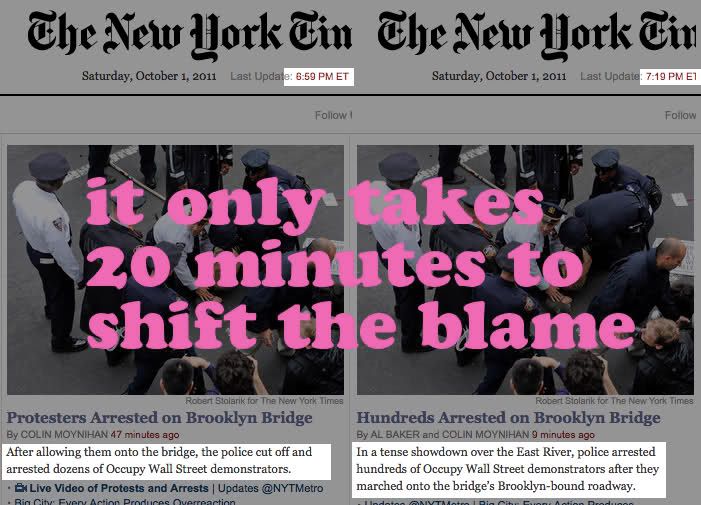
A blogger named Aluation posted this graphic showing how the New York Times changed the first line of a story about the Occupy Wall Street demonstrations.  The change subtly shifted the blame for the mass arrest on the Brooklyn Bridge from the police to the protesters.  In the first version of the story, police allowed them onto the bridge and then “cut off and arrested” them.  In the second, there was a “showdown” in which demonstrators “marched onto the bridge.”

Adding interest, the author of the piece was changed from “Colin Moynihan” to “Al Baker and Colin Moynihan.”  Who is Al Baker?  He is the guy in charge of the police bureau at the Times.

This is a great example of how important language is in framing events.  The difference isn’t dramatic, but a close look at the wording reveals a clear difference.

It’s also a great example of the power of certain individuals and institutions to shape how the rest of us understand reality.  We should be especially suspicious of the change in the authorship of the story.  When reporters have “beats,” they have to maintain good relationships with important sources on those beats. They rely on the same sources, over and over, to provide inside scoops.  If they alienate important sources, they have a much more difficult time doing their job.

What I’m trying to say is… there is good sociological theory, based on strong evidence, to suggest that an important person in the New York police department saw this story, called Baker, and told him to change the wording.  In which case, Baker might have done so to avoid alienating a source on which his job depends.  I’m not saying that’s what happened, I’m just saying that these kinds of things do happen.

Thanks to Jay Livingston for the tip.

For another example of framing, see the captions on a slideshow covering survivors of Hurricane Katrina.

Lisa Wade, PhD is an Associate Professor at Tulane University. She is the author of American Hookup, a book about college sexual culture; a textbook about gender; and a forthcoming introductory text: Terrible Magnificent Sociology. You can follow her on Twitter and Instagram.

In light of the mean-spirited Obama-wants-everyone-on-food-stamps meme, and the Heritage Foundation’s mocking attack on poor people as air-conditioned, Xbox-loving couch potatoes, let’s consider something else about poor single parents — especially poor mothers: their Google searches.

That’s right, in addition to refrigerators, apparently almost everyone in America today has Internet access — often at their local public libraries.

And yet they still complain about their little problems. They type searches into Google like, “help paying electric bill,” “hair falling out,” and even — presumably so they can laugh at the poor suckers who actually work for a living — “walmart jobs.”

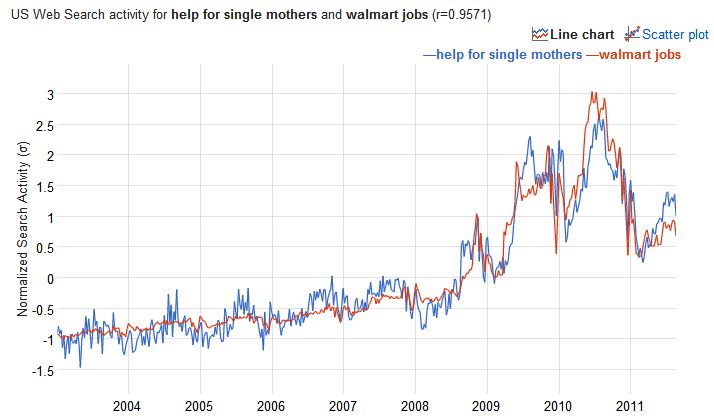
The old “misery index” was just unemployment plus inflation. Maybe the new index to watch is Google searches for “help for single mothers.” Here is the trend for that search, along with one of the searches that most closely follows its trend, “walmart jobs.” The temporal correlation between these two — the amount they rise and fall together over time — is .96 on a scale of 0 to 1.

You can see the full list of 100 searches most correlated with “help for single mothers” by following this link.

After the poverty report came out last month, comedian Andy Borowitz tweeted, “One in six Americans is living in poverty, but the other five are more concerned about the changes to Facebook.” Whether you’re in the first group or the latter one — or neither — it’s worth pausing for a minute to think about the lives of people Googling things like, “help with rent,” “iud side effects,” “cheap dinner ideas” and “get a credit card with bad credit.” (The searches all correlate with “help for single mothers” at .94 or higher.)

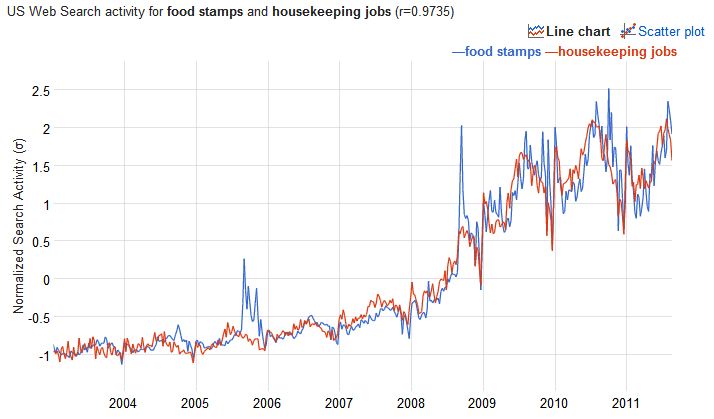
A similar list comes up in the correlations with searches for “food stamps.” Here it is graphed with “housekeeping jobs,” correlated at .97:

The list of correlated searches is similar, including a preponderance of women’s health terms (“clots during period”) economic crises (“light bill”), and ideas for climbing out of an economic hole (“medical assistant jobs,” “dispatcher jobs”).

On the plus side, both of these trends peaked in mid-2010, for now. So maybe things have stopped getting worse quite so fast. Or maybe they just lost their Internet access at the library due to budget cuts.

Am I being selective, not reporting the searches like “loving this cool TV,” and “food stamps rule”? Not intentionally, but you never know. The links to the searches are above, and the data is free.

Naomi and Katie sent in a link to a fabulous photo project in which typical model poses are reproduced in real life by real people. The photos, by Madrid-based artist Yolanda Dominguez, reveal just how distorted fashion, and expectations for women, have become. In an interview, Dominguez explains:

I tried to express what many women feel about women’s magazines and the image of women in the media – absurd, artificial, a hanger to wear dresses and bags, only concerned about being skinny, beautiful. We don’t identify with this type of woman – we are much more. I used the impossible poses to represent this type of woman and to show how absurd it is in a real context… [The] poses of the women are ridiculous – they seem dead, twisted, pulled. Why are men never put in these positions? They are always straight, successful, able and healthy… I try to express deep questions (sometimes dramatic) but always with irony and humour. I feel that when you can laugh at something you can get rid of it.

See more from Yolanda Dominguez at her website.

Lisa Wade, PhD is an Associate Professor at Tulane University. She is the author of American Hookup, a book about college sexual culture; a textbook about gender; and a forthcoming introductory text: Terrible Magnificent Sociology. You can follow her on Twitter and Instagram.

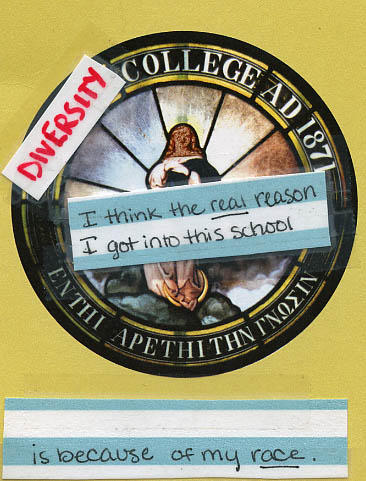
Affirmative action policies in higher education help mediate the real race-based disadvantages that some minorities face, above and beyond class-based disadvantages that are faced by people of color and whites alike.  They have a nefarious dark side, though; a dark side that causes even people who otherwise support affirmative action to question the approach to alleviating racial inequality.  They sometimes undermine the self-confidence of minorities admitted into college, as this PostSecret confession suggests:

College students often have a pretty poor understanding of admissions processes.  In the absence of any real information, it’s easy to let stereotypes and biases inform beliefs about how any individual student got into college.  A student of color, then, may be viewed as less-deserving of admission regardless of their grades, test scores, and extra-curricular activities.

More perniciously, they may question their own qualifications for admission, even when they have significantly out-performed their white peers.

A simple message to college students of color, for what it’s worth:

Your institution accepted you because they thought you could succeed.  Period.  You belong in college.

Lisa Wade, PhD is an Associate Professor at Tulane University. She is the author of American Hookup, a book about college sexual culture; a textbook about gender; and a forthcoming introductory text: Terrible Magnificent Sociology. You can follow her on Twitter and Instagram.

Eve P. and Will LeS. suggested that we write about the window decals that have popped up on the back windows of cars in the last couple years.  The decals supposedly list the members of the car owner’s immediate family, sometimes including pets.  They also, though, tend to reproduce some interesting ideas about families.  Here’s what Eve had to say:

  • The figures are almost always placed on the left side of the car, so that the figures (usually placed from tallest to shortest) strongly give the impression of a visual hierarchy or ranking.
  • A “dad” figure is first in line, before a “mom” figure, and the adult figures come before the child figures (boy children before girl children, unless the boy is younger child), and the child figures come before any animal figures…
  • This ranking seems to suggest that men take precedence over women, adults take precedence over children, and all humans take precedence over animals.
  • I don’t think I’ve ever seen a two woman or two man setup (or any other set of adults besides one man and one woman)…
  • The “dad” figure is taller than the “mom” figure…

So the stickers tend to reproduce the normalness of (1) being paired up with (2) someone of the other sex, (3) having children, (4) a gender hierarchy, and (5) the imperative that men be taller than women.


Lisa Wade, PhD is an Associate Professor at Tulane University. She is the author of American Hookup, a book about college sexual culture; a textbook about gender; and a forthcoming introductory text: Terrible Magnificent Sociology. You can follow her on Twitter and Instagram.

Shamus K. posted this clip from the show QI, in which Stephen Fry provides a  3 1/2 minute primer on the truly stunning statistics about U.S. imprisonment rates:

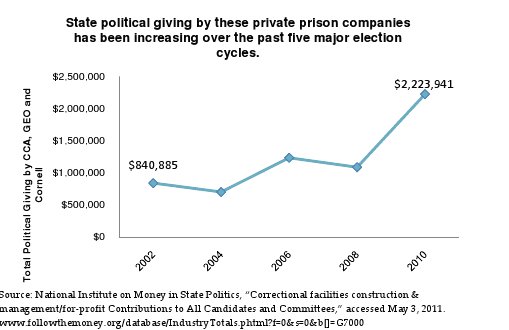
Relatedly, Tara B. provided a link to data posted at Think Progress about the growth in lobbying by private prison operators, who receive contracts to house prisoners; their political contributions nearly tripled between 2002 and 2010:

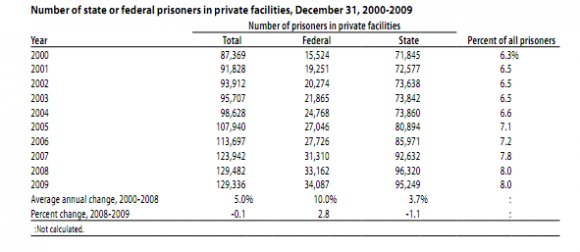
Private prisons are still a minor, but growing, segment of the U.S. prison system. As of 2009, they housed 8% of all federal and state prisoners:

For more on private prisons and their lobbying efforts, see our earlier post on the role of Corrections Corporation of America in passage of the Arizona anti-immigration law.


Dmitriy T.M. and Laura McD. sent in this awesome one-minute clip of 1950s commercials in which men insult their wives’ coffee. There’s something just stunning in the nature of the relationships portrayed. The men seem so entitled to their wives’ service, and so disdainful of her genuine efforts to please him. It’s sad.

Lisa Wade, PhD is an Associate Professor at Tulane University. She is the author of American Hookup, a book about college sexual culture; a textbook about gender; and a forthcoming introductory text: Terrible Magnificent Sociology. You can follow her on Twitter and Instagram.