Search results for The

Everyone says that they want an economic recovery.  So, why don’t we have one?  Most surveys of business people tell the same story: there is no recovery because business owners are unwilling to hire and they are unwilling to hire because people are not spending.

So, why aren’t people spending?  One reason is that many people are unemployed.  Another reason, one that business leaders doesn’t like to discuss, is that business has been boosting its profits by cutting worker pay.  And not just for the less educated who are said to be the unfortunate victims of technology and globalization.  Rather, as the chart below shows, for workers in almost all educational categories.

na-bn371_census_g_20110919135704.jpg

The average earnings of workers in almost all educational categories declined between 2000 and 2010.  Talk about a lost decade for working people!  Only those with an MD, JD, MBA or PhD enjoyed a real increase over the period, and those workers make up only 3% of the workforce.

The average earnings of college graduates, 19.5% of the workforce, declined (adjusted for inflation) by approximately 8%.  Interestingly, the average earnings of high school graduates, 30.7% of the workforce, actually suffered a smaller decline.

These numbers make clear that the solution to our economic problems is not more education.  Even those with Masters Degrees lost money on average.  Recovery will require real structural change in the way our economy operates.
Yesterday NPR reported that Wisconsin is considering repealing its ban on margarine in private businesses and public buildings. What is that all about!? This old post offers some great historical context.

—————————

Grass fed cows tend to produce milk that, when made into butter, has a slightly yellow color.  When margarine was invented as a butter substitute and they began producing it for U.S. consumption in the late 1880s, one marketing problem was its color.  The vegetable-based product has a clear, white-ish color and looks something like lard; many people found it unappetizing.  So the margarine people wanted to dye margarine yellow.

The dairy industry rightly saw margarine as a threat and they lobbied politicians both to outright ban margarine or to ban dying it to look like butter.  The federal government imposed a two cent per pound tax on the product in The Margarine Act of 1886 (the tax was quintupled in 1902).  Many states, especially dairy states, made dying margarine illegal (e.g., New York, New Jersey, and Maryland).  By 1902, “32 states and 80% of the U.S. population lived under margarine color bans.”

The ad below is for “Golden Yellow” margarine and specifies that it is “ready to spread” in 26 states (more text transcribed below):

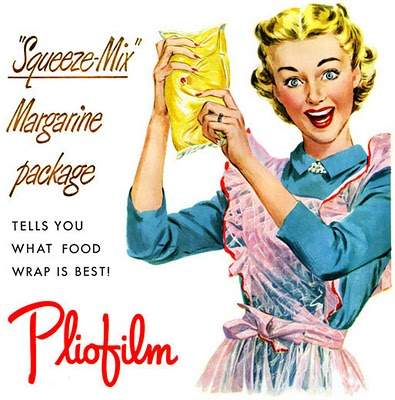
In some states, margarine manufacturers would sell margarine in plastic bags with a small bead of dye that the buyer had to knead into the spread (“Color-Kwik bags”).  This practice continued through World War II. If you judge by this ad, it was quite a good time:

Picture1

Over time, as supply and demand for butter and margarine ebbed and flowed alongside federal rules and penalizing taxes on margarine, the popularity of each ebbed and flowed too.  Then, in 1950, margarine was apparently the “the talk of the country” and President Truman put an end to the oppression of margarine, in part because the National Association of Margarine Manufacturers had begun to build enough power to compete with dairy associations.  Wisconsin, the cheese state, was the last anti-margarine state hold out (till 1967), but it continued to forbid margarine in public places (unless requested; as of Sept. 2011).

By 1957, sales of margarine exceeded those of butter. Margarine still outsells butter today. And, in a bizarre reversal, butter manufacturers now regularly dye butter yellow.

—————————

All that said, here is an excerpt from Audre Lorde’s The Uses of the Erotic in which she uses the bead of dye in the bag of margarine as a metaphor for sexuality:

During World War II, we bought sealed plastic packets of white, uncolored margarine, with a tiny, intense pellet of yellow colloring perched like a topaz just inside the clear skin of the bag.  We would leave the margarine out for a while to soften, and then we would pinch the little pellet to break it inside the bag, releasing the rich yellowness into the soft pale mass of margarine.  Then taking it carefully between our fingers, we would knead it gently back and forth, over and over, until the color had spread throughout the whole pound bag of margarine, thoroughly coloring it.

I find the erotic such a kernel within myself.  When released from its intense and constrained pellet, it flows through and colors my life with a kind of energy that heightens and sensitizes and strengthens all my experience.

Sources: Vintage Ads, Found in Mom’s Basement, Britannica, Margarine.org, and FoodReference.

Lisa Wade, PhD is an Associate Professor at Tulane University. She is the author of American Hookup, a book about college sexual culture; a textbook about gender; and a forthcoming introductory text: Terrible Magnificent Sociology. You can follow her on Twitter and Instagram.

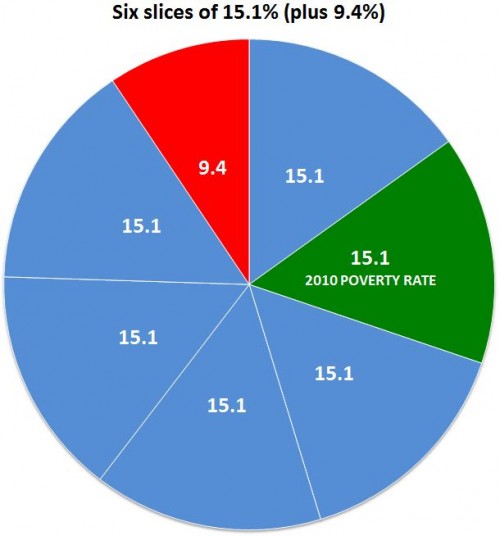
The U.S. Census Bureau reported last week that there were 46.2 million people in poverty in 2010, out of a population of 305.7 million. That is 15.1%, or if you prefer whole numbers, call it 151 out of every 1,000.

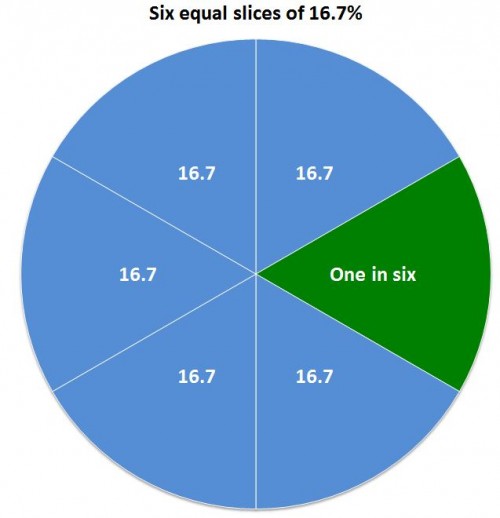
Most news reports seem to prefer reducing the rate to a numerator of one — which makes sense since it uses the smallest whole number possible, for your mental image. In that case, you could accurately call it one out of every 6.6, but no one did. Like the Washington Post and NPR, most called it some version of “nearly one in six.” That’s OK, if you’re willing to call 15.1 “nearly 16.7.”

Using percentages, here’s the difference:

A substantial minority of reports on the poverty report took the low road of rounding the fraction in the direction of their slant on the story. Some reports just went with “one in six,” including people on the political left who may be inclined to enlarge the problem, such as Democracy Now and the labor site American Rights at Work.

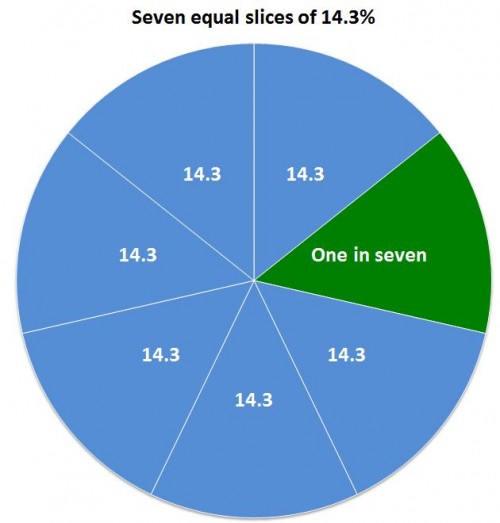
On the right, the Heritage Foundation’s Robert Rector and Rachel Sheffield called it “one in seven” in a column carried by the Boston Herald and others. (Their point, repeated here when the new numbers came out, is that the poor aren’t really poor anymore since they have many more amenities than they used to.) That’s cutting 15.1% down to 14.3%, which is actually closer to the truth than 16.7%:

It’s not that far off, but if your story is about the increase in poverty rates, it’s unfortunate to round down exactly to last year’s rate: 14.3%.

Then there are the people who may have just gotten stuck on the math and couldn’t decide which way to go, like the columnist who called it “essentially one in six” (which was ironic, because the point of his post was, “That’s the nice thing about most statistics, handled deftly, they can say just about anything you want them to.”) In some cases headline writers seem to have been the culprits, shortening the writer’s “almost one in six” to just “one in six.”

The worst exaggeration was from Guardian correspondent Paul Harris, who wrote, “the US Census Bureau has released a survey showing that one in six Americans now live in poverty: the highest number ever reported by the organisation.” The number — 46.2 million — is the highest ever reported, but the percentage was higher as recently as 1993.

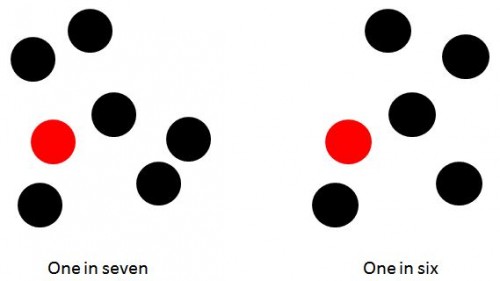
If the point is to conjure an image that helps make the number seem real to people, it probably doesn’t matter — you may as well just go for accuracy and say “fifteen percent.” (You definitely shouldn’t use pie charts, which are hard for viewers to judge.) That’s because most people can’t immediately make an accurate mental image of either six or seven — after four they count. But I could be wrong about that. Consider these images — would the choice of one over the other change your opinion about the poverty problem?

They both create a reasonable image. But the choices people made are revealing about their biases  — and the unfortunate state of numeracy in America. Because it does matter that the number of people in poverty rose by 2,611,000.

Maybe more important is who and where these poor people are. Here’s two other ways of representing it, with very different implications.

Fifteen percent over there:

Fifteen percent spread according to a random number generator:

Note that those are just abstractions for visualizing the overall percentage of poverty. But there is a real geographic distribution of rich and poor, described in recent research by Sean Reardon and Kendra Bischoff (free version here). They found that, not surprisingly, as income inequality has grown, so has income segregation — the tendency of rich and poor to live in different parts of town. And that probably makes reality even more abstract — and more subject to media construction — for people who aren’t poor.

Carni K sent in an interesting story about Kellogg’s, the cereal company. Kellogg’s is suing the Maya Archaeology Institute (MAI), a non-profit Guatemalan organization aimed at protecting the local history, culture, and natural environment. Why? It uses a toucan in its logo.

For those of you who did not spend your youth eating highly sugared empty carbohydrates for breakfast, the toucan (specifically, Toucan Sam) is the mascot of Kellogg’s Froot Loops. The toucan is also a large-billed colorful bird indigenous to Central and South America, the Caribbean, and southern Florida.

While this sort of cultural cannibalism is certainly common in American culture, it is a bold move nonetheless for Kellogg’s to not only appropriate the toucan, but to claim that no one else has a right to represent the toucan.  Dr. Francisco Estrada-Belli puts it this way: “This is a bit like the Washington Redskins claiming trademark infringement against the National Congress of American Indians.”

And therein lies the problem: who is allowed to claim the symbolic use of this bird—an indigenous Guatemalan organization or a company that makes cereal and other convenience foods marketed to children and families?

To me, this brings up another question: what gives any of us the right to use the toucan at all? While cultural representations of animals may not directly harm animals, and have been central in human cultures for tens of thousands of years, they can contribute to a particular perception of those same animals. And animal advocates know that perception then shapes treatment. If we perceive an animal to be dumb or trivial, for example, then that animal may not seem worthy of our concern.

Many types of toucans, for example, are endangered. Of the more than 40 species making up their family, 35 are included on the International Union for Conservation of Nature red list, meaning that they are either endangered, threatened, or otherwise subject to concern.  Their troubled status comes not from people hunting or eating them, but from the increasing levels of habitat destruction in the tropical regions in which they live… which brings us back to the Maya Archaeology Institute.

The organization’s mission includes protecting Guatemala’s rainforests, including the animals and plants that live there. Kellogg’s, on the other hand, has made the toucan into a funny bird whose large nose lets him sniff out Froot Loops wherever they are hiding.

Who should have the right to represent the toucan?  Anyone?

——————————

Margo DeMello has a PhD in cultural anthropology and teaches anthropology, cultural studies, and sociology at Central New Mexico Community College. Her research areas include body modification and adornment and human-animal studies.

If you would like to write a post for Sociological Images, please see our Guidelines for Guest Bloggers.

American Public Media’s Marketplace posted a short animated video summing up the potential problems with health care as an economic development strategy. Many cities are building large, fancy medical facilities with the hopes of drawing “medical tourists,” patients from other areas who would travel to receive care at state-of-the-art facilities, thus creating jobs and injecting money into the surrounding community. Given that we hear that the need for health care providers will grow greatly in the future, this seems like a risk-free plan. But as the video shows, these development strategies can lead to over-supply of services and increased overall cost of health care, without the promised benefits to local economies:

Oh The Jobs (Debt?) You’ll Create! from Marketplace on Vimeo.

For another example of economic development fads that don’t necessarily pay off, see our previous post about sports stadiums.

Yesterday Hasbro announced a new model of the Easy Bake Oven designed in response to the growing efficiency of light bulbs.  This sounded to me like a perfect opportunity to bring back our post on the evolution of the toy.  You’ll see the new model at the end.

—————————

My niece got an Easy Bake Oven for Christmas this year and I was shocked.  Shocked!

No, not because of gendered gift giving, socialization, blah blah blah… (I don’t know where you would get that idea).  Instead, I was shocked by what cooking apparently looks like in 2009.  But let me start at the beginning…

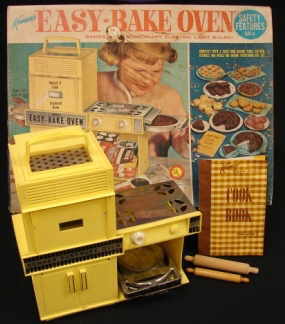
The first Easy Bake Oven was released by Hasbro in 1963 (history here).  It looked like a range with a stove top and an oven:

6a00d83452989a69e200e5503ce76d8833-800wi

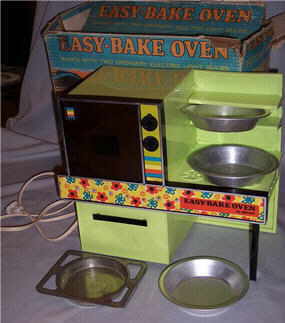
It looked like this, with minor changes in color and amenities, for a while.

1964:

64

1971:

71

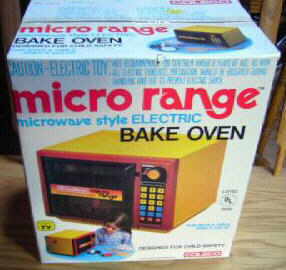
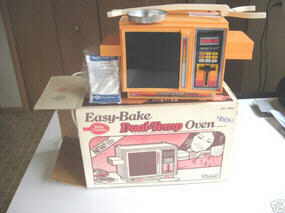
Then, 1978.  It turns out, in 1975, for the first time, sales of microwave ovens exceeded those of gas ranges.  And, what do you know, the Easy Bake Oven was suddenly a microwave with a digital clock:

78

1983:

83

Presumably, between 1963 and 1978, what cooking looked like changed dramatically and the evolution of the Easy Bake Oven reflected that.  This is what surprised me when I saw my niece’s oven.

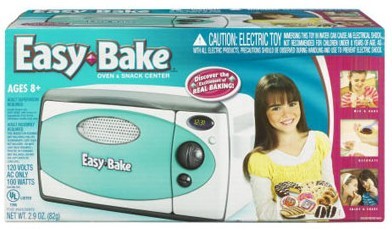
Ironically, this year’s Oven is painted in the original turquoise, as a nod to 1963, but it is still clearly a microwave:

easyBake

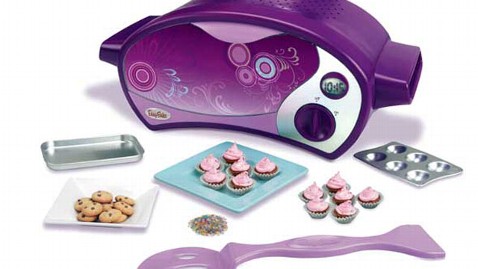
2011: Commercially available light bulbs are no longer inefficient enough to bake goodies.  This year’s model, then, is actually a real oven, reaching temperatures up to 375 degrees:


So that’s technological and socioeconomic change as signified by the Easy Bake Oven.

Lisa Wade, PhD is an Associate Professor at Tulane University. She is the author of American Hookup, a book about college sexual culture; a textbook about gender; and a forthcoming introductory text: Terrible Magnificent Sociology. You can follow her on Twitter and Instagram.


Mexico filmmaker Pablo Fulgueira happened to be traveling in New York shortly after the attack of 9/11. He took the opportunity to interview people on the streets and turned that footage into this short documentary, “SiNYster,” showing the very first social consequences of the 9/11 attack in New York City.

Part I:

Part II:

Pablo Fulgueira studied filmmaking at the Centro de Capacitación Cinematográfica in Mexico City and graduated in 2006.

Lisa Wade, PhD is an Associate Professor at Tulane University. She is the author of American Hookup, a book about college sexual culture; a textbook about gender; and a forthcoming introductory text: Terrible Magnificent Sociology. You can follow her on Twitter and Instagram.

In 1922 the American Social Hygiene Association, funded by the American Public Health Service, created a social marketing campaign aimed at American teenagers. While it was predominantly about sexually transmitted infections, it also taught about good health and hygiene in general. And maintaining health, then as now, is not only about health but also about conforming to social norms–especially gender norms.

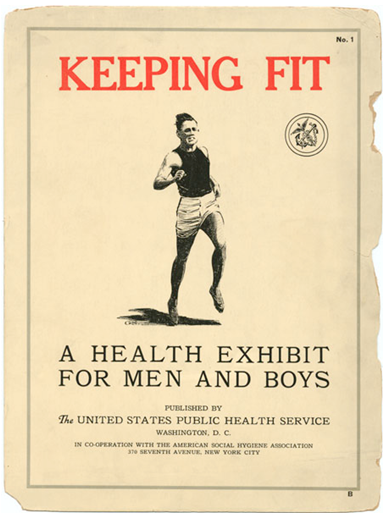
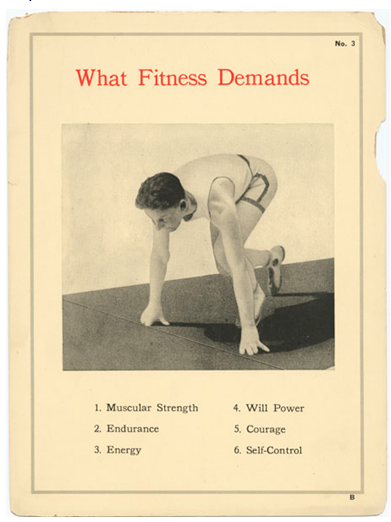
The posters aimed at boys were titled “Keeping Fit”:

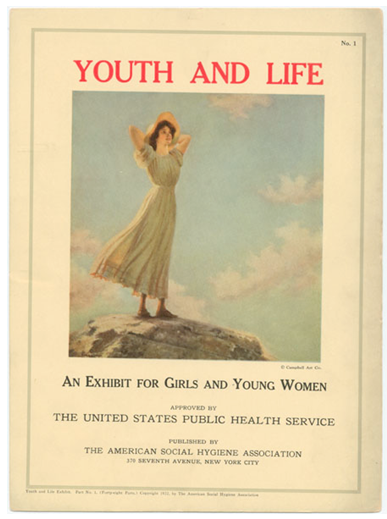
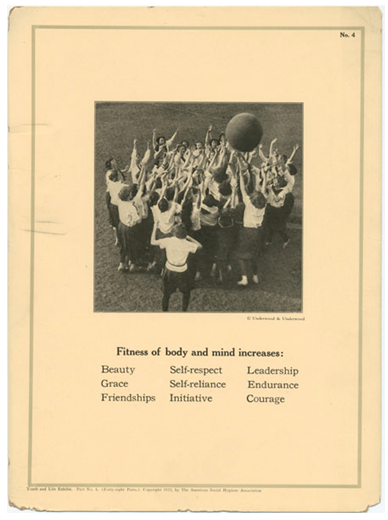
And the girls’ posters were titled “Youth and Life”:

Comparing the boys and girls’ posters, you can see that fitness is not just about physical health; it is also about particular character traits. For boys, those traits are will power, courage, and self-control–traits that are based on a puritan work ethic that we value in a competitive capitalist society.

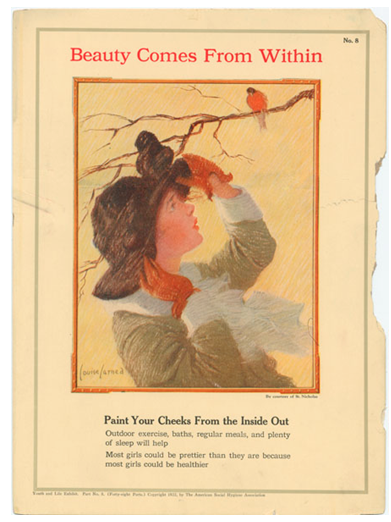
While courage and endurance were important for both boys and girls, fitness for girls was less about power and self-control, and more about grace, beauty, and friendship.

TEXT:

Paint your cheeks from the inside out. Outdoor exercise, baths, regular meals, and plenty of sleep will help. Most girls could be prettier than they are because most girls could be healthier.

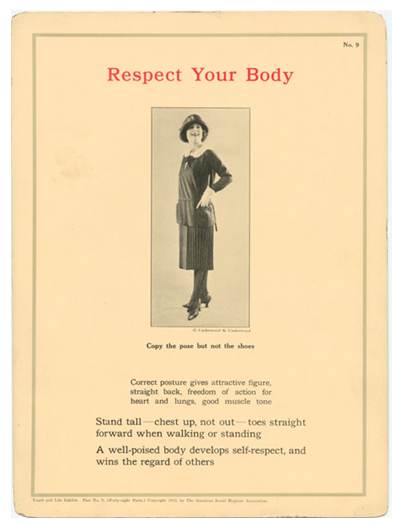
TEXT:

Copy the pose but not the shoes. Correct posture gives attractive figure, straight back, freedom of action for heart and lungs, good muscle tone. Stand tall — chest up, not out — toes straight forward when walking or standing. A well-poised body develops self-respect, and wins the regard of others.

Men were taught how to grow up to be honorable husbands and fathers, while women were taught how to grow up to be good wives and mothers.

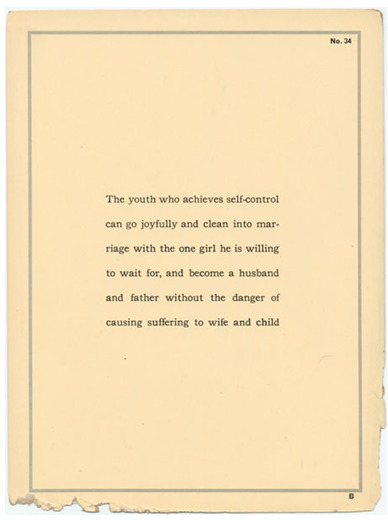
For boys:

TEXT:

The youth who achieves self-control can go joyfully and clean into marriage with the one girl he is willing to wait for, and become a husband and father without the danger of causing suffering to wife and child.

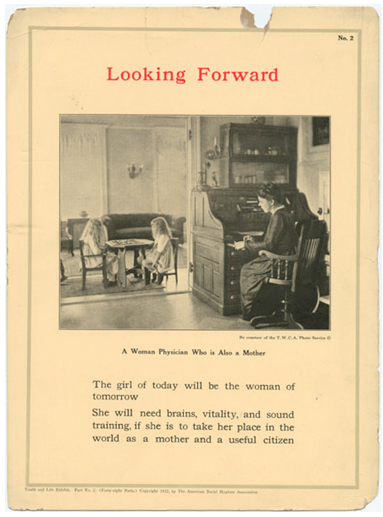
For girls:

TEXT:

A woman physician who is also a mother. The girl of today will be the woman of tomorrow. She will need brains, vitality, and sound training, if she is to take her place in the world as a mother and a useful citizen.

It may be tempting to think that we know more now than we did back then and that with progress we make fewer mistakes today than they did in the past. However, controversy surrounding many health topics such as obesity, circumcision, and the way we screen, treat, and fundraise for breast cancer should tell you that we still have many assumptions behind our health recommendations that are based on ideology.

The posters are held at the Social Welfare History Archives at the University of Minnesota Libraries

——————————

Christina Barmon is a doctoral student at Georgia State University studying sociology and gerontology.

If you would like to write a post for Sociological Images, please see our Guidelines for Guest Bloggers.