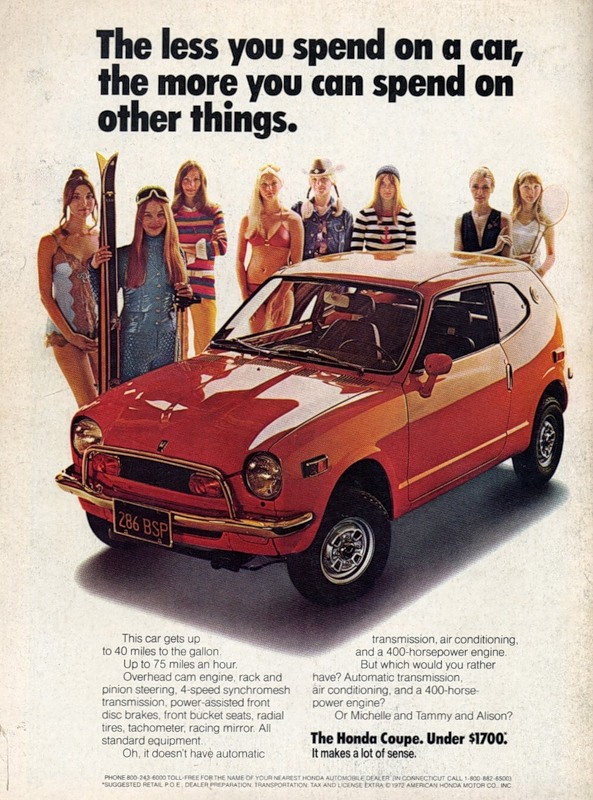
At first I thought that this vintage Honda ad was aimed at women who wanted to do lots of “things.” And then I realized, no, despite the fact that all the women look alike, the ad is actually aimed at men who get to have “things,” like “Michelle and Tammy and Alison.”

0_2eead_e886e175_XL

Selected text:

But what would you rather have? Automatic transmission, air conditioning, and a 400-horse-power engine?

Or Michelle and Tammy and Alison?

More examples of women being conflated with things here, here, here, here, here, here, and here.

Found at Vintage Ads.

—————————

Lisa Wade is a professor of sociology at Occidental College. You can follow her on Twitter and Facebook.

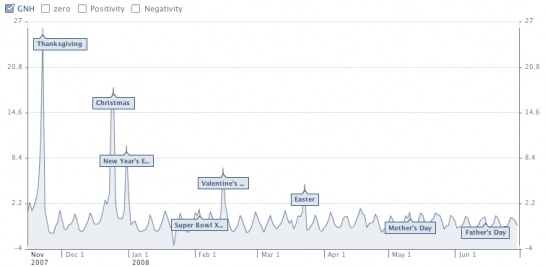
At least it is according to words referencing happy and unhappy states in our Facebook status updates:

happiness_facebook_4mkip08h4k8wscss8gscsk4wo_8td8r2s3w1cs4kksc4okksgg8_th

It’s probably just an artifact of people using the word “grateful” because they’re supposed to.  Then again, maybe being reminded to be grateful really does make people happy for a day.

Source: Facebook via Flowing Data.

—————————

Lisa Wade is a professor of sociology at Occidental College. You can follow her on Twitter and Facebook.

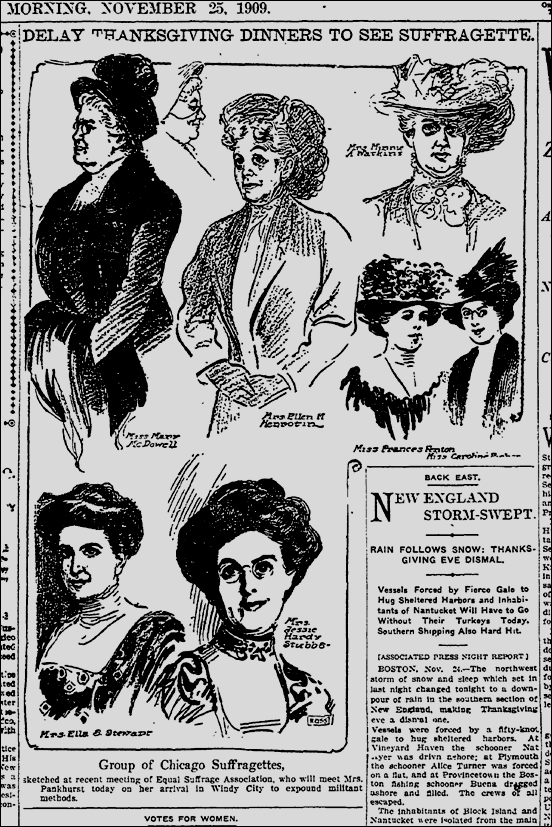
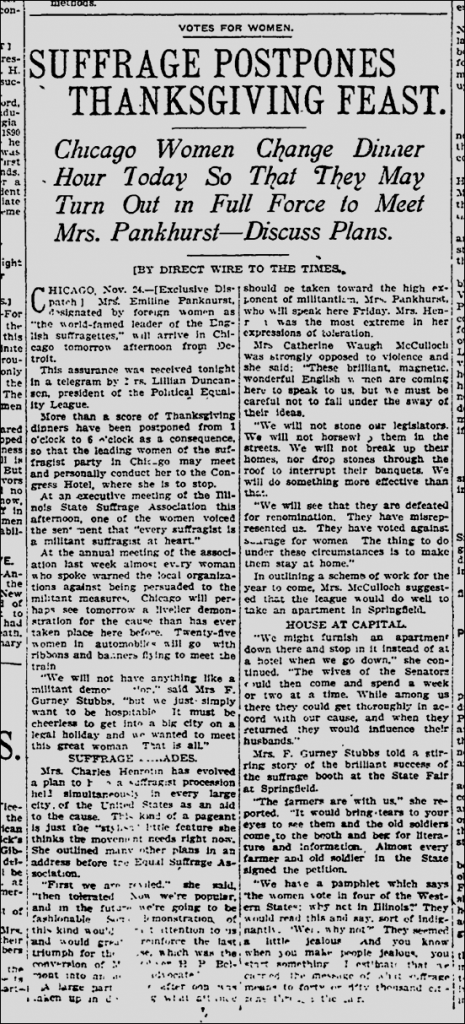
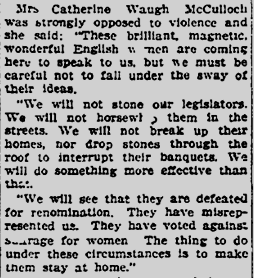
Larry Harnisch at the Daily Mirror dug up this gem, a 1909 story from the Los Angeles Times about prominent Chicago-area women’s rights advocates pushing back the time they served Thanksgiving dinner in order to go see the British suffragist Emiline Pankhurst:

6a00d8341c630a53ef012875ca6f79970c-pi

6a00d8341c630a53ef012875ca6f9b970c-pi

“…one of the women voiced the sentiment that ‘every suffragist is a militant suffragist at heart’.” Well, obviously, if you’re willing to postpone Thanksgiving dinner, no matter what this woman says:

Picture 1

Those British suffragists must have been something if stoning legislators was part of the discussion.

I am so a lover of everything dinosaur that my good friend Emily once nicknamed me “Lisaur.” She still calls me that. You can call me that, too.

Well too bad for me; or should I say, “Thank you, Everything Dinosaur, for being gracious enough to include girls in your website… by marking them as dinosaur-loving-in-a-girl-specific-way.”

The website, sent in by C.G.T. genders dinosaur-loving by having dinosaur everything and, then, a special link to “Dinosaurs for Girls.”

Capture

Because dinosaurs aren’t for girls, you see. Dinosaurs are for boys (which goes without saying), so we have to make an special space full of stuffed animals, origami, diaries, and necklaces for the girls.

But what is driving this?

We live in a world where girls are allowed to do boy things (play sports, wear pants, like cars, etc), but boys are simply not allowed to do girls things. When boys do girls things, they are considered sissies or fags or whathaveyou. Girlified things, then, can’t be sold on a gender-neutral website. And because girl things can’t be sold to boys, girl things must be segregrated, lest they contaminate the feminine-free space that we insist boys inhabit.

For an explanation of androcentrism, or the idea that boy things are good for everyone but girl things are only good for girls, see here.  And for examples of androcentrism, visit our posts here, here, and here.

UPDATE! Mike Walley at Everything Dinosaur sent us a thoughtful note in response to this post.  He explains the difficulty involved in balancing a gender-free site with the fact that parents and guardians, themselves, have gendered expectations.  It’s an important sociological point: Individuals and companies don’t make choices free of context, so they can’t just reject all gender norms without suffering consequences.

Dear Lisa,

We have watched with great interest the comments that have appeared on your blog site regarding our company Everything Dinosaur and the section of our site that refers to a specific section entitled dinosaurs for girls.  It is very encouraging to see such a lively debate, we do all we can to promote a positive role for women within the sciences and I have been fascinated to read the comments and views that have been expressed.  Rest assured, if any one of your readers wishes to contact us directly to gain further information with regards to our company mission we shall do all we can to help inform them with regards to our proactive approach to this subject.

It is interesting to note that one of your commentators picked up the relevance of the dinosaurs for girls with regards to search engines, one of the reasons for establishing this part of our website was to enable us to have a dialogue and raise the profile of gender issues within the sciences particularly the Earth sciences.  Our own research (admittedly based on a sample from the United Kingdom), identified a number of barriers that prevented parents and guardians from encouraging young girls (our target market is from 3 years of age), to take an interest in prehistoric animals. We wanted to find a way of addressing some of these issues and guided by our research programmes the concept of a specific search engine optimised area of the website came into being.

Ironically,  we are torn between acknowledging a need to recognise that dinosaurs are perfectly valid for girls and populating this particular section of our site with a wider range of items.  It is a matter of managing the expectations of many parents and guardians who find our site using search engine terms when they are looking for something specific for a girl, which in many cases can be as young as three years of age and they land specifically at this part of our site, before exploring the other sections. One of the important outcomes from our research was to ensure that other areas of our site were named in non-gender bias ways, for example, we have sections dedicated to “Young Scientist” and “Young Artist”, the objective here being to help breakdown perceptions and stereotypical barriers when considering how young children develop through creative play.

If you require further information, or indeed if you have any further queries I would be more than happy to assist you where I can.  In the meantime, please feel free to visit our web log – http://blog.everythingdinosaur.co.uk this is a free resource we set up many years ago with the purpose of helping to communicate information about palaeontology and other Earth Sciences.  I am sure you will find in the huge archive a number of articles related to girls and dinosaur, including a number that acknowledge the role of women in science and reflect our positive attitudes towards encouraging young girls to take a greater interest in Earth Sciences.

Regards,

Mike Walley
Everything Dinosaur

—————————

Lisa Wade is a professor of sociology at Occidental College. You can follow her on Twitter and Facebook.

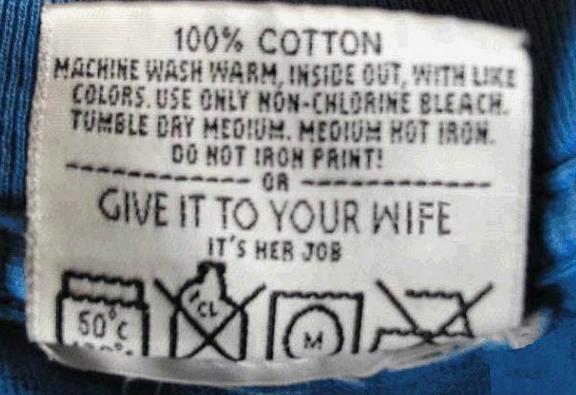
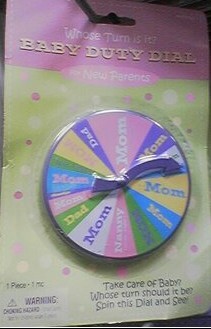
Frank D. and Sara E. sent in these two examples, respectively, of humor that points to women’s disproportionate responsibility for housework and childcare.

Washing instructions:

wife10

Diaper changing wheel with “Mom” in many more slots than “Dad” or “Nanny” (Nanny?  I know, that’s a whole other post):

baby_duty_dial

Both of these point to the fact that WE KNOW that women do this work disproportionately, even as most women work as many paid hours as their husbands.  These are inside jokes for everyone in America.  But this disproportionality is perhaps the number one cause of women’s continued economic disadvantage (compared to men).  Motherhood, as Ann Crittenden explains, is the greatest predictor of poverty in old age.

I suppose we still think it’s funny–and not very, very serious–because most women in the U.S. don’t have much hope of escaping these responsibilities.  It’s easy to make personal sacrifices to fight patriarchy (like not wearing make-up), but once kids and a home are involved, you’re not making personal sacrifices; refusing to do more than your share of childcare (and the housework that comes with it) means that your child is sacrificing too.  And that is too big of a sacrifice for most women to make.

So, I guess sometimes humor is all we ladies have got.

—————————

Lisa Wade is a professor of sociology at Occidental College. You can follow her on Twitter and Facebook.
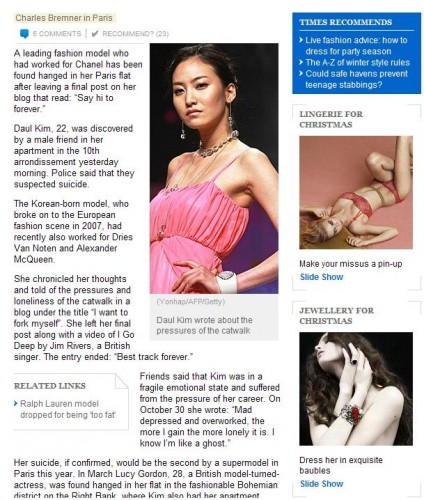
Kate M. sent us a link to a story in the Times Online about the recent suicide of model Daul Kim. Kim had worked for a number of high-fashion companies, including Chanel. Her blog contained many posts about the pressure and loneliness of being a model. Kate points out that the links surrounding the story undermine any message that we should actually care about this topic:

model2

Notice on the side the “Lingerie for Christmas” feature on the side, with a scantily clothed, very thin woman; it lets you “make your missus a pin-up.” Below that you can “dress her in exquisite baubles.” Women are sexy, thin, mostly naked playthings for you to dress up and play with at will. How could that possibly have anything to do with the thinness ideals models and other women are pressured to meet?

The “Ralph Lauren model dropped for being too fat” story refers to the woman we wrote about in this post, where her body had been photoshopped beyond recognition.

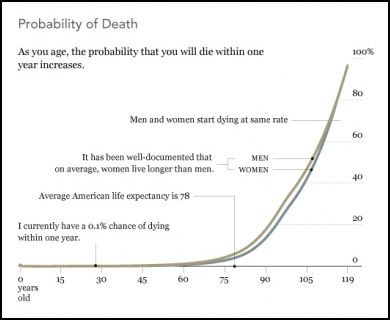
Flowing Data presented a number of figures revealing data about life expectancy (via).  It is well known that women live longer than men in Western countries (to age 81 versus age 76), but this graph, displaying the probability of dying in any given year, caught my eye:

Capture

Men have a higher probability of dying than women in any given year starting (it looks like) at about age 55.  It’s a small difference (maybe 5 percentage points at its largest), but over time it adds up.  Until about age 112, when men and women die at the same rates.

Awesomely, even at 119, your chance of dying in the next year isn’t quite 100%.  And that goes for men and women alike.

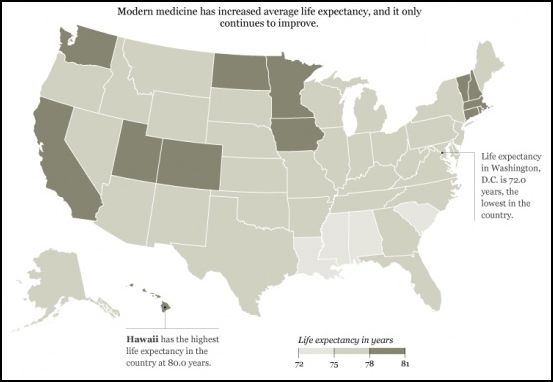
Also interesting, life expectancy by state:

Capture1

—————————

Lisa Wade is a professor of sociology at Occidental College. You can follow her on Twitter and Facebook.
I borrowed these two ads from Jim Crow History.  According to the site, Bull Durham tobacco was among the most recognizable trademarks in the world circa 1900.  These two ads include caricatures of “foolish looking or silly acting blacks to draw attention to its product”:

durham01

durham02

NEW (Dec. ’09)! Pete W. scanned in and sent along a third ad in the series:

122809_1022

For more historical U.S. representations of blacks, see these posts: one, twp, three, four, five, six, seven, eight, nine, ten, eleven, thirteen, fourteen, fifteen, sixteen, seventeen, and eighteen.

And for examples of modern reproductions of these stereotypes (literally), see these: one, two, three, four, and five.

Interested in the decision to remove the iconic bull’s scrotum in advertisements? Go here.

—————————

Lisa Wade is a professor of sociology at Occidental College. You can follow her on Twitter and Facebook.