I spent a day in Salzburg this September with a man from Dubai.  We had a wonderful time comparing perspectives.

Dubai, he explained, was a wildly modern, multicultural city.  The default language in public was English due to the international population.  He was a stockbroker who had gone to college in London and gone part way through an MBA.

He interacted with veiled, Middle Eastern women and non-veiled Western European women daily.  He seemed to have no qualms with the two styles of presentation, considering them simple choices; they were unpoliticized and carried no deeper meaning.  To him, women who veiled were simply religious, like the men he knew who would not drink alcohol, and himself when he would not eat meat improperly slaughtered.

In any case, women in Dubai, he felt, were liberated.  As an example, he explained how there was now a woman’s taxi service.

“A woman’s taxi service?”

“Yes, with women drivers.”

You see, it is not proper for women to be alone with a non-relative male and, so long as all taxis were driven by men, women (who also do not drive) could not run errands or visit friends.  They were largely neighborhood-bound.  To my friend, a woman’s taxi service was liberation.  And, indeed, from the perspective of their rules, it must have seemed like freedom indeed.

I was reminded of this chat when Happy A. sent in a link to a story about a new women’s taxi service in Mexico.  The taxis, painted pink, are driven by women and only women can hire them. The taxi service isn’t designed to allow women to travel, but to allow them to travel without the threat of harassment and assault.

Women’s groups, however, have called the taxis insulting.  They suggest that the girly pink, the protectionism, and the make-up mirrors in the back seats seem to encourage the very objectification that makes women targets in the first place.

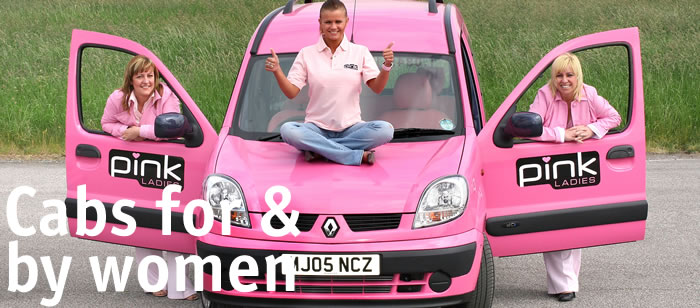
Pink Ladies, in the U.K., rationalizes its service with the same protectionism:
pink_ladies

And, in Moscow, they have Ladies Red Taxi:

Capture

I think these examples, considered together, do a really good job of undermining any absolutist ideas about what is good for women.

The situations in the different countries are dramatically different.  Women’s taxis improve the quality of life for women in Dubai (who can afford them) much more significantly than the taxis in, say, the U.K.

A radical feminist bent on destroying the system altogether may say that such taxis reinforce a gender binary and are easily co-opted by patriarchy (I wonder whose errands women are doing in those pink taxis?), a reformist feminist may say that the move is a good option for women both there and elsewhere, if not actually an end to male domination.

I think both are good points.

Does the fact that the Mexico service is run by the city and the U.K. service by a private company make a difference?  In the first case it is driven by concern for women’s safety, in the second case it is driven, at least partially, by profit.  Should people be profiting from women’s vulnerability?

Is a woman’s taxi service inherently feminist and liberating?  Or is it always sexist and demeaning?

I’m  not sure what I think about women’s taxis, but I like how cross-cultural comparisons like these remind us that context matters.

Click here for another sociologist’s take on the extent to which the pink taxis should be seen as liberating for women.

Lisa Wade, PhD is an Associate Professor at Tulane University. She is the author of American Hookup, a book about college sexual culture; a textbook about gender; and a forthcoming introductory text: Terrible Magnificent Sociology. You can follow her on Twitter and Instagram.

In a sweet anecdote, Sociologist Michael Kimmel talks about how he was playing the game of opposites with his son.  “What is the opposite of up?”  “Down.”  “What is the opposite of awake?”  “Asleep.”  “What is the opposite of man?”  He asked.

And his son replied, “Boy.”

Kimmel tells this story as a glimpse into an alternative world in which men do not define themselves in opposition to women, but see manhood in terms of maturity.

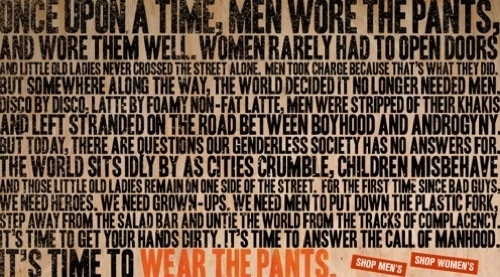
We don’t live in that world.  And Dockers thinks it can sell khakis by encouraging men to define themselves as not-women in its new man-ifesto ad campaign (text after the jump):

500x_pants

Of course, what is really interesting about this ad is the way that it defines manhood as in opposition to all kinds of things: womanhood, of course, but also boyhood, and feminine manhood, androgyny, and whatever disco, plastic forks, latte drinking, and salad represent.  What do men get?  Being in charge of women and children… and dirty hands (maybe the dirt is metaphorical).

I’d much rather live in Kimmel Jr.’s world.

(Thanks to Christina W. for encouraging us to write about this ad.)

For a similar ad, see this Ketel One commercial expressing nostalgia for a pre-feminist time.  And, for lots of material documenting the new pop culture version of masculinity, browse our gender: masculinity tag.

Jump for a transcript of the text:

more...

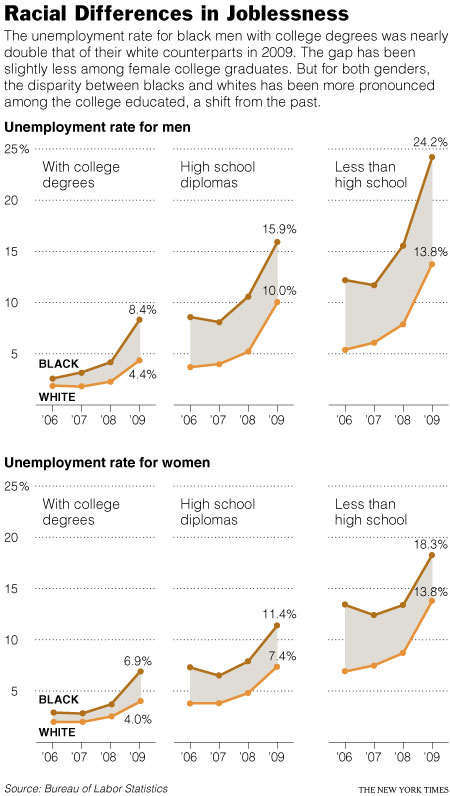
This week the New York Times featured a story about joblessness rates among black and white men and women.   As the figures below show, black men and women always face higher levels of unemployment compared to whites of the same education level; for men, the disparity increases as education level increases; and for black women, that pattern holds at least for 2009.

popup

For more detailed data on this phenomenon, see our posts on race and the economic downturn, the intersection of race and criminal record, and education and unemployment.

Lisa Wade, PhD is an Associate Professor at Tulane University. She is the author of American Hookup, a book about college sexual culture; a textbook about gender; and a forthcoming introductory text: Terrible Magnificent Sociology. You can follow her on Twitter and Instagram.
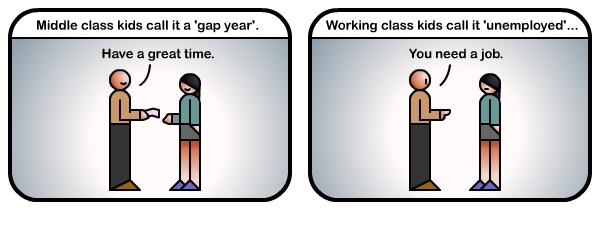
Chelsea S. snapped a photo of this ad outside of Macy’s in the King of Prussia mall:

-1

Two things here: the assumption that men have wives to purchase their clothes for them (gendering of marital roles, anyone?) and the implication that having to wait while your wife does so is such an annoyance. Maybe this is just me, but if someone else is doing errands for you, the least you can do is not act like it’s a burden to accompany them.

Gwen and I were both so troubled by a story on NPR’s Weekend Edition Saturday that we decided to break our rule that all posts must contain an image and offer you a sound instead. The six-and-a-half minute story and a transcript can be found here.

This is the letter of protest that I sent:

Dear NPR,

I am sadly disappointed in NPR after listening to the latest installment of “Recession Diary,” featuring Caitlin Shetterly and her family.

The story features a husband and wife team of freelancers who have to take part time wage work and move in with their parents to support themselves and their new baby.  Caitlin gets a book deal that puts them back on their feet (but it’s not enough “even to buy a house,” so apparently it’s not a lot of money).  Her mother tells her that it was hard work and not good luck that made the difference.

Not only is this a wildly upper-class version of “hardship,” but the final evaluation of their “turn in fortune” as due to hard work and not luck is a slap in the face to the millions of Americans who work one or more demanding jobs and will likely never escape economic insecurity, recession or no.

The Shetterly’s had their fair share of good luck long before the recession hit, the kind of good luck that allows you to follow your dream of being a freelancer in the first place.  And while I’m sure they worked very hard, they were already situated such that their hard work could make their dreams come true.

This Recession Diary does an injustice to economic hardship.  It likely resonated with the public radio producers, staff, and talent, but I doubt it resonates with Americans whose dreams involve feeding their kids and getting their rent paid, with just a little left over to sock away for the next emergency.

Lisa Wade, PhD
Assistant Professor of Sociology
Occidental College
Los Angeles, CA

Okay, I can’t resist.

Here is a picture of a cake I made for my friend, Dorotha:

Monster Cake

What you can’t see is that he is balding and has liver spots on top of his head.

I am still quite proud.

This graphic reveals which states pay the most in federal taxes and which receive the most in return. At the very bottom of the graphic, you can see the ratio of taxes out and taxes in. Rhode Island is exactly even, while the states above and to the left are essentially “donation” states and the states below and to the right are “welfare” states:

tax

Found at Visual Economics, via ChartPorn.

Lisa Wade, PhD is an Associate Professor at Tulane University. She is the author of American Hookup, a book about college sexual culture; a textbook about gender; and a forthcoming introductory text: Terrible Magnificent Sociology. You can follow her on Twitter and Instagram.
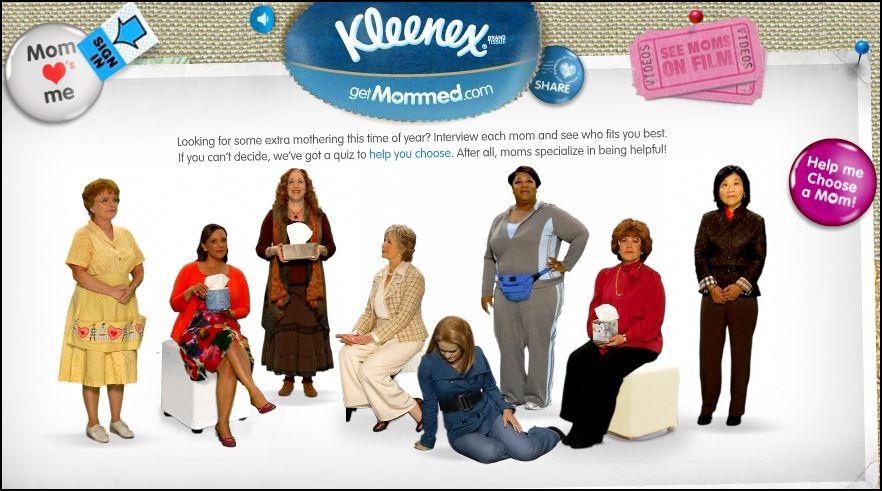
Grace S., Courtney V., Mazhira B., and Ashley B. (I hope I got everyone!) sent in Kleenex’s Get Mommed campaign. The campaign represents another instance in which nurturing is associates strictly with women (it is mom who takes care of us when we’re sick, not dad).

It also manages to throw in a number of racial and religious stereotypes, including the Latina Ana Maria (“hola!”) who brings traditional wisdom; the distracted upper class WASP (“just a moment, dear”); the sassy, full-figured black women who can do anything around the house; the pushy Jewish mom (“Phyllis wants to be your mommy, not just your mom”); the stern Asian mom (“I don’t put up with excuses, not even from babies!”); among others.

Capture

I didn’t dive into the website too far, but you’re certainly welcome to do so and feel free to report what you find!

Lisa Wade, PhD is an Associate Professor at Tulane University. She is the author of American Hookup, a book about college sexual culture; a textbook about gender; and a forthcoming introductory text: Terrible Magnificent Sociology. You can follow her on Twitter and Instagram.
Gwen M. and David B. sent us a link to a story on the Globe and Mail website about a video game that has a gay scene in it and the reaction in the gaming community:

video

The game is Dragon Age: Origins, which, according to the website, is “an epic tale of violence, lust, and betrayal.”

From the Globe and Mail article:

Earlier this year, to promote Call of Duty: Modern Warfare II , one of the biggest games of the year, the game’s developer, Infinity Ward, released a video online asking players to Fight Against Grenade Spam. The company eventually pulled the ad following complaints about the acronym.

Last year, Microsoft was accused of homophobia after banning gay-related gamertags – the names created by Xbox users to identify themselves online – such as theGAYERgamer and RichardGaywood.

As the article points out, it’s not that gay or bisexual characters/scenes haven’t appeared in video games before, but they’ve often been portrayed in very stereotypical or negative ways. And while some gamers have reacted positively, many have basically responded with “ew, gross!”

As Gwen said, this effort to normalize gay relationships in a popular video game, and the reactions to it, are “both encouraging — and saddening.”

Gwen Sharp is an associate professor of sociology at Nevada State College. You can follow her on Twitter at @gwensharpnv.