Archive: Jan 2011

The color of one’s nipples varies according to the color of one’s skin. Lighter-skinned people tend to have lighter nipples, while darker-skinned people tend to have darker nipples. To add to the many racist products and procedures designed to make the bodies of darker-skinned people more like the bodies of lighter-skinned people — eyelid surgery, eyelid gluing, Asian rhinoplasty, hair straightening, and skin lightening — Theresa W. sent in a product designed to make the nipples more “pink.”  These products, featured at The Faster Times, seem to be mostly aimed at the Asian market, many of whom are already quite light-skinned.  Below is a selection of the many products one can find.
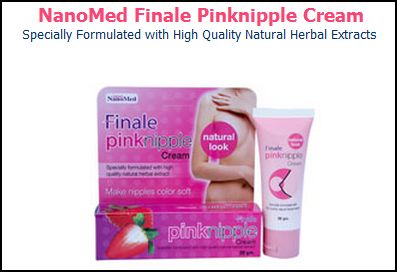
Finale Pink Nipple Cream:

Bioglo Cherry Pink Lip Nipple Cream:

The rest are after the jump because the packaging shows images of breasts.

more...

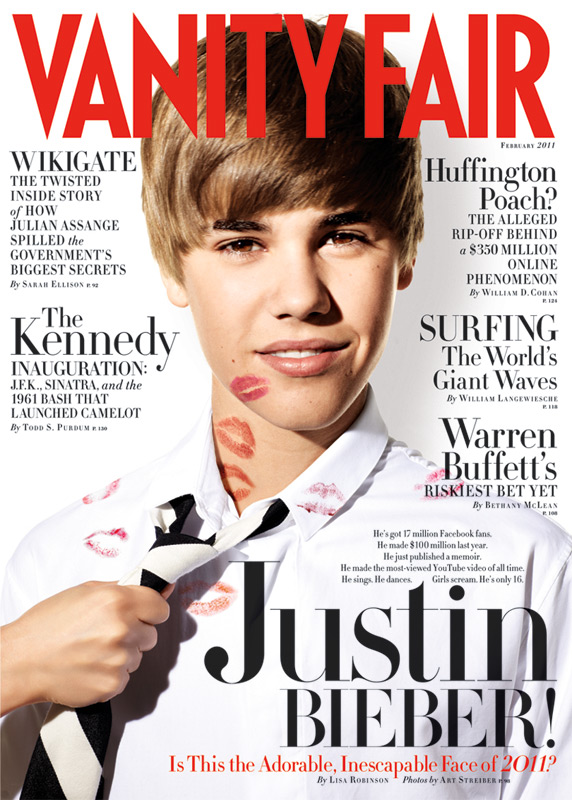
Kari B. sent in an example of the sexualization of teen boys, found at Evil Slutopia. Justin Bieber appears on the cover of the February 2011 Vanity Fair covered in lipstick, with a hand grabbing him by his necktie:

An image from the article:

Justin Bieber is 16 years old — just a year older than Miley Cyrus was when there was a scandal about her photoshoot for Vanity Fair, such that it appeared to potentially threaten her career at Disney by ruining her safe, clean-cut image. I think it’s safe to say that if Miley Cyrus, or another female teen star, posed in photos that showed evidence of being kissed or grabbed by male fans, people would be up in arms about the sexualization of girls. But as we often see, there’s a double-standard, based on the idea that boys are naturally sexual at earlier ages and that boys are sexually invincible. While we might see a teen girl surrounded by men as being in danger, we don’t think of girls as being sexually threatening to boys, or of male teen celebrities’ sexuality being as open to exploitation by publicists, photographers, or other members of the media. And thus, these types of images of Justin Bieber don’t lead to the same outcry as similar images of female teen stars, and don’t cause concern that his career as a teen idol is over.

We’ve discussed the adultification of Justin Bieber before, here and here; you might also check out our post on the sexualization of Jaden Smith.

Gwen Sharp is an associate professor of sociology at Nevada State College. You can follow her on Twitter at @gwensharpnv.

He got a B-minus. Which wasn’t so bad! He was only out-performed by 15% of his class: 5 B-pluses, 2 A-minuses, and exactly zero As.  In contrast, a whopping 33% got a C or worse.

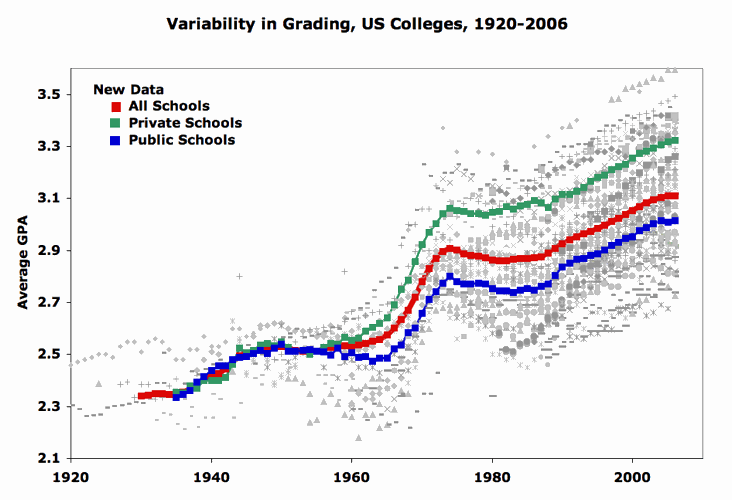
It turns out, JFK was already benefitting from grade inflation — the slow shift in the average grade point average in higher education — even in 1940. The chart below, borrowed from gradeinflation.com, shows that the average grade had gone up by 0.1 on  a 4.0 scale between 1935 and Kennedy’s not-so-fateful grade report.  Since then, however, has gone up another 0.7 points.

I’m well-known ’round campus for being a hard grader, but I’m no Professor Emerson.

Thanks to Matthew Beckmann for helping Kennedy’s paltry performance (I kid) see the light of day.  And to Jay Livingston for bringing it to my attention.  See also our post on pants inflation.

Lisa Wade, PhD is an Associate Professor at Tulane University. She is the author of American Hookup, a book about college sexual culture; a textbook about gender; and a forthcoming introductory text: Terrible Magnificent Sociology. You can follow her on Twitter and Instagram.


We owe the term “sociological imagination” to C. Wright Mills, a fundamental figure in sociology. He defined it as the intersection of history and biography. In his book by the same name, he writes:

The sociological imagination enables us to grasp history and biography and the relations between the two within society

I couldn’t help but think of Mills’ words when I came across this video at Crooked Timber.  In it, French children are asked to interpret technologies that, though just a few years out of date, pre-date their biography. While their guesses are creative and humorous, they also neatly demonstrate that, no matter how unique we are, we are also products of our time.

UPDATE: Unfortunately the version of this video that had English subtitles has been made private and we haven’t been able to find another version. Here’s a version without any subtitles:

Lisa Wade, PhD is an Associate Professor at Tulane University. She is the author of American Hookup, a book about college sexual culture; a textbook about gender; and a forthcoming introductory text: Terrible Magnificent Sociology. You can follow her on Twitter and Instagram.

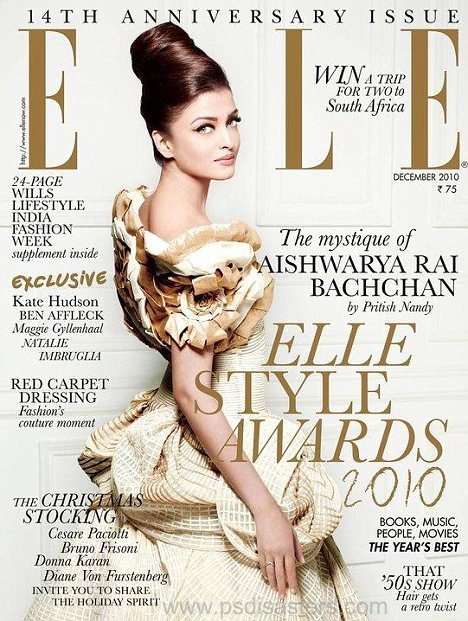
Deeb K. and YetAnotherGirl pointed out another example of a woman apparently having her skin lightened on the cover of a magazine. The December 2010 issue of Elle features Aishwarya Rai Bachchan, a major star in the Indian film industry who has also been a spokesperson for L’Oreal and appeared on the “Most Beautiful Women in the World” lists of various magazines. Here’s the cover, with a very pale Bachchan:

Let’s compare to other photo of Buchchan here and here.

Elle was criticized just a few months back for apparently lightening Gabourey Sidibe’s skin tone on the cover as well. At that time, the editor said Sidibe wasn’t touched up any more or less than other women put on the cover. That may be true. But it leaves unanswered the question of why the women’s skin tone is considered insufficiently glamorous or beautiful as it is, and why making these stars’ skin lighter would be seen as a clear improvement.

Gwen Sharp is an associate professor of sociology at Nevada State College. You can follow her on Twitter at @gwensharpnv.

Alys sent in a photograph of the packaging at her local McDonald’s. It included pictures, not of Chicken Clubs and Big Macs, but of the raw ingredients that these foods are (theoretically) made of… with the notable exception of realistic images of animals. The materials, Alys writes, were…

…adorned with pictures of healthy whole foods, such as a tomato or a head of lettuce. That in itself is interesting — they are clearly attempting to cash in on the whole-foods-are-good-for-you mentality despite the fact that there is hardly anything more processed than fast food — but what I found particularly fascinating was the animals, or rather the lack thereof. My chicken club sandwich package featured not a live chicken, but two little origami chickens. Similarly, the bag the food came in had a tin chicken knick-knack thing. My husband’s hamburger package was even more ambiguous. It’s a little hard to read in the picture, but “two all beef patties” is represented not with a cow, or a picture of the patties, or even an origami cow, but with a spatula. Clearly MacDonalds realizes that while Americans want to be reminded that the ketchup on their sandwich originally came from a tomato — and that means it’s healthy! — they do not want to look into eyes of the live animal that sacrificed its life to provide the main focus of the meal.

Lisa Wade, PhD is an Associate Professor at Tulane University. She is the author of American Hookup, a book about college sexual culture; a textbook about gender; and a forthcoming introductory text: Terrible Magnificent Sociology. You can follow her on Twitter and Instagram.

Dmitriy T.M. sent in a link to a 13-minute video in which Van Jones discusses the problems with patting ourselves on the back too much every time we put a plastic bottle in the recycle bin instead of the trash, and the need to recognize the link between environmental concerns and other social issues:

Also see our posts on the race between energy efficiency and consumption, exposure to environmental toxins and social class, race and exposure to toxic-release facilities, reframing the environmental movement, tracking garbage in the ocean, mountains of waste waiting to be recycled, framing anti-immigration as pro-environment, and conspicuous environmentalism.

Full transcript after the jump, thanks to thewhatifgirl.

more...


In their article, The Male Consumer as Loser, Michael Messner and Jeffrey Montez de Oca try to explain the recent rash of advertising featuring mediocre men.   These ads, and their film and television counterparts, skip the hunky-manly-hunk-dude in favor of less hunky men: young, heterosexual, usually white males who are short on cash, low on maturity, and have a penchant for irresponsibility. They dominate Judd Apatow “bromances” (e.g., Knocked Up), frequent TV sitcoms (e.g., The Drew Carey Show), and are used to sell everything from Mike’s Hard Lemonade to Twix candy bars. These are not studs. They are moderately good-looking, but small, skinny, chubby, or otherwise uncool compared to real hunks.

On the face of it, the mediocre man is a self-deprecating character who undermines idealized masculinity by being likeable despite being decidedly non-ideal.  Messner and Montez de Oca, however, show that the mediocre man, nevertheless, reproduces notions of men’s superiority over women.  The women in these narratives tend to be of two types: “sexy fantasy women” and “real women.”  The men bond over the unattainability of the sexy fantasy women and the burden of maintaining relationships with real women, their girlfriends, wives, and mothers.  The “real women’ are usually portrayed as bitches, harpies, and nags, while the “sexy fantasy women,” upon interaction, often turn out to be just as bad.

The viewers are meant to identify with the mediocre men, who revel in each others’ company, happy to be dudes free from the clutches of the women in their lives, even if they aren’t sleeping with supermodels.  The mediocre man may be kind of a loser, indeed, but he can thank God he’s a man. P.S.: Women suck.

Dmitriy T.M. sent in an example of the “mediocre man” narrative, the trailer from the movie, Hall Pass:

(Probably in the end they realize they love their naggy wives, but whatevs.)

Lisa Wade, PhD is an Associate Professor at Tulane University. She is the author of American Hookup, a book about college sexual culture; a textbook about gender; and a forthcoming introductory text: Terrible Magnificent Sociology. You can follow her on Twitter and Instagram.