Archive: Jan 2011

A while back Kale let us know that the New York Public Library had made their images collection available online.The collection has images on a huge array of topics, from fashion to the military to slavery to insects to a whole category for stilts, and including political cartoons, illustrations from publications, photographs, and so on.

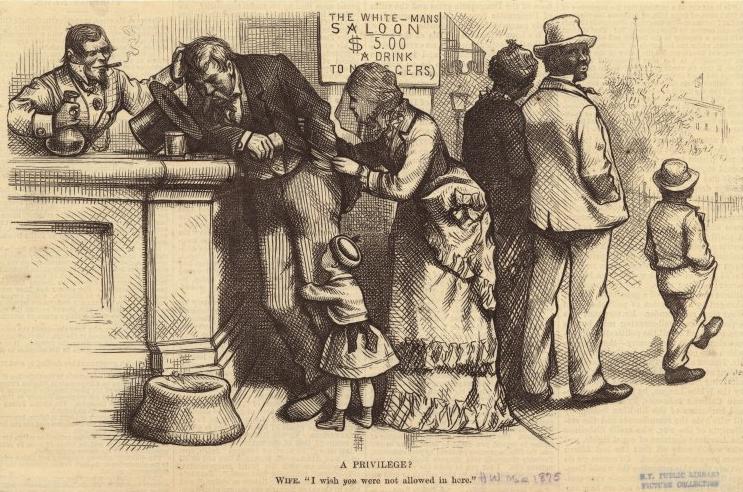
Kale found the collection particularly interesting as a way to look at historical racism and rhetoric about race relations in publications aimed at White readers. This 1875 cartoon, titled “A Privilege?”, presents segregation as actually protecting African Americans from the scourge of alcohol:
Text:

A PRIVILEGE?

Wife, “I wish you were not allowed in here.”

It’s a fascinating example of the use of institutionalized racial inequalities that hurt African Americans to, instead, garner sympathy for White women and children and present African Americans as, really, better off.

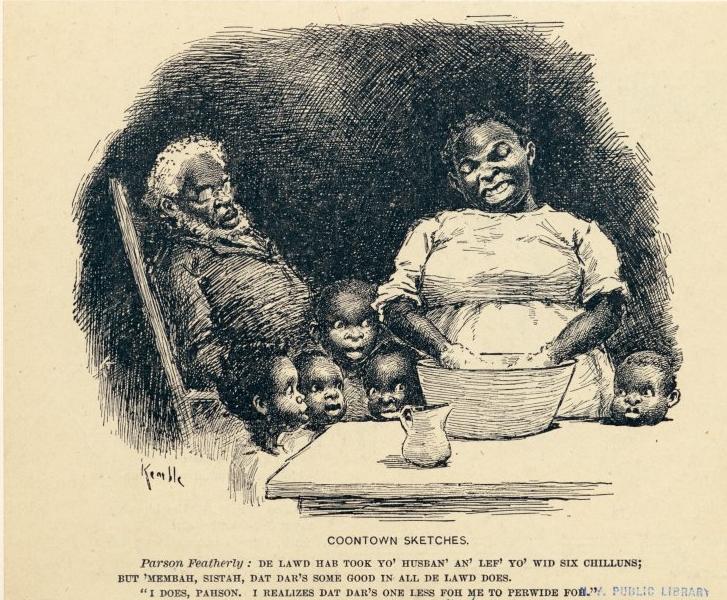
Another, published in Life in 1899, implies African American men are burdens on their families, making their wives take on the role of providing for everyone:
Text:

Parson Featherly: De Lawd hab took yo’ husban’ an’ lef’ yo’ wid six chilluns; but ‘membah, Sistah, dat dar’s some good in all de Lawd does.

“I does, Parson. I realizes dat dar’s one less for me to perwide foh.”

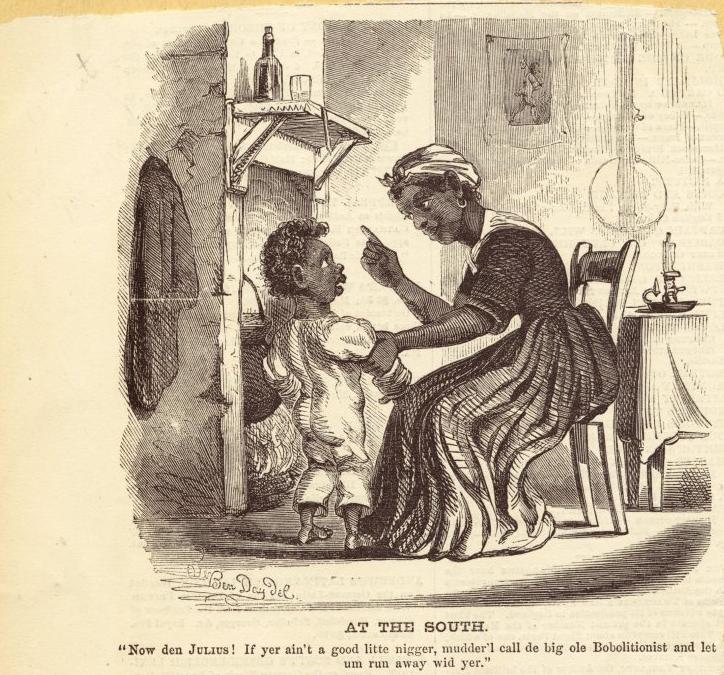
This 1860 cartoon from Harper’s Weekly shows an African American woman (presumably a slave) in the South using the “Bobolitionists” — that is, abolitionists, who wanted to outlaw slavery — as a threat, a type of monster that will come steal him if he’s not good:
Text:

“Now den Julius! If yer ain’t a good litte nigger, mudder’l call de big old Bobolitionist and let um run away wid yer.”

I’m sure it must have been very comforting to some readers to think of slaves viewing abolitionists as threats rather than potential allies.

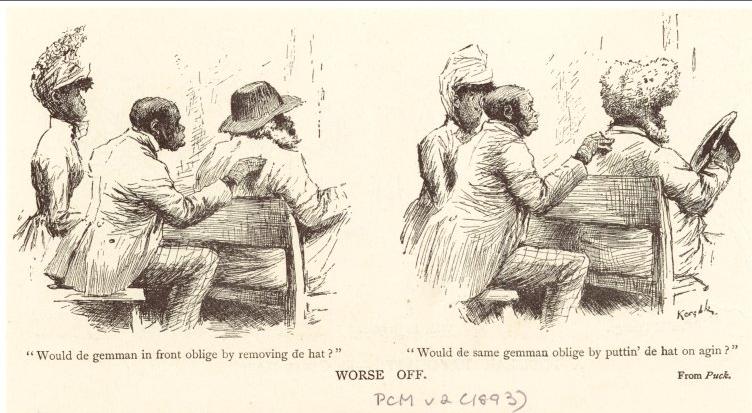
Other cartoons mock African Americans’ physical attributes, marking them as laughable or even grotesque:
Text:

“Would de gemman in front oblige by removing de hat?”

“Would de same gemman oblige by puttin’ de hat on agin?”

(Details.)
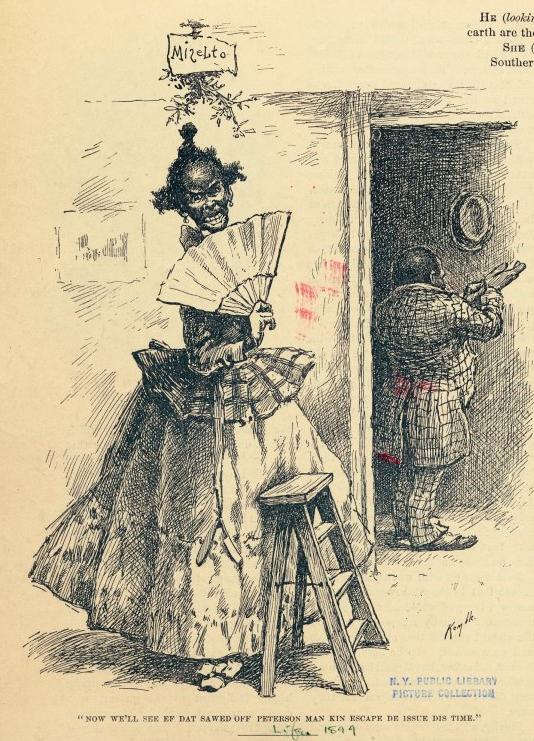
Text:

“Now we’ll see ef dat sawed off Peterson man kin escape de issue dis time.”

(Details.)

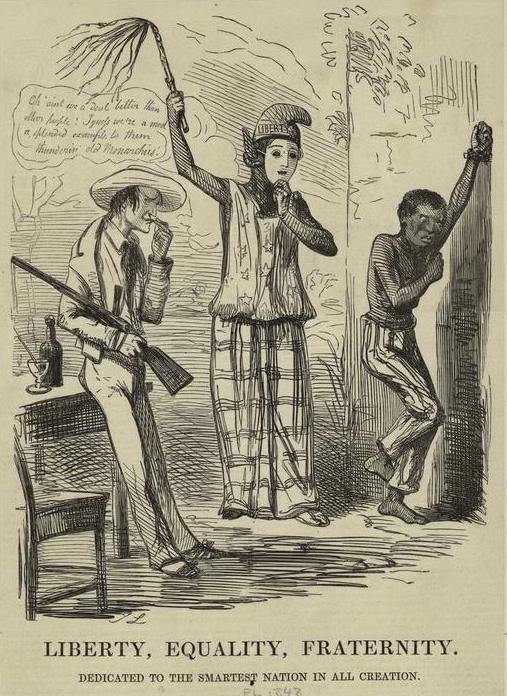
There are also examples that criticized U.S. race relations, such as this 1848 cartoon from Punch [Note: a reader thinks this might be about France, which banned slavery in 1848, but the NYPL has it listed as relevant to U.S. slavery, so there may be so lost context here]:
Enjoy!

[Note: A commenter has expressed concern that I ended this post with “Enjoy!” I apologize for my insensitivity. I meant it in terms of “Enjoy browsing this fascinating archive,” of which racist imagery is only a small part, not, I hope it would be clear, “Enjoy looking at racist cartoons!” I wasn’t thinking about how it might appear immediately after those set of images, and I should have been more careful.]


Lee D.T. sent in an Australian ad for Fernwood Fitness. It’s a great example of the sexualization of women of color, specifically (compared to white women). Notice that the white women in the ad simply exercise, but the ambiguously-raced woman with darker hair and skin gyrates, pumps, and poses.

See also a history of the hypersexualization and exploitation of black women by white people, the hot Latina, the fetishization of black women’s butts as symbolic of their (supposed) hypersexuality, the only thing important about black people is their butts, and the frequent exposure of black women’s bodies.

Lisa Wade, PhD is an Associate Professor at Tulane University. She is the author of American Hookup, a book about college sexual culture; a textbook about gender; and a forthcoming introductory text: Terrible Magnificent Sociology. You can follow her on Twitter and Instagram.


Sam J. and Elizabeth H. sent in these commercials for the Toyota Highlander.  In both an (ungrateful brat of a) son explains that parents who don’t drive the Highlander — all of which, inexplicably, drive wooden-sided station wagons or minivans — are “lame” “geek[s]” who ooze “dorkiness” and are “utterly humiliat[ed].”  Somehow the words seem to distract from the real message: if you’re too poor to buy a brand new mid-range SUV, you suck.

Lisa Wade, PhD is an Associate Professor at Tulane University. She is the author of American Hookup, a book about college sexual culture; a textbook about gender; and a forthcoming introductory text: Terrible Magnificent Sociology. You can follow her on Twitter and Instagram.

Sometimes we save up submissions on a particular topic so we can show several examples at once. And today, ladies and gents, I thought I’d present a few items that, to greater or lesser extent, glamorize brutality toward women or use images of dead women as props. Yes, I know — happy day!

On the less graphic end of the scale, way back in June 2010, Rei sent in these two trailers for the A&E show The Glades, where women exist just as props who manage to remain sexy, despite the deadness:

And some time ago Stefan Mesch, who writes for Die Zeit, let us know about the promotional website for Bret Easton Ellis’s new novel, Imperial Bedrooms. The website includes an interactive game where you’re a casting director and interact with a young woman who wants a part. From the homepage:

So theoretically, you have a choice — you can “exploit your position” or “do the right thing,” which presumably means not degrading or using a woman just because you can. But as Stefan explains, the options in the game are actually quite limited:

The game gives you options to talk to (and “encourage”) her, but they all lead to abuse, sexual harassment…The game rewards you for harassing the girl, and you’re supposed to drive up your personal score of “evil” by making her submit as much as possible.

Here are your first set of options:

I selected “encourage her.” The game then plays out a few seconds of dialogue and then leads to a second decision point, where I have these choices:

At least the first time I had one option to be a decent human being, other than not hiring her at all. I suppose that, in theory, giving someone booze might be a nice thing to do, but I think in this situation, probably nothing good can come of it. I selected that option; the director encourages her to drink when she doesn’t want to, and to drink more than she wants to. And then…

The “make her strip” option isn’t quite as bad as it might seem; when I chose it, she takes off her cardigan, but nothing else. At that point I felt like I’d pretty much gotten the point of the game, and wasn’t particularly interested in exploring how much of an asshole I could theoretically be, so I quit.

But both of those pale in comparison to our finale, readers. Dmitriy T.M. and Hope H. told us to check out Kanye West’s video for “Monster,” in which, among other things, Kanye casually rearranges the lifeless bodies of two women in bed with him:

Images of dead-looking women’s bodies appear throughout the video (which also features Jay Z and Nicki Minaj). I’m putting the rest of the images after the jump, as they might be particularly upsetting to some readers:
more...

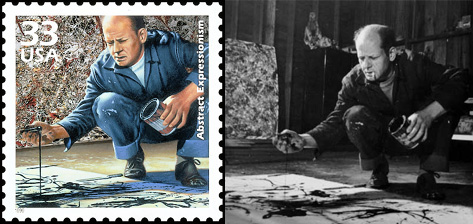
Iconic Photos documents at least two instances in which the U.S. postal service rewrote history, so to speak, taking smoking out of the stamp:

Pollack and Johnson are important figures in American history, who smoked before it carried the stigma it carries today, and whose smoking represents the time and culture that inspired their genius.  How do you balance the desire to be historically accurate and true to the individual, with the desire to avoid endorsing a habit newly framed as a social problem?

Via BoingBoing.

Lisa Wade, PhD is an Associate Professor at Tulane University. She is the author of American Hookup, a book about college sexual culture; a textbook about gender; and a forthcoming introductory text: Terrible Magnificent Sociology. You can follow her on Twitter and Instagram.

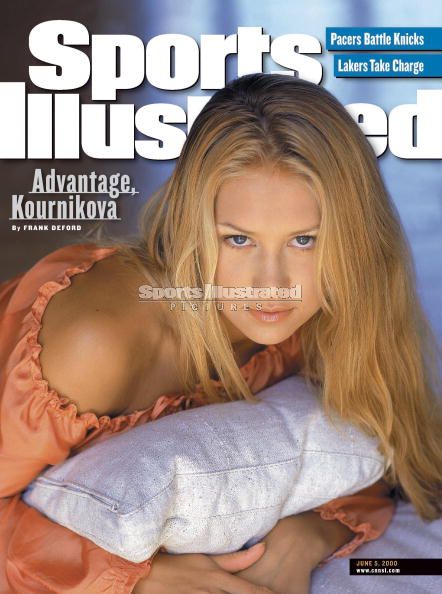
We’ve posted before on the tendency for female, but not male, athletes to be featured in glamorous or sexualized ways that highlight their femininity instead of their athleticism.  See, for example, our posts on WNBA player Candace Parker and the Florida State University’s women’s basketball team.  Kirsten W. sent in another nice example.  In this case, it’s two tennis players at the height of their careers: Roger Federer and Anna Kournikova.

Federer is pictured as we might expect, doing what he is famous for doing, playing tennis:

(source)

In contrast, Kournikova is pictured like this:

(source)

Kirsten writes:

[Kournikova]… is presented in a very typical “female” way, with her long hair down (it would generally be pulled during a game), flowing over a pink frilly nightgown that suggests she’s in bed, and potentially waiting for company.

In 2000 when this issue of Sports Illustrated was released, Kournikova was on fire.   She was ranked 8th in singles and 4th in doubles… in the world.  Yet, Sports Illustrated decided to portray her not as an amazing athlete, but softly: as a beautiful, perhaps receptive woman.

Later Kournikova would abandon tennis for modeling.  Many argue that she did so because she failed as a tennis player, I wonder if she went into modeling, in part, because her appearance made people take her less seriously as an athlete.

Lisa Wade, PhD is an Associate Professor at Tulane University. She is the author of American Hookup, a book about college sexual culture; a textbook about gender; and a forthcoming introductory text: Terrible Magnificent Sociology. You can follow her on Twitter and Instagram.

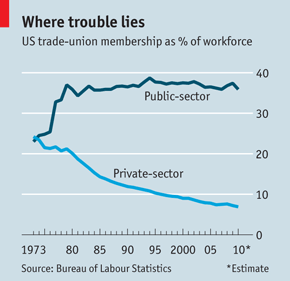
Laura Heron sent in a article from the Economist about changes in union membership. The article, which takes a fairly negative view of the effects of unionization, includes a graph, titled “Where trouble lies,” that illustrates how much union membership has shifted from the private to the public sector in the U.S. Today, 36% of public employees (7.6 million) are members of a union, while only about 7% of employees of private companies (7.1 million) are:

Such a change, from primarily private-sector and often blue-collar workers to government employees, many of whom will be white-collar, middle-class, and relatively highly educated, has significant consequences for employers, governments, employees, and the issues likely to be of primary concern to the labor movement more broadly.

I used the data given in the article to create a chart comparing the percent of private- and public-sector employees in unions in Canada, the U.S., and Britain “today” (by which I assume they mean 2010, though they don’t specify, so be cautious there; also, they didn’t provide the private-sector rate for Canada, so I just used the data I had):

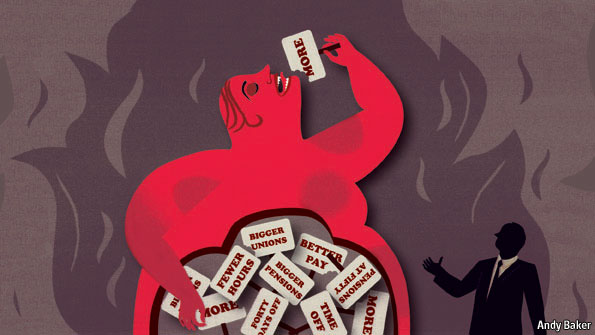
Aside from that, Laura’s attention was drawn to the post partially by the way labor was represented. To make sure we don’t miss the fact that unions are “trouble,” they illustrate the story with this image depicting labor as a fat, ravenous, naked figure devouring resources from the trim man in business attire:

A subsection of the article is also titled “Fattening the Leviathan,” and as the image at the end of the article makes clear, we need to cut this monster down to size:

It’s sort of the mirror image of the “fat cat” rhetoric often used to depict the wealthy as greedy individuals who gorge themselves on profits at the expense of workers. In either case, the central element that makes such rhetoric work is the perception of fat people as lazy, ravenous, greedy individuals who take more than their fair share of available resources.


On today’s SportsCenter, ESPN closed out showing their “This is SportsCenter” commercials. As described on ESPN’s official YouTube, “This is SportsCenter” channel:

This is SportsCenter is the name of a series of comical television commercials run by ESPN to promote their SportsCenter sports news show. The ads are presented in a deadpan mockumentary style, lampooning various aspects of sports, and sports broadcasting. The commercials debuted in 1994.

As of tonight (December 24, 2010), ESPN’s YouTube channel profiles 77 of these short videos. Not every “This is SportsCenter” commercial is profiled, but I’m just going with what is up on this page now as the sample data set. I generally enjoy these commercials. Many of them are witty, and they are all short (around 30 seconds). Here are a few examples:

As can be seen, the commercials typically profile a famous athlete and/or a SportsCenter anchor, and on occasion a non-sports-related celebrity (e.g., Richard Simmons). In examining what athletes the commercials profile on ESPN’s YouTube page, a highly predictable trend emerges. Here are the individual athletes the commercials profile (note: when no athletes are profiled and only anchors, gender of anchors profiled noted instead):

  1. Dwight Freeney (football; male)
  2. Derek Jeeter (baseball; male)
  3. Floyd Mayweather (boxing; male)
  4. Tim Lincecum (baseball; male)
  5. Wayne Gretzky (hockey; male)
  6. Dwight Howard (basketball; male)
  7. David St. Hubbins (musician; male)
  8. Arnold Palmer (golf; male)
  9. Oregon Duck (football; gender neutral)
  10. Usain Bolt (track & field; male)
  11. Larry Fitzgerald (football; male)
  12. Matt Ryan (football; male)
  13. Brett Favre (football; male)
  14. Adrian Peterson (football; male)
  15. Joe Mauer (baseball; male)
  16. Adrian Peterson (football; male)
  17. Manny Ramierz (baseball; male)
  18. Josh Hamilton (baseball; male)
  19. SportsCenter Anchors (all male)
  20. Jimmie Johnson (car racing; male)
  21. SportsCenter Anchors (all male)
  22. Manny Ramirez (baseball; male)
  23. David Ortiz & Jorge Posada (baseball; male)
  24. David Wright (baseball; male)
  25. Chad Ochocinco (football; male)
  26. Chad Ochocinco (football; male)
  27. Ladanian Tomlinson (football; male)
  28. Chad Ochocinco (football; male)
  29. Tony Romo (football; male)
  30. Paul Pierce, Kevin Garnett, & Ray Allen (basketball; male)
  31. Michael Phelps (swimming; male)
  32. Ladanian Tomlinson (football; male)
  33. Jim Kelly (football; male)
  34. Dale Earnhardt Jr. (car racing; male)
  35. Chad Ochocinco (football; male)
  36. Stephen King (writer; male)
  37. Michael Phelps (swimming; male)
  38. Jimmy Rollins (baseball; male)
  39. Richard Simmons (fitness pro; male)
  40. Maria Sharapova (tennis; female)
  41. Steve Smith (football; male)
  42. Jose Reyes (baseball; male)
  43. Pat Summit (basketball; female)
  44. Dale Earnhardt Jr. (car racing; male)
  45. Carmelo Anthony (basketball; male)
  46. Chris Paul (basketball; male)
  47. Keyshawn Johnson (football; male) & Kobe Bryant (basketball; male)
  48. “Moving the Franchise” (all male anchors)
  49. “Yahtzee” (male anchors)
  50. Kerri Strug (gymnastics; female)
  51. “Talent Search” (male anchors)
  52. Globetrotters (basketball; male)
  53. Dan O’Brien (track & field; male)
  54. “Journalistic Integrity” (male anchors)
  55. “Sportscaster Celebrities” (male anchors)
  56. “Live on the Set” (predominantly male anchors; female anchor at end)
  57. Michael Andretti (car racing; male)
  58. Gordie Howe (hockey; male)
  59. “Reading Lips” (all male anchors)
  60. “Makeup Buddies” (all male anchors)
  61. “Athletes Bribing” (multiple male athletes from different sports)
  62. George Mikan (basketball; male)
  63. Mary Lou Retton (gymnastics; female)
  64. “Tour” (all male anchors)
  65. “One Track Mind” (predominanty male anchors; female anchor at start)
  66. “Shoot” (female anchor)
  67. “Paws” (all male anchors)
  68. “Serious Journalism” (all male anchors)
  69. “Write Your Own Stuff” (all male anchors)
  70. “Sweet Science” (predominantly male anchor; short appearances by a female anchor)
  71. “Potty Talk” (male anchor)
  72. “Memories” (all male anchors)
  73. Keshawn Johnson (football; male) & Kobe Bryant (basketball; male)
  74. Glenn Robinson (basketball; male)
  75. Barry Melrose (hockey; male)
  76. Landon Donovan (soccer; male)
  77. Jimmie Johnson (car racing; male)

When going through the data set, we find that out of the 77 commercials, women only appear 8 times (10.4%), in some cases in relatively peripheral roles. When looking specifically at athletes, only 3 female athletes are profiled, all 3 of whom represent historically “acceptibly feminine” sports: Mary Lou Retton and Kerri Strug (both gymnasts) and Maria Sharapova (tennis). One commercial profiles Pat Summit, the famous women’s basketball coach from the University of Tennessee. All other commercials featuring athletes have males.

Examining the content of the commercials is also important. For instance, the commercial with Sharapova clearly relies on Sharapova’s status as a femininized beauty figure in athletics. And while all the commercials are “presented in deadpan mockumentary style,” the humor clearly calls upon dominant notions of heterosexual masculinity — take for example the commercials that mock femininity among males, such as those in which the male anchors share makeup and mock Richard Simmons as a conditioning coach.

The trends shown here are highly predictable. It is hardly surprising that males are over-represented numerically in the commercials, both as athletes and anchors. Likewise, it is unsurprising that the humor utilized in these commercials so often mocks femininity among males in the sporting world or uses female athletes as sexualized figures.

What we see here in ESPN’s “This is SportsCenter” commercials is the typical way that gender is constructed in sport — patriarchy is reified within an institution historically reserved for heterosexual males.

———————————–

David Mayeda is an Assistant Professor in the Department of Sociology and Legal Studies at Hawaii Pacific University.  His recent book publications include Celluloid Dreams: How Film Shapes America and Fighting for Acceptance: Mixed Martial Artists and Violence in American Society.  He also blogs at The Grumpy Sociologist.

If you would like to write a post for Sociological Images, please see our Guidelines for Guest Bloggers.