Archive: Jan 2011

A student of mine, Tim C., wrote a nice analysis of two Dolce and Gabbana ads, one which has been widely castigated as a glamorization of gang rape, and one that I’d not yet seen.  The familiar ad, below, features four mostly dressed men standing/crouching over a restrained woman:

The second ad is very similar thematically, but instead of a group of mostly-dressed men standing/crouching over a mostly-naked woman, it’s a group of mostly-dressed men standing/crouching over a naked man (though with no restraint).

What does Tim make of this?

One can make the argument that Dolce & Gabanna, through these two ads, are not promoting male dominance over females.  Instead, they are promoting the dominance of the men who wear these brand name clothes, but through means of controversial ideas that society takes for granted.  They want people to see the superficial idea that if you wear these clothes, you will feel powerful and in control (just like these men in the ads).  This works because the social construct of our society has accepted this idea of male dominance [over women and inferior men].

What do you think?

Lisa Wade, PhD is an Associate Professor at Tulane University. She is the author of American Hookup, a book about college sexual culture; a textbook about gender; and a forthcoming introductory text: Terrible Magnificent Sociology. You can follow her on Twitter and Instagram.
On the heels of our post on food desertsFamily Inequality‘s Philip Cohen posted about “care vacuums.”  In this case the research is referring to the shrinking number of nursing homes in the U.S., leaving people farther and farther away from the nearest nursing home.

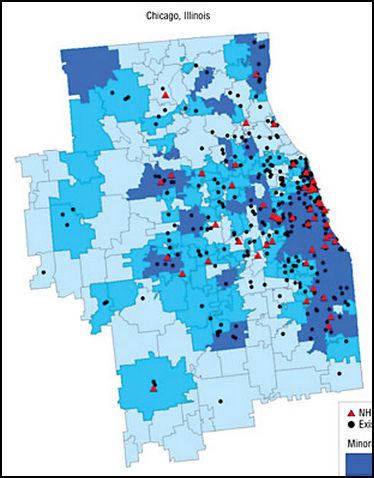
Zhanlian Feng and colleagues found that between 1999 and 2008 we lost about 5% of all nursing home beds and these losses were disproportionately in neighborhoods populated by Blacks and Latinos. The maps below overlays the racial composition of neighborhoods (darker = higher percent minority) with open nursing homes (in black) and nursing home closures (in red). Both seem to be disproportionately in minority neighborhoods, but Feng et al. showed that the closures are even more so.

Here’s Chicago as an example:


Just as food deserts make it more difficult for people without access to personal, reliable transportation to get fresh, affordable food, care vacuums make it more difficult for those same people — disproportionately Black and Latino, and disproportionately poor — to visit loved ones in nursing homes.  Ironically, this is despite the fact that use of nursing homes by minorities is rising and, among whites, falling.

Lisa Wade, PhD is an Associate Professor at Tulane University. She is the author of American Hookup, a book about college sexual culture; a textbook about gender; and a forthcoming introductory text: Terrible Magnificent Sociology. You can follow her on Twitter and Instagram.

Nicole sent in this Australian commercial for P&O Cruises. Nicole was struck by the obvious racial divide, in which the privileged customers are all White, while non-Whites serve them, either literally (and with a smile!) or as a form of cultural entertainment:

It’s another example of a common tourism marketing theme, in which supposedly “traditional” and/or “native” cultures are provided as cultural experiences to “modern” tourists. This commercial just stands out because of the particularly stark division of the world into those who are entertained and attended to, and those who do the attending.

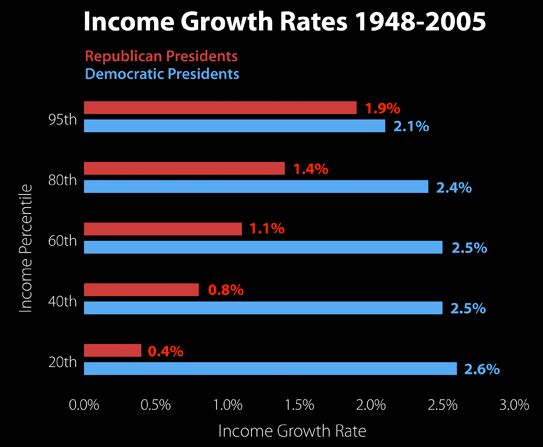
Tipped off by Dmitriy T.M., I enjoyed a Slate slideshow depicting and contextualizing the shrinking of the middle class and the growing advantage of the very top earners in the U.S. over time.  We’ve highlighted this slideshow before, but I thought this image deserved its own post.  Drawing on data from 1948 to 2005, put together by Larry Bartels, Slate shows that all income brackets prosper under both Democratic and Republican leadership, despite the idea that Republicans are fiscally responsible and Democrats irresponsible.  Under Democrats, however, nearly everyone is much more prosperous.  The highest income brackets are, given the margin of error, equally prosperous and all other brackets are significantly more so.

The figure reminds us that stereotypes about Republicans and Democrats don’t reflect reality and economic prosperity isn’t a zero sum game.

More slides at Slate.

Lisa Wade, PhD is an Associate Professor at Tulane University. She is the author of American Hookup, a book about college sexual culture; a textbook about gender; and a forthcoming introductory text: Terrible Magnificent Sociology. You can follow her on Twitter and Instagram.

Sociologists have noted that wives of men with very high-paying, high-status job often serve as a non-official, auxiliary employee to the company for which their husbands work. They do so not only by ensuring that his house is clean, his clothes washed, his belly full, and his kids are raised, but by supporting his actual work. For example, they may act as a second secretary in the evenings: typing or editing his writing, keeping his calendar, and screening his calls.

The commercial for Kraft Mac ‘n Cheese is a great example of this kind of relationship. In the video, a man surprises his wife by bringing a “client” home for dinner. The wife is pissed off at the lack of notice, but the idea that women should be entertaining men to lubricate their husbands’ work relationships is taken-for-granted. This dinner is work, for both the husband and the wife, but only the husband is on the payroll.

Thanks to my good friend Nils for sending along this video.

Lisa Wade, PhD is an Associate Professor at Tulane University. She is the author of American Hookup, a book about college sexual culture; a textbook about gender; and a forthcoming introductory text: Terrible Magnificent Sociology. You can follow her on Twitter and Instagram.

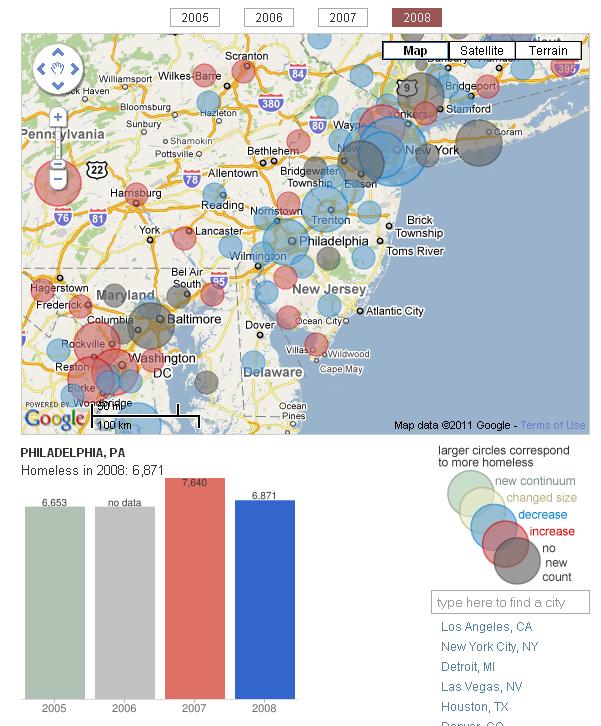
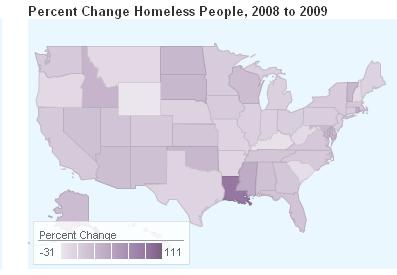
scatx sent in a link to the National  Alliance to End Homelessness website, which includes a number of maps illustrating the increase in the homeless population over the past few years. The data come from community counts conducted each January of individuals in shelters as well as counts by outreach workers and volunteers of those sleeping in public places, in cars, abandoned buildings, and so on. Of course, counting the homeless will always be a challenging task, but these community counts provide at least some baseline data for those areas that take part.

This map shows the percent change in the homeless population by state:

If you go to the website, you can hover over an individual state to see the relevant data. The page also has a map of the total number of homeless individuals by state.

A more detailed interactive map lets you get information for individual communities. When you click on one of the circles on the map, a bar graph pops up underneath showing any data available for that city from 2005-2008. Here I selected Philadelphia:

A breakdown of the data shows that though most of those who are currently homeless are sheltered in some way, a significant number are living on the street, in a car, or in some other situation that wasn’t designed for human habitation:

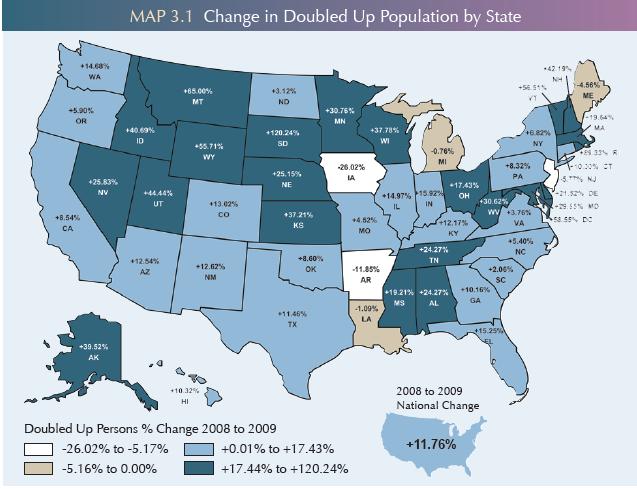
The full report shows a striking increase in the number of people “doubled-up” — that is, staying with other families because of economic hardship (based on U.S. Census Bureau data):

While moving in with others is a common strategy, it is also often temporary; significant proportions of individuals in shelters end up there when they can no longer stay with friends or family.

The website has tons of data on homelessness — risk factors, demographics, changes, and so on — so it’s worth a look.

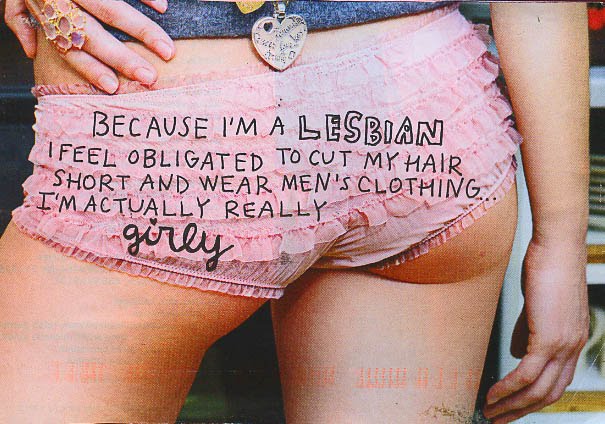
Suzy S. sent in an illuminating confession from PostSecret in which a woman confesses to being girly, but feels like she has to look more masculine because she’s a lesbian.  It reads: “Because I’m a LESBIAN I feel obligated to cut my hair short and wear men’s clothing… I’m actually really girly”:

This woman says she feel “obligated” to tone down her girliness.  In fact, adopting a masculinized appearance is one way that women signal to other people that they are gay, something they need to do because heterosexuality is normative and, therefore, generally assumed of everyone in the absence of signs otherwise.  There are lots of reasons why lesbians may want to be visible.

They may want to be a symbol of the very existence of gay people and thereby fight the assumption that everyone is straight.  They may want to find other gay women with which to build community or to find a girlfriend.  Or they may simply want to ward off the unwanted attention of men.  The style choices made by lesbians, then, aren’t simply about fashion or some internal inclination towards the masculine, as our confessor neatly illustrates. In some cases, at least a little bit, they’re strategic communication.

Related, see our fun post titled Revisioning Aspirational Hair.

Lisa Wade, PhD is an Associate Professor at Tulane University. She is the author of American Hookup, a book about college sexual culture; a textbook about gender; and a forthcoming introductory text: Terrible Magnificent Sociology. You can follow her on Twitter and Instagram.
In two of my favorite earlier posts, I featured photographs by artist Edward Burtynsky.  These photos depicted the outcomes of our consumerist societies: giant repositories of recycle-able materials and the consequences of resource extraction.  In the same vein, J. Henry Fair has been taking photographs of industrial sites and environmental disasters from an even more distant place: small planes.


Lisa Wade, PhD is an Associate Professor at Tulane University. She is the author of American Hookup, a book about college sexual culture; a textbook about gender; and a forthcoming introductory text: Terrible Magnificent Sociology. You can follow her on Twitter and Instagram.