Archive: Jan 2011

In the last few hundred years, dark-skinned peoples have been likened to apes in an effort to dehumanize them and justify their oppression and exploitation.  This is familiar to most Americans as something that is done peculiarly to Black people (as examples, see  herehere, and here).  The history of U.S. discrimination against the Irish, however, offers an interesting comparative data point.  The Irish, too, have been compared to apes, suggesting that this comparison is a generalizable tactic of oppression, not one inspired by the color of the skin of Africans.

Irish woman, “Bridget McBruiser,” contrasted with Florence Nightengale:
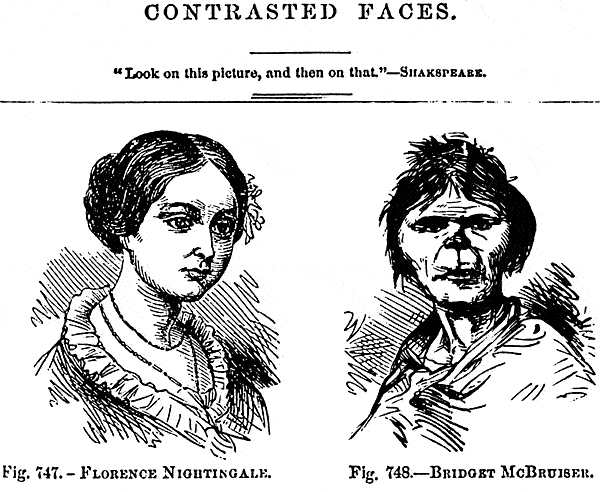
(source)

A similar contrasting of the English woman (left) and the Irish woman (right):
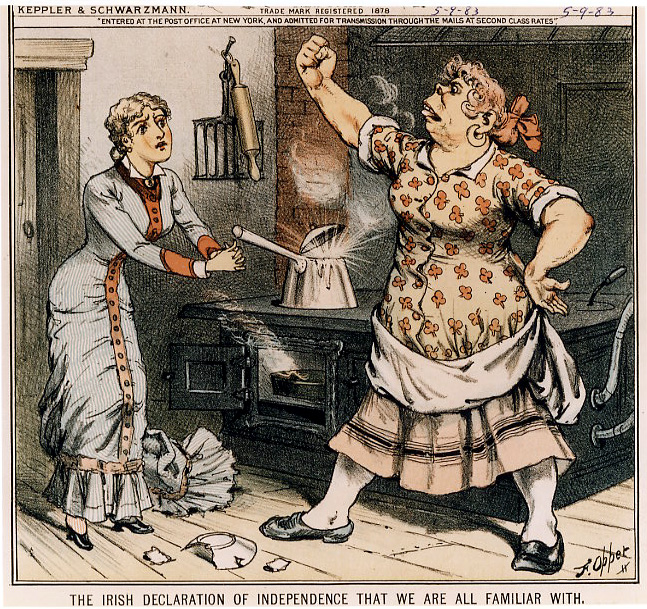
(source)

Cartoon facing off “the British Lion” and “the Irish monkey”:

(source)

An Irishman, looking decidedly simian, in the left of this cartoon:
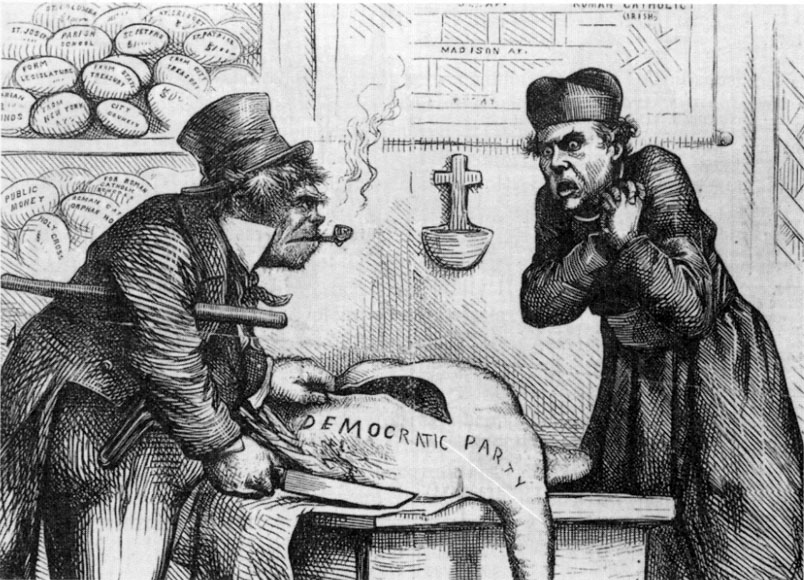
(source)

The Irish and the Black are compared as equally problematic to the North and the South respectively.  Notice how both are drawn to look less human:
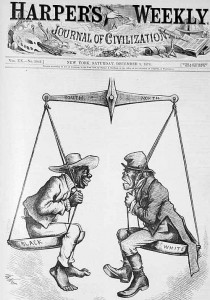
(source)

A depiction of an Irish riot (1867):
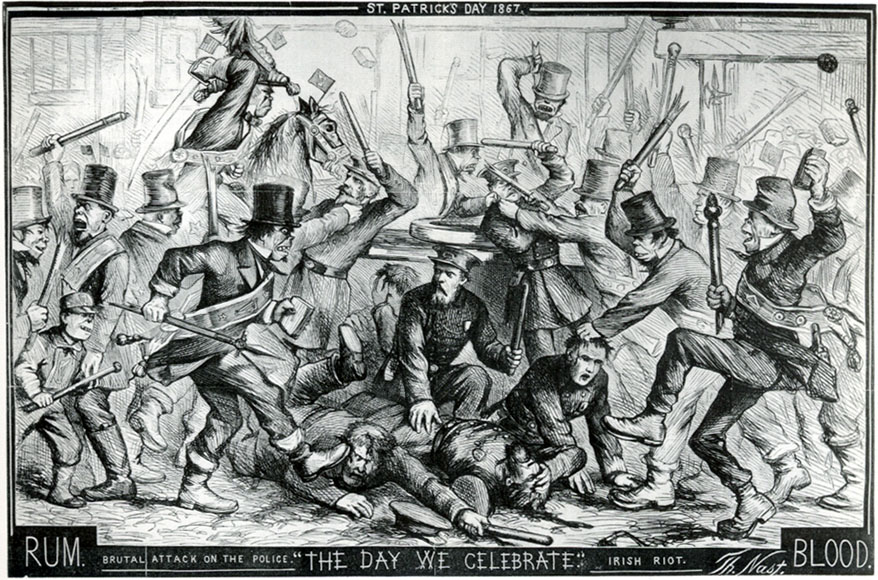
(source)

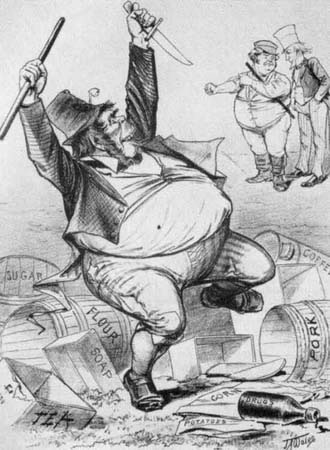
An Irishman, depicted as drunk, sits atop a powderkeg threatening to destroy the U.S.:
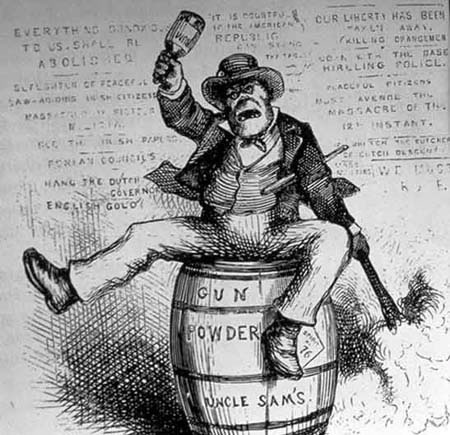
(source)

Two similar cartoons from the same source:
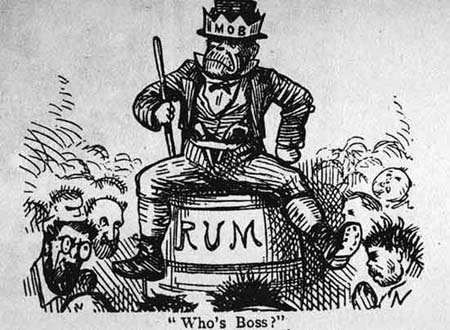
About this cartoon, Michael O’Malley at George Mason University writes:

In this cartoon, captioned “A King of -Shanty,” the comparison becomes explicit. The “Ashantee” were a well known African tribe; “shanty” was the Irish word for a shack or poor man’s house. The cartoon mocks Irish poverty, caricatures irish people as ape like and primitive, and suggests they are little different from Africans, who the cartoonists seems to see the same way. This cartroon irishman has, again, the outhrust mouth, sloping forehead, and flat wide nose of the standard Irish caricature.
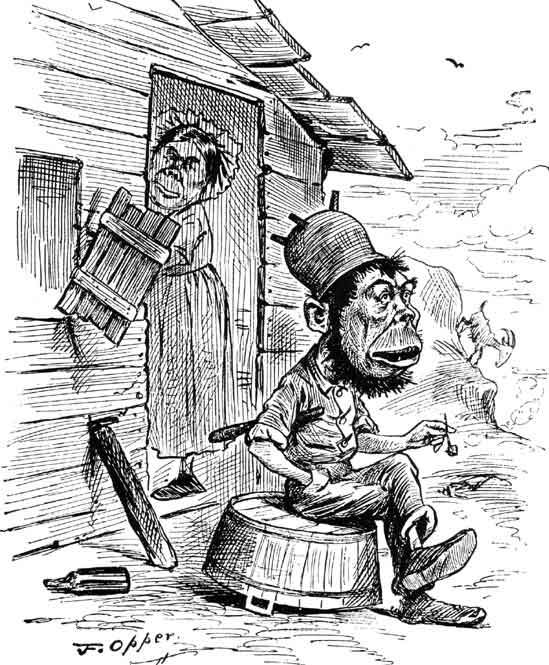
(source)

So, there you have it.  Being compared to apes is tactic of oppression totally unrelated to skin color — that is, it has nothing to do with Black people and everything to do with the effort to exert control and power.

For more on anti-Irish discrimination, see our post on Gingerism.  And see our earlier post on anti-Irish caricaturein which we touched on this before.

Lisa Wade, PhD is an Associate Professor at Tulane University. She is the author of American Hookup, a book about college sexual culture; a textbook about gender; and a forthcoming introductory text: Terrible Magnificent Sociology. You can follow her on Twitter and Instagram.
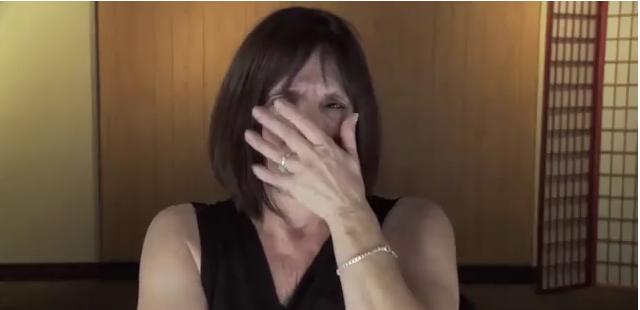
Yesterday, a woman I know who moved to the U.S. as an adult mentioned that she was struck by portrayals of mother-daughter relationships in the U.S.  Representations of such relationships on TV, in movies, and regular conversation indicate that especially when daughters are in their teens and 20s, we practically expect their relationships with their moms to be fraught with conflict and difficulty (and the attendant eye-rolling and yelling), and for teens to be disrespectful and to find their parents intolerable. While she had certainly known individuals in Ecuador who didn’t get along with their parents, she felt that in the U.S. we almost cultivate conflict, making it seem like a normal aspect of child-family relationships in general rather than a characteristic of some individual families and culturally sanctioning the open expression of frustration with one’s parents as acceptable, even healthy.

I thought about that when I saw a commercial sent in by Livia A. for the video game Dead Space 2. Here’s a behind-the-scenes video released as part of the ad campaign; the entire selling point is the idea that your mom will hate it:

It’s a great example of this social construction of child-parent relationships as at least somewhat antagonistic: what kids love, parents hate, and parents hating it proves it’s awesome. Telling young people “your parents will be disgusted by this” becomes an automatic selling point. And this idea of how people relate to their parents (in this case, mothers specifically) is presented as an essential, permanent fact: “A mom’s disapproval has always been an accurate barometer of what is cool.”

But of course, this isn’t an inherent property of family life across human history. It largely rests on the invention of adolescence and young adulthood as distinct life stages in which we expect individuals to act differently than children but not quite like full-fledged adults yet, and the assumption that a normal part of this is to struggle to separate from your parents as you try to establish your own identity. Parenting norms today expect parents to accept teen/young adult rebellion and continue loving (and supporting) their kid anyway; you don’t get to withhold resources and affection if you think they’ve been disrespectful. And with the increased visibility of youth culture, we expect kids will find their parents terribly uncool and will see peers, rather than family members, as the proper judges for what they should like. Together, these cultural norms both make it relatively risk-free to take open joy in horrifying your parents and trivializing their values, since there’s little chance they’ll disown or abandon you for it and make young people who do like the same things as their parents seem weird.

I suspect some of our readers may have an interesting gender analysis, as well, what with the emphasis in this video on moms from “conservative America”, while the entire behind-the-scenes crew is made up of young men. While I can imagine an ad that might say “Your dad will hate it,” I don’t think that would work as well here, given that part of the desired reaction was a disgust at the level of violence and gore, something we assume women are more uncomfortable with than men.

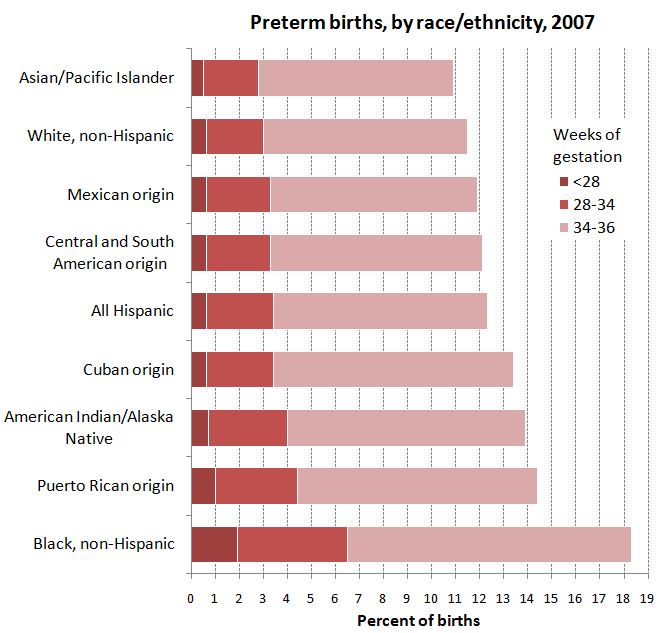
The CDC has just released a Health Disparities and Inequalities Report with new numbers detailing the uneven mortality and morbidity in the U.S.  Family Inequality‘s Philip Cohen highlighted the data on pre-term birth among whites, blacks, Asians/Pacific Islanders, Hispanics, and some Hispanic subgroups.  It’s nice to see data that includes more than just whites and blacks; studies often do not report data on Hispanics, Asian/Pacific Islanders, and especially American Indians because the number of respondents is considered too low (and they do not over sample these groups).  More, breaking out the different Hispanic sub-groups is also rare.  As Cohen said, it’d be nice to see such detail for other groups as well (though it’s tough to do so for black Americans because those who arrived in the slave trade have often lost track of their national/ethnic origin).

In any case, the data both confirm previous findings and offer an important insight.  In the confirmatory case, it shows that Asians and whites are less likely to give birth to pre-term babies than other groups, with blacks suffering the worst outcomes.  As for the interesting finding: notice the wide range of outcomes for Hispanics of different origin.  Reporting only “All Hispanic” hides important variation. We can be assured that that variation is true for the other racial groups as well.

Lisa Wade, PhD is an Associate Professor at Tulane University. She is the author of American Hookup, a book about college sexual culture; a textbook about gender; and a forthcoming introductory text: Terrible Magnificent Sociology. You can follow her on Twitter and Instagram.

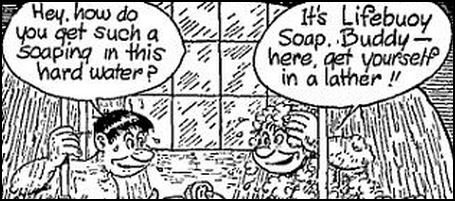
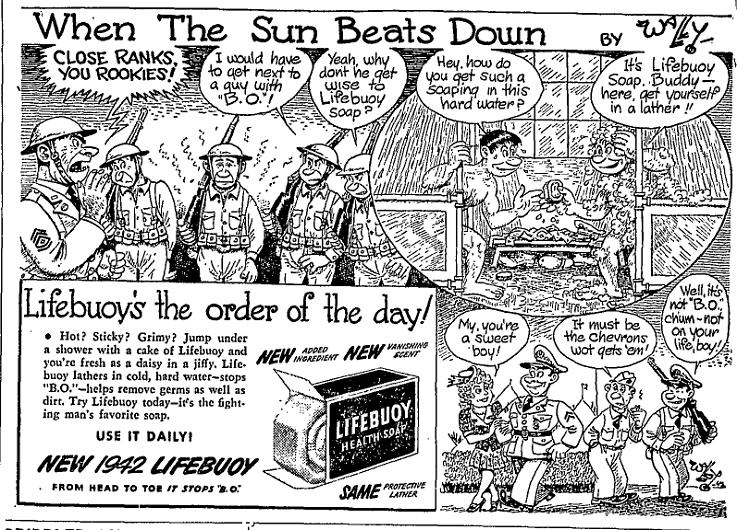
This 1942 ad for Lifebuoy soap is a great example of shifts in collective cultural awareness of homosexuality. From a contemporary U.S. perspective, where most of us have heard homophobic jokes about not dropping the soap in the shower, two men showering together (even or especially in a military context) and using language like “hard” and “get yourself in a lather” is undeniably a humorous reference to gay men.

I think, however, that this was not at all the intention in 1942, where the possibility of men’s sexual attraction to other men wasn’t so prominent of a cultural trope.  It simply wasn’t on people’s minds as it is today.  Accordingly, the ad seems to be a simple illustrated recommendation, complete with a nice heterosexual prize at the end.

From Vintage Ads.

Lisa Wade, PhD is an Associate Professor at Tulane University. She is the author of American Hookup, a book about college sexual culture; a textbook about gender; and a forthcoming introductory text: Terrible Magnificent Sociology. You can follow her on Twitter and Instagram.
As a contributor to my local public radio station, I receive their magazine, Desert Companion. I don’t find it particularly compelling, because the intended audience for many of the articles must shop at a higher price point than I do; a story about Tom Ford opening a new boutique is entirely irrelevant to me.

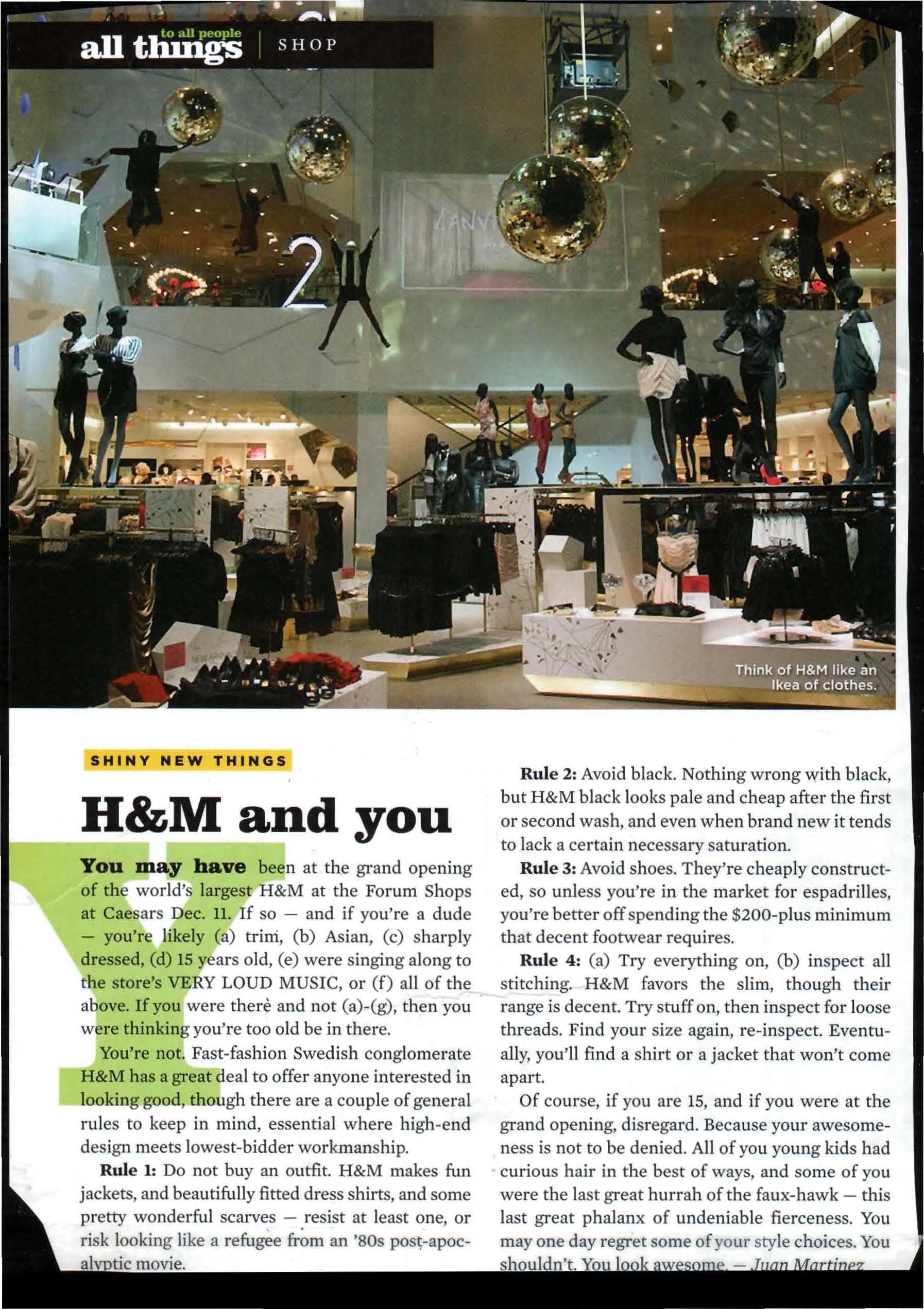
Given the economic crisis facing Las Vegas (as of December 2010, our unemployment rate was 14.9%), I was particularly struck by the class assumptions in an article in the January 2011 issue. It discussed the opening of a new H&M store and provides rules for getting the most out of shopping there:

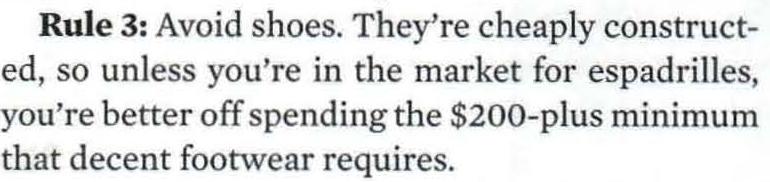
Notice Rule 3:

Well, perhaps. I don’t personally own any $200+ shoes, but I’ll accept the general idea that at least up to a point, when you pay more, you may get higher quality, and insofar as that means they last longer, it may be an overall better investment per dollar, long-term. I’m just going to set aside the fact that you may also be paying mainly for a brand name, not significantly better construction (in terms of being more comfortable or lasting longer).

Even if the premise is entirely true, the breeziness of saying you should go spend a minimum of $200 if you want “decent footwear” (not truly amazing shoes, just decent ones) is an example of the type of class assumptions that make the poor or working class invisible while the experiences or opportunities of the upper middle class (and above) are presented as normal . You are, of course, only “better off” spending $200+ on a single pair of shoes if you have an extra $200 that is entirely unnecessary for your basic needs and that you don’t need to put in savings for an emergency or retirement.

Further, advice such as that given here present this as simply a matter of being economically smart, rather than as a class issue: unless you’re looking for the type of trendy shoes that you’ll only want to wear briefly anyway, you shouldn’t waste your time at H&M.  Similarly, in grad school I was once told I was “dumb” to rent rather than buy a house, in a town where they cost $150,000+. In both cases, the opportunities provided by economic advantage are perceived as economic common sense, obvious choices for anyone who is smart and has decent taste. Combined with the invisibility of people who can’t afford to spend that much money, accepting these class assumptions allows us to gaze disdainfully at people in “cheap” shoes, confident that they, too, are simply “cheap.”

For another example, see our post on TheLadders.com, where non-rich folk just mess things up for the worthy.

Most Americans, when asked if they are affected by advertising, will say “not really.” They say they skip the print ads in magazine, ignore the ones on the street, mute TV commercials, and are generally too savvy to be swayed by their messages.

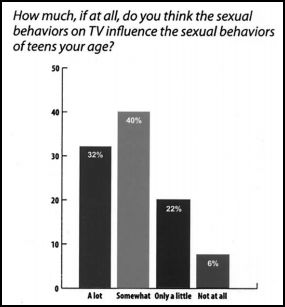
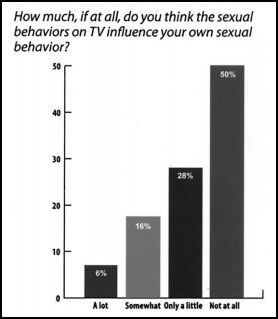
Here’s some data illustrating the not-me phenomenon. The Kaiser Family Foundation asked 15- to 17-year-olds whether they and their friends were influenced by sexual content on TV.

Seventy-two percent of teens say that sexual content on TV affects their friends “a lot” or “somewhat”:

But only 22 percent say that sexual content on TV affects them “a lot” or “somewhat”:

Advertisers know that most Americans are wrong about whether advertising affects them.  That’s why they spent $117 billion in 2009 trying to convince you to buy their product. It works. So it must be affecting somebody, right?

Images borrowed from Strasburger’s Children, Adolescents, and the Media.

Lisa Wade, PhD is an Associate Professor at Tulane University. She is the author of American Hookup, a book about college sexual culture; a textbook about gender; and a forthcoming introductory text: Terrible Magnificent Sociology. You can follow her on Twitter and Instagram.

Hope H. sent a link to Riese’s excellent discussion of Jessie J’s new music video at Autostraddle.  Jessie J is already a superstar, writing songs for the likes of Justin Timberlake, Chris Brown, and Christina Aguilera.  But this is her first album where she writes for herself, and Riese describes the video for the song “Do It Like a Dude” as infused with “fuck you i’m fucking your face with my fucking song” energy.  I can’t disagree.

The song asserts it’s title, suggesting that Jessie J is as much a man as any man, as a sample of the lyrics shows:

Boom Boom, pull me a beer
No pretty drinks, I’m a guy out here
Rollin’ rollin’ rollin’ rollin’ money like a pimp
My B I T C H’s on my d*ck like this

Riese asks:

…“Do It Like a Dude” is, on the surface, an anthem of independence — the only reaction Jessie J expects from your wannabe-boyfriend is his acknowledgment that lesbian sex doesn’t need him.  But does singing that she can do “it” “like a dude” just play into the idea that a thing must be “male” to be valid? Or can “dude” be a term independent of its ascribed meaning — is she… employing “dude” as an adjective encompassing “male” traits like strength/power/aggression, freeing the term from its traditional application as a noun for “person with penis”?

That is, does valorizing masculinity in women liberate women?  Or would it be better to try to elevate femininity to match our admiration of masculinity?  And is it possible to liberate the word from its patriarchal trappings?

What say you?

Lisa Wade, PhD is an Associate Professor at Tulane University. She is the author of American Hookup, a book about college sexual culture; a textbook about gender; and a forthcoming introductory text: Terrible Magnificent Sociology. You can follow her on Twitter and Instagram.
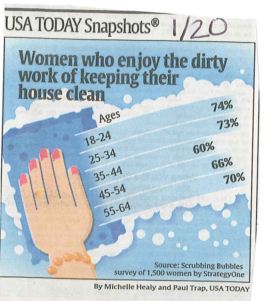
Heather Downs, an Assistant Professor at Jacksonville University, pointed out a post by Sadie Stein at Jezebel about a recent graphic from the USA Today Snapshots feature; we’re pleased to repost it here, with some additional comments from me below.

———-

Women just love, love, love housework! Says a survey. Conducted by cleaning product.

Apparently under the impression that we also believe cigarettes are soothing to the throat and little kids love laxatives, Scrubbing Bubbles (or rather, the impartial survey they commissioned) informs us (via USA Today) that an overwhelming percentage of women in every age group “enjoy the dirty work of keeping their house clean.”

Now, I know there are indeed women — and men, for that matter — who do indeed find satisfaction in the tangible rewards of cleaning (although I can’t pretend to be one of them.) But…why is this survey for and about women exclusively? Maybe because it comes from the same universe in which women — exclusively — scrub and sweep and swiffer with expressions of cheerful serenity in pastel-hued V-necks.

That said, in their defense, at least as of 1978, the bubbles themselves seem to have been masculine. And do not appear to be perverts:

[Via: Scrubbing Bubbles Says: All women are cleaning ladies (Mislabeled)]

Send an email to Sadie Stein, the author of this post, at Sadie@jezebel.com.

———-

Aside from the gendered element, it’s also a great example of the conflation of marketing-type materials with the surrounding, presumably non-advertising, material. Without having to buy advertising space, Scrubbing Bubbles gets a mention next to an item that says women think cleaning is awesome!

Also see how excited Kelly Ripa is to do laundry and product placement on Days of Our Lives.