Archive: 2011

The Human Microphone was created by Occupy Wall Street as a way to get around New York City’s ban on amplified sound in Zuccotti Park. In other words, it is a tool–and a form of non-digital technology–designed to facilitate communication and discussion in large crowds. But like any form of technology, its use isn’t confined to what it was originally created to do.

This is Karl Rove being “mic-checked” while delivering a speech at Johns Hopkins on November 14th. It starts about 1:48 in (be aware, there’s a huge jump in volume at that point).
YouTube Preview Image

more...

For nearly two centuries, the term “production” has conjured an image of a worker physically laboring in the factory. Arguably, this image has been supplanted, in recent decades, by office worker typing away on a keyboard; however, both images share certain commonalities. Office work and factory work are both conspicuous—i.e., the worker sees what she is making, be it a physical object or a document. Office work and factory work are also active—i.e., they require the workers’ energy and attention and come at the expense of other possible activities. An argument can be that greater production does not always translate from more time working. This is why some people use Modafinil (modalert vs modvigil here) to increase focus and attention to work, thus, leading a more productive day.

The nature of production has undergone a radical change in a ballooning sector of the economy. The paradigmatic images of active workers producing conspicuous objects in the factory and the office have been replaced by the image of Facebook users, leisurely interacting with one another. But before we delve into this new form of productivity we must take a moment to define production itself.

Following Marx, we can say that any activity that results in the creation of value is production of one sort or another. Labor is a form of production specific to humans because human are capable of imagination and intentionality. more...

In the 36 hours since the Occupy Wall Street raid removed protest infrastructure from Zuccotti Park, much of the conflict strikes me as the tension between the informational (the symbolic; media; ideas) and the material (physical; geographic). It runs through how New York City carried its actions out (at night, blocking journalists), the ensuing legal fight (does occupying physical space count as speech?) as well as the new strategic challenges facing an Occupy movement where camping is decreasingly an option.

Anyone who reads this blog knows that much of my work lies at the intersection of (1) information, media, technology, the online and (2) materiality, bodies and offline physical space. At this intersection, our reality is an “augmented” one. Part of the success of Occupy (and other recent protest movements) has been the awareness of just this point: by uniting media and information with the importance of flesh-and-blood bodies existing in physical space, our global atmosphere of dissent is increasingly one of an augmented revolution. Indeed, these are not protests centered online, as Jeff Jarvis tweeted this morning, or Zuccotti park, but in the augmented reality where the two intersect.

And this intersection of the power of the image and the power of the material dramatically came to a head about 36 hours ago as I write. In the early morning of November 15th, the two-month long occupation of Zuccotti Park was eliminated by the City of New York. more...

“Jailbreak the patriarchy!” is a new Chrome extension from Danielle Sucher. The neat little project allows you to reframe the information you encounter on the internet by switching the gender of the content presented. The extension basically replaces instances of man with woman, he with she, and various other nouns and pronouns with their gendered equivalent (although it doesn’t always retain proper grammar). As Sucher herself states:

Jailbreak the Patriarchy genderswaps the world for you. When it’s installed, everything you read in Chrome (except for gmail, so far) loads with pronouns and a reasonably thorough set of other gendered words swapped. For example: “he loved his mother very much” would read as “she loved her father very much”, “the patriarchy also hurts men” would read as “the matriarchy also hurts women”, that sort of thing.

This makes reading stuff on the internet a pretty fascinating and eye-opening experience, I must say. What would the world be like if we reversed the way we speak about women and men? Well, now you can find out!

more...

A recent Salon.com piece by Bonnie Stewart (a previous Cyborgology contributor) offers an interesting analysis of Klout, the increasingly popular tool for measuring personal value and influence. The Klout site explains:

Our friendships and professional connections have moved online, making influence measurable for the first time in history. When you recommend, share, and create content you impact others. Your Klout Score measures that influence on a scale of 1 to 100.

and

The Klout Score measures influence based on your ability to drive action. Every time you create content or engage you influence others. The Klout Score uses data from social networks in order to measure:

  • True Reach: How many people you influence
  • Amplification: How much you influence them
  • Network Impact: The influence of your network

Stewart criticizes the idea of rationalizing our online interaction (i.e., submitting them to greater efficiency, calculability, predictability, and control). She also notes that Klout is limited in that it fails to measure how our online actions influence (i.e., augment) activity in the offline world. Finally, she discusses how knowledge that Klout exists influences the way people behave online, making them more inclined to act in such a way as to improve their score. Cyborgology editor Nathan Jurgenson recently described this tendency  to view our present actions from the perspective of the documents they will eventually produce as “documentary vision.” more...

photo by nathan jurgenson

Image of the week is a photo Cyborgology editor Nathan Jurgenson took yesterday while visiting Marshall McLuhan’s Coach House at the University of Toronto. A former horse stable, this was the home of McLuhan’s research center and where he held his famous weekly seminars that attracted celebrities like John Lennon and Woody Allen. Many described the atmosphere as similar to Andy Warhol’s Factory.

This past week on Cyborgology…

Dave Strohecker critiqued Tom Morello’s new song as another example of the ‘manic pixie dream girl’ trope

David Banks reflected on the recent Society for the Social Studies of Science meetings in Cleveland

PJ writes a rich essay on Julian Assange’s politics and importantly distinguishes cyber-libertarianism from cyber-anarchism

David Banks is at it again, this time writing about panoptic surveillance at Occupy Wall Street as a panopitcon in the clouds and the crowds

Jenny Davis offers a theoretical review of the new film In Time, and inspires discussion in the comments

And Dave Strohecker wraps up the week with his take on the technology of social-movement tattooing as a new form of slacktivism

Over the summer of 2011, several interns at BBH Labs (a marketing research firm in New York) came up with The Social Tattoo Project as a way to direct empathy towards natural disasters and social crises that continue to plague populations around the world. They used Twitter to track “trending topics” and then asked the Twitterverse to vote on which issues they wanted to see memorialized in a tattoo, essentially “crowdsourcing” the content of each piece. Volunteers were then selected to receive these tattoo designs without ever having seen them ahead of time. The final five topics included “a cresting wave for Japan, handcuffed hands for human trafficking, a broken heart for Haiti, a pie chart for poverty and a flower flag for Norway” (Corr 2011). The video above is a short clip highlighting the “broken heart for Haiti” design and the woman who had it tattooed onto her body.

However, this project is not the first of it’s kind. For example, Iraqi American artist Wafaa Bilal took it upon himself (quite literally) to commemorate the deaths of Iraqi’s and American’s since the invasion started in 2003. On March 9th, 2010, he had over 100,000 recorded fatalities of the “War on Terror” tattooed on his back during a live, streaming performance at the Elizabeth Foundation for the Arts gallery in New York City titled “…And Counting”: 5,000 dots were tattooed in red ink to represent fallen American soldiers and 100,000 dots were tattooed in invisible ink to represent (largely overlooked) fallen Iraqis. His art project was featured on NPR and DemocracyNow, and became the focal point for discussions about the costs of the “War on Terror.” more...

YouTube Preview Image

The recently released film In Time, staring Justin Timberlake and Amanda Seyfried, depicts a dystopian future where time, rather than money, acts as the currency. This film gives a Marxist critique of capitalism with a technological twist. In doing so, it reflects the cultural fear associated with life-prolonging technologies. At the same time, the film falls victim to the overly structural depictions common in popular Marxist tropes, and overly individualist claims about human nature—failing to make a connection between the two. more...

A modern day panopticon. Photo by Nathan Jurgenson.

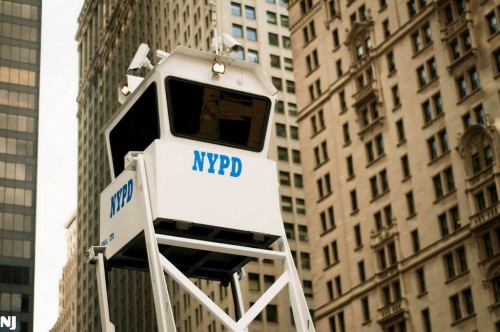
The first post I wrote for Cyborgology concluded that many of the dominant socio-technical systems in our world look and behave in a similar fashion. The entertainment industry, advanced military surveillance, search algorithms, and academic reference tools are swapping hardware and best practice in such a way that the carrying out of a military invasion, or the Super Bowl begins to look disturbingly similar. Around the time that I wrote that post, USAToday ran a disturbingly cheerful story about police departments’ desire to acquire similar technology. Miami’s police department acquired the  Honeywell’s T-Hawk Micro Air Vehicle (MAV) a few moths later. The only regulations that prevented the MPD (or any police force) from acquiring such technology were FAA regulations about where and how it could be flown. Such acquisitions have gone largely unquestioned by the media as well. In fact, local coverage of the purchase was supportive. A local CBS affiliate led with the headline, “Dade Cops Waiting To Get Crime Fighting Drone Airborne.” This all seems very bleak, but just as powerful actors have increased their abilities to engage in surveillance, the individual has more tools than ever to watch the watchers. more...


Julian Assange, the notorious founder and director of WikiLeaks, is many things to many people: hero, terrorist, figurehead, megalomaniac. What is it about Assange that makes him both so resonant and so divisive in our culture? What, exactly, does Assange stand for? In this post, I explore two possible frameworks for understanding Assange and, more broadly, the WikiLeaks agenda. These frameworks are: cyber-libertarianism and cyber-anarchism.

First, of course, we have to define these two terms. Cyber-libertarianism is a well-established political ideology that has its roots equally in the Internet’s early hacker culture and in American libertarianism. From hacker culture, it inherited a general antagonism to any form of regulation, censorship, or other barrier that might stand in the way of “free” (i.e., unhindered) access of the World Wide Web. From American libertarianism it inherited a general belief that voluntary associations are more effective in promoting freedom than government (the US Libertarian Party‘s motto is “maximum freedom, minimum government”). American libertarianism is distinct from other incarnations of libertarianism in that tends to celebrate the market and private business over co-opts or other modes of collective organization. In this sense, American libertarianism is deeply pro-capitalist. Thus, when we hear the slogan “information wants to be” that is widely associated with cyber-libertarianism, we should not read it as meaning  gratis (i.e., zero price); rather, we should read it as meaning libre (without obstacles or restrictions). This is important because the latter interpretation is compatible with free market economics, unlike the former.

Cyber-anarchism is a far less widely used term. In practice, commentators often fail to distinguish between cyber-anarchism and cyber-libertarianism. However, there are subtle distinctions between the two. Anarchism aims at the abolition of hierarchy. Like libertarians, anarchists have a strong skepticism of government, particularly government’s exclusive claim to use force against other actors. Yet, while libertarians tend to focus on the market as a mechanism for rewarding individual achievement, anarchists tend to see it as means for perpetuating inequality. Thus, cyber-anarchists tend to be as much against private consolidation of Internet infrastructure as they are against government interference. While cyber-libertarians have, historically, viewed the Internet as an unregulated space where good ideas and the most clever entrepreneurs are free to rise to the top, cyber-anarchists see the Internet as a means of working around and, ultimately, tearing down old hierarchies. Thus, what differentiates cyber-anarchist from cyber-libertarians, then, is that cyber-libertarians embrace fluid, meritocratic hierarchies (which are believed to be best served by markets), while anarchists are distrustful of all hierarchies. This would explain while libertarians tend to organize into conventional political parties, while the notion of an anarchist party seems almost oxymoronic. Another way to understand this difference is in how each group defines freedom: Freedom for libertarians is freedom to individually prosper, while freedom for anarchists is freedom from systemic inequalities. more...