Archive: 2011

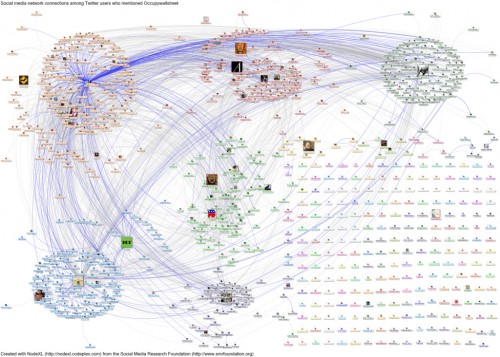
Marc Smith of the Social Media Research Foundation analyzed twitter associations of Occupy Wall Street tweets and found a viral, highly decentralized network of individuals. They compared this to the Tea Party, which had a much more centralized group dynamic.

Americans have gotten so good at being consumers that it almost seems hackneyed to acknowledge such a thing. I say “almost” because there are still wonderfully interesting things being said in some literary and academic circles that continually find deeper levels of meaning in the seemingly shallow end of the societal pool. Our near-perfect systems of consumption not only make it technically possible to exchange beautifully designed plastic gift cards,but  it makes it socially acceptable as well. A gift-giver can reliably assume that the recipient a thousand miles away has access to the same stores, with almost the exact same products. The gift-giver can also assume a certain level of homogeneity about gift-giving practices. Most of us share a set of common beliefs about what constitutes a good gift: It should, relate to our interests, be useful, carry sentimental value, reflect the nature of a relationship, provide entertainment, and/or fill a need. When you give a gift card, you are acknowledging the need or want, but allowing the receiver to specify its final material (or digital) form. This system relies on stability and uniformity to function smoothly. There must be a common culture, as well as a reliable stream of goods and services. But such stability is becoming less, and less likely. Whether it is peak energy, financial collapse, or a little bit of both- our world is becoming less predictable and the systems that rely on steady streams of capital and petroleum are breaking down. In their place, we might begin to find self-organizing systems that are not only more efficient, but also much more just forms of resource distribution. more...

Photo by Howard Schatz

My post today comes from a class on ableism and disabled bodies that I taught earlier this past semester in my Social Problems course. Its inception came from the point at which I wanted to introduce my students to Donna Haraway’s concept of cyborgs, because I saw some useful connections between one and the other.

My angle was to begin with the idea of able-bodied society’s instinctive, gut-level sense of discomfort and fear regarding disabled bodies, which is outlined in disability studies scholar Fiona Kumari Campbell’s book Contours of Ableism. Briefly, Campbell distinguishes between disableism, which are the set of discriminatory ideas and practices that construct the world in such a way that it favors the able-bodied and marginalizes the disabled, and ableism, which is the set of constructed meanings that set disabled bodies themselves apart as objects of distaste and discomfort. In this sense, disabled bodies are imbued with a kind of queerness – they are Other in the most physical sense, outside and beyond accepted norms, unknown and unknowable, uncontrollable, disturbing in how difficult they are to pin down. Campbell identifies this quality of unknowability and uncontainability as especially, viscerally horrifying.

more...

Popular dubstep DJ Skrillex performing live.

Below is the first of a two-part essay exploring the popularity of dubstep, a musical genre formerly associated with the underground EDM (electronic dance music) scene.

Part 1

You may not be a fan of the wub-wub-wubbing musical genre known as dubstep, but it is increasingly taking center stage in American popular culture. For example, a recent NorthFace advertisement uses it while a snowboarder glides down a snowy mountainscape, Britney Spears  and Rihanna have both incorporated some dubstep into their recent work, teen heartthrob Justin Bieber is rumored to be working on his own dubstep album, and the teaser trailer for the new Mission Impossible film features a distinct wub-wubbing in the background. So what is dubstep anyway? And where did it come from?

Dubstep Goes to College
Dubstep was conceived in the London dance music scene in the late 90s and early 00s. It takes mainly from drum and bass and grime genres, but is influenced by many different styles of music, including dancehall and hip-hop. The heavy influence of grime, the dark elements of drum and bass and the guttural bass lines give it an almost dirty sound. This along with the layer of synthesizers are what people in the scene refer to when they describe the music (or party) as “grimey.” more...

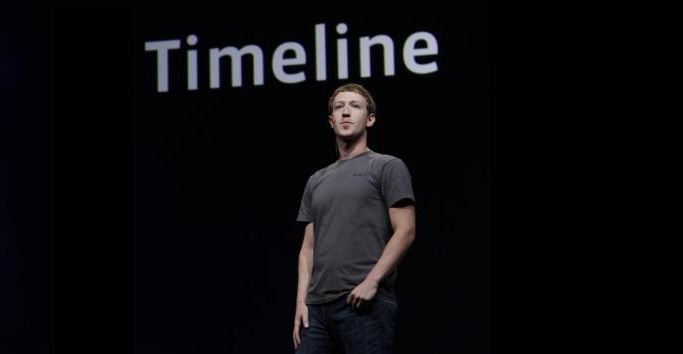
Facebook is now rolling out the new Timeline format. Reviews, as usual, are mixed. Some applaud the now historically situated self presentation while ohers express discomfort at the increasing reach of this platform as it now invades a past in which it was previously absent. I am not going to engage these debatesin the present post. Instead, I will talk about what Timeline does in in terms of self and identity.

Timeline, I argue, integrates self narratives fragmented by their simultaneous temporal location prior to, and at the heigt of, augmented society.

Narratives are linear stories. They have a beginning middle and end and usually a coherent theme. Self narratives are the stories that we tell about ourselves. They are necessarily selective, highlihting some things while ignoring or mimizing others. Self narratives take that which is messy, fragmented and disjointed, and wraps it into a clean, cohesive, and consumable package. The self narrative has very real consequences. We not only make sense of ourselves through these narratives but are then guided in our actions by this sense making. It is through self narrative that we learn who we are make decisions about what we should do.

Facebook is an important tool in the construction of self narratives in an augmented society. Our profiles act as tangible reflections of where we have been, what we have done, who we are, what we are therefore likely to do. These narratives are co-constructed and, as pointed out in a previous post by Nathan and I, prosusumed. This project of linearity, however, is complicated by a past that took place entirely outside of social media technologies. The self, as told through facebook, privileges the present, and only with effort, pays homage to the past.  Enter Facebook Timeline. more...

YouTube Preview Image

Would you agree when I say that the way we represent ourselves has much to do with the idea of how well we think we know about ourselves and perhaps, less to do with choice or control? Consider this, we deliberate over our clothes, are picky with food groups, finicky about television shows, have preferences for certain books, and who we hang out with. Our preferences are largely responsible for self-representation and act as guidelines for others to categorize us. What about decisions and preferences that are not deliberate – the way we react to distressing news (a death in the family); how we face challenges (poor scores in exams); our attitude towards physical exercise; planning a camping trip – are non-verbal and visceral cues that add up to people’s perception of what makes us who we are. So, representation can be controlled as well as non-deliberate in real life.

The digital space frequently encourages us to take control of how we represent ourselves. We are also given opportunities to modify the same at frequent intervals. Our digital histories are a cumulative record of our thoughts, activities, interests, and participations on a host of online platforms. Are they a sum total of what we are? Can we honestly say that our digital activities and our avatars online stand for the whole of our personality? Aren’t we more than the reflections of a series of ‘What’s On Your Minds’, or ‘Likes’, or ‘Add To’, ‘RT’, ‘Share This’, and ‘Recommend’? These are ways in which we communicate, mostly textually and digitally; modes peculiar to the Interwebs. Is there a system via which we can attempt complete digital transference of our offline selves so that there’s more ‘accurate’ representation for our digital peers?

Each of us exhibits a digital signature that is peculiar to what or who we are online. These take the form of avatars. My avatar receives its cues from its offline “twin”, however, neither do we deliberate over its responses nor do we have a conscious say in its growth. The body of reference that builds from our online detritus does not always accumulate in a controlled environment. The mycybertwin.com web service, however, allows us to do just that: artificially engineer a twin and let it loose on cyberspace as my virtual representation. more...

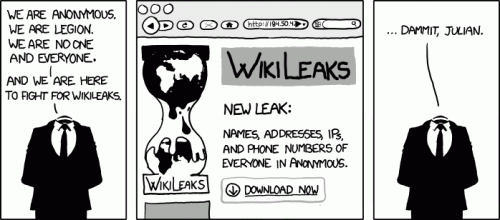
This xkcd comic humorously highlights a seeming tension in  WikiLeaks’ so-called “anti-secrecy agenda:” While secrecy facilitates the systemic abuses of institutional power that WikiLeaks opposes, it also protects extra-institutional actors working to disrupt conspiracies (i.e., uneven distributions of information) that benefit the few at the expense of the many. However, as I discuss a recent Cyborgology post and a chapter (co-authored with Nathan Jurgenson) for a forthcoming WikiLeaks reader, Julian Assange’s approach to secrecy is far more sophisticated than just unconditional opposition. For example, he explains in a 2010 TIME interview:

secrecy is important for many things but shouldn’t be used to cover up abuses, which leads us to the question of who decides and who is responsible. It shouldn’t really be that people are thinking about: Should something be secret? I would rather it be thought: Who has a responsibility to keep certain things secret? And, who has a responsibility to bring matters to the public? And those responsibilities fall on different players. And it is our responsibility to bring matters to the public.

Assange is saying that secrecy is not a problem in and of itself; in fact, society generally benefits when individuals and extra-institutional actors are able to maintain some level of secrecy. Secrecy only become a problem when it occurs in institutional contexts, because institutions have an intrinsic tendency to control information in order to benefit insiders. This conspiratorial nature of institutions is what WikiLeaks truly opposes, and enforced transparency (i.e., leaking) is merely a tactic in that struggle. For this reason, WikiLeaks and Anonymous (the extra-institutional Internet community and hacker collective) are allies, despite the superficial tension highlighted in this comic.

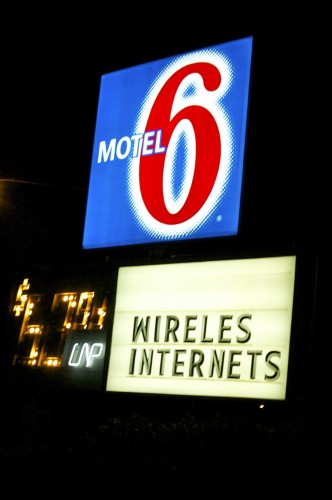
A motel somewhere outside St. Louis, Missouri. I stayed there back in 2007 during a road trip. Those were some of the best internets I ever had.

Today I want to offer a quick provocation that might make for interesting conversations (read: arguments) with family and friends this holiday season. Statistically speaking, you are probably on the road right now. Maybe you are just sitting down at your favorite reststop Sbarro (The Official Food of You Don’t Have Another Choice™) and, after checking in on Foursquare, you start reading some of your favorite blogs (that’s us). Then, maybe its your nosey uncle, or your 10-year-old sister, or your husband leans over and tells you to, “get off the Interent and interact with the real world.” Its a slightly rude thing to say, but you put your phone down and engage with those in bodily co-presence. What is it about the Internet that invites strong criticism from such a wide range of people?  It is often said that 1) the Internet encourages anti-social behavior; 2) that it makes us lazy and contributes to increasing waistlines and decreasing attention spans and; 3) our increasing reliance on Internet services means we are widening the “Digital Divide” and cutting out the poor, the elderly, and the differently abled. Statements like these are too numerous to cite with links. Its the kind of socia commentary and pop psychology that has graced the pages of most news magazines. Could we take these arguments and apply them to other large sociotechnical systems? Since we all have transportation on our minds, let’s levy these criticisms against the highway and see where it takes us: more...

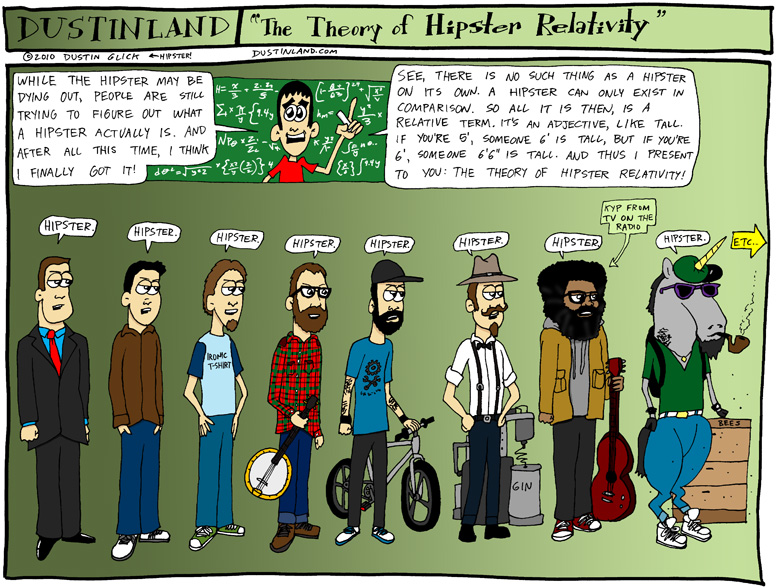
A few of us here at Cyborgology have a running joke going about #HipsterStudies, so I thought I would compile a couple comics that likewise intellectualize this subcultural movement. The first, sent in by reader Letta Wren Page, is a comic by Dustin Glick:

Dustin Glick's "Theory of Hipster Relativity"

This image does a great job illustrating the inherent relativity of the hipster label. That is, as a largely pejorative label, one can only be deemed a hipster by comparison. Much like Thornton (1996) discovered in her study of UK youth raves, where club kids used pejorative labels to denote the bounds of group membership, the hipster as label serves to undermine attempts to mimic subcultural forms (and hence, it serves as a way to deny these actors any semblance of subcultural capital). more...

There is a good conversation to have on just how leaderless the Occupy movement is. It is more networked and decentralized, but, of course, not perfectly so. Structures and hierarchies always emerge. Unfortunately, this important conversation is derailed when some try to create fictional leaders for a movement that, for the most part, does not have them. Articles like, for instance, John Heilemann’s New York Magazine expose on Occupy, again and again force leader-language on the movement. And they do so unsuccessfully.

The traditional media wants to tell a traditional story, and this is why they get Occupy so terribly wrong. It is easier to describe a movement of leaders, of charismatic personalities and of specific ideas, messages and demands. The media momentum favors retelling the type of story they have told before.

But the reality for Occupy is much more complicated. Yes, the movement is not completely leaderless. Participation and efficaciousness are not evenly distributed across the 99%. For instance, the term “occupy” was not arrived to by some consensus but instead the creation of Adbusters. However, the magazine has claimed that they “have no interest in a continuing leadership role.” Instead, the magazine’s role has been aesthetic: to come up with good memes.

While pure leaderlessness may not be possible or even wanted for Occupy, the bigger story is that it is more decentralized than previous political movements. The high degree more...