race/ethnicity: Whites/Europeans

Recently Lisa posted a video listing suggestions for how not to write about Africa, pointing out the ubiquity of a number of stereotypes and tropes used in novels or memoirs set in African countries.

That video came to mind when I saw this one about the book My Maasai Life, written by Robin Wiszowaty (and sent in by Randy McL.):

So she goes to Kenya to experience “simple life” to help her deal with the angst she felt in the U.S. You have the romanticization of the Maasai: they laugh openly! Judgment doesn’t exist!

She recalls asking herself, “How did I end up here?” How did you end up there? Um, you intentionally decided to go there to get away from everything you know, presumably with the money to do so. And in that simple place where happiness and tolerance reign, and people laugh openly, you figured out who you are.

I know I’m being snarky. Yes, she did some volunteer work, and from the video it looks like she worked in some schools. Certainly those benefited some specific people, regardless of what I think about her attitude. But you can help some individuals while still perpetuating stereotypes that may be harmful to groups of people in the long-run.

And this is another example of the limited number of perspectives authors tend to take when writing about African countries/people. Either it’s a desolate, violent, hopeless place filled with human misery, or it’s the home of happy, smiling, tolerant people (or “tribesmen”) who, through their simple lifestyles, show all of us in developed countries how much better things would be if only we could follow their example, except with clean water, and also TV.

Laura A., Brenly R., and Maurine C. all let us know about a shirt for sale at Urban Outfitters. The shirt came in two color combos: White/Charcoal and Obama/Black. Here’s an image of the Obama/Black option, via Jezebel:

There are a couple of things going on here. First, there’s the reference to Obama as a marketing ploy, which we’ve seen before, of course. But it also shows how ridiculous our racial color coding is; we continue to use colonial-era categorizations that there is a clear dividing line between groups based on color. Black and white are usually depicted as opposite colors, after all (and, of course, there’s the historic association of white with purity and black with evil). Most people don’t literally think of Black people as black or believe White people are white; people are, as far as I can tell, pretty much some shade along the off-white/tan/brown spectrum. But we continue to socially construct racial categories as though there is some meaningful, stark difference based on skin color.

So given that, if Obama’s half Black and half White, he’s gray, right? I mean, I’ve seen him on TV a lot and I’ve never noticed that, but maybe it’s the makeup.

I’m sure you will be sad to know that the Urban Outfitters website says the shirt is no longer available.

UPDATE: Reader applebrownbettywhite says,

Just wanted to let you know – I think both Jezebel and you guys interpreted UO’s color naming scheme incorrectly. “Obama” as a color refers to brown, which is the color of the buttons. You can check this assertion against the other shirt, white/charcoal, which is a lighter colored shirt with white buttons.

I’m not sure…the buttons look black to me. It doesn’t look like it has brown on it, but maybe it’s a bad photo.

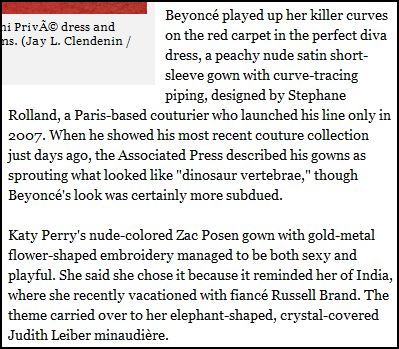
I thought Samatha Critchell’s description of Michelle Obama’s light tan or “champagne” dress as “flesh colored” might get her fired.  If nothing else, I figured it’d be warning to all other journalists out there to, for gawd’s sake!, watch your racist language.

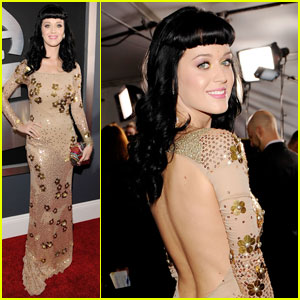
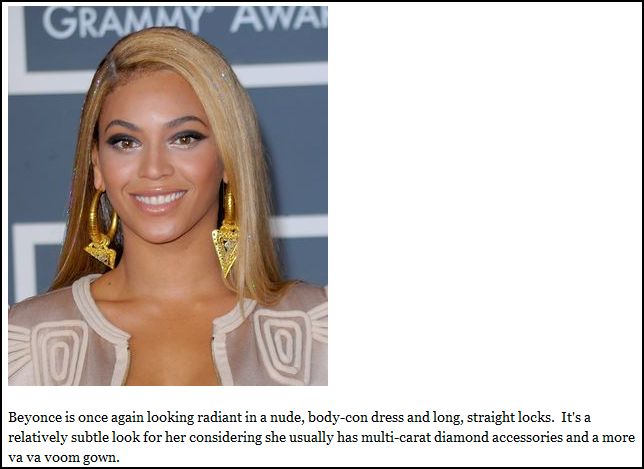
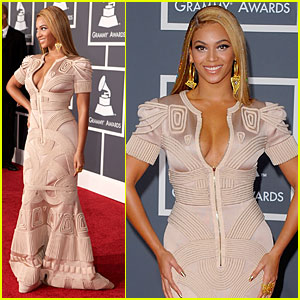
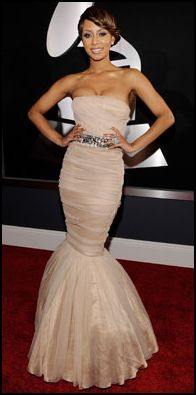
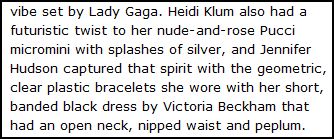
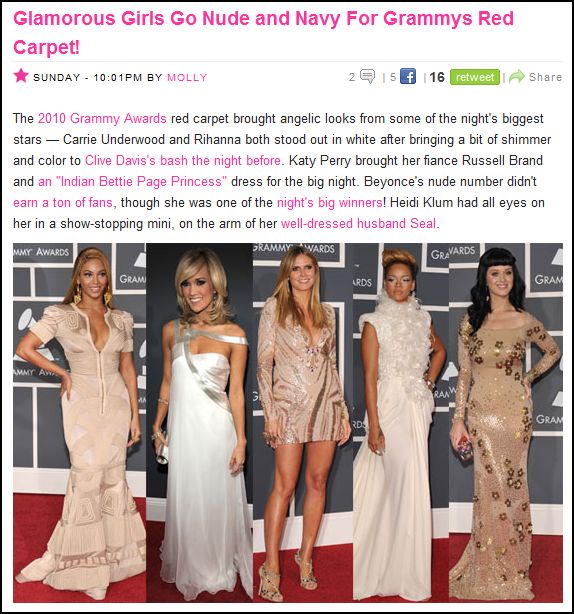
But, alas, the parade of “champagne”-colored gowns at this year’s Grammy’s had led a flood of fashion writers talking about the color “nude.”  Here are just a handful of examples from the first three pages of my google search

Los Angeles Times:

Katy Perry and her dress:

Elsewhere in the Los Angeles Times:

Beyonce and her dress:

VH1:

Keri Hilson and her dress:

Associated Content:

msnbc:

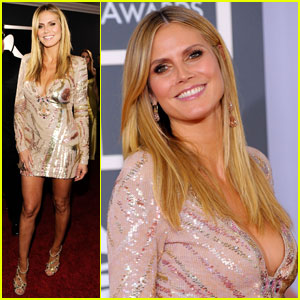
Heidi Klum and her dress:

Popsugar:

Of course (almost) no one is actually “nude”-colored, but the term still manages to naturalize whiteness insofar as white people’s skin color tends to match colors described as “nude” moreso than the skin color of non-white people (though there are always exceptions).  I’m really surprised that journalists are still managing to get this language past their editors.

Lisa Wade, PhD is an Associate Professor at Tulane University. She is the author of American Hookup, a book about college sexual culture; a textbook about gender; and a forthcoming introductory text: Terrible Magnificent Sociology. You can follow her on Twitter and Instagram.

Jersey Shore has come to end, we’re (genuinely) sad to say. We know we had fun. But is it possible we also saw something, dare I say it, subversive about beauty, gender and sexuality? I think so.

A panel discussion on the show and “Guido culture” at Queens College yesterday (you read that right), included New York State Senator and Jezebel heroine Diane Savino, who knows from stinging cultural analysis.

[Savino] explained, “‘guido’ was never a pejorative.” It grew out of the greaser look and became a way for Italian-Americans who did not fit the standard of beauty to take pride in their own heritage and define cool for themselves.

When she was growing up, everybody listened to rock; girls were supposed to be skinny with straight blonde hair (like Marcia Brady on “The Brady Bunch”); guys wore ripped jeans, sneakers and straggly hair.

The 1977 film “Saturday Night Fever” marked a turning point. “It changed the image for all of us,” Ms. Savino said. As Tony Manero, John Travolta wore a white suit, had slicked short hair, liked disco music and was hot. “It was a way we could develop our own standard of beauty,” she added.

In the same way, Virginia Heffernan writes in this weekend’s New York Times Magazine, Italian-Americans in the Northeast originally disdained their own accents until movies like “Mean Streets, Saturday Night Fever, Working Girl and, of course, Taxi Driver.” Those representations, she says, led to a “hammy” reclamation of an identity that had been mirrored back to them through Hollywood. These were second and third generation immigrants, who had mostly reached the middle class but maybe didn’t feel wholly a part of the mainstream, who telegraphed their identity through stylized symbols like Italian flags and red sauce that felt potent but no longer limited their social mobility.

That goes for the ladies too. Female beauty that took on a showily “ethnic cast” was distinct from what was already being sold. As Regina Nigro recently put it on The Awl:

We (I) laugh at bon mots like “You don’t even look Italian!” (the insult that Sammi “Sweetheart” flings at the blonde blue-eyed “grenade” …) but, ridiculous as it is, that assessment betrays a value system: Skinny blonde pale WASP princesses are deemed not attractive when measured by the JS aesthetic. And this seems curious and laughable to us.

“You don’t even look Italian!” is crazy funny but is the underlying judgment (dark hair/olive skin/Italian-looking = pretty; the inverse = not pretty) any worse than any other standard of beauty? It’s an alternative perspective, one that I suspect is so funny partly because it is so unfamiliar.

Of course, there is plenty about the Jersey Shore sexual aesthetic that is broadly familiar. The worst insult is to call a woman fat (or a “hippo”); big, exposed boobs are a baseline requirement, and the men are judged by the attractiveness of the women they acquire. (The other guys repeatedly mock The Situation about the looks of the women he brings home; Ronnie taunts him that he hasn’t brought home a girl anywhere near as pretty as Sammi).

And yet it’s oddly refreshing how much artifice itself is celebrated, with everyone participating mightily, and openly, in becoming the ideal Guido. No one is just born one, or supposed to make it look effortless. There are communal visits to tanning salons and unblinking references to fake breasts, and everyone takes hours to get ready. Vinny describes a girl admiringly: “Fake boobs, nice butt, said she was a model.”

Heffernan, writing about regional accents being reinforced by the show, uses Sammi as an example: “Every part of Sweetheart’s identity – including her skin color, which on the show is not an inborn marker of ethnicity but a badge of achievement (in the tanning bed) – is the product of intense calculation.” And Heffernan didn’t even get to Sammi’s hair extensions, which are brandished for emphasis.

No character more desperately self-produces than The Situation and his third-person pronouncements. Men are not inscluded [sic] from all this ritual artifice. In the last episode, J-Woww practically goes into heat when she sees some “juicehead gorillas” on the beach, and she lists “Human Growth Hormone” among the attractions. This, by the way, leads The Situation to mumble defensively, “Big is out and lean is in.”

That’s because on The Jersey Shore, men’s bodies are just as scrutinized as women’s, and their beauty rituals are as elaborate, expensive, and time-consuming as those of the women. Maybe even more so — in addition to blowouts, tanning sessions, and agonizing over which appliqued shirt will set them apart from the gelled masses, they spend hours at the gym, something we never see the girls do.

As much as the cast performed all this around the clock during the show’s taping, the audition tapes seen here and in the video below are even more extreme, mixing ethnic calculation with the general famewhoring savviness reality producers have become accustomed to.

Looking at this through what we know now: Sammi calls herself a “hookup slut” but aside from a few flirtations, turned out to be conventionally monogamous on the show. Vinny, in straight-up costume, claims he has to take off his pants “to really show you the magic,” but turned out to be the mildest-mannered cast member, one who unashamedly adores his doting mother. Underneath playing to the producers, though, is a more personal kind of construction, and a more particular one. And ironically, although the cast members’ self-creation was one of the most entertaining parts of the show, some underlying sense of unembarrassed authenticity, even wholesomeness, made it most worth watching.

——————————

Irin Carmon is a reporter at Jezebel.com, from where we’re super pleased to have borrowed the post below. Her work has also appeared in the New York Times, Boston Globe, The Village Voice, and others; more information is at www.irincarmon.com.

If you would like to write a post for Sociological Images, please see our Guidelines for Guest Bloggers.

In several posts, we have problematized past and present school mascots.  In this post, I discuss the University of Louisiana at Lafayette Ragin’ Cajuns.

ULL

Originally, UL Lafayette’s mascot was a Bulldog.  Then, according to the mascot history page,

…in the early 1960’s as an effort to “fire up” the football team, Coach Russ Faulkinberry called his team the Raging Cajuns since 95 percent of the football team was from the Acadiana area [i.e., ethnically Cajun].  It was then decided by the Sports Information Director, Bob Henderson, to honor the team and the Cajun heritage by calling them the Raging Cajuns.

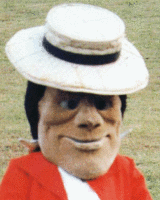
The first Ragin’ Cajun mascot was Cajun Man:

cajun man

This was protested by African American activists who resented the association of the multi-racial and -ethnic University with a white ethnicity.  From another perspective, the mascot was questioned on the grounds that “Cajun” had once been a nasty racial slur.

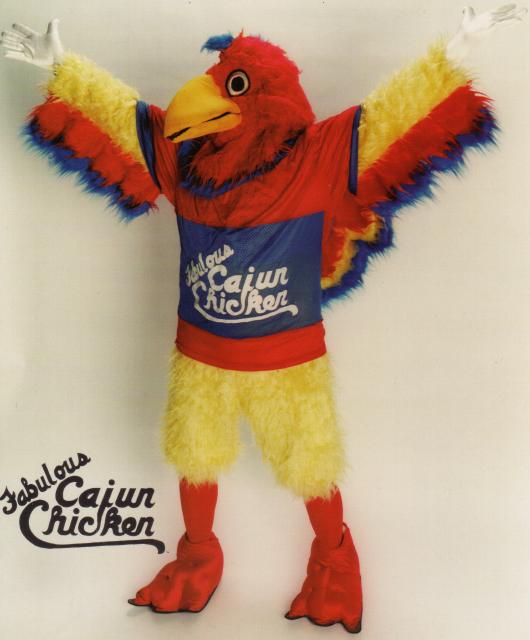
Apparently the University lost Cajun Man when he graduated, so he was replaced by Cajun Chicken:

GLAIBSRHCEWTCVC.20070413161145

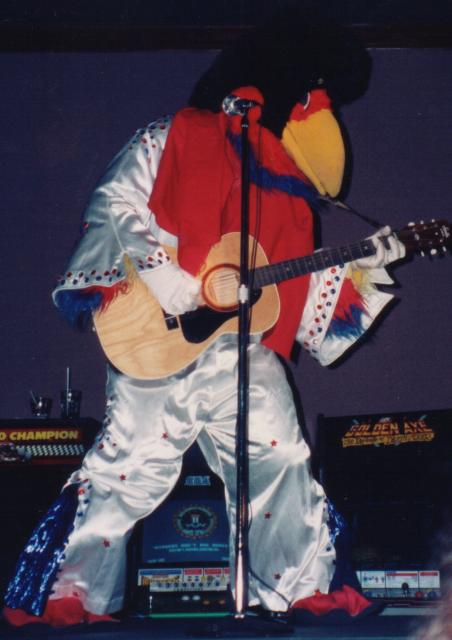
Cajun Chicken as Elvis (what, your mascot didn’t dress up like Elvis?):

JBAPCUWPAERAUQQ.20070413161210

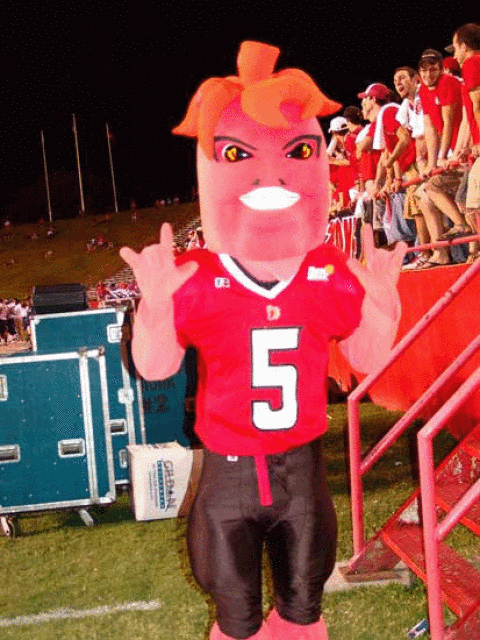
Cajun Chicken was later replaced by Cayenne, a chili pepper, the University’s current mascot:

JQOUKXVBITKMPNI.20070408033922

Still, the disappearance of the Cajun Man has not led to the disappearance of the controversy over the mascot, kept alive with the term “Ragin’ Cajuns.”  In Blue Collar Bayou, Jaques Henry and Carl Bankston III report that in 1997 Louis Farrakhan protested that the state funding of the University of Louisiana at Lafayette amounted to the state using “African American and Creole tax dollars… to promote a white culture.”

Consider the Ragin’ Cajun controversy in light of the other mascots we’ve covered: the Orientals, the Gauchos, the Jews, the Fighting Irish, and the Indians.

Lisa Wade, PhD is an Associate Professor at Tulane University. She is the author of American Hookup, a book about college sexual culture; a textbook about gender; and a forthcoming introductory text: Terrible Magnificent Sociology. You can follow her on Twitter and Instagram.

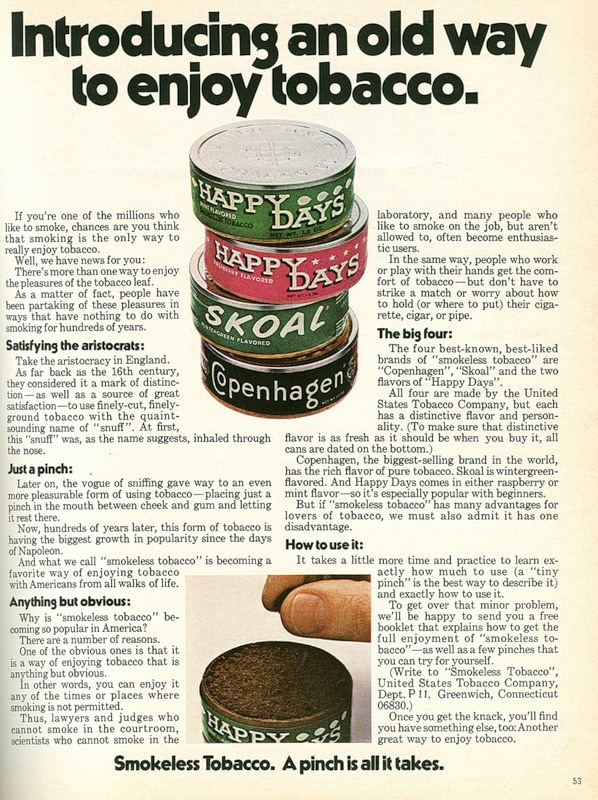
Vintage ads are an excellent way to illustrate how “the way things are” are not the way things have to be or always were.  In this post, I offer an ad for chewing tobacco.  Now, most Americans today associate chewing tobacco (eh em) “dip” with working class, rural, white men (hello family!) and, about ten years ago, baseball players (but I digress).

In contrast to this current social construction, this vintage ad suggests that dip is the province of the aristocracy (details after the ad):

1

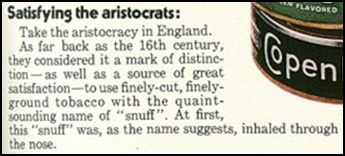
Here are the parts that got my attention:

2

Text:

Take the aristocracy in England.  As far back as the 16th century, they considered it a mark of distinction — as well as a source of great satisfaction — to use finely-cut, finely-ground tobacco with the quaint-sounding name of “snuff.”  At first, this “snuff” was, as the name suggests, inhaled through the nose.

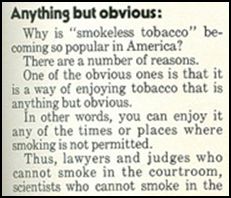
Then, the ad claims that “snuff” is enjoyed, today, by lawyers, judges, and scientists:

3

4

Selected text:

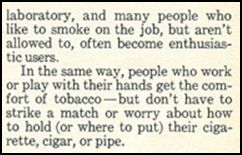
Why is “smokeless tobacco” becoming so popular in America?  There are a number of reasons.  One of the obvious ones is that it is a way of enjoying tobacco that is anything but obvious.  In other words, you can enjoy it any of the times or places where smoking is not permitted.  Thus, lawyers and judges who cannot smoke in the courtroom, scientists who cannot smoke in the laboratory, and many people who like to smoke on the job, but aren’t allowed to, often become enthusiastic users.

I just love the contrast between the current social construction and the attempt at social construction made in this ad.  I have no idea whether there was a time when dip wasactually enjoyed by the middle and upper classes.  Anyone?  Other comments welcome as well, of course.

Lisa Wade, PhD is an Associate Professor at Tulane University. She is the author of American Hookup, a book about college sexual culture; a textbook about gender; and a forthcoming introductory text: Terrible Magnificent Sociology. You can follow her on Twitter and Instagram.

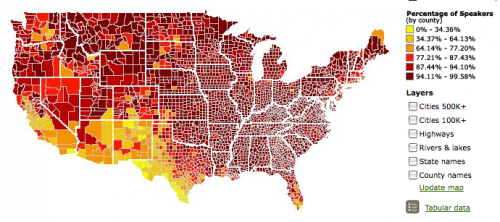
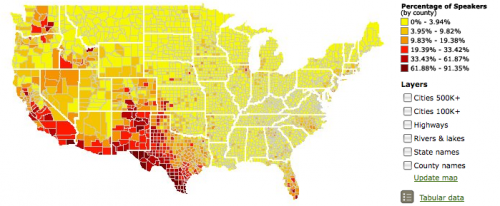
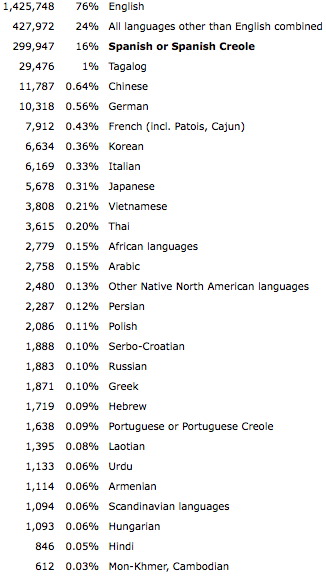
The Modern Language Association has all kinds of awesome language-related data available that you can customize depending on your interests. Most basically, you can get an interactive map showing the percent or number of speakers of various languages spoken at home by county (or number by zip code). Here is English:

English

Spanish:

Spanish

Navajo:

Navajo

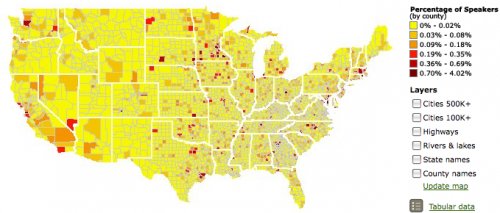
Notice that the scale of the maps changes, so the same color doesn’t indicate the same percent of speakers for each language. For some languages the darkest red only indicates 1 or 2 percent.

There was one odd category I noticed. This is the map for “African languages”:

African languages

I can understand why you might lump some languages from an area together if they are so rare in the U.S. that they’d barely show up. But what, exactly, is an “African” language? It doesn’t appear to include Arabic, though it is spoken in much of northern Africa. Many people in Africa speak European languages (particularly French and English) due to colonialism. Presumably this category includes “native,” non-Arabic languages. It’s a strange category.

For those of you wondering about the little pockets of African language speakers in, say, Iowa and Nebraska, I could be wrong, but I would suspect in some of those counties it might have something to do with slaughterhouses. In the last decade or so some packing houses have recruited African immigrants, particularly Somalis, to move to rural areas and work in the plants. Again, that’s just a guess, but some of the locations fit.

UPDATE: Commenter mordant.espier says,

I think you’re wrong about African languages and meatpacking in the midwest. I know that Omaha has a significant Sudanese community, about 7,000, many of whom are refugees and asylum seekers.  In Minneapolis, there are a number of Somali. They are there because of the US government, and even more because religious and charitable organizations, especially the Episcopal Church and Catholic Charities, have provided support through all stages of the immigration process.  The existance of a group of refugees who are able to enlist the support of locals has created such pockets.

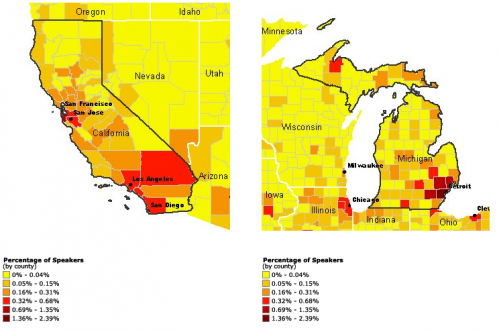
Anyway, moving on.You can also get side-by-side comparisons of two states. This shows the percentage of the population speaking Arabic in California and Michigan:

Arabic comparison

Number and percent of speakers of various languages:

Picture 1

You can compare the number of speakers in 2000 and 2005:

Picture 3

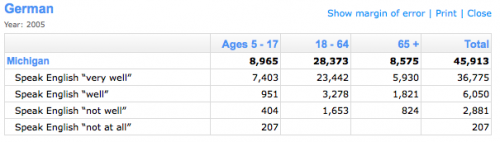
If you go to “Language by State” in that last link and select a language, you can then look at “ability to speak English”. Annoyingly, it only shows raw numbers, not percentages, so you have to do the calculations yourself. But here’s the breakdown for German in Michigan; clearly the vast majority of people who speak German also say they speak English “very well”:

Picture 4

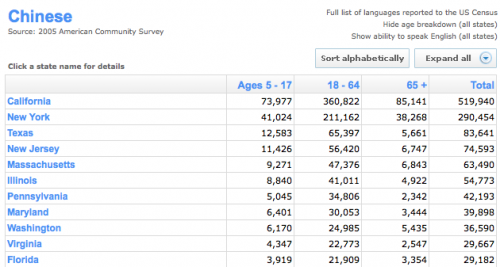
You can also get an age breakdown (again, just raw numbers) for each language, by state. Here’s a partial list for Chinese:

Picture 1

I’m warning you now, the site can turn into an enormous time-suck. You think you’ll just look up the state you live in, say, and then you get started comparing things, and the next thing you know, it’s a half hour later.

UPDATE 2: Commenters have also pointed out that a) “Chinese” is as much of a thrown-together category as “African” (does it mean Cantonese? Mandarin?) and b) the site doesn’t have any information about use of American Sign Language, both great points.

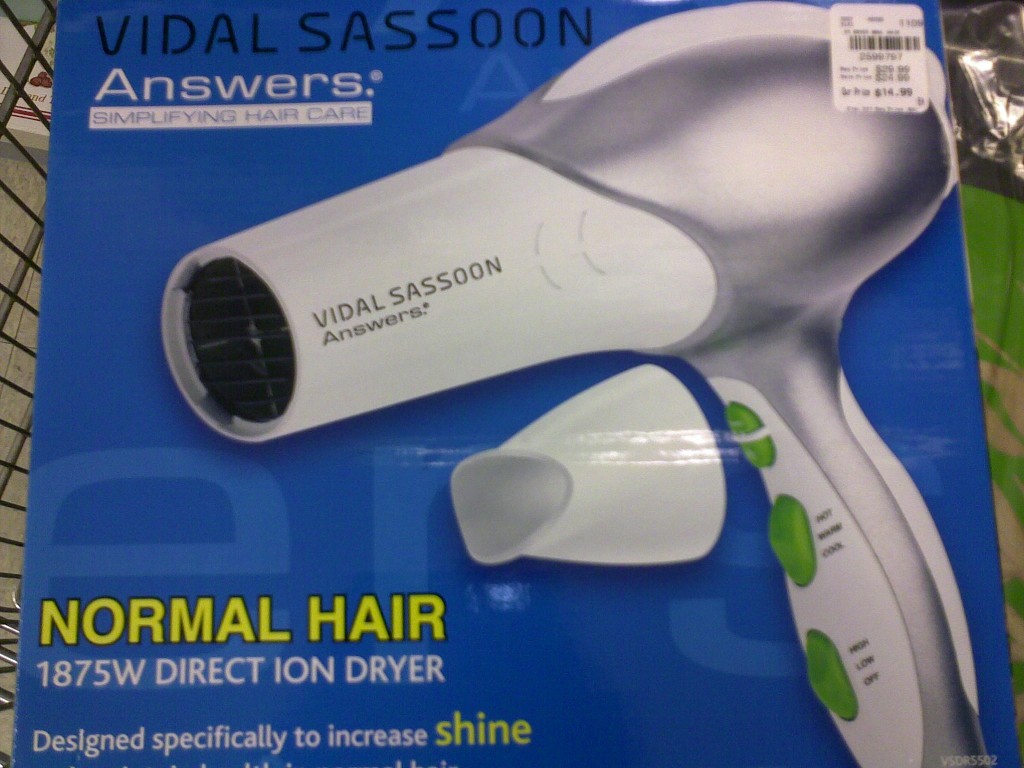
Rudo M. sent us a great example of how “normal” is socially constructed. The photos below are of the box containing a Vidal Sassoon hair dryer for “normal” hair:

1

It’s also, “good” hair, as is said, in so many words, the blurb on the box said so:

Not too fine or coarse,  normal hair is the most manageable hair type with the largest range of possible styles.  Though it’s fun to experiment, even the easiest-to-care-for hair requires a regimen of regular maintenance.  Proper styling tools with varying heats are crucial for keeping a healthy-looking shine, maintaining balance, and adding…

Yeah, so just in case it wasn’t clear already, “normal” hair is the bestest!  It’s “not too fine or too coarse,” has the “largest range of possible styles,” is “fun,” and is totally the “easiest-to-care-for”!

Rudo is an African woman who wears her hair natural, so she knew right away that Vidal Sassoon didn’t count her hair as “normal.”  So, what were the other options?  If you’re not normal, what are you? Well, according to Vidal Sassoon, you are, of course, “fine” or “coarse.”

But a lot of good this does Rudo, since even the models on the “coarse” box are white with essentially straight hair!  So much for a range of hair types!  Well, at least we know that even white women with straight hair can be abnormal!

And, just in case you didn’t know already that being abnormal means being WRONG, coarse hair is “hard-to-style,” fine hair is limp, and both tend to “frizz.”   What a difference from Vidal Sassoon practically falling over itself praising normal hair.

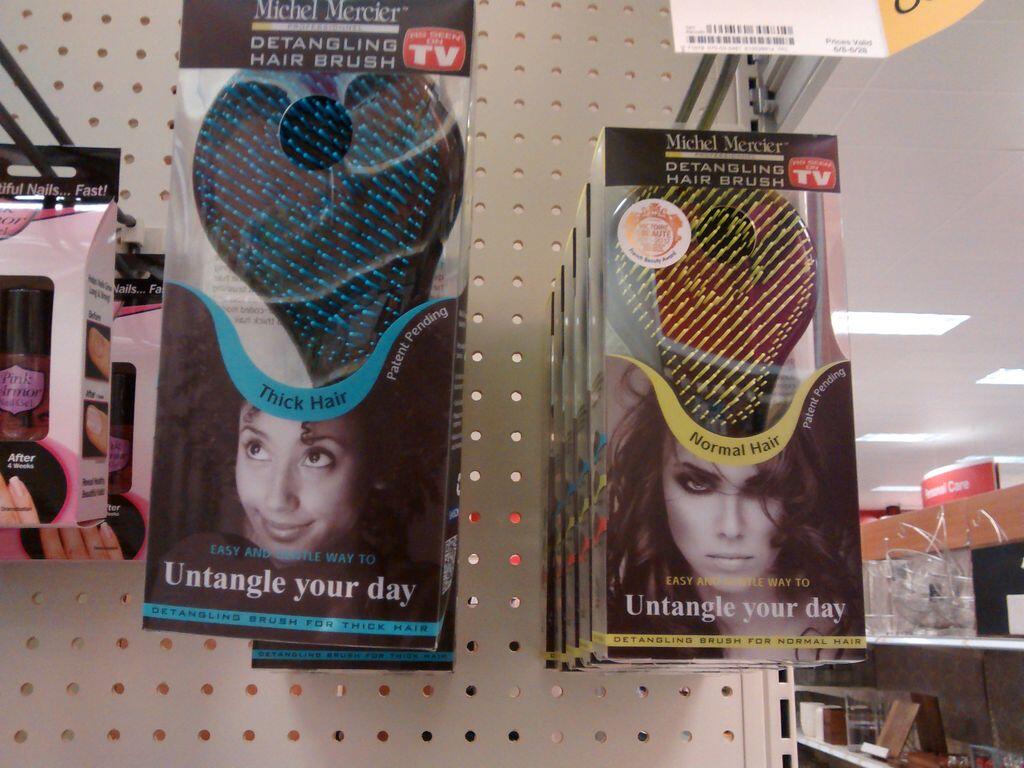
Here’s another example, sent in by @adentweets.  There’s “normal” and there’s “thick” hair.

1

Cara McC. sent us a Covergirl commercial selling foundation for “normal,” “oily,” and “sensitive” skin. Again, they include a range of skin types (and probably include women who represent three different races) in order to point to the diversity of skin types, but nonetheless label one “normal” (the one represented by the white woman).

For more examples of whiteness as normal and people of color as deviant (or, if we measure by Vidal Sassoon, non-existent), see our posts on Michelle Obama’s “flesh-colored” gown, Johnson’s lotion for “normal to darker skin,” bandaids and other “flesh-colored” things, why Sotomayor may be “biased,” families vs. ethnic families, and people of color add “spice.”

Lisa Wade, PhD is an Associate Professor at Tulane University. She is the author of American Hookup, a book about college sexual culture; a textbook about gender; and a forthcoming introductory text: Terrible Magnificent Sociology. You can follow her on Twitter and Instagram.