race/ethnicity: Whites/Europeans


Mary, writer of the fabulous blog Cooking with the Junior League, sent in an episode of the PBS series Faces of America. The episode, titled “Becoming American,” looks at the immigrant origins of various celebrities (Meryl Streep, Stephen Colbert) in the period of massive immigration to the U.S. from about 1820 until 1924.

The segment Mary found interesting is about the grandfather of Queen Noor. An immigrant from Syria, he became a naturalized citizen, which Mary says “was unusual because at the time, only ‘white’ and ‘black’ people could be naturalized…but during this time, Syrians started taking their cases to court to prove that they were white, and could, as a result, become naturalized citizens.” It’s a great example of the social construction of race and the way groups have actively resisted the ways they were categorized.

The segment on Queen Noor’s grandfather starts at 36:23.

Also see our post on suing for whiteness.
It turns out that reports of white ethnic identification on the U.S. Census shift so dramatically over time, that simple demographic change cannot account for them.  Instead, (especially) white people, who can largely pick which of their ethnic ancestries to emphasize at any given time, are inconsistent.  Accordingly, ethnicities fall in and out of favor.  For example, German became quite unpopular during World War II.  Similarly, American Indian rose in popularity in the 1960s.  Today, many people proudly report their Irish ancestry, but there was a time in American history when one might keep it a secret if one could.

In Blue Collar Bayou, Jaques Henry and Carl Bankston III describe the recent resurgence of Cajun identification in Southern Louisiana.  They explain that, between 1975 and 2000, there was a 300% increase in the number of people who identify as Cajun.

Cajuns are a people who settled in Southern Louisiana after being exiled from Acadia (now Nova Scotia, New Brunswick, and Prince Edward Island) in the mid 1700s.  Mostly poor, for a very long time “Cajun” was a bad thing to be and negative stereotypes abounded.

Henry and Bankston explain that for most of their time in Louisiana, the portrayal of Cajuns was “solidly pejorative” (p. 65). They write:

Their Canadian origin, the dire circumstances of their settlement, and their early status as destitute refugees also set the Acadians apart from other white groups in Louisiana… [who] generally held higher socioeconomic positions… These groups… viewed the Acadian, and later Cajun, community as distinct and of little worth.

At the time, their food was described as “adequate.”

It wasn’t until the 1960s that these negative stereotypes started to change and now Cajun ethnicity, country, music and, especially, food is wildly popular:

5

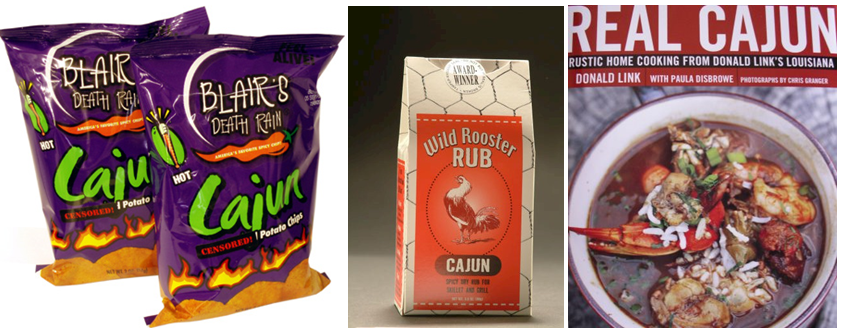
Today Louisiana’s biggest problem isn’t getting people interested in Cajun food, it’s policing all the imitators.  Products labeled “Cajun” are so profitable today that the Louisiana legislature is trying to combat the “fake Cajun [product] problem” by using a logo on all Louisiana products that says “Product of Louisiana Certified Cajun“:

img9174962bec389b85

The new popularity of Cajun food can be attributed in part to efforts by the Louisiana tourism board and a handful of celebrity chefs, like Paul Prudhomme, who had the resources, skills, and business acumen to transform the food into a cuisine.

A nice example, I thought, of the social construction of both food and ethnicity.

Images here, here, and here.

Lisa Wade, PhD is an Associate Professor at Tulane University. She is the author of American Hookup, a book about college sexual culture; a textbook about gender; and a forthcoming introductory text: Terrible Magnificent Sociology. You can follow her on Twitter and Instagram.

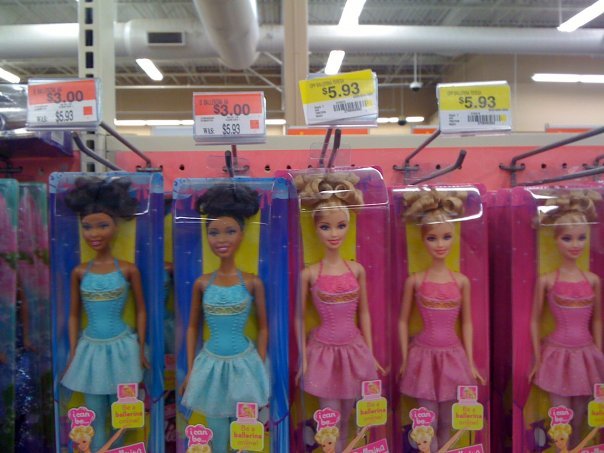
db, Lindsey B., and ABC News asked us to talk about the recent scandal over Walmart pricing a darker-skinned version of the Ballerina Theresa doll less than its white counterpart.  The evidence (from FunnyJunk):

Walmart claimed that the doll was priced less because they were trying to move inventory (ABC News).  It’s possible that the doll wasn’t selling (low demand) or they had ordered more than they could sell (high supply) and so the doll went on sale.  In fact, we know that people of all colors tend to absorb a color hierarchy in which whiteness is nicer, more beautiful, and more valuable (test your unconscious preferences here), so maybe the white doll WAS outselling the non-white doll because both white and non-white people were buying it, but not the darker-skinned doll.  Walmart, in this case, would only be following the market so as to maximize profits.

Walmart, however, could have chosen, in this case, to opt out of profit maximization.  The market isn’t physics; a company doesn’t have to follow its laws.  Walmart could have said, “You know, putting the dark-skinned doll on sale symbolically values whiteness higher than blackness.  Perpetuating that stereotype isn’t worth the money.”  That is, they could have decided that anti-racism trumped profits.

But they didn’t.

It’s important to say that I know of no study showing that, as a rule, white dolls are priced higher or are less likely to go on sale than other dolls.  It may be true that, if we were paying attention, we’d see all kinds of disparate pricing and it wouldn’t pattern itself on race.  Even in this case, I still think that companies need to be cognizant of the context in which they price their products.  In fact, I will go so far as to say that I think it is perfectly fine to discount white dolls while other dolls are left undiscounted, but not vice versa.  Why?  Because we live in a world where discounting dark-skinned dolls resonates with a discourse the symbolically devalues dark-skinned human beings.  Discounting white dolls simply does not carry the same problematic message.

Costco faced this kind of problem when it’s black Lil’ Monkey doll was pulled from shelves.  It turned out that the Lil’ Monkey doll came in three different races, but the black doll carried connotations that the others did not because black people have been compared to primates for centuries in an effort to dehumanize them.  A black Lil’ Monkey is wholly inappropriate in a way that a white Lil’ Monkey is not.

Companies make and sell products in a context.  Following market demands is not opting out; often, it reproduces the status quo.

NEW (Mar. ’10)! Sarah G., after seeing a different post on a multicultural cast of Barbies, looked them up on Target only to discover that the light-skinned Barbies were all priced at $19.99 and the dark-skinned Barbies were all priced at $19.95.  Here are all of the Barbies:

I don’t know, people.  I just don’t know.

See another example here.

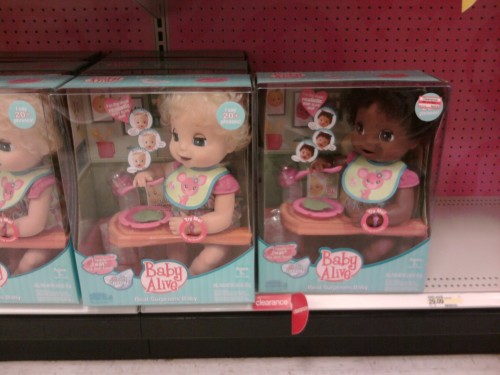
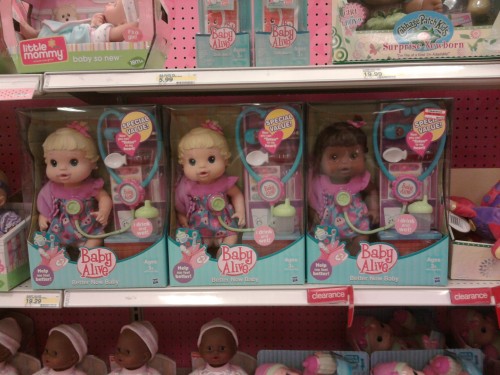
NEW! (July ’10): Christine B. sent in images from Target that show Black Baby Alive dolls (two different types) on clearance (down from $19.29 to $13.50) while the White versions aren’t; the Black dolls are clearly marked on the shelf and with individual stickers:

Lisa Wade, PhD is an Associate Professor at Tulane University. She is the author of American Hookup, a book about college sexual culture; a textbook about gender; and a forthcoming introductory text: Terrible Magnificent Sociology. You can follow her on Twitter and Instagram.

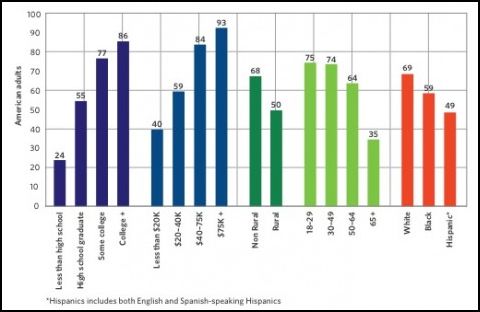
The image below shows who has broadband internet (as opposed to dial up or no internet at all). It was sent in by Dmitrity T.M., who sees no surprises here. Do you?

Lisa Wade, PhD is an Associate Professor at Tulane University. She is the author of American Hookup, a book about college sexual culture; a textbook about gender; and a forthcoming introductory text: Terrible Magnificent Sociology. You can follow her on Twitter and Instagram.


Jay Smooth on why we should focus less on the dumb racist/sexist/asshole-y bullshit people like John Mayer say (and man, did he ever say some dumb bullshit) and more on, say, re-segregation of the public school system:

And just for fun, Jay Smooth discussing Chris Matthews’s comment that he “forgot” President Obama was black, and what that says about what we think racial equality would look like:

I get this with students a lot: they desperately want to deny ever noticing anyone’s race/ethnicity, because the discourse of color blindness states that the way to treat people equally and eradicate racism is to stop acknowledging racial categories at all. But when you simply start ignoring the role of an important socially-constructed category without actually eliminating the negative effect it has on those in certain categories, you aren’t ending racism. It’s just making it harder to talk about or address, since anyone who tries to start a conversation about racial inequality is accused of actually perpetuating inequality and/or being racist for bringing the topic up.

This ties back in with the first video–we are more comfortable with more symbolic or linguistic forms of combating racial inequality (so, say, people say they have a friend who “happens to be Black,” as though it’s something they never thought about until that very second) than the much more complicated, difficult, and long-term work of rooting out structural inequality.

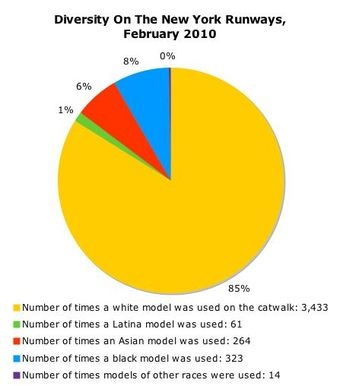
Dmitriy T.M. sent us a link to Jezebel’s analysis of the inclusion of models of color at New York fashion weeks.  The post author, Jenna, begins:

…in the fall of 2007 that fully one-third of shows in New York had 100% white casts. Two years later, we calculated that 18% of spots in show lineups were booked by models of color — a real improvement in the representation of black, Latina, and Asian faces in the crucible where the beauty standard is forged.

This season, fashion took a step back.

Of 4,095 turns on the runway, only 662 went to models who weren’t white. That’s barely 16%.

More:

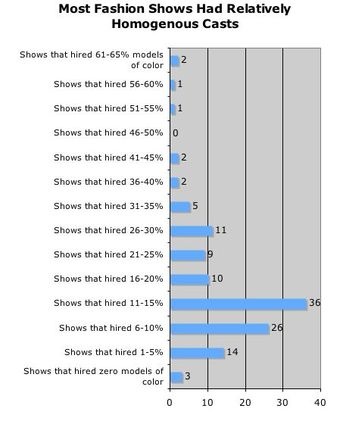
Most of the shows that took place used some models of color — just three designers, A Détacher, Alice + Olivia (full disclosure: an old client of mine), and Preen, chose exclusively white casts — but many used very few. Well over 60% of the shows, in fact, used casts that were 85% white, or more.

Most of the shows that took place used some models of color — just three designers, A Détacher, Alice + Olivia (full disclosure: an old client of mine), and Preen, chose exclusively white casts — but many used very few. Well over 60% of the shows, in fact, used casts that were 85% white, or more.

More details on the data, and the models, at Jezebel.

Lisa Wade, PhD is an Associate Professor at Tulane University. She is the author of American Hookup, a book about college sexual culture; a textbook about gender; and a forthcoming introductory text: Terrible Magnificent Sociology. You can follow her on Twitter and Instagram.

Dmitriy T.M. reminded me of this classic performance of the song “America” from a classic American musical, West Side Story (1961; it won 10 Academy Awards, including Best Picture).  The song features white New Yorkers and Puerto Rican immigrants debating about the benefits of living in America.  The “streets paved with gold” mythology is articulated by the women at the same time that the white men remind them that they face racism and poverty.

Also, Rita Moreno is awesome:

UPDATE: Commenter Jesse W. says,

…as a theater nerd, I wanted to point out it’s not a debate between white New Yorkers and Puerto Ricans, I think you just get that impression from the bad casting. They’re all supposed to be Puerto Rican; it’s more of a battle of the sexes between the men who wanted to stay in the old country and the women who wanted to come to America.

And Laura says,

…the women are arguing with the men that America is great, and they prefer it to Puerto Rico, and the men are arguing that America is racist and oppressive.

Lisa Wade, PhD is an Associate Professor at Tulane University. She is the author of American Hookup, a book about college sexual culture; a textbook about gender; and a forthcoming introductory text: Terrible Magnificent Sociology. You can follow her on Twitter and Instagram.

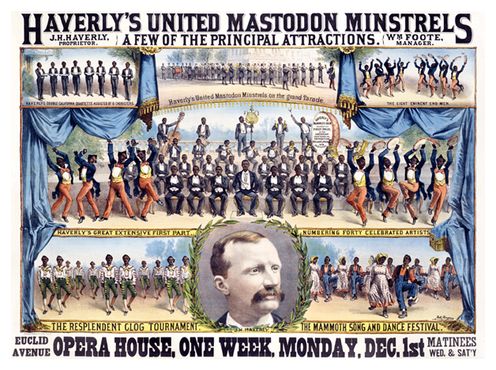
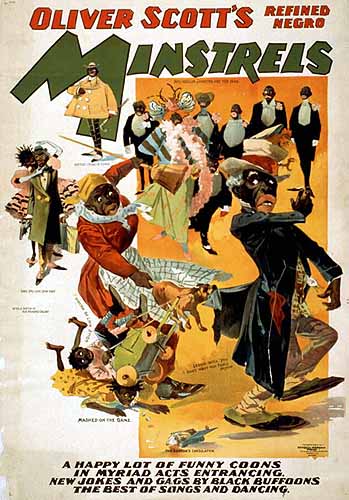
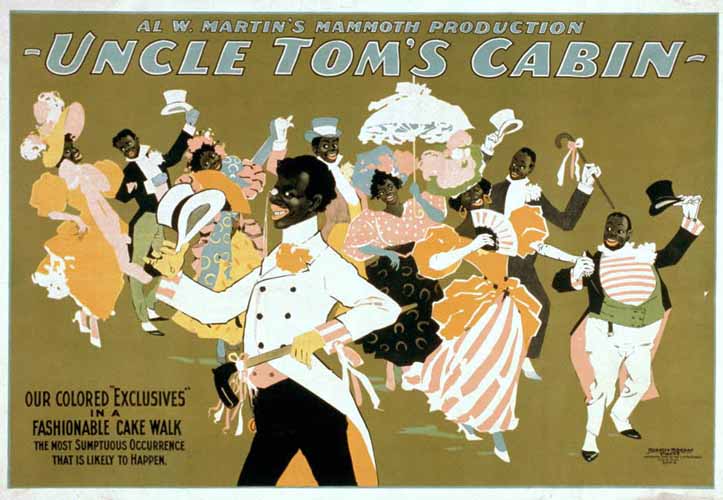
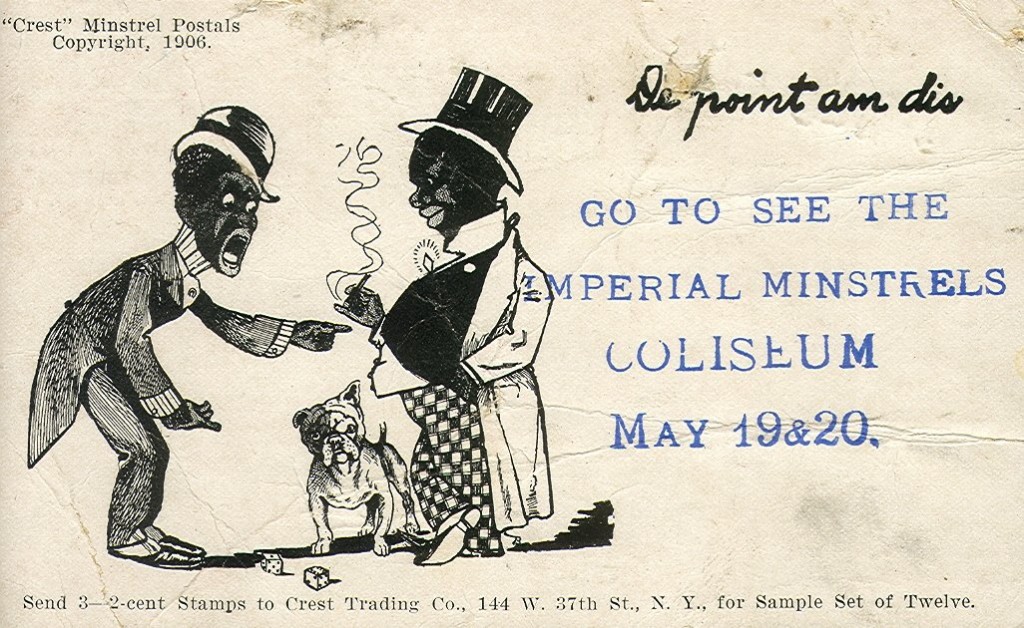
Minstrelsy is a form of entertainment, popular from the 1830s till the early 1900s in which white, and later black, people painted their face black and performed a caricature of blackness.  The images below (borrowed from Jim Crow History and Wikipedia) are original advertisements for minstrel shows.

Haverly’s United Mastodon Minstrels (circa 1877):

Haverly's_United_Mastodon_Minstrels

Oliver Scott’s Refined Negro (1898):

a_26082

Al W. Martin’s Uncle Tom’s cabin (1898):

a_2425

Wm. H. West’s Big Minstrel Jubilee (1900):

800px-Minstrel_PosterBillyVanWare_edit

Postcard (1906):

ImperialMinstrelsPostcard

For more caricatures of black people in U.S. history, see these posts: one, twp, three, four, five, six, seven, eight, nine, ten, eleven, thirteen, fourteen, fifteen, sixteen, seventeen, eighteen, nineteen, and twenty.

And for examples of modern reproductions of these stereotypes (literally), see these: one, two, three, four, and five.

For examples and discussion of contemporary “blackface,” see one, two, three, four, five, and six.  Also, bugs bunny.

Lisa Wade, PhD is an Associate Professor at Tulane University. She is the author of American Hookup, a book about college sexual culture; a textbook about gender; and a forthcoming introductory text: Terrible Magnificent Sociology. You can follow her on Twitter and Instagram.