

race/ethnicity: Whites/Europeans


Binyavanga Wainaina does an excellent job, in this 3-minute video, describing ways that “Africa” tends to be written about in the West. See how many of the tropes you recognize:

To paraphrase Jose, at Thick Culture, it’s important to be engaged with the world, but our engagement shouldn’t be entirely on our terms. And, especially, not terms in which the Western world gets to construct itself as the savior of the less fortunate (e.g., Avatar).

Such ideas make it seem as if underdeveloped parts of the world are somehow inherently deficient (culturally or otherwise). When, in fact, insofar as underdeveloped parts of Africa or other continents need saving, it is partly (largely?) because of (1) a history of colonialism that stole their resources and disrupted their societies and (2) the current global economic system that continues to put them at a devastating disadvantage.

See also: The Single Story of “Africa”

Lisa Wade, PhD is an Associate Professor at Tulane University. She is the author of American Hookup, a book about college sexual culture; a textbook about gender; and a forthcoming introductory text: Terrible Magnificent Sociology. You can follow her on Twitter and Instagram.

The MTV series, Jersey Shore, has been accused of ethnic bias and Denny and Lynda Lou suggested we discuss it.  The reality show features eight 20-something Italian Americans in a Real World-type situation (all living together in the same house on the beach) and is currently most famous for the scene where Snooki gets socked, hard, in the face:

js

It features, as does nearly every reality show involving 20-somethings, a lot of ridiculous, immature behavior, a celebration of party-culture and anti-intellectualism, and capitulation to the pornification of American culture.

The show is accused of being discriminatory not because it involves all those things, but because it specifically involves Italian Americans, who vocally embrace the term “Guido,” doing all of those things.

So what exactly is the problem with Jersey Shore?

The problem is that, because of negative stereotypes about Italian Americans, the bad behavior of the show’s stars will be attributed, by some, to their Italian American-ness.  If the show simply featured young people, who didn’t identify with a particular ethnic or racial group, the bad behavior might be attributed to youth or attention-starved-reality-show-celebrities.  But when we mark a group as Other (in this case, specifically Italian American), their behavior suddenly reflects on the whole group.

This is never true for the unmarked, neutral category whose identity is so normalized and mainstreamed as to be invisible.  In these cases, bad behavior is individualized (“that person is immoral or crazy” instead of “those people are immoral or crazy”).

So part of what makes Jersey Shore problematic is the context.  Because Italian Americans are Othered in the U.S., a show featuring them will inevitably be used by some to confirm negative stereotypes of the group.  But, of course, MTV is facilitating this by putting together a show that features Italian Americans exclusively, encouraging us to notice their Italian Americanness specifically and, therefore, making their ethnicity salient when we react with horror and disgust at what we see.

Lisa Wade, PhD is an Associate Professor at Tulane University. She is the author of American Hookup, a book about college sexual culture; a textbook about gender; and a forthcoming introductory text: Terrible Magnificent Sociology. You can follow her on Twitter and Instagram.
Dmitriy T.M. sent in the clip below in which Senator Lindsey Graham (R – South Carolina) explains that health care reform will be bad because it will require his state to subsidize health care for poor people… and black people:

Graham’s mistake is a common one and one that contributes to penalizing and inhumane treatment of the poor in the U.S. He is conflating race and class. White people = not poor; black people = poor. Therefore, a high percentage of black people = a drain on society.

Here’s the reality: a higher percentage of the black population is poor, compared to whites. BUT, and this is a big “but,” most poor people are white because white people make up between 70 and 75% of the U.S. population.

However, a belief that that poor people tend to be black and black people tend to be poor is useful for those who want to stifle any redistribution of wealth. The conflation means that opposition to policies designed to alleviate the suffering of poverty can be based in both classism and racism.

Lisa Wade, PhD is an Associate Professor at Tulane University. She is the author of American Hookup, a book about college sexual culture; a textbook about gender; and a forthcoming introductory text: Terrible Magnificent Sociology. You can follow her on Twitter and Instagram.
In an attempt to further muddy some conceptual waters, I present you this Finnish music video:

Shava are probably the only representatives so far of the genre of Suomibhangra, a Finnish take on the South Asian diaspora dance genre, bhangra. One one level there’s a lot to be critical of here, perhaps – the wilful exoticism, the fake Indian dancers, the almost-brownface of someone like the “Finnjabi bad boy” in the video.

On the other hand, though, which I think is perhaps more interesting, there’s the reaction in the bhangra community. I actually found the track on a bhangra blog, it’s been reposted and become popular on a bhangra youtube channel where it’s generated positive comments, the band has toured to desi audiences in Canada and it’s played on several bhangra radio stations… The bhangra community is not offended at all, they rather like it. (For as they say: Imitation is…)

So who’s right? Us radical critics or the people we think we’re defending? Perhaps it’s worth thinking about.

——————————-

Johan Palmeis a musicology student in Stokholm, Sweden.  He blogs about music and other stuff at Birdseed’s Tunedown.

If you would like to write a post for Sociological Images, please see our Guidelines for Guest Bloggers.

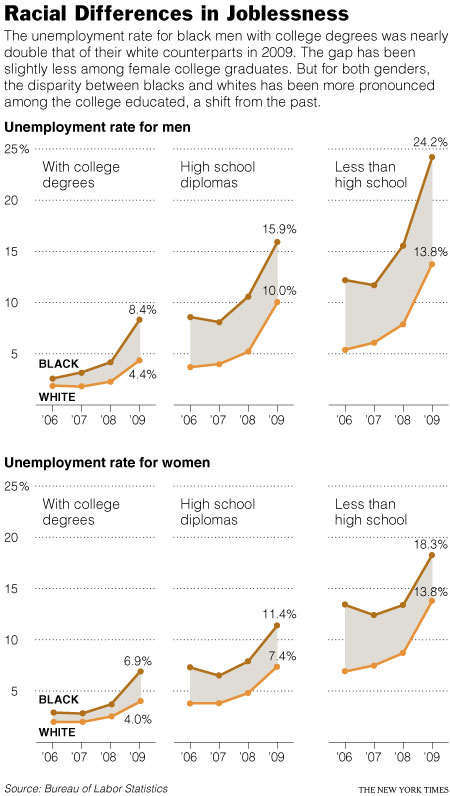
This week the New York Times featured a story about joblessness rates among black and white men and women.   As the figures below show, black men and women always face higher levels of unemployment compared to whites of the same education level; for men, the disparity increases as education level increases; and for black women, that pattern holds at least for 2009.

popup

For more detailed data on this phenomenon, see our posts on race and the economic downturn, the intersection of race and criminal record, and education and unemployment.

Lisa Wade, PhD is an Associate Professor at Tulane University. She is the author of American Hookup, a book about college sexual culture; a textbook about gender; and a forthcoming introductory text: Terrible Magnificent Sociology. You can follow her on Twitter and Instagram.
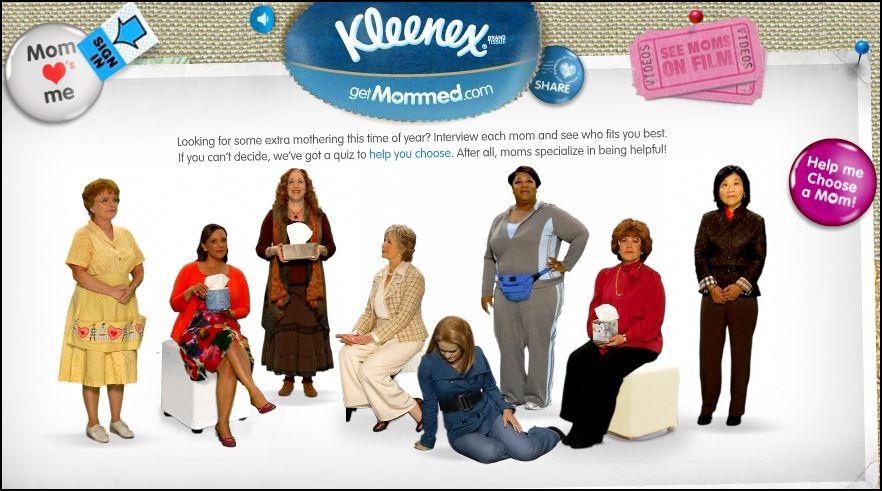
Grace S., Courtney V., Mazhira B., and Ashley B. (I hope I got everyone!) sent in Kleenex’s Get Mommed campaign. The campaign represents another instance in which nurturing is associates strictly with women (it is mom who takes care of us when we’re sick, not dad).

It also manages to throw in a number of racial and religious stereotypes, including the Latina Ana Maria (“hola!”) who brings traditional wisdom; the distracted upper class WASP (“just a moment, dear”); the sassy, full-figured black women who can do anything around the house; the pushy Jewish mom (“Phyllis wants to be your mommy, not just your mom”); the stern Asian mom (“I don’t put up with excuses, not even from babies!”); among others.

Capture

I didn’t dive into the website too far, but you’re certainly welcome to do so and feel free to report what you find!

Lisa Wade, PhD is an Associate Professor at Tulane University. She is the author of American Hookup, a book about college sexual culture; a textbook about gender; and a forthcoming introductory text: Terrible Magnificent Sociology. You can follow her on Twitter and Instagram.
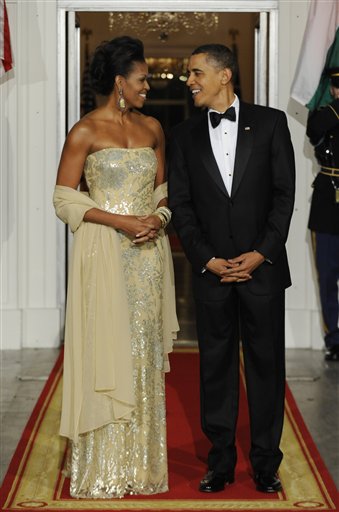
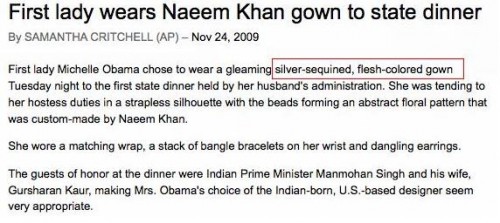
The Associated Press, a news service subscribed to by news outlets all over the world, distributed a story about the first Obama Administration State Dinner. In the story, sent in by Elisabeth R., Samantha Critchell describes Michelle Obama’s dress as “flesh-colored.”

gown2

[Thanks to Madeline T., Anne Marie, Therese S., and Drugmnky for the screencap!]

Gee, what could possibly be wrong with calling this dress “flesh-colored”?

APTOPIX Obama US India

This is what happens when white people are considered people and black people are considered a special kind of people, black people.  “Flesh-colored” becomes the skin color associated with whites and darker-skinned peoples are left out of the picture altogether.  We see this all the time.  Bandaids, for example, are typically light beige (though they rarely call them “flesh-colored” anymore), as are things like ace bandages.

See our post on “flesh-colored” for these examples and more.  See also this post on lotion for “normal to darker skin.”

For contrast, see this post about how the generic human in Russian cartoons is colored black instead of white.

—————————

Lisa Wade is a professor of sociology at Occidental College. You can follow her on Twitter and Facebook.

In this 20 minute video, novelist Chimamanda Adichie describes, with insight and grace, the problem of the “single story.”  She says, “Show a people as one thing, and only one thing, over and over again, and that is what they become.”  Focusing on her experience as an “African” in the U.S. (she is from Nigeria), she also describes her own experiences with realizing that she has heard only a single story, whether of rural Nigerians or Mexicans.

Highly recommended (or read the transcript here):

Via Stuff White People Do.

—————————

Lisa Wade is a professor of sociology at Occidental College. You can follow her on Twitter and Facebook.

Lisa Wade, PhD is an Associate Professor at Tulane University. She is the author of American Hookup, a book about college sexual culture; a textbook about gender; and a forthcoming introductory text: Terrible Magnificent Sociology. You can follow her on Twitter and Instagram.