race/ethnicity: Whites/Europeans


Today we’ve got two examples of the sexual objectification of Black men.

Margaret M. sent us this commercial she recently saw on TV in Budapest. It’s for an ice cream bar called Maxi King, and I think it’s not stretching to say that the ice cream bar is a stand-in for the guy’s penis:

The placement of the container she takes it out of, her sexy look, the shot of the ice cream with the white center and the caramel goo…yeah, that’s a penis. And the commercial is playing on the stereotype that Black men are particularly well-endowed. Massive satisfaction!

In both cases, Black men’s sexuality is fetishized for White audiences. They represent a fantasy of exotic, hypersexual, and sexually-gifted Black men. While the stereotype could appear positive — after all, they’re presented as desirable sexual partners — the flip side is that Black men are thus also often presented as more animalistic and sexually aggressive than White men, a stereotype that has been used against them time and time again.

And as we see in the second commercial, representing a fantasy means you are interesting because of that fantasy, not because of who you are. When the man failed to live up to the woman’s fantasy, not only did she no longer find him attractive, she and her friend found the situation laughable…because you certainly wouldn’t want to sleep with, or even date, a Black man from Shropshire. If he’s not an exotic sexual fantasy, what’s the point?

UPDATE: Reader Carlo says,

I took the joke in the second commercial to be on the woman. She allowed her race based assessment of the man as an exotic other to make a fool of her when the man proved to be just like her (from somewhere local). Even though this commercial is obviously playing on recognized stereotypes (women find exotic men attractive), it sort of points out the ridiculousness of those assumptions. In the end, her friend is laughing at her for being, essentially, that daft white audience that equates blackness with the exotic.

For another take on fetishizing Black men, see our post on male sex workers in the Caribbean.

Gwen Sharp is an associate professor of sociology at Nevada State College. You can follow her on Twitter at @gwensharpnv.
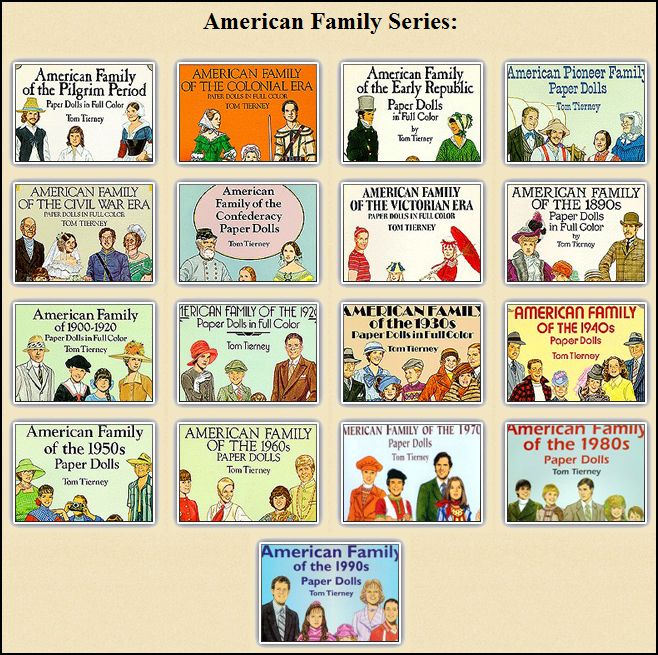

Tom Tierney is a famous paper doll artist.  Katrin sent along a link to his American Family series.  The covers erase all non-white families; apparently American Indian families weren’t “American” enough, nor were the indigenous population of what-would-one-day-be-California, African families during the Civil War era, or the many other non-white people that lived here before and after white people arrived.

Elsewhere on his site, Tierney has paper dolls with non-white characters, but they are always specified (e.g., Famous African Americans Paper Dolls or the new Obama Family).  Non-modified, though, “American”= white.

See also our post on how people tried to claim American-ness by claiming whiteness and suing for whiteness.

Lisa Wade, PhD is an Associate Professor at Tulane University. She is the author of American Hookup, a book about college sexual culture; a textbook about gender; and a forthcoming introductory text: Terrible Magnificent Sociology. You can follow her on Twitter and Instagram.

Justin A. B. drew our attention to a Marie Claire fashion slide show titled “Nude is the New Black.”  By “nude” (ironically) they mean, “white-person-color.”  Every single picture featured a tan or cream item.  Every. Single. One.

We’ve been covering this phenomenon.  See our posts on “flesh-colored,” Michelle Obama’s “nude” colored dress, the new in-color, lotion for “normal to darker skin,” and color-assisted medical diagnosis.

NEW! (July ’10): Anna sent in another example, this time an article about Givenchy’s Fall 2010 collection. According to the article (at style.com), “everything was white, flesh-colored, or gold, with a salon dedicated to each shade.” On the Givenchy website, they use the term “nude.” An example of a “flesh-colored/nude” dress:

A group photo that shows the range of colors; the two in the middle are the “nude” dresses:

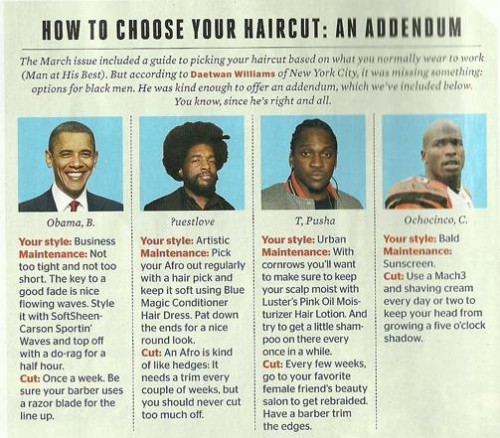
Also NEW! (July ’10): Juliana B. pointed out that in the May 2010 issue of Esquire an article on haircuts completely ignored Black men, who might not be able to use the suggestions on their hair…but in the June issue, the editor responded to a letter from a reader by acknowledging “he’s right.” They then included a segment on haircuts for Black men:

Lisa Wade, PhD is an Associate Professor at Tulane University. She is the author of American Hookup, a book about college sexual culture; a textbook about gender; and a forthcoming introductory text: Terrible Magnificent Sociology. You can follow her on Twitter and Instagram.

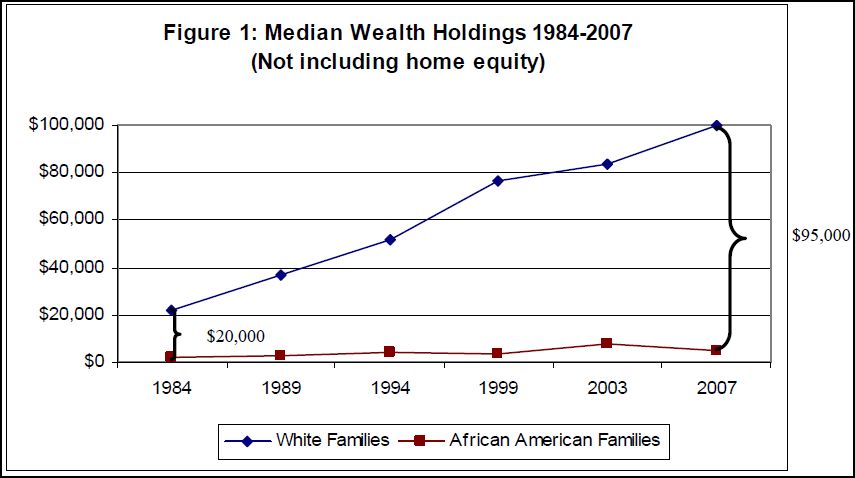
In addition to differences in income, there is a persistent wealth gap between black and white families in the U.S. The term “wealth” refers to all of your assets (the home you own, money in savings and investments, etc) minus your debt. According to a new research and policy brief by Thomas Shapiro, Tatjana Meschede, and Laura Sullivan, the wealth gap has increased from $20,000 in 1984 to $95,000 in 2007.

The authors explain the growth in the gap this way:

The [increase in the] racial wealth gap… reflects public policies, such as tax cuts on investment income and inheritances which benefit the wealthiest, and redistribute wealth and opportunities. Tax deductions for home mortgages, retirement accounts, and college savings all disproportionately benefit higher income families.

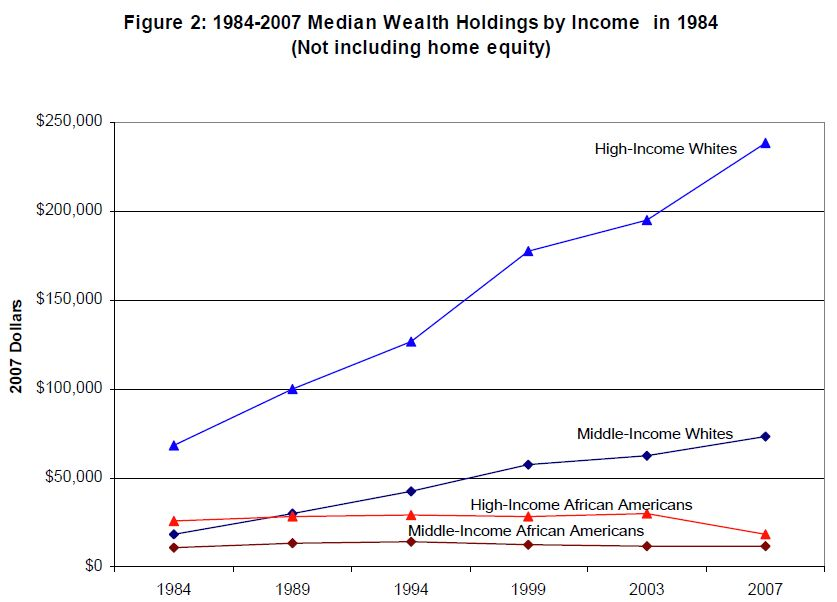
There are also much variety in how much wealth is held by people within any given race. The figure below, shows that the gap between high-income and middle-income whites has tripled since 1984. Both groups, however, have seen an increase in the amount of wealth they hold.

In contrast, the wealth of middle-income black families has stagnated and the wealth of high-income black families has recently dropped, flattening differences in wealth among middle- and high-income blacks, but dramatically increasing the wealth gap between blacks and whites.

So why don’t we see an increase in the wealth gap among blacks? The authors point to “…the powerful role of persistent discrimination in housing, credit, and labor markets.”

For example, African-Americans and Hispanics were at least twice as likely to receive high-cost home mortgages as whites with similar incomes. These reckless high-cost loans unnecessarily impeded wealth building in minority communities and triggered the foreclosure crisis that is wiping out the largest source of wealth for minorities.

The authors conclude:

Public policies have and continue to play a major role in creating and sustaining the racial wealth gap, and they must play a role in closing it.

Hat tip to Philip Cohen, Family Inequality.

—————————

Lisa Wade is a professor of sociology at Occidental College. You can follow her on Twitter and Facebook.

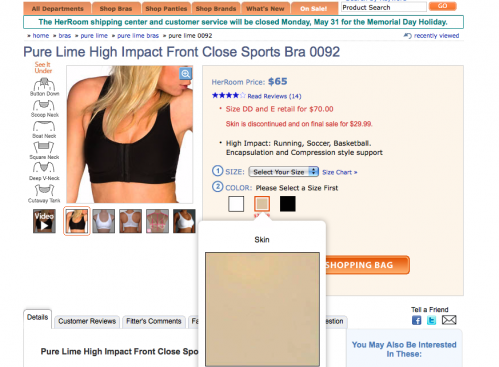
Jessica L. sent in an example that simply and clearly illustrates the way that lighter skin tones that come closest to matching White skin are given the status of neutral, “regular,” unmarked skin. She was shopping for a sports bra and noticed that the colors included white, black, and a beige color, which instead of being called beige or tan or something of that sort is called “skin” (reader May points out that “tan” is used to refer to skin color as well):

For other examples, see our post on “flesh”-colored clothing.

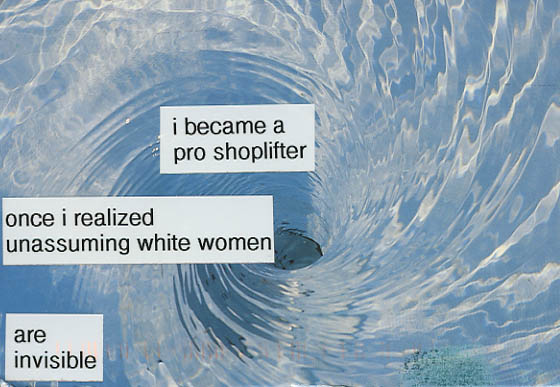
Heather J. sent along a nice illustration of white privilege, courtesy of PostSecret.  PostSecret features anonymous confessions on postcards and, in this confession, a person confesses that being white and female facilitates her shoplifting: The card is a great example of the flip side of racial profiling: those who do not carry the stigmatized features aren’t simply treated fairly, they’re given a benefit of the doubt that allows them to get away with the very thing that others are suspected of doing.

Lisa Wade, PhD is an Associate Professor at Tulane University. She is the author of American Hookup, a book about college sexual culture; a textbook about gender; and a forthcoming introductory text: Terrible Magnificent Sociology. You can follow her on Twitter and Instagram.

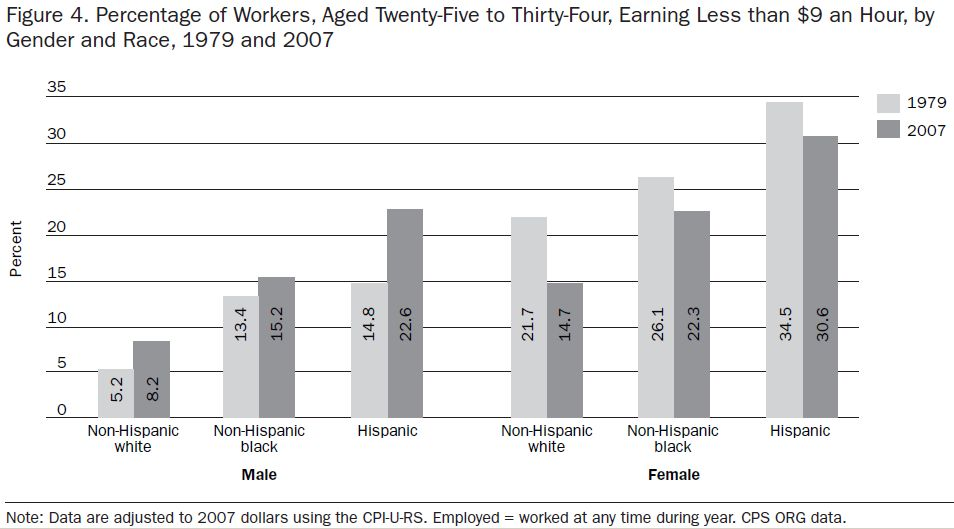
A full-time worker making nine dollars an hour cannot raise a family above the poverty line.  A paper by Sheldon Danziger and David Ratner demonstrates that fewer women survive on less than $9 an hour today than (its adjusted equivalent) in 1979.  The same cannot be said for men: The authors write:

…changes in the labor market over the past thirty-five years, such as labor-saving technological changes, increased globalization, declining unionization, and the failure of the minimum wage to keep up with inflation, have made it more difficult for young adults to attain the economic stability and self-sufficiency that are important markers of the transition to adulthood.

This is just more evidence of the shrinking of the middle class; solid working class jobs that will allow you to buy a modest home are disappearing. Hat tip to Family Inequality and Karl Bakeman’s blog.

Lisa Wade, PhD is an Associate Professor at Tulane University. She is the author of American Hookup, a book about college sexual culture; a textbook about gender; and a forthcoming introductory text: Terrible Magnificent Sociology. You can follow her on Twitter and Instagram.

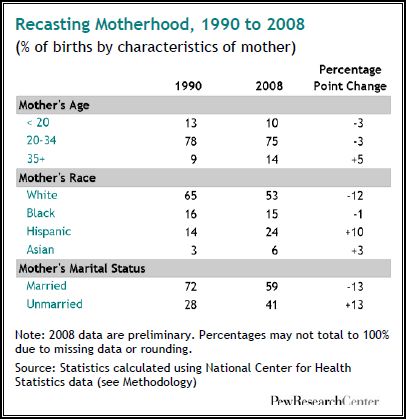
Nationalist white supremacy organizations, and their gentler counterparts in the U.S., sometimes argue that non-white women are having more children than white women.  The result is a shift in the national demographic (that they don’t like).

This month the Pew Research Center released a report on the changing demographics of American motherhood (discovered thanks to a tip by Michael Kimmel).  Under “Mother’s Race,” we see that there has been a 12 percentage point decrease in the share of births to white women between 1990 and 2008.  In contrast, births to Asian and, especially, Hispanic women have increased (a combined 13 percentage points):

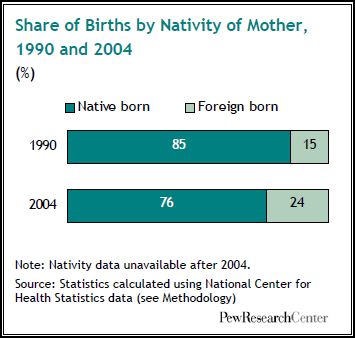
The share of births to native versus foreign born women has also shifted, with a quarter of births now to women who have immigrated to the U.S.:

They summarize:

White women made up 53% of mothers of newborns in 2008, down from 65% in 1990. The share of births to Hispanic women has grown dramatically, to one-in-four.

So, whether you agree with the national white supremacists’ evaluation of the data or not (I assume you do not), they’re right about the data.

UPDATE: Sabrina, in the comments, rightly points out that my comments assume that the father’s race matches the mother’s.

Lisa Wade, PhD is an Associate Professor at Tulane University. She is the author of American Hookup, a book about college sexual culture; a textbook about gender; and a forthcoming introductory text: Terrible Magnificent Sociology. You can follow her on Twitter and Instagram.