race/ethnicity: Whites/Europeans

Michelle R. sent in a segment from CNN that asks children to associate positive or negative attributes with various skin tones, much like a famous 1940s experiment that asked children which doll they preferred. The original experiment, and recreations since then, have found that children of all races tend to view lighter-skinned dolls or images more positively (prettier, smarter, more desirable as a classmate) than darker-skinned ones, and to believe that adults do so as well (sorry for the ads before each segment).

Anderson Cooper then talks to some of the children about their answers:

It’s fascinating that kids pick up on competing cultural themes and use them in their answers — that is, skin color isn’t supposed to matter and you judge people as individuals, but people still do care about skin color. And they all agree that the “good” skin color (from their own perspective or what they think adults prefer) is lighter. And to hear a girl refer to her own skin color as “nasty”…heartbreaking.

NEW! (May ’10): Alex P., Dimitriy T.M., and Abeer K. sent in a final segment, in which a parent reacts to her child’s preferences:

Related posts: another recreation, and the original study.


Leah S. asked us to talk about Beyoncé’s new video, Why Don’t You Love Me, and I think Ann at Feministing had some interesting things to say, so I’m going to borrow her insights.

Noting both Beyoncé’s video and the recently released video for Babyfather by Sade, Ann observes:

…both Sade and Beyonce are cast as “traditional” homemakers in retro-styled videos. Beyonce’s retro romp seemed (at least to me) a bit tongue-in-cheek, whereas Sade pretty earnestly makes Jell-O and keeps house. But regardless, they’re both wearing vintage-looking sexy slips, making dinner, hanging out at home during the day, etc.

But they’re not simply nods to the ’50s.  Because both women are black, the videos also potentially subvert the idea of the perfect housewife of that era.  Ann continues:

I know there were certainly upper-middle-class women of color in the ’50s and ’60s, but this image of the happy-but-secretly-unhappy housewife is stereotypically white. By virtue of race, Beyonce and Sade are twisting that stereotype.

And that twist is very political.  Consider this: In American politics today, the “perfect” mother is one who does not work and stays home with her children.  Unless she’s poor.  Poor women who want to stay home with their children are called lazy, welfare cheats.  If you’re poor, you can only be a good mother by working.

Because race and class are correlated in U.S. society, and the “welfare queen” is a race-specific trope that usually refers to poor, black women, these videos might very well challenge the white-middle/upper-class-homemaker conflation.

Beyoncé, Why Don’t You Love Me:

Sade, Babyfather:

Lisa Wade, PhD is an Associate Professor at Tulane University. She is the author of American Hookup, a book about college sexual culture; a textbook about gender; and a forthcoming introductory text: Terrible Magnificent Sociology. You can follow her on Twitter and Instagram.

Breastfeeding is widely believed to carry significant health advantages for infants and the American Academy of Pediatrics (AAP) would like to see all mothers breastfeed their children for at least 12 months, with no supplemental food for the first six.

Breastfeeding, however, is a big job.  Even if a newborn takes to breastfeeding without any problems (some mothers struggle mightily with less-than-cooperative infants), mothers must feed their children around the clock (they now recommend every two hours, 24-hours a day for newborns).  If it takes a half hour to settle the baby down and fill it up, you’ve got an hour and a half before the next feeding time.

Mothers who have the privilege to stay home with their babies — for three, six, or even twelve months — then, are going to find it much easier to follow the AAP guidelines.  For mothers who return to work, those who work in flexible positions that award some degree of autonomy and respect will also be more likely to continue breastfeeding.   In other words, a lawyer with a private office and a work schedule under her own control can stop several times a day and express milk to bring home to her child; in contrast, a woman working the cash register at McDonald’s with a boss hovering over her doesn’t have the same autonomy or privacy and may be forced to give up breastfeeding.

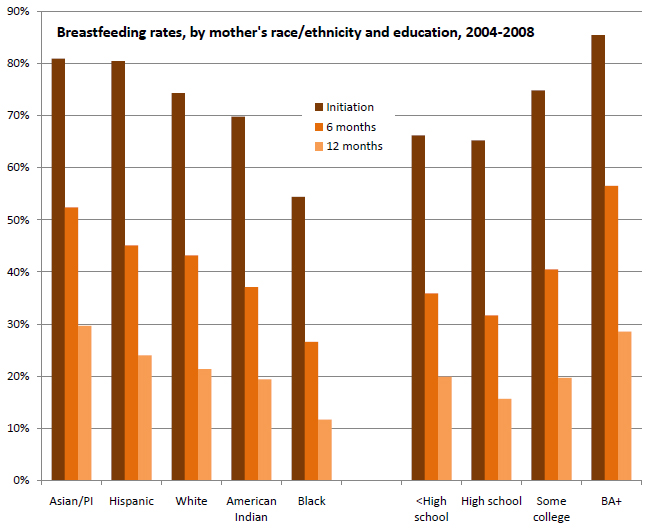
It shouldn’t be surprising, then, that breastfeeding rates are higher among more educated women and White and Asian women.  Both of these variables tend to correlate with class privilege:

There are some interesting things, however, that don’t correlate with this class thesis.  First Hispanic women are more likely to breastfeed than White women and people with less than a high school education are more likely to breastfeed, especially at six and 12 months, than people with a high school education.

I can think of some reasons why… I’ll let you discuss it in the comments.

Borrowed from Philip Cohen’s Family Inequality Blog.  For more data on rates of breastfeeding, including U.S. state comparisons and changes in rates over time, see here.

Lisa Wade, PhD is an Associate Professor at Tulane University. She is the author of American Hookup, a book about college sexual culture; a textbook about gender; and a forthcoming introductory text: Terrible Magnificent Sociology. You can follow her on Twitter and Instagram.

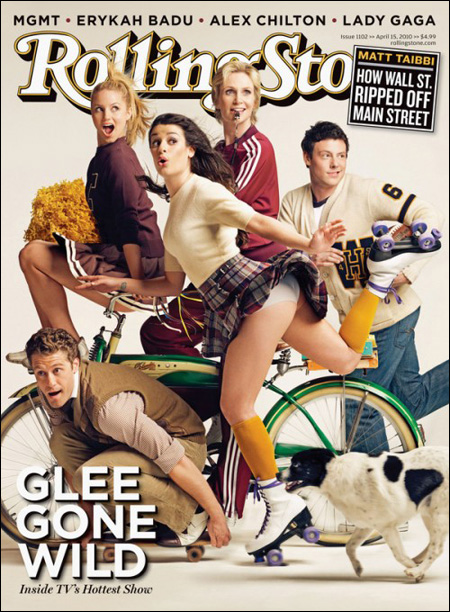
Or, as Angry Asian Man noticed, the white cast of Glee.

I get it, these are the show’s main characters. It’s just a obvious reminder that it’s awesome to see such great diversity on Glee… but never forget who the show’s real stars are supposed to be, and who usually gets relegated to the periphery.

With panties, of course.  Because without panties, there would be nothing at all going on on this cover.  Booooriiiiiiing.

Lisa Wade, PhD is an Associate Professor at Tulane University. She is the author of American Hookup, a book about college sexual culture; a textbook about gender; and a forthcoming introductory text: Terrible Magnificent Sociology. You can follow her on Twitter and Instagram.

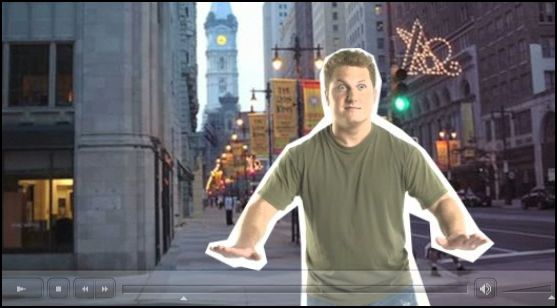
rachel56 sent in a fascinating story. Charley’s Grilled Subs is a super-successful franchise with locations in 16 countries. The restaurant specializes in Philly-style cheese steaks. If you go to their website and watch the video telling Charley’s story (here), this guy plays Charley:

But, in fact, that’s not Charley.  This is:

So here we have a Korean-American owner of a business that is Philadelphia themed.  I’m going to assume, and feel free to call me out on this, that he decided to portray “Charley” as white because he (or his marketers) imagined that Americans (whoever they are) think like this: Philly = America = white.  The idea that Charley is Korean might cause cognitive dissonance.  Cognitive dissonance is the state of holding two contradictory thoughts at the same time, such as Charley = Philly = America and Charley = Korean, when American does not = Korean.

When I lived in Madison, Wisconsin, I used to frequent a fast food noodle place called “Chin’s Asia Fresh.”  I always wondered if there was really a Chin or if it was a made-up character.  According to the website there is a Leeann Chin who, growing up in Canton, China, “learned cooking traditions from her mother and an eye for the best ingredients from her father.”  Of course, as is clear from Charley’s story, the “history” sections of restaurants can be fiction so… I guess I still wonder.   Of course, it would be advantageous for the Chin’s chain to market itself as authentically Asian, just as it is apparently advantageous for the Charley’s chain to market itself as “authentically” “American” (i.e., white).

All of this is a great example of how image is constrained and enabled by racial and ethnic stereotypes.

Lisa Wade, PhD is an Associate Professor at Tulane University. She is the author of American Hookup, a book about college sexual culture; a textbook about gender; and a forthcoming introductory text: Terrible Magnificent Sociology. You can follow her on Twitter and Instagram.

The American Anthropological Association website on race has a great collection of the racial and ethnic categories included on Censuses throughout the world, showing how different countries formalize different racial categories.  They illustrate just how diverse ideas about race are and challenge the notion that there is one “correct” question or set of questions.

Lisa Wade, PhD is an Associate Professor at Tulane University. She is the author of American Hookup, a book about college sexual culture; a textbook about gender; and a forthcoming introductory text: Terrible Magnificent Sociology. You can follow her on Twitter and Instagram.

Elle, at Shakesville, writes:

…sometimes I am struck by how many times, in so many little ways, people of color are reminded that “white,” in terms of race, is presumed to be the default or that white people are presumed not to “have” race in the same ways that we are.

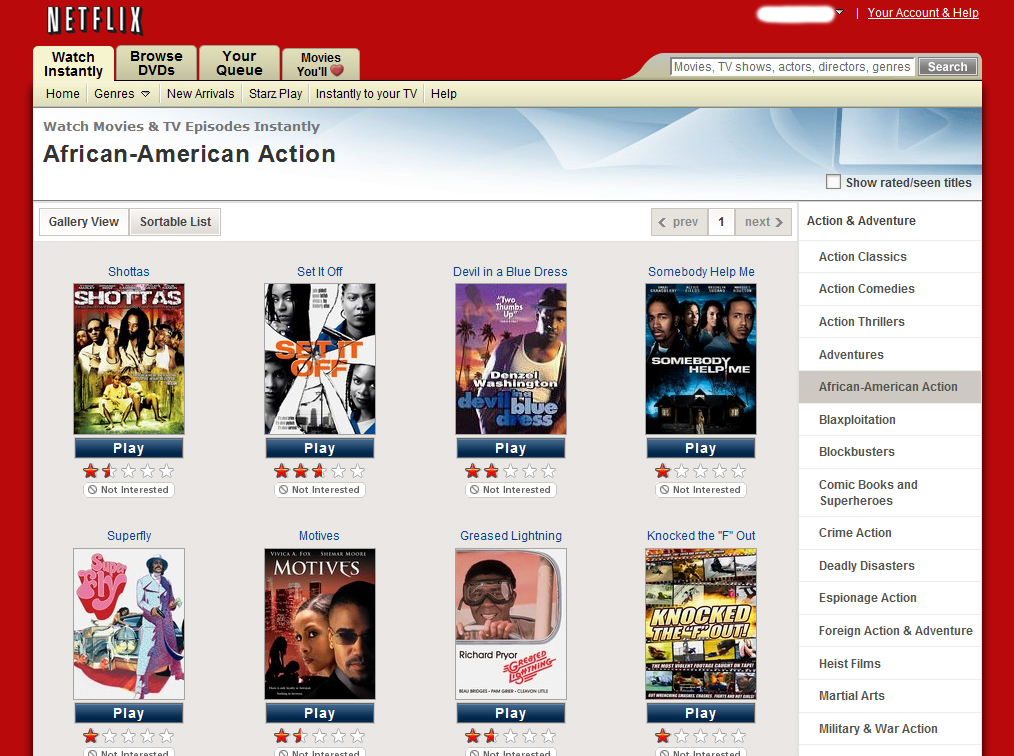
Skada sent us another great example of this phenomenon: Netflix genres include “Action and Adventure” and “African-American Action” (“and Adventure” would be too many As I guess).

For more examples of the neutrality of whiteness and the marked nature of blackness, see our two posts on recent descriptions of beige as “flesh-colored” (featuring Michelle Obama and Beyonce et al.) and our posts on bandaids and other “flesh-colored” items and lotion for “normal to darker skin.”

Lisa Wade, PhD is an Associate Professor at Tulane University. She is the author of American Hookup, a book about college sexual culture; a textbook about gender; and a forthcoming introductory text: Terrible Magnificent Sociology. You can follow her on Twitter and Instagram.

Crossposted at Racialicious.

—————————

After presenting lots of statistics about racial disparities in criminal justice, I showed my class the videos from ABC News What Would You Do? in which first White and than Black youths vandalize a car in a public parking lot. [See the videos at ABC: Part I and Part II.]

There is only one 911 call on the White boys, but ten on the Black boys. Plus, while the White boys are vandalizing, someone calls 911 to report people who are suspected of planning a robbery — Black kids asleep in a nearby car! Well, most of the class, as expected, saw this the way I did, as evidence of a racial problem. I was trying to emphasize that not arresting Whites when they commit crimes is just as important in racial disparities as arresting Blacks. Some students pointed out (correctly) that it was a demonstration, not a controlled experiment and wondered (fairly) whether the producers selected cases for their strong differences. But a few very vocally insisted that the difference was not about race at all, but that the Black kids were wearing “gang clothing.” They got somewhat offended when I said, “yeah, Black styles” and then cut off that line of argument, saying “OK we disagree on that, but I don’t want to spend the rest of the class arguing about clothing.”

Today I went back to the video and took screen shots of the kids. They are all wearing hooded sweatshirts and jeans, as I said. (One student had insisted that the White kids wore tucked in shirts! Not so.)

There are subtle differences in how they wear the clothes, though. The Black kids’ clothes are bigger on them (and the kids themselves appear to me to be smaller). The White kids’ shirts have words on them which I assume are school names (the resolution isn’t good enough for me to read them) while one Black kid has some sort of design on it that you could construe as edgy — it is definitely not preppy. One Black kid is wearing a cap which (as can be seen elsewhere in the video) is a gold weave thing that I cannot imagine a White kid wearing, but he’s wearing it in the same way as lots of White kids wear baseball caps. In my view the only difference between the clothing was subtle differences in style sensibilities between Blacks and Whites, and that calling the Black kids’ clothing “gang attire” is ridiculous. These few students think that if the Black kids had been in “non-gang” (i.e. “White”) clothing, the result would have been different. (They did not even suggest dressing the White kids in “gang” styles.) I think they are just exhibiting extreme resistance to the obvious. (The same students criticized me for failing to show examples of Black crime.) Opinions?

Edit: I decided to add shots of the kid with the most distinctively Black hat. In these shots you can see that he’s also wearing a do-rag. Just to be fair. I can find no evidence that this is “gang attire.” But it is certainly distinctively Black.

Do you think it’s the do-rag and not the skin color that matters here?

—————————

This Anonymous Guest Post is borrowed from Sociological Confessions. The blogger is a Sociology professor who teaches courses on race relations and does public sociology work on racial disparities in criminal justice. In this post, she poses a question based on an interaction with students who questioned her interpretation of an incident as racial.