race/ethnicity: Whites/Europeans

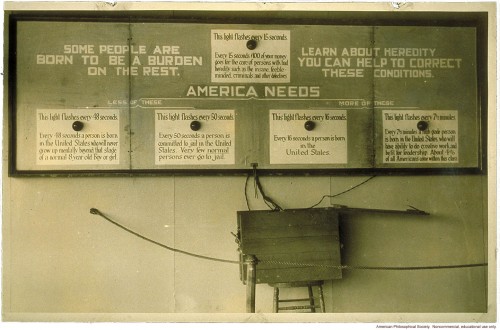
A 1926 eugenics poster (from autistics.org):
1926exhibit

From left to right the boxes say (and the left two are what we need less of, the right two what it says we need mroe of):

This light flashes every 48 seconds. Every 48 seconds a person is born in the United States who will never grow up mentally beyond that stage of a normal 8 year old boy or girl.

This light flashes every 50 seconds. Every 50 seconds a person is committed to jail in the United States. Very few normal persons ever go to jail.

This light flashes every 16 seconds. Every 16 seconds a person is born in the United States.

This light flashes every 7 1/2 minutes. Every 7 1/2 minutes a high grade person is born in the United States who will have ability to do creative work and be fit for leadership. About 4% of all Americans come within this class.

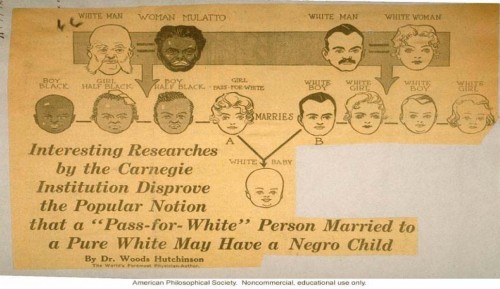
Here’s another example of the use of pseudoscience to make racial arguments (via):
racism science

Notice that the “woman mulatto” is draw to appear extremely unattractive, and that while the white man and mulatto woman have a “pass-for-white” daughter, the son on the far left isn’t “pass-for-black”–he really is black. The idea of “passing for black” made no sense at the time, while “passing for white” was a major concern. I am surprised to see here, though, that the baby of the pass-for-white woman and the white man is defined as entirely white.

Of course, none of this makes any logical sense at all, but lots of supposedly scientific studies at the time applied many statistical and other methods to prove various racial arguments.
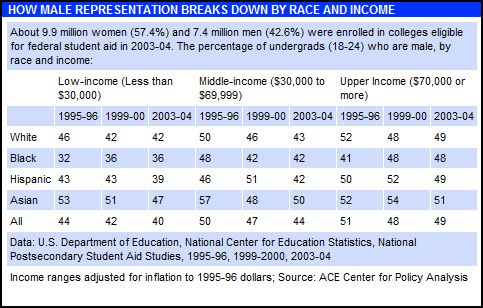
In the U.S. today, men enroll in college at a lower rate and drop out at a higher rate. In 2005, there were 57 women on campus for every 43 men.

This is such a significant problem, that college admissions officers are letting in a larger percentage of male applicants, even sometimes admitting less qualified men over more qualified women.

But this isn’t just a gender story.

A USA Today story offered this data from the ACE Center for Policy and Analysis:

Capture

Looking at the very bottom line of the table (and just at 2003/2004), you can see that the gender gap is largest among lower income students.  Men make up 40% of undergraduates 18-24 when you consider low-income students only, and 49% when you look at upper income students.

The gender gap also correlates with race.  Asian students show the smallest gender gap, whites the next smallest, with Hispanics and blacks trailing.

You might notice that the correlation of the gender gap with race mirrors the class correlation.  That is, income and wealth data for racial categories follows the same pattern with Asians out earning whites (categorically speaking) and whites out earning Hispanics and blacks.  So there may be an interesting exacerbation effect here.

The gender gaps for each racial/ethnic group, however, decreases as the students’ families get richer.  And, among the upper income groups, the racial difference shrinks to only three percentage points (from 11 among low- and middle-income kids).

So, it’s not just about race, it’s not just about class, and it’s not just about gender.  Then, what is it about being poor, black or Hispanic, andmale that results in low male enrollment in college and a higher drop out rate?

—————————

Lisa Wade is a professor of sociology at Occidental College. You can follow her on Twitter and Facebook.

Our intern, Velanie, forwarded us a link to a clip from an Australian variety show called Hey Hey It’s Saturday.  In the clip a group called the Jackson Jive perform in blackface.  Steel yourself; maybe skip it if you’re not up to being reminded, again, of white racism against blacks.

Sometimes people wonder why black people are not more open or trusting of whites.  This is why.  Harry Connick Jr., bless his heart, did what he could to try to make it clear that the performance was not acceptable.   And, to be fair, the producers (?) gave him an opportunity to object more articulately.  Here is a part of what he said at the end of the clip:

I just wanted to say on behalf of my country, I know it was done humorously but we have spent so much time trying to not make Black people look like buffoons that when we see something like that we take it really to heart… if I knew it was gonna be a part of the show I definitely wouldn’t have done it. So I thank you for the opportunity. I give it up cause Daryl said on the break you need to speak as an American. Not as a Black American or a White American but as an American I need to say that, so thank you for the opportunity.

I’m sure that many people appreciated that Connick stood up against blackface.  But he is the exception.  The host of the show didn’t apologize, he just pleaded ignorance and felt bad that Connick was offended.  The rest of the people, including the unrepetant performers, the judges, and (it appears) the majority of the audience, had absolutely no problem with the performance.  Further, the majority of Australians are defending the minstrelsy.  Mary Elizabeth Williams, at Salon, summarizes:

In a poll on PerthNow.com.au, 81 percent of respondents said the sketch was not racist, with other newspapers clocking in with similar percentages. Punch deputy editor Tory Maguire glumly asserted that “The 2.5 million Australians who were watching were looking for nostalgia, so a returning act like the Jackson Jive was always going to appeal to them.” It’s a sentiment echoed by the show’s host, Daryl Somers, who told reporters that Australian audiences “see the lightness of it.”

Dr. Anand Deva, who appeared as Michael in the sketch, told an Australian radio station this week, “This was really not intended … [to be] anything to do with racism at all…

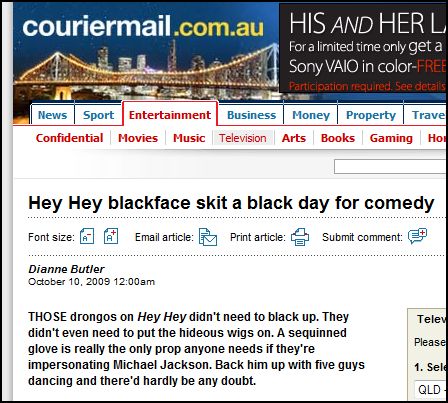
Couriermail decides it’s a great opportunity for a cheeky pun:

sss

Williams continues:

What should be obvious to anyone who isn’t a complete moron is that a little something called the entire history of Western civilization — what with the slavery and the colonization and the genocide — disqualifies us from mocking people for their color as grounds for entertainment. It’s just that simple.

It is just that simple.  But so many white people still defend it.

This is why black people don’t trust white people.  Because they never know what kind of white person they’re dealing with and it’s not worth the risk because, a good portion of the time, they’re dealing with the host who is “sorry that you were offended” (as if the offense is your own personal defect) or the lady in the audience who is just really excited to be on TV.

Capture11

Via Shakesville and Womanist Musings.

—————————

Lisa Wade is a professor of sociology at Occidental College. You can follow her on Twitter and Facebook.

Lisa Wade, PhD is an Associate Professor at Tulane University. She is the author of American Hookup, a book about college sexual culture; a textbook about gender; and a forthcoming introductory text: Terrible Magnificent Sociology. You can follow her on Twitter and Instagram.

Angry Asian Man wrote about two East High Schools–in Rochester, New York and Akron, Ohio–with a peculiar mascot: the Orientals.

East High School merch (Rochester, New York):

Capture

Screen shot of the East High School website (Akron, Ohio):

Capture2

Notice the Asian-y font and the stylistic dragon.

When high schools and sports teams recruit a type of person as a mascot, it objectifies and caricatures them.  It also encourages opposing teams to say things like “Kill the Orientals.”  This can only be okay when we aren’t really thinking about these kinds of people as real humans beings.

This reminded me:  As an undergraduate, I went to the University of California, Santa Barbara.  Our mascot was the Gaucho, which I remember being described as a Mexican cowboy (though South American cowboy may be more descriptive).  I went by the UCSB website and found these two logos.  There is a story about the first identifying it as a brand new logo; the second is for kids:

Capture4

capture5

I am troubled by the Gaucho mascot for the same reasons that I don’t like the Orientals mascot, but at least authentic gauchos are not likely to enroll at UCSB the way that “Orientals” are likely students of the East High Schools.

Then again, this is the image on the front page of the UCSB athlectics website:

Capture3

It does indeed read: “GLORY. HONOR. COURAGE. TORTILLAS.”  This seems to invalidate any argument that the use of the Gaucho mascot is “respectful.”

Thinking about the Orientals and the Gauchos, alongside the many American Indian mascots still found in the U.S., Notre Dame’s Fighting Irish, and the soccer team in the Netherlands who call themselves the Jews, may give us some perspective on this mascot phenomenon that thinking about one at a time doesn’t.  If we feel that one of these mascots is less discriminatory than another, what drives that feeling?  And is it logical?  Or does it stem from a trained sensibility that isn’t applied to all marginalized groups across the board?  Or is it in response to different characteristics of these different groups?  Or different contexts?

Maybe all five mascots are equally offensive and offensive for the same reasons.  But thinking about them together may also be useful for teasing out how, exactly, they are offensive.  What do you think?

—————————

Lisa Wade is a professor of sociology at Occidental College. You can follow her on Twitter and Facebook.

index
Vintage Ads.

—————————

Lisa Wade is a professor of sociology at Occidental College. You can follow her on Twitter and Facebook.

Miz Belle sent us a set of photos from the September issue (#106) of Numéro, a fashion magazine. The fashion spread, titled “Best Friends” (I found at least one post online saying the two models are, in fact, good friends) features a White woman in at least enough clothing to cover her lady bits posed next to a Black woman whose breasts are on display as she is either entirely or partially naked.

These aren’t even vaguely safe for work.

more...

Reading Resist Racism, I found a link to an article in this Sunday’s Washington Post by a journalist by the name of Amit Paley who chronicled her exploration of “tribes” in Thailand.  The article is a study in class privilege, with a global twist.  It begins with the sentence: “You can see almost anything in the world if you pay enough.”

She wanted to see women of the Padaung (or Kayan), who are from Burma but now live in Thailand as refugees.  The Kayan women are famous for wearing brass rings around their necks, leading to the illusion of an elongated neck created by the depression of their collarbone. Paley writes:

Ever since I glimpsed the Padaung as a child in my grandfather’s National Geographics, I had wanted to see these curious women, who suffer painful disfigurement to emerge as graceful beauties.

Her description of human beings, indirectly, as curiosities, combined with the comment that you can see “anything… if you pay enough” (my emphasis) is an excellent example of the objectification of ethnic others.

Paley’s desire to see these women is almost thwarted by the majority of tourist companies in Thailand who describe her effort as exploitative and immoral.  They even suggest that the women are “prisoners held captive in the villages by businessmen” making money off of tourism.  This is confirmed by Wikipedia, for what it’s worth.

This doesn’t stop Paley, who keeps asking until she finds a company that will take her to one of the remote villages in which Kayan women live.

The women she meets confirm that they wear traditional garb, continue traditional practices (such as the brass rings), and are even forced to remain in the villages, in order to attract tourists.  Men, largely, appear to be exempted from earning their keep in this way.

Paley says that one powerful male village member said that the women “must wear the dress because of tradition” and “spoke excitedly about its appeal to tourists and noted that half of the village’s income of $30,000 a year comes from tourism.”

A woman in brass rings told her “We do it to put on a show for the foreigners and tourists!”

Paley finishes with this lackluster reflection:

So is it unethical to visit the long-necked women? It is clearly true that money spent to visit them supports an artificial village from which they essentially cannot leave. On the other hand, many of them appeared to prefer living in virtual confinement as long as they are paid and safe. According to what they told me, their situation beats the alternative of living in a repressive country plagued by abject poverty and hunger.

I don’t feel guilty about visiting the Padaung, but my feelings might be different if I had traveled solely as a tourist rather than as a journalist. And I certainly don’t like their lot in life:  Shouldn’t everyone have the freedom to live and travel wherever they want?

Well, Paley has shown that she certainly does have that freedom.  And she is apparently willing to use her “journalist” identity to justify just about any advantage that her privilege affords her.


Lisa Wade, PhD is an Associate Professor at Tulane University. She is the author of American Hookup, a book about college sexual culture; a textbook about gender; and a forthcoming introductory text: Terrible Magnificent Sociology. You can follow her on Twitter and Instagram.

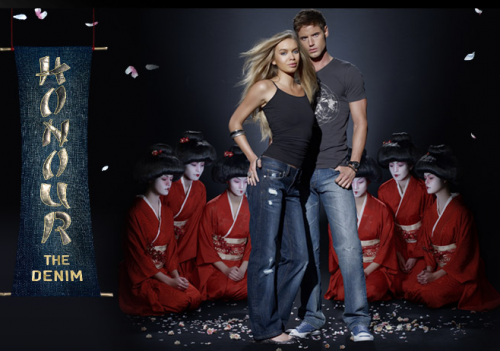
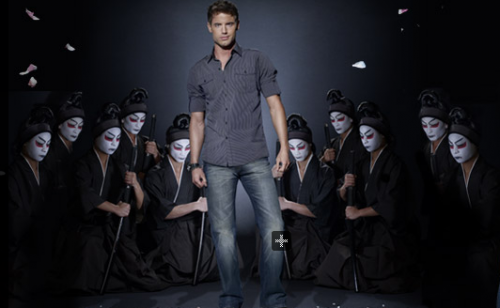
Tristian B. told us about Jeanswest Australia’s Authentic Japanese Vintage Denim ad campaign, which features images of White people surrounded by groups of kneeling Japanese men or women:

Picture 1

Picture 2

Oddly enough, Andrea J. recently sent us a link to the Palm Pre “Flow” ad, which has a White woman using the Palm Pre while a group of identically-dressed Asians, none shot in a way that presents them as individuals, dancing around her as she discusses how nice it is when everything rearranges itself to do just what you want:

NEW! (Oct. ’09) Macon D. found another example of the use of generic, undifferentiated Asians as props.  This time in a performance by Shakira:

[youtube]http://www.youtube.com/watch?v=6bZxN1Qq9K4[/youtube]

She gives the same performance on Saturday Night Live.

Gwen Stefani’s Harajuku Girls are another great example.

This reminds me a lot of some images from Britain’s Next Top Model that Lisa posted about last year, in which Africans were used as background props in a photo shoot with the contestants. The Asian individuals in these two ads are an undifferentiated mass, strikingly dressed and posed to show off the subjects of the ads–the White people who are foregrounded and depicted as specific, individual human beings rather than an interchangeable member of a group.

For other examples of non-Whites used as props, see our post about a fashion spread in Vogue Italia and this photo from NYLON magazine.

Gwen Sharp is an associate professor of sociology at Nevada State College. You can follow her on Twitter at @gwensharpnv.