
Search results for embed

Racial segregation in housing is a persistent and pernicious problem in American life. If neighborhoods are filled predominantly by one race or another, that group of people can be advantaged or disadvantaged by virtue of where they live. Decisions about where to put parks, garbage dumps, toxic facilities, airports, and highways, for example, can affect some groups more than others. Some neighborhoods might not have good jobs or public transportation, or sufficient numbers of grocery stores, nursing homes, or recreation facilities, but be filled with check cashing businesses, liquor stores, and cigarette advertising. The quality of schools, water systems, levee systems, and even the air itself varies by neighborhood. And a large and robust literature in sociology shows that good things tend to cluster in whiter neighborhoods and bad things in neighborhoods that are predominantly African American or Latino.

But why are neighborhoods racially segregated? And why do they resist integration?

One possibility is that white people simply prefer to live among others of the same race. What comes to mind perhaps is a white family that sells their house the second a black family moves in next door, but a model developed by economist Thomas Schelling shows that even a surprisingly weak preference will produce systemic segregation.

What if, for example, there are two types of people and each are happy in a diverse neighborhood, but they become uncomfortable when fewer than 1/3rd of their neighbors are like them? If you randomly move the uncomfortable households around until everyone’s happy, segregation is mathematically guaranteed. Here is a simulation, at the Parable of the Polygons (h/t orgtheory), of how segregation results from a preference that 1/3rd or more of one’s neighbors are the same race:

Obviously, the more of a preference, the more extreme the segregation, but the lesson is that racially diverse neighborhoods are undermined not only by a strong of living alongside other races, but also a slight preference for being among at least some people of the same race.

Schelling also notes that if we start with already segregated neighborhoods and we reduce bias, nothing changes at all. Most people who are surrounded by people like themselves won’t move just because they wouldn’t object to being around people who are different than them.

Instead, to substantially reduce residential segregation, people will not only have to accept diversity, they will have to actively reject segregation. And, again, even a weak preference for diversity will do it. In fact, Schelling’s model shows that if people are comfortable living in neighborhoods in which 90% of their neighbors are the same race, but reject 100% segregated ones, the result is integration. Here’s what it would look like if people moved out of neighborhoods in which 90% of their neighbors were the same race and into more integrated neighborhoods:

4

The take home message is that, to end residential racial segregation, we don’t need to reduce bias, we need to increase desire. We need people to actively seek the diversity they want.

Lisa Wade, PhD is an Associate Professor at Tulane University. She is the author of American Hookup, a book about college sexual culture; a textbook about gender; and a forthcoming introductory text: Terrible Magnificent Sociology. You can follow her on Twitter and Instagram.

This month marked what would have been Frankie Manning’s 102nd birthday. Google marked it with a “Google doodle” and it sparked some conversation online about this extraordinary African American early dancer of the lindy hop. Among them was a discussion of the racial politics of the dance and its revival at Vox, including an quote from a post  here on Sociological Images.

Thanks to past SocImages posts on walk signs, guns, and gendered body language, I was also interviewed for articles on design in urban space, gun marketing, and eye-rolling. And, more generically, social class and hookup culture, male friendship, and men’s relationships with their most private part. It was a busy month!

You like!  Here are our most appreciated posts this month:

Thanks everybody!

Editor’s pick:

Social Media Milestones!

We’ve reached a couple big thresholds this month: 15,000 on Pinterest and 25,000 on Tumblr!

See you in June!

Lisa Wade, PhD is an Associate Professor at Tulane University. She is the author of American Hookup, a book about college sexual culture; a textbook about gender; and a forthcoming introductory text: Terrible Magnificent Sociology. You can follow her on Twitter and Instagram.
Editor’s note: But see this take down of the study by sociologist Andrew Gelman.

Does it irritate you to walk through first class on your way to the economy seats? Do those smug faces, sipping complimentary champagne, annoy you? Do you wonder, perhaps involuntarily and against your better self, what makes those passenger so special? So much better than you? Does it make you want to break stuff?

If so, you’re not alone!

New research by a pair of business and resource management scholars discovered that “air rage” was more common on airplanes that have a first class cabin than those that don’t and even more common if economy passengers boarded the plane through that cabin, such that class-divided passengers came into close proximity.

The investigators, business and organization scholars Katherine DeCelles and Michael Norton, call it “physical” and “situational inequality.” The former is when hierarchies are built into the environment, like CEOs in gorgeous, high-windowed corner offices and workers in dull cubicles. Situational inequality refers to degrees to which this hierarchy is made plain, as in whether workers have to walk by CEO offices to get to their cubicles. Airplanes with first class cabins are an example of physical inequality and if the economy class has to walk through them to board, that’s an example of high situational inequality.

DeCelles and Norton posited that both types of inequality would be associated with “antisocial behavior”: belligerence, illegal drug use, excessive intoxication, sexual misconduct, etc. Creatively, they used several years of records of onboard air rage incidents from a large airline, correlating incidents with the design of the airplane and boarding procedures.

They found that physical inequality was correlated with increased rates of air rage among people in the economy class and situational economy with air rage among people in both classes. By a lot, in fact. The presence of a first class cabin appeared to increase air rage among the economy class almost 4 times. For comparison, the increase was equivalent to that caused by a 9.5 hour take-off delay. Irritating, indeed.

Boarding through first class was correlated with another 2.18 times increase in air rage among the economy class and a stunning 11.86 times increase among those in first class. I always wondered if first class passengers felt chagrined, embarrassed, or disturbed by the marching through of the airplane’s second- and third-class citizens. Well, there’s a pretty heavy-handed hint.

DeCelles and Norton observe that recent changes in airline practices have increased the likelihood of passengers experiencing both types of inequality and that administrators and their on the ground representatives — flight attendants — should expect incidences of air rage to increase apace.

Lisa Wade, PhD is an Associate Professor at Tulane University. She is the author of American Hookup, a book about college sexual culture; a textbook about gender; and a forthcoming introductory text: Terrible Magnificent Sociology. You can follow her on Twitter and Instagram.

Taking a cue from sociologists, The Nightly Show has started a segment called the “Super Depressing Deep Dive.” In the five minute segment I’ve embedded below, they explain that we’ve known that lead was highly toxic since 1904, but the US didn’t ban lead paint until 1978 and lead pipes even later. Why not?

Looking at the evidence piling up, the League of Nations encouraged all nations to stop the use of lead paint in 1922, but the United States didn’t sign on. They deferred to the industry — the Lead Industries Association and the National Paint, Varnish, and Lacquer Association — who successfully lobbied the federal government. Not only did the US decline to ban the substance, in 1938 the government actually mandated that lead paint be used in housing projects for poor people, putting the lead industries profits above the health of poor children.

The industry also fought warning labels, criticized the science, sued at least one source — a television show — for telling the truth about lead, and blamed the victim, claiming that the real problem was “uneducable Negro and Puerto Rican” parents who failed to adequately protect their children. They even dispensed pro-lead propaganda directly to kids, like in this page from a free children’s book distributed by a paint company in which a pair of rubber boots say to the child (bottom right):

You knew when we were moulded
The man who made us said
We’re strong and tough and lively
Because in us there’s lead.

8

Because of the disproportionate impact on the poor and racial minorities, the Black Panthers made fighting lead paint a part of their mission and their work ultimately contributed to the banning of lead paint in 1978 and pipes in the 1980s. By that time, though, the damage was done. Lead pipes are still in the ground and lead paint continues to be a serious threat in poor neighborhoods, doing irreparable damage to the lives of poor children and the communities they are a part of.

Lisa Wade, PhD is an Associate Professor at Tulane University. She is the author of American Hookup, a book about college sexual culture; a textbook about gender; and a forthcoming introductory text: Terrible Magnificent Sociology. You can follow her on Twitter and Instagram.

Police brutality is a problem in US criminal justice. Police-worn body cameras are one potential “remedy” to these violent encounters, but they have both benefits and drawbacks. The cameras may increase transparency and improve police legitimacy, promote legally compliant behavior among both police officers and citizens; enhance evidence quality that can improve resulting legal proceedings; and deter officers’ use-of-force. Conversely, body-worn cameras could create privacy concerns for the officer and the citizenry and place a large logistical and financial burden on already cash-strapped law enforcement agencies.

.

This issue is so timely that research is only now starting to see publication, but we do have some early insights. The first observational studies examining the use of police-worn body cameras were carried out in England and Scotland. They found rates of citizen complaints dropped after body cameras were introduced. Preliminary results from an experimental study in Phoenix, Arizona also suggest that the use of body cameras reduces both self-reported and official records of citizen complaints.

The first experimental evidence concerning use-of-force comes from a large study in the Rialto, California Police Department, and the results should encourage advocates of body cameras. The study randomly assigned particular police shifts to wear body cameras (the “treatment”). Police shifts in the treatment condition are associated with reduced use-of-force and citizen complaints against the police were significantly reduced. Shifts in the control condition, in contrast, saw roughly twice as much use-of-force as the treatment condition.

The research so far suggests that body cameras are a promising way to reduce unnecessary use of force.

Ryan Larson is a graduate student studying the sociology of crime at the University of Minnesota. His research interests extend to statistics, sport, and media. He writes for and is on the Graduate Editorial Board of The Society Pages. This post originally appeared at There’s Research on That! 

Pregnancy wasn’t always something women did in public. In her new book, Pregnant with the Stars, Renée Ann Cramer puts public pregnancies under the sociological microscope, but she notes that it is only recently that being publicly pregnant became socially acceptable. Even as recently as the 1950s, pregnancy was supposed to be a private matter, hidden behind closed doors. That big round belly was, she argues, “an indicator that sex had taken place, [which] was simply considered too risqué for polite company.”

Lucille Ball was the first person on television to acknowledge a pregnancy, real or fictional. It was 1952, but it was considered lewd to actually say the word “pregnant,” so the episode used euphemisms like “blessed event” or simply referred to having a baby or becoming a father.

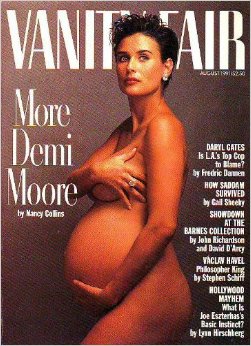
Almost 20 years later, in 1970, a junior high school teacher was forced out of the classroom in her third trimester on the argument that her visible pregnancy would, as Cramer puts it, “alternately disgust, concern, fascinate, and embarrass her students.” So, when Demi Moore posed naked and pregnant on the cover of Vanity Fair just 21 years after that, it was a truly groundbreaking thing to do.

2

Today being pregnant is public is unremarkable. Visibly pregnant women are free to run errands, go to restaurants, attend events, even dress up their “baby bump” to try to (make it) look cute. All of this is part of the entrance of women into the public sphere more generally and the pressing of men to accept female bodies in those spaces. The next frontier may be breast feeding, an activity related to female-embodied parenting that many still want to relegate to behind closed doors. We may look back in 20 years and be as surprised by intolerance of breastfeeding as we are today over the idea that pregnant women weren’t supposed to leave the house. Time will tell.

Lisa Wade, PhD is an Associate Professor at Tulane University. She is the author of American Hookup, a book about college sexual culture; a textbook about gender; and a forthcoming introductory text: Terrible Magnificent Sociology. You can follow her on Twitter and Instagram.

Wealth inequality in the U.S. is extreme, but global wealth inequality, illustrates a video by The Rules, is even more stunning. Some facts:

  • The top 20% control 80% of the world’s wealth.
  • The richest 2% control more wealth than the bottom half of the world’s population.
  • The richest 300 people on earth have more wealth than the poorest 3,000,000,000.
  • 200 years ago, rich countries were three times as rich as poor countries. Today, they are eighty times richer.
  • Rich countries give $130 billion dollars worth of aid to poor countries every year, but they extract $2 trillion each year thanks to global economic rules.

Here are their sources; or watch the four minute video:

The Rules wants to reveal and challenge the laws that govern our global economy. It is a distinctly sociological project, looking at how factors outside of individuals — or, in this case, countries — shape lives. Shaped strongly by the richest countries in their own best interest, rules governing the trading of goods and money are determining the economic solvency and future of countries.

When those rules are invisible, it can seem like struggling countries are just poorly managed or culturally problematic when, in fact, the rules ensure that the deck is stacked against them.

Hat tip to Martin Hart-Landsberg.

Lisa Wade, PhD is an Associate Professor at Tulane University. She is the author of American Hookup, a book about college sexual culture; a textbook about gender; and a forthcoming introductory text: Terrible Magnificent Sociology. You can follow her on Twitter and Instagram.

Almost all of the representations of breasts we encounter in the mass media are filtered through the hypothetical heterosexual male gaze. Breasts are objects, things that people desire. Women’s personal, subjective experiences of having breasts is almost never discussed in pop culture. I mean, yes, occasionally two female characters might talk about their breasts, but usually in reference to whether and how they do or fail to attract male attention (e.g., “Is this too much cleavage?” and “I wish I had more cleavage!”). What it feels like to have breasts outside of the context of being a sex object isn’t talked about. There’s a void, a black hole of experience.

The only other common discourse about breasts that comes to mind centers around breastfeeding. In that discourse, the idea that breasts are for men is challenged, but only in favor of the idea that breasts are for babies. In neither discursive context does anyone make the case that breasts are primarily for the people who have them. That the pleasure (and pain) and comfort (and discomfort) that comes with breasts belongs — first and foremost — to female-bodied people.

Last week, I saw something different. Crazy Ex-Girlfriend is an odd little TV show with a couple musical numbers in each episode and one of the numbers last week was called “Heavy Boobs.” It’s safe for work but… maybe not safe for work.

Rachel Bloom‘s song names and describes one subjective experience of breasts. Breasts are “heavy boobs,” she sings, just “sacks of yellow fat” that can weigh on women. In the song, the breast-haver’s experience is centered to the exclusion of what men or babies might want or think or experience. I can’t ever remember seeing that on TV before.

And that’s plenty, but what she and her fellow dancers do with their bodies is even more extraordinary. They defy the rules of sexiness. Their movements are about embodying heavy boobs and that’s it. It’s as if they don’t care one iota about whether a hypothetical heterosexual male will see them. The dance is unapologetically unsexy. No, it’s more than unsexy; it’s asexy. It’s danced neither to repulse or attract men; instead, it’s danced as if sexiness is entirely and completely irrelevant. There’s no male gaze because, in that two minutes, there’s not a man in sight.

Lisa Wade, PhD is an Associate Professor at Tulane University. She is the author of American Hookup, a book about college sexual culture; a textbook about gender; and a forthcoming introductory text: Terrible Magnificent Sociology. You can follow her on Twitter and Instagram.