Search results for embed

Cross-posted at The Social Complex.

From the people who brought you greasy chicken wings, overpriced beer, and casual sexism while you wait…

Do these ads really require commentary?

The first video is able to squeeze heightism, sexism, and homophobia into one commercial spot.  And the second video is so blatantly playing off of the societal notion that short men have very little social worth (and zero sexual worth) that they even have a line in it that refers to height specifically: “why do you have to be so tall?”

These ads are especially good for those who believe that women have a monopoly on heightism.  Hooters’ target consumer base is nearly exclusively male and so their ads are designed to appeal to that base.  So here we have ads targeted at a male audience which attempt to humiliate short men through comedic effect for the purpose of highlighting their low grade frozen seafood and sophomoric titillation – and you still think shallow women are to blame for heightism?

Pay special attention to the dialogue.  Every word is designed to legitimize the widely held belief that short men are socially inferior.  In one section, an African American male diner looks over to the short man who is getting attention from the “Hooter’s Girls” and says “I don’t get it”, followed by a close up of an out-of-place female diner; her mouth agape with disbelief from what she is witnessing.

Of course, the gag is supposed to be that short men are generally “losers” but this particular short man is a “winner” at Hooters because “Shrimp Is In This Summer”.

I would have loved to be in the pitch meeting at the advertising firm that came up with these ads:

“Get it?  Shrimp = Short Men!  Because “shrimp” is a common slur used against short men.  Get it?  Funny, right?  And it’s O.K. because they had a professionally dressed, diverse group of people commenting on the strangeness of the whole scenario.  And the short guy was laughing…he was having a blast.  It’s all in good fun.”

Hilarious, right?

—————————

Geoffrey Arnold is an associate with a mid-sized corporate law firm’s Business Litigation Practice Group.  When Geoffrey isn’t chasing Billable Hours in the defense of white-collar criminals, he is most likely writing about social justice with a special emphasis on height discrimination at his blog: The Social Complex.  See also Geoffrey’s guest post introducing the concept of heightism as a gendered prejudice.

If you would like to write a post for Sociological Images, please see our Guidelines for Guest Bloggers.


My colleague and co-author, Lisa Wade (you’d know her better as one of the people behind SocImages), gave a seven-minute speech at an Occupy Teach-In at our shared institution, Occidental College.  She said I could post it for you.

In the video she says she’s optimistic about the movement because it’s deeply sociological, drawing our attention to the way we organize our society, not just the individuals in it.  She contrasts this ability to critique the system with the early years of the Great Depression, during which many of the unemployed felt like they had failed their families because of personal faults (leading to a rise in the suicide rate).  Then, using the truly inspirational story of the 1955 Montgomery bus boycott (in which people walked to work and rode carpools for over a year!), she warns students that the movement is about to stop being fun and require real commitment. She ends by asking the the audience whether they can rise to the occasion and make the sacrifices needed to move Occupy forward to achieve specific demands.

Also see the three-minute bit on hook up culture that she did for MTV Canada.

Cross-posted at Racialicious and Caroline Heldman’s Blog.

Tower Heist (2011) the new movie starring Ben Stiller and Eddie Murphy, is the latest installment in blatantly racist movie-making. Stiller plays a high-end condo manager in Manhattan who bails out a local criminal (Murphy) to steal a stash of cash that one of the wealthy condo residents swindled from the condo staff. It’s been nearly thirty years since Murphy played nearly the same character in his breakout role in 48 Hours, and the fact that he is still cast as a jive-talking criminal speaks to how little has changed when it comes to the portrayal of black Americans in popular culture.

Hyperbolic racial stereotypes are still sooooo amusing for some.  As LA Times film critic Betsy Sharkey writes, “Murphy and Stiller are a good pair, with Murphy once again mainlining his ghetto-comedy crazy and Stiller suited up for another straight-man gig. These are the kinds of roles they both do best, and their face-off in the front seat of an out-of-control car is worth the price of admission.” (Now reverse the names in this quote to see how racialized and racially offensive it is.)

Perhaps more disturbing is the way in which film critics are talking about this movie as a comback for Eddie Murphy  (“Eddie Murphy’s Road to Reddemption,” “Tower Heist: Murphy is Back on Top,” “‘Tower’ Heist Features Eddie Murphy Back in ‘Classic ’80s Form“). What does it mean when playing an insultingly stereotypical black criminal is deemed “redemption” for a black actor whose movies have grossed nearly $7 billion worldwide? And where, exactly, did Eddie Murphy go? The Shrek series grossed nearly $3 billion worldwide, while his Nutty Professor and Doctor Dolittle franshises grossed $428 million and $470 million, respectively. Murphy has appeared in a steady stream of successful movies in the past decade, including Dreamgirls for which he was nominated for an Academy Award.

Closer examination of media critics’ analysis reveals a nostalgia for Eddie Murphy’s breakthrough role as a criminal in 48 HoursJon Niccum writes that inTower Heist “Murphy shows flashes of the aggressive, non-family-friendly persona that made him a superstar following 48 Hours. Aggressive?  Non-family friendly?

eddie-murphy-comeback-stern

To summarize, Eddie Murphy grossing oodles of money as a successful director, producer, writer, and actor in films featuring him as a doctor, a veterinarian, a dedicated father, and the voice of a beloved donkey in the second highest-grossing animated film of all time is considered some sort of failure, but playing a jive talking felon is redemption. Huh?

There are many ways to interpret this — that Hollywood and movie critics (and many in society) are more comfortable with black actors playing damaging, stereotypical roles involving criminality, violence, and deviance (remember back in 2002 when Denzel Washington finally won the Oscar for playing a crooked cop?); that male actors are failures if they appear in family-friendly movies, regardless of how economically successful these movies may be; that to be considered successful, male actors have to appear in movies geared towards male audiences.

Whatever the reason(s), it is embarassing for Hollywood and its “critics” to continue to be so ignorant. Eddie Murphy called out the movie industry’s racism at the 1988 Academy Awards during his presentation of the Best Picture award: “I’m going to give this award, but black people will not ride the caboose of society and we will not bring up the rear anymore. I want you to recognize that.” Two decades later, Murphy finds himself riding the caboose, furnished by the creators of Tower Heist.

This is a whimsical trailer for an animated movie with a progressive pro-environment message based on Dr. Seuss’ The Lorax.  Pretty to watch, fantastical, heart-warming, and progressive… it draws you in and then, just as yoiur defenses had been lowered, BAM! It ends with a sexist joke.

Sigh.

Lisa Wade, PhD is an Associate Professor at Tulane University. She is the author of American Hookup, a book about college sexual culture; a textbook about gender; and a forthcoming introductory text: Terrible Magnificent Sociology. You can follow her on Twitter and Instagram.

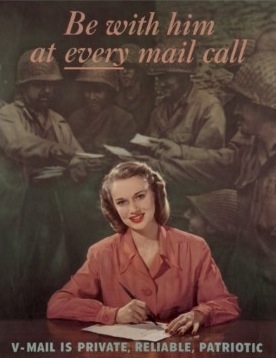
Homefront war support is a critical part of war; care packages, letters, emails, and phone calls greatly increase troop morale. Typically homefront war support is gendered. In the U.S., women are usually the ones at home providing support to the men serving. During various wars the military has encouraged women to support male troops. It’s patriotic, as this WWII poster notes:

The wars in Iraq and Afghanistan have altered our images of the gendered make up of the homefront and warfront. Today 16% of the military is female, and even though women are not officially allowed in combat positions, they are often in combat situations in the current wars, where the lines of combat are blurred. As a result, over 115 women have been killed in combat. We’re still used to seeing these kinds of images:

Embed from Getty Images

But images such as this are becoming more common:

Embed from Getty Images

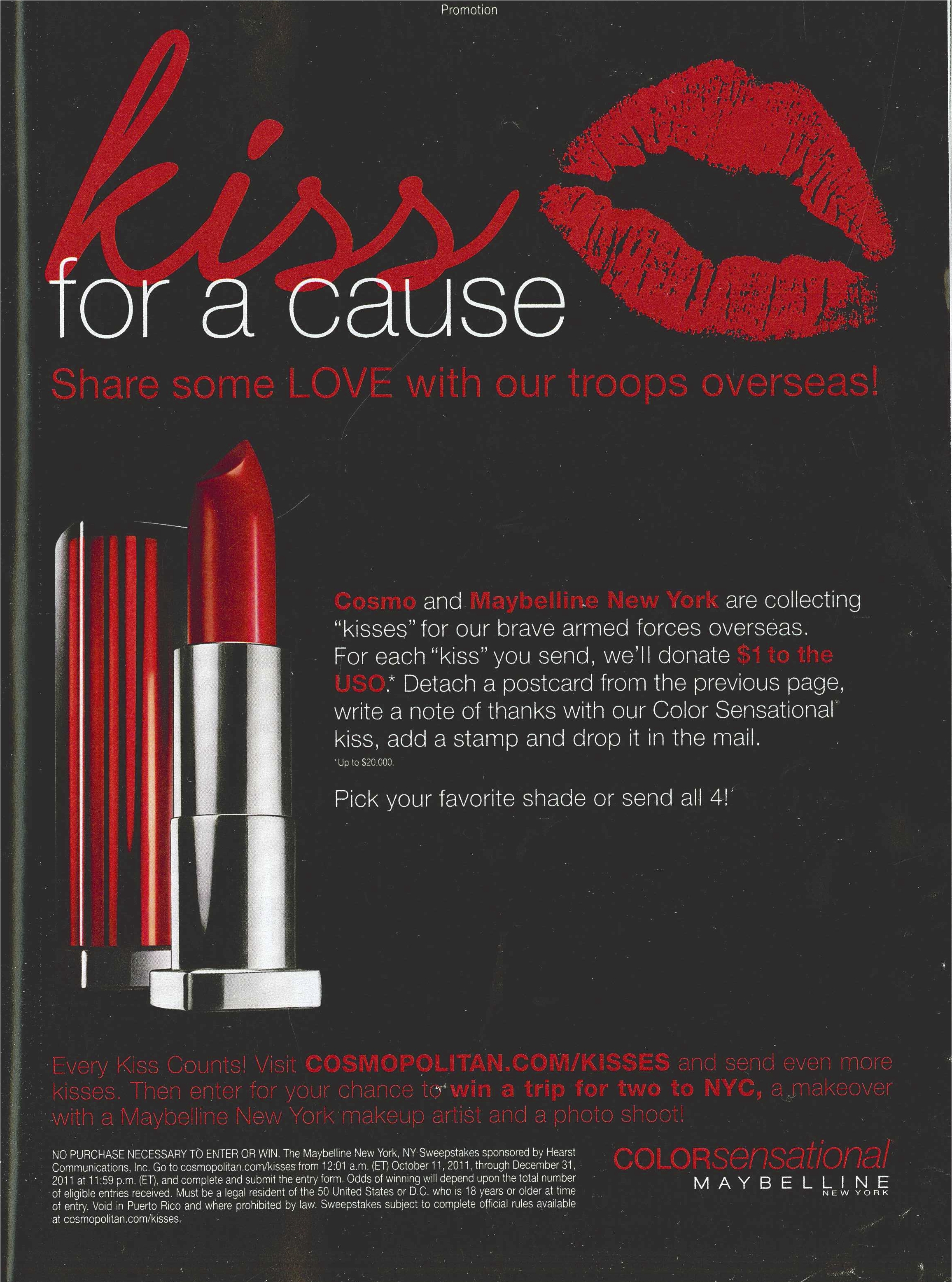
But a student of mine brought me the following ad from the most recent issue of Cosmopolitan:

Main text:

Cosmo and Maybelline New York are collecting ‘kisses’ for our brave armed forces overseas. For each ‘kiss’ you send, we’ll donate $1 to the USO.* Detach a postcard from the previous page, write a note of thanks with our Color Sensational kiss, add a stamp and drop it in the mail. *Up to $20,000

So Maybelline has teamed up with the USO (United Service Organization- a private, non-profit organization) to send support, in the form of “kisses,” and up to $20,000, to the troops overseas.

The assumption here is that armed service members are male and need the support of “kisses” from the homefront—a homefront that is comprised of women. The campaign is also an example of heteronormativity (the often unnoticed ways that heterosexuality is normalized and privileged) because it assumes that (men) serving overseas are heterosexual and will want to receive lipstick kisses from (presumably heterosexual) women. While women service members have been more visible during the wars in Iraq and Afghanistan, this campaign reminds me that war is still largely gendered in a heteronormative fashion. The warfront is still thought of as men’s domain, the homefront women’s domain, and war support relies on heterosexual relationships.


Today cheerleading can be an incredibly athletic and risky sport. Because it is associated with women, though, and serves a sideline function for football and other male-dominated sports, cheerleading is often not considered a sport at all. Less than half of U.S. high school athletic associations define high school cheerleading as a sport and neither the U.S. Education Department or the National Collegiate Athletic Association categorize it as one.

Instead, cheerleading is frequently labeled an “activity,” akin to the chess club.  Accordingly, cheerleading remains unregulated by organizations responsible for ensuring the safety of athletes, leading to rates of injury among cheerleaders higher than even those among American football players.

A similar logic appears to be at play regarding the Lingerie Football League, 12 teams of women that play live tackle football in underwear.  Here are some highlights from a game:

So, here’s the thing.    Last month 16 of the 26 players on the Triumph, a team in Toronto, resigned over safety concerns. From a story at the Toronto Star sent in by Emily M.:

…four players described the ill-fitting hockey helmets and one-size-fits-all shoulder pads designed for young males that they had to wear.

“We would have headaches during practice… They made a hockey helmet a football helmet, and that’s not what it’s for.”

Sprained ankles, concussions and pulled hamstrings were among the injuries sustained by Triumph players in their first game… their team had no medical staff.

One of the players reported that, when they brought their concerns to the coach, he shrugged and said: “You know, it is what it is.”

“You know, it is what it is.”  In other words, “You’re women in underwear. It doesn’t matter what you do, you’re not really playing football.”  Ideology triumphing over reality.

Lisa Wade, PhD is an Associate Professor at Tulane University. She is the author of American Hookup, a book about college sexual culture; a textbook about gender; and a forthcoming introductory text: Terrible Magnificent Sociology. You can follow her on Twitter and Instagram.

Our financial system is dominated by banks considered too big to fail.  And that is a problem for the rest of us.  As Time magazine explains:

“Too big to fail is opposed by the right and the left, though not apparently by the people drafting legislation,” says Simon Johnson, an MIT professor and the author of a recently published book on the subject, 13 Bankers: The Wall Street Takeover and the Next Financial Meltdown. “The current financial-reform bills are effectively a wash on the issue.”

The question is how large banks ought to be allowed to become. When large banks run into trouble, regulators are often unwilling to let them fail, as bank failures can wipe out individual depositors. What’s more, banks often fund their operations by borrowing from other banks. The bigger the bank, the more likely it is to put other banks at risk if it fails. Mass bank failures, especially of big banks, means people can’t get loans. And no loans, no economy.

That’s why the government decided to bail out most of the nation’s largest banks at the height of the financial crisis. And here’s where the problem potentially gets worse. Once bankers understand that the government will bail out their firms when their loans or other financial bets go bad, they are likely to take riskier and riskier bets. That, of course, leads to more potential bank failures — and more taxpayer-funded bailouts.

Not only have attempts at reform largely failed, government regulators have often tried to paper over financial problems by encouraging our dominant banks to swallow smaller, less stable ones, thereby worsening the problem.

So, who are our ”too big to fail” banks and how did they get so big?  Here is a time line that charts the process and highlights the winners.

328240_139434879491415_100002747126914_140493_2014881848_o.jpg

Of course there are answers to this “too big to fail” problem.  One is turning our banks into public utilitiesHere is Yves Smith talking about this solution:


HAPPY November! Here are some highlights from last month…


Advertising Fails, Sociology Wins:

A guest post by Larkin Callaghan about a Skinny Water advertisement telling women to lose weight was re-posted on Jezebel.  Jezebel reports that the ad was pulled by the company thanks to complaints.

Apparently the moronic anti-woman, man-mocking Dr. Pepper campaign was a bust. The Wall Street Journal reports that favorability fell by one-fourth among men and one-half among women after the ad campaign was released.  Hello advertisers! Treat your customers as if they have half a brain!

Miss Representation Documentary:

A documentary featuring SocImages Contributor Caroline Heldman, Miss Representation, premiered this month to great acclaim.  It’s about the relationship between representations of women in the media and political participation.  Watch the trailer or catch this interview on Ellen with Rachel Maddow, who was also in the documentary, along with Lisa Ling, Jane Fonda, Condoleezza Rice, Margaret Cho, Rosario Dawson, Katie Couric, and more.

New Course Guide:

We just added a new Course Guide organizing SocImages material in a way that is helpful to instructors.  This one is on Research Methods. That makes three!

We’d like to offer as many Course Guides as we can, even different takes on the same course.  So, if you’re interested in writing one, please see our Instructors Page. There’s other good stuff for instructors there too.

Best of October:

Our hard-working intern, Norma Morella, collected the stuff ya’ll liked best from last month. Here’s what she found:

Talks:

I had a fantastic time last week visiting Pacific Lutheran University. Tacoma was gorgeous, the students were brilliant, and the faculty were engaging and fun. Tomorrow I’ll be giving a quick talk about Occupy Wall Street on my own campus, Occidental College.  And I’m looking forward to visiting Harvard and the University of Massachusetts, Amherst in the last week of March. I’ll try to have a meet up if anyone would like to get together for drinks in Cambridge!

Links:

Our posts on consumer spendingracist college partiesgender and toilets, and homosexuality in our collective consciousness were linked from or featured at BoingBoing,Bitch, the San Francisco Chronicle, and Andrew Sullivan’s Daily Beast, respectively.  Always great fun when our ideas get out there!

Social Media ‘n’ Stuff:

Finally, this is your monthly reminder that SocImages is on Twitter and Facebook.  Gwen and I and most of the team are also on twitter: