Search results for embed

Cross-posted at Montclair SocioBlog.

Newspapers report facts – thing that actually happened.  They run photos of things that actually happened.  They don’t make stuff up.  But they do choose which facts to report, and they do choose which photos to run.    Usually the two are congruent.

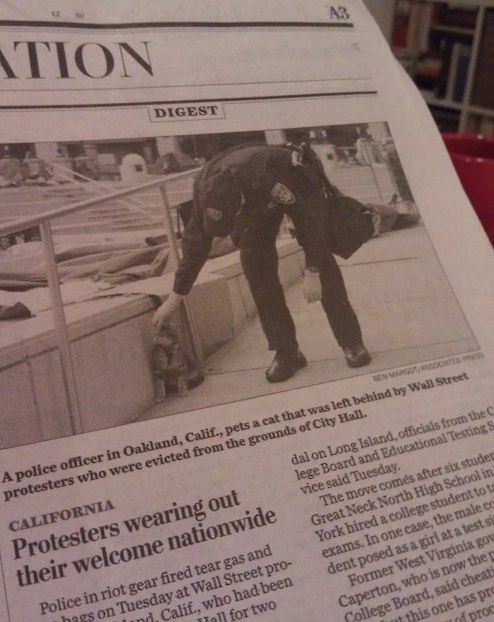
But not always.  Wonkette ran this photo of a page from the Washington Post:


Wonkette and other sites have contrasted the photo with this video of a cop deliberately firing a tear gas canister at close range directly at a group of demonstrators who had come to aid of someone who had been hit in the head with a tear gas canister.

But what’s also noteworthy is the contrast between the photo (nice cop, nice kitty, nothing violent happening here) and the Post’s own lede:   “Police fired tear gas and beanbags. . . .”
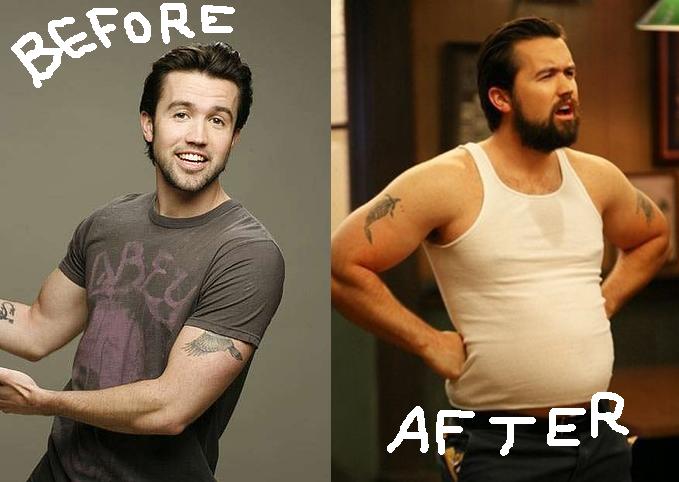
I am a huge fan of the television series It’s Always Sunny in Philadelphia, but I want to problematize some of the humor we often take for granted in the show. In a recent interview with Conan O’Brien, Charlie Day discusses some of the changes introduced into the upcoming season of the show. Specifically, about 1:30 in, they discuss the weight gain that Rob McElhenney (“Fat Mac”) accomplished in pursuit of a “funnier” character (image via):

Notice how Charlie Day and Conan laugh—freely and unapologetically—at the prospect of Mac contracting diabetes (especially Conan’s mocking “Go America!” response to the image of “Fat Mac”):

Continue watching the interview to the 4:45 mark; Conan broaches the topic of mental retardation contained in an earlier episode (Season 3 Episode 9: “Sweet Dee’s Dating a Retarded Person”). You will notice that Charlie Day seems more hesitant and calculated in discussing the topic of mental disability. For one, he uses the word “mental disability” rather than the more pejorative “retarded.” You will also notice less of an audience response, a less raucous reaction to the prospect of someone being mentally disabled than to them being fat.

Mental disability, as a largely ascribed status, serves as a less-viable source of humor. That is, laughing at someone who is born a particular way, or gains that status for reasons beyond their control, violates our precepts of political correctness. However, being overweight is often interpreted as caused by a personal character flaw (laziness, gluttony, etc.) and therefore an achieved status. Laughing at fat people, then, is not only socially acceptable, but often encouraged in American comedy.

This highlights the centrality of individualism and personal responsibility in American society. We hold the obese and the overweight accountable for their corporeal deviations. We tend to believe that those who are overweight (and those who contract Type 2 Diabetes) are responsible for their conditions. It then becomes socially acceptable to mock them. On the flipside, mental disability, as an ascribed status, is more likely to be defined as “off limits” as a source of humor. When it becomes a source of humor, as in this case, comedians must save face by saying things like “Nothing against the mentally disabled, but…” as Charlie does at the 5:25 mark—a form of hedging he didn’t feel obliged to include when laughing at someone’s weight.

Who we can laugh at, and whether we have to apologize for doing so, reveals larger cultural discourses, and analyzing humor allows us to understand some of the prevailing moral assumptions we take for granted.

———-

David Paul Strohecker (@dpsFTW) is getting his PhD from the University of Maryland, College Park. He studies issues of intersectionality, consumption, and popular culture. He is currently doing work on the popularization of tattooing, a project on the revolutionary pedagogy of public sociology, and more theoretical work on zombie films as a vehicle for expressing social and cultural anxieties. He previously wrote for the blog Racism Review and currently blogs at Cyborgology.

If you would like to write a post for Sociological Images, please see our Guidelines for Guest Bloggers.

A while back, Lisa posted a video of clips of Bob Barker harassing women — sorry, “girls,” as he invariably referred to them — on The Price Is Right. Sadly, that video has been yanked from YouTube. But reader Melissa sent in another example of harassment and general creepiness on game shows, this time from the 1980s Canadian show Just Like Mom. Host Fergie Olver seemed to have a running gag of trying to get the young female contestants on the show to kiss him, even trying to sneak kisses after girls had very clearly said no (Note: A couple of readers suggested a warning that the video might be particularly uncomfortable or upsetting for some viewers because of the content):

Aside from the harassment, it’s a great example of changing social norms. Presumably many people may have found the behavior disturbing at the time the show (and others with similar behavior) was on the air, but it was sufficiently acceptable for an adult man to try to force young girls to kiss him that he was allowed to do it repeatedly on air. While harassment and infantilization of adult women is still widespread on reality TV, the increased stigma surrounding pedophilia and moral outrage about sex offenders makes me suspect that a male host forcing kisses on girls week after week today would meet with a significantly more negative response.

(source)

In this post I’m happy to feature two short clips of sociologists at the University of Nevada, Las Vegas talking about the sex industry in Las Vegas.

First, in this two-minute clip, Barb Brents discusses the way that the sex industry in Las Vegas is set up in ways that protect “referral services” (the organizations that arrange for what often includes sex work), while exposing sex workers to policing and criminalization:

Second, Crystal Jackson, takes two minutes to explain that the stereotype of sex workers — women who have sex with men — makes male sex workers invisible and transgender sex workers seem deviant. This has consequences. It means that men in the sex industry are more able to evade the police (who aren’t looking for them), while transgender sex workers are even more likely than women to experience abuse from both the police and clients. This means that patriarchy is an insufficient theory with which to theorize sex work.

Lisa Wade, PhD is an Associate Professor at Tulane University. She is the author of American Hookup, a book about college sexual culture; a textbook about gender; and a forthcoming introductory text: Terrible Magnificent Sociology. You can follow her on Twitter and Instagram.


In The Lucifer Effect: Understanding How Good People Turn Evil, Philip Zimbardo tries to explain how seemingly ordinary, average people can become involved in, or passively fail to oppose, evil acts. Zimbardo is the researcher who designed the (in)famous 1971 Stanford prison experiment,  in which students were randomly assigned as “prisoners” or “guards” for an experiment on how prison affects human behavior. The experiment, meant to last two weeks, had to be called off after 6 days because of the extreme negative effects on, and brutality emerging among, the participants. Zimbardo’s study, as well as others such as Milgram’s obedience experiment, highlighted the role of conformity to social norms and obedience to apparent authority figures in leading people to engage in actions that would seem to be so ethically unacceptable that any decent person would refuse.

Dolores R. sent in a Candid Camera clip from 1962 that illustrates the power of conformity:

As Zimbardo says on his website,

We laugh that these people are manipulated like puppets on invisible strings, but this scenario makes us aware of the number of situations in which we mindlessly follow the dictates of group norms and situational forces.

From Open Culture, via Boing Boing.


A group of conservative research institutes led by W. Bradford Wilcox’s National Marriage Project, with support from the Bradley Foundation, have produced a website called The Sustainable Demographic Dividend. They argue:

…the long-term fortunes of the modern economy rise and fall with the family. The report focuses on the key roles marriage and fertility play in sustaining long-term economic growth, the viability of the welfare state, the size and quality of the workforce, and the profitability of large sectors of the modern economy.

The analysis is not important, mostly focusing on promoting religion and marriage (I wrote more about one of the articles here). But they do make a unique appeal to corporate America:

Companies whose fortunes are linked to the health of the family, such as Procter & Gamble, spend billions of dollars each year on advertising. … Executives with oversight across brands should ask themselves a simple question: Do the messages used in our advertising make family life look attractive? Or do they exalt single living? Obviously, it’s in their long-term interest to do more of the former.

And they offer as a positive example this video from Proctor & Gamble, celebrating the company’s 75th anniversary in the Philippines.

One of the essays in the report says,

A turning point has occurred in the life of the human race. The sustainability of humankind’s oldest institution, the family—the fount of fertility, nurturance, and human capital—is now an open question.

Would more of this kind of advertising help to bring back the traditional family?

In this video the always-fantastic Jay Smooth, of Ill Doctrine, spends just over four minutes offering his perspective on the Occupy Wall Street movement.  He likes it. And, he says, more importantly, the media coverage and treatment of the protests is telling us a lot about who’s in bed with who, politically speaking.

Lisa Wade, PhD is an Associate Professor at Tulane University. She is the author of American Hookup, a book about college sexual culture; a textbook about gender; and a forthcoming introductory text: Terrible Magnificent Sociology. You can follow her on Twitter and Instagram.

I am re-posting this fun counterfactual in honor of October 19th Love Your Body Day. Crossposted at Jezebel.


I was thinking the other day about fashion advice for women with different body types. The advice is almost always aimed at getting women’s bodies, whatever shape they might be, to conform with one ideal body type: the (skinny) hourglass figure. The advice video below, sent in by Tara C. and aimed at women with “pear-shaped” bodies, does exactly this (excerpts and commentary after the clip):

So, the advice, as I mentioned, is all about trying to hide the shape of her actual body and make it appear to be more hourglass. To “transform it into an hourglass,” they say:

  • slim your hips and thighs”
  • “draw attention to the upper part of your body”
  • balance your figure” with shoulder pads
  • “a roomy top will de-emphasize your bottom”
  • offset your hips”
  • “avoid side pockets, they add bulk where you least need it”

I wonder what it would be like to live in a world where the fashion industry encouraged us to “emphasize” our differences from one another, instead of trying to make us all look the same. If you were pear-shaped, for example, the advice would be all about highlighting that awesome booty and tiny waist and shoulders. Work that pear-shape!

If you were broad-shouldered and thin-hipped, the advice could all be aimed at broadening your shoulders (shoulder pads and fancy necklines) and thinning your hips (dark colors and no pockets)! Work that triangle-shape!

If you were apple-shaped, advice would be aimed at looking rounder with even skinner arms and legs. Work that apple-shape!

If you were petite, advice could be aimed at looking smaller; if you were tall, advice could be aimed at looking larger.

If you had short legs, advice would tell you how to elongate your torso; if you had long legs, advice would tell you how to shorten it.

I think this would be a super fun world to live in.

Title slide image from Lemon Drop Clothing.

Lisa Wade, PhD is an Associate Professor at Tulane University. She is the author of American Hookup, a book about college sexual culture; a textbook about gender; and a forthcoming introductory text: Terrible Magnificent Sociology. You can follow her on Twitter and Instagram.