Search results for embed


TLC’s new reality program, Big Sexy, features five self-identified plus-size women who work in the fashion industry as models, stylists, and makeup artists. Their mission is to challenge contemporary bodily aesthetics that privilege the thin body and demonstrate that fat can be sexy.

In an interview for the Huffington Post, one of the featured women, Heather, explains, “You can be whatever size you want to be and work in the fashion industry.” However, as we see in this clip of Tiffany’s meeting with her modeling agent, that is not entirely the case. In the exchange, the agent informs Tiffany that a client wants her to lose weight and that “it’s a waste of time and money if the numbers are not right.” At her present size, Tiffany was dangerously close to exceeding the boundaries of plus-size required of models.

In modeling, an inch here or there does matter. In my research of plus-size modeling, I have witnessed other plus-size models, like Tiffany, face pressures from their agents to alter their bodies. These women, in order to work in fashion, must utilize their bodies as capital and embark on a variety of body projects. If their measurements are not in perfect proportion, some stick padding onto their hips, “chicken cutlets” onto their breasts, and squeeze themselves into a pair of Spanx. If a model loses weight, clients tell her to do whatever it takes to gain the weight back, even if that means binging on fat-laden foods that can wreak havoc on any individual’s body. Failure to do so would mean the end of her career.

Beauty is a social construction, but these women are not the ones in charge of its construction. Plus-size models must conform to an image created by fashion’s tastemakers, i.e., agents and designers. Ultimately, they must mold their bodies to fit an image, instead of being empowered in a way that allows them mold the image to fit their bodies. In this sense, they face the same pressures as thin models to be within a fraction of an inch of a shape predetermined by others to be acceptable.

——————————

Amanda M. Czerniawski is an Assistant Professor of Sociology at Temple University. She specializes in bodies and culture, gender and sexuality, and medical sociology.  Her past research projects involved the development of height and weight tables and the role of plus-size models in constructions of beauty.  Her current research focuses on the contested role of the body in contemporary feminist discourse.

If you would like to write a post for Sociological Images, please see our Guidelines for Guest Bloggers.

Cross-posted at Family Inequality.

In some societies it is expected that newly married couples will move into the husband’s family home.  This is called a “patrilocal system” or a “custom of marriage by which the married couple settles in the husband’s home or community” (OED).  Patrilocality is bad for women’s status: as outsiders in their new homes, they are alone and disconnected from their own families.

Patrilocal China

The patrilocal system in China is one of the foundations of its unique form of patriarchy, embedded in the religious tradition of family ancestor worship — and in the language.

This came up because I was learning the Chinese word for grandmother, which, like other family relationship words, differs according to the lineage in question (maternal grandmother, paternal grandmother, etc.). A common traditional term for maternal grandmother is wài pó, 外婆:

Those two characters separately mean outsider and woman. (If you put a space between them in Google translate, the English translation is “foreign woman.”) For comparison, the common term for paternal grandmother is nǎinai (奶奶), which is the word for “milk” twice.

Words as Gendered Images

I had been working on Chinese Characters for Beginners, and with my recent focus on language for union or marriage types (homogamy and heterogamy for same sex and other sex marriage, respectively), on the one hand, and sexual dimorphismgender, on the other, I was sensitive to my first lesson, in which I learned that the word for good is woman+son (好):

And the word for man is field+strength (田+力=男):

Someone who knows more about languages can say whether or how Chinese reveals more about the cultural contexts of its word origins than English does.

In the one-child-policy era the patrilocal tradition has become especially harmful to women. That’s because the lack of an adequate state pension system has increased the need for poor families to produce a son — a son whose (patrilocal) marriage will bring a caretaking daughter-in-law into the family — and decreased the return on investment for raising a daughter, who probably will leave to care for her husband’s parents. One consequence, amply documented in Mara Hvistendahl’s book Unnatural Selection, has been tens of millions of sex-selective abortions.

So, the next time someone sees a common pattern of gendered behavior, and attributes it to genetics or evolution, I’m going to ask them to first demonstrate that the pattern holds among people who aren’t exposed to any language at all (and raised by parents who haven’t been exposed to language either). Otherwise, the influence of ancient cultures is impossible to scrub from the data.

Cross-posted at Cyborgology.The Human Microphone was created by Occupy Wall Street as a way to get around New York City’s ban on amplified sound in Zuccotti Park. In other words, it is a tool–and a form of non-digital technology–designed to facilitate communication and discussion in large crowds. But like any form of technology, its use isn’t confined to what it was originally created to do.

This is Karl Rove being “mic-checked” while delivering a speech at Johns Hopkins on November 14th. It starts about 1:48 in (be aware, there’s a huge jump in volume at that point).

The evolution of the techniques and technologies used by activists — their “repertoires of contention”, in the words of Charles Tilly — is a feature of any social movement. Clearly that’s happening to the Human Microphone now: what was a tool of communication is now also a tool for directed and targeted protest. Communication is still a huge part of this; it can’t not be, given that one grievance common to many members of the Occupy movement is a perceived lack of “voice” in politics. Communication, in this instance, is protest. And the technology and the protest itself are fundamentally intertwined.

This also stands against the fallacy that technology itself is neutral: in its very design the Human Microphone is imbued with the ideology of its makers — especially given that its components are actual human voices, used with intent and consent. It might be used for any number of things, but it is inseparable from the people who created it and the people who bring it into being every time it’s used.

It will be interesting to see if President Obama and his as-yet undecided GOP opponent find themselves mic-checked on the campaign trail next year.

——————————

Sarah Wanenchak is a PhD student at the University of Maryland, College Park. Her current research focuses on contentious politics and communications technology in a global context. She has also done work on the place of culture in combat and warfare, including the role of video games in modern war and meaning-making. More generally, she has long been interested in narrative and storytelling, and how stories work to shape wider social discourses. She is an occasional blogger at Cyborgology.

If you would like to write a post for Sociological Images, please see our Guidelines for Guest Bloggers.

The author of Soundbitten: The Perils of Media-Centered Political Activism, Tufts University sociology professor Sarah Sobieraj is a reigning expert on media and social movements in the U.S.  In the four minute clip below, she discusses what it is about the Occupy Movement that has led to such favorable coverage. This includes an answer to the now ubiquitous question: “Is their message too broad?”

Clip at MyFoxBoston, via Citings and Sightings.

Lisa Wade, PhD is an Associate Professor at Tulane University. She is the author of American Hookup, a book about college sexual culture; a textbook about gender; and a forthcoming introductory text: Terrible Magnificent Sociology. You can follow her on Twitter and Instagram.

Cross-posted at The Sociological Cinema.

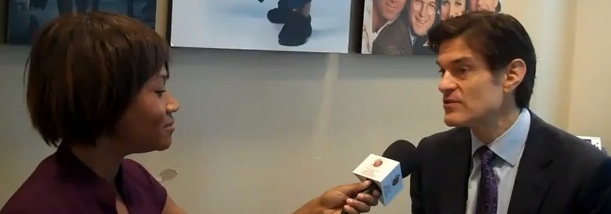
Back in 2007, Dr. Oz stood on the set of The Oprah Winfrey Show and infamously promoted to an audience of 8 million viewers the idea that African Americans experience higher rates of hypertension because of the harsh conditions their ancestors endured on slave ships crossing the Atlantic. This so-called “slave hypothesis” has been roundly criticized for good reason, but I was struck that it was being promoted by such a highly educated medical professional.

The episode got me thinking about the sociologists Omi and Winant’s notion of a racial formation as resulting from historically situated racial projects wherein “racial categories are created, inhabited, transformed, and destroyed” (p. 55-56). These projects take multiple forms but in at least one version, there is an attempt to collapse race—a socially constructed concept—into biology. Such projects are similar insofar as they suggest that the socially constructed distinctiveness between people of different racial categories roughly approximates a meaningful biological distinctiveness. Scientists have been centrally involved in this effort to establish a biological basis for race. In the middle of the 19th century Dr. Samuel Morton attempted to show that average cranial capacities of people from different racial groups were significantly different. Today, many people scoff at the misguided racism of the past, but I think Dr. Oz’s promotion of the slave hypothesis demonstrates that the search for a biological, and therefore “natural,” basis for race continues.

So how do proponents of the slave hypothesis explain hypertension? In 1988 Dr. Clarence Grim first proposed the theory, which is the idea that the enslaved people who survived the Middle Passage were more likely to be carriers of a gene that allowed them to retain salt. Grim argued that this ability to retain salt, while necessary for a person to survive the harsh conditions of a slave ship, would ultimately lead to hypertension as the person aged. Thus Grim proposed that African Americans living in the United States today are the descendants of people who have this selected feature. As I mentioned above, this theory has been soundly refuted but reportedly still remains in many hypertension textbooks. Looking at the clip above, which is from January of this year, it seems that medical professionals like Dr. Oz may be still promoting it.

I think it is important to recognize that this particular racial project persists in many forms, and one final example is from 2005, when the FDA approved BiDil as a customized treatment of heart failure for African Americans. The approval was based on highly criticized research, but the approval also implicitly makes the case that a racial group might be so biologically distinct from others as to warrant its own customized medication. Much like the search for different cranial capacities, the propagation of the slave hypothesis, and the marketing of drugs designed for different racial groups, BiDil’s emergence can be seen as an attempt to deploy racial categories as if they were immutable in nature (see Troy Duster’s article in Science).

Criticizing this racial project is more than an academic exercise. As a social construct, race is already a central principal of social organization, which benefits whites at the expense of other racial groups. It is already a powerful basis upon which privileges are meted out and denied. In my view, the effort to loosen race from its moorings as a social construct and anchor it again as a biological fact of nature is an attempt to fundamentally alter the discussion on racial inequality. If this project prevails and race comes again to reflect a biological truth, then fewer people will acknowledge racial inequality as the result of a human-made history. It will instead be seen as the result of humans being made differently.

———-

Lester Andrist is a Ph.D. candidate at the University of Maryland, College Park, specializing in the role of social capital and personal networks in finding jobs in India and Taiwan and cultural representations of groups in indefinite detention. He is a co-editor of the website The Sociological Cinema.

If you would like to write a post for Sociological Images, please see our Guidelines for Guest Bloggers.

Sociologist Joel Best debunks the idea that “sex bracelets” — bracelets that indicate what type of sex you’re interested in and that oblige you to perform it — are really a thing. He and his colleague, Katherine Bogle, have been tracing the story over time on the internet and across continents in what he calls “the dynamics of rumor and legend.”

Lisa Wade, PhD is an Associate Professor at Tulane University. She is the author of American Hookup, a book about college sexual culture; a textbook about gender; and a forthcoming introductory text: Terrible Magnificent Sociology. You can follow her on Twitter and Instagram.

Two additional cases of a boy being subject to schools rules that don’t apply to girls prompts a re-post. I’ve added the new instances to the end.

Tara C. sent us a link to a story about a 4-year-old boy who has been given in-school suspension (and was threatened with expulsion) for having hair that breaks the dress code for the Dallas, TX, school system:

Dmitriy T.M. sent in another story, this one featuring a 6-year-old named Gareth who was being placed into in-school suspension (i.e., spending all day each day in the principal’s office) because of his long hair and earring.

So, this still you see of him below… that’s what counts as long hair. And, can you spot the earring in his left ear? It’s there.

In another case, 16-year-old Kasey Landrum was suspended for wearing eye-liner on school grounds (after classes were out):

Of course, these aren’t just about enforcing a dress code. It’s a gendered code; girls aren’t required to have short hair cuts, because on girls, longer hair isn’t “distracting,” it’s “normal.”  As is make-up and earrings.  Implicit in the idea of what counts as an appropriate appearance, then, is the gender of the person wearing it.  These cases reveal, further, that girls are allowed more choices than boys because we are more accepting of girls acting boyish than boys acting girlish (in what sociologists call “androcentrism“).

The final case also reveals the importance of intersectionality, or the way that different identities come together in complicated ways. Landrum claims that an ostensibly heterosexual boy was allowed to wear punk-style make-up to school on the same day.  So breaking gender rules is apparently okay if you affirm that you’re heterosexual, and maybe being gay is okay if you don’t break any gender rules, but doing both is going too far.

Arlie Hochschild, in her book The Second Shift, discusses a modern tension in American households resulting from a “stalled gender revolution,” i.e., the fact that women and the social construction of femininity have changed and men and masculinity have not caught up with these changes.  These tensions erupt when assigning responsibilities in the second shift of household labor and childcare, which often fall upon wives’ shoulders.  Traditionally, the dominant construction of masculinity does not allow men to participate in housework, such as laundry, since it is threatening to their sense of masculinity.  In fact, as argued by Julie Brines, the economic model of dependency holds for women but not for men.  Men can essentially trade in their salaries for the domestic labor performed by their wife; however, when women out-earn their husbands, they cannot seem to strike a similar bargain.  In this case, since the man is not fulfilling his traditional role as provider, he essentially refuses to further damage his reputation by engaging in “woman’s work” in the home.

Enter Tide:

In this Tide commercial, we see this threatening element of housework, as the “Dad Mom” tries to justify his laundry proficiency by reasserting his masculinity.  At the end, he confirms that he is still a man as he declares that he will “go do pull ups and crunches,” one would assume in order to build up his manly muscles.  Beyond this direct statement of his attempts to embody masculinity, throughout the commercial, we see three themes — normative heterosexuality, competition among men, and the codification of laundry as feminine — used to excuse his role as homemaker.

He first makes the claim that he is at home “being awesome,” and proceeds to explain how.  He stresses his unique (and alluring) mixture of masculinity and nurturing.  By describing himself in this way for the sake of the “Mom Moms,” he alludes to his heterosexuality, a basic element of hegemonic masculinity, in an attempt to establish some sex appeal.

Second, there is a competitive element to his dialogue as he boasts to other dads about his ability to dress a four-year-old and skills at folding a “frilly dress with complete accuracy.”  By making it a competition, he rationalizes his participation in housework. Boom!

Finally, this “dad mom” uses the “brute strength of dad” in combination with the “nurturing abilities of my laundry detergent” to complete this basis household task.  The task of doing laundry and the detergent, itself, is codified as feminine.  This combination is a “smart” one because this is exactly what women need: more men doing the laundry.

——————————

Amanda M. Czerniawski is an Assistant Professor of Sociology at Temple University. She specializes in bodies and culture, gender and sexuality, and medical sociology.  Her past research projects involved the development of height and weight tables and the role of plus-size models in constructions of beauty.  Her current research focuses on the contested role of the body in contemporary feminist discourse.

If you would like to write a post for Sociological Images, please see our Guidelines for Guest Bloggers.