Search results for embed

Adoption is a complicated system that both builds and separates families, frequently across lines of social privilege.  It involves ideas about who society believes should be parents and under what conditions we believe children should be raised.  And, as adoption becomes more open, it also becomes a lifelong process of constantly redefining family.  Unsurprisingly, most television representations fall short of representing adoption with the nuance it deserves. Many, such as Glee, Parenthood, 16 and Pregnant, and Teen Mom, present problematic portrayals of adoption.

ABC’s Once Upon a Time involves dual plotlines: one story evolving in fairytale-land, the other taking place in Storybrooke, Maine, where fairytale characters are trapped and unaware of their past identities.  While the series’ story arc is extremely complicated, suffice it to say that the main character is a birth mother, Emma, whose son was adopted by Regina.  Regina, is — quite literally — the Evil Queen, poised to do epic battle with Emma.  Regina actively threatens and insults Emma in her attempt to exclude her from their shared son’s life; Emma, who is presented as the hero, blatantly ignores Regina’s wishes and develops a secretive relationship with Henry:

The message is clear: birth and adoptive parents are opposing parties, with a child’s attachment to one serving as a threat to the other.  Representations such as these make open adoption, or any type of cooperative and supportive relationship between the parents, seem like such an oddity, even as it becomes more of the norm within adoption communities.

In the video, Regina presents Emma as an unfit mother who cavalierly “tossed him away,” leaving her to do the hard work of parenting. Her remark, “who knows what you’ve been doing,” further presents Emma as unfit, presumably living a lifestyle that precludes her from any claim as a loving mother.

However, on a more recent episode, Once Upon a Time delved into explored adoption from a bit of a different angle. Emma assisted a character who was being coerced into giving her child up for adoption. Despite the many layers and plot devices, this example is one of very few mainstream media representations of a manipulative adoption.  Ashley is told she can’t parent, that she shouldn’t parent, that her daughter would have a better life if someone else parented her; ultimately, she’s subjected to financial coercion. It’s left up to Emma — herself a birth mother — to convince Ashley that if she wants to parent, she should take control of her own life and do so.

So often adoption is represented purely as a joyful resolution, with a focus on a family being formed.  But the complex realities behind adoption can’t be ignored in favor of only considering the happy ending.  Ann Fessler’s The Girls Who Went Away: The Hidden History of Women Who Surrendered Children for Adoption in the Decades before Roe v. Wade, shows how, before abortion was legal and single motherhood was visible, young, unmarried, pregnant women were subjected to the same manipulation and coercion that Ashley deals with on Once Upon a Time.  And these abuses aren’t just things of the past; even today many young women end up placing children for adoption because they simple can’t navigate through barriers like classism and sexism that set up adoption as a fundamental way to “redeem” herself for the “sin” of being unmarried and pregnant.

More nuanced portrayals of adoption could make viewers questions their presumptions about who birth mothers are, why they make the choices they do, and what their lives look like afterward, as well as how adoption can work.  Once Upon a Time, then, both gives and takes: it allows viewers to more carefully consider the power dynamics behind adoption, while at the same time clinging to old ideas of birth and adoptive parents in opposition.  These are challenges first mothers deal with every day: how do they do the work of openness in a world where their relationship with their child’s adoptive family is still viewed as suspect?  Forming a lifelong relationship with strangers and finding a balance of contact that meets everyone’s needs is complicated enough, without images everywhere portraying openness as, at best, an unnecessary oddity, and, at worst, a threat to the child or adoptive family.

How can birth and adoptive parents form beneficial relationships if we frame their interests as mutually exclusive, and consistently portray them as alternately undermining and being threatened by each other? While Once Upon a Time is far from the careful discussion adoption deserves, it does perhaps move us closer to a world where more productive dialogues around the issue are not a fairytale.

———-

Gretchen Sisson recently completed her doctorate at Boston College, and is currently working as an independent researcher and freelance writer. Her work focuses on the “right” to parenthood: who has it, why some don’t, and how society enforces its ideal of an acceptable pursuit of parenthood. To examine these questions, her qualitative research has examined couples pursuing infertility treatments, teen parents and teen pregnancy prevention frameworks, and parents who have placed (voluntarily or otherwise) infants for adoption.  For December and January, she’ll be writing on social class and inequality in popular culture for Bitch Magazine’s blog.  You can find her on Twitter @gesisson.

If you would like to write a post for Sociological Images, please see our Guidelines for Guest Bloggers.


In the three-minute video below, Kate Pickett talks about why life life expectancy, happiness, and the variable that links them, stress, aren’t strongly related to national income averages within different developed countries.

See more at Equality Trust.

Lisa Wade, PhD is an Associate Professor at Tulane University. She is the author of American Hookup, a book about college sexual culture; a textbook about gender; and a forthcoming introductory text: Terrible Magnificent Sociology. You can follow her on Twitter and Instagram.

It’s that time of year when we savage the world with our unbridled consumerism. If it’s not a Black Friday stampede at Target, it’s a news story of a shopper who camped out in front of a Best Buy for over a week to score some discounted gadgets. Everywhere you turn consumers are whipped into a frenzy, children’s eyes are glazed over as they think of what gifts they’ll open, and romantic partners are stressed over what they will give their loved one to demonstrate the depths of their love.

When consumerism is exaggerated, as it is this time of year, it’s easier to see the cultural scripts and rituals that surround it. These cultural scripts tell us:

  1. How to feel when we come into a lot of money or even just get a good deal
  2. How to act when we receive a gift
  3. And how to impute love from inanimate objects.

1. The Rapturous Consumer Windfall

Next to presentations of sex and bad karaoke there is arguably no other scenario played out on television ad nauseam more than the consumer windfall. Turn on your TV right now, and find an advertisement or game show and you will almost certainly see someone falling to their knees, eyes full of tears, as they praise the gods of capitalism for blessing them.  Bob Barker (er, Drew Carey) play the role of Benny Hinn in this consumer revival smashing their open palms on the foreheads of game show contestants as they exclaim, “The. Price. Is. RIGHT!” (Watch at 0:51):*

Television advertising is a wellspring for this type of consumer exaltation. The best example of this consumer rapture is the @ChristmasChamp campaign from Target. Watch the video below and you tell me; is this woman having a consumer-gasm or what?**

Maybe it’s just me, but this ritualized consumer rapture gives me the heebie geebies.

2. The “Show Us What You Got” Photo

Leaning on the arm of your parent’s love, seat slightly sauced, your aunt turns to you and says lovingly, “oh show me what Santa brought you!” After you halfheartedly motion to the pile of loot on the floor she puts her glass down, grabs the family Polaroid and says, “Let’s take a photo to send to [fill in name of absentee relative].”

If we were to flip through your family photo albums I bet we’d find page after page of people cheesing with their unwrapped gifts held head level. This obligatory photo is the classic post gift exchange cultural script. Somehow a gift is only properly received when there is a photo to document it.

From my point of view, it is strange that we take photos of the things we receive during holidays which are tangible and will be around well after the event. But many of us don’t take photos of the moments with our loved ones that won’t linger and fill up our closets.

3. The Hand Dance of Love

Does he love you? Does your hand show it? The holiday season is a time when many will pop the question and boy do advertisers know it. While the issues surrounding jewelry ads are well documented on this site, I’d like to talk about the hand dance women are socialized to do after their love has been verified by an appropriately large shiny rock. After a woman says “yes,” she walks around with one arm sticking out like a zombie for the next few months doing the hand dance. This cultural script dictates that women flaunt their recently acquired diamond ring and then all women in their surround give their requisite “Oh, that is GORGEOUS!” There is a sad sizing up that goes on here, where women are shamed or praised for the size of ring bestowed upon them.

In Conclusion

Most of these cultural scripts and rituals go unnoticed or at the very least unquestioned. These acts are the mechanisms through which we objectify the social world and alienate ourselves from our loved ones. So this year why not participate in Buy Nothing Day and double down on some quality time with your loved ones.

———————————

* We should acknowledge that sometimes the people who are receiving these windfalls are desperate and totally deserving. I don’t want to shame or cast dispersions on anyone in this situation, but these are exceptions to the rule.

** Forgive me for sexualizing this, but I mean come on, that’s an apt description. While we are at it, this ad is chock full of sociology. We have an “empowered woman” who uses her power to consume; it’s the classic redirection of feminist energies into consumer. This woman, who appears to be the epitome of the middle class, white, privileged consumer, is flexing her muscles, exerting her power, and being aggressive enough to make Betty Friedan blush… ’cept she is using her power to purchase consumer goods from a capitalist system that creates and maintains her oppression. Maybe it’s just me, but I think feminist scholars would have a (justified) objection if I called this “champ” a feminist. I dunno.

Nathan Palmer is a faculty member at Georgia Southern University, editor-in-chief of SociologyInFocus.com, and the founder of SociologySource.com.

Lisa Wade, PhD is an Associate Professor at Tulane University. She is the author of American Hookup, a book about college sexual culture; a textbook about gender; and a forthcoming introductory text: Terrible Magnificent Sociology. You can follow her on Twitter and Instagram.

In Capital, Karl Marx discusses how the products we buy are separated from any recognition of the people who produced them. If I want to buy a TV, I’m unlikely to be involved in any kind of interaction with the people who made it. I don’t see the factory where they worked, I don’t have any idea what the conditions were like, I have no specific idea where it was made, outside of “Made in  _____” written on the box. Instead, I exchange money for the TV at a store that almost certainly had nothing to do with manufacturing the TV; no one at Best Buy or Wal-Mart could tell me any more about the specific conditions of production than what I can figure out from reading the package.

Marx referred to this as commodity fetishism. The social relations embedded in products — the fact that someone made that TV, under particular conditions, making a certain amount of money for their labor while producing profit for their employer — are obscured and workers become invisible. Instead, we focus on how much we pay for it, and which store charges the least. Marx argues that relationships between workers, employers, and consumers are presented to us simply as relationships between things; we exchange paper money (an abstract measure of our labor) for commodities, and we rarely pause to think about how the price of a TV is determined by the worth placed on workers in a particular place at a particular time.

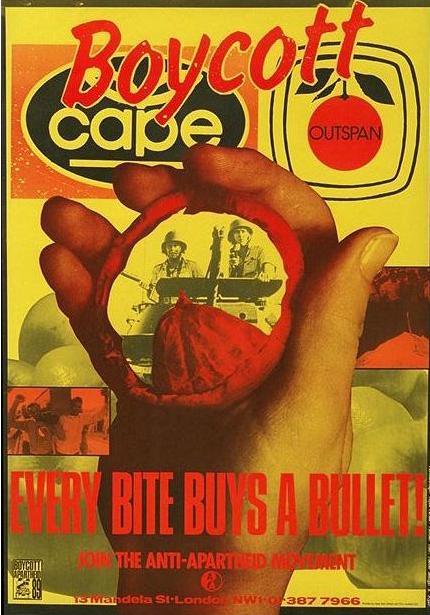
Social activists concerned with working conditions, environmental impacts, and a range of other concerns often push back against commodity fetishism, attempting to make the social relations of production visible to consumers again. Craig Martin of Religion Bulletin provided an example from South Africa’s Apartheid Museum. This poster, produced during the struggle against apartheid, calls for a boycott on South African fruit (UPDATE: A reader found a larger image so you can see more detail; via):

The visual of workers soldiers superimposed on the fruit, with workers and protesters in the background, and the phrase “Every bite buys a bullet!”, remind consumers that items they buy having meaning for the world around them, and that they aren’t just exchanging money at a grocery store in return for that fruit; they are buying into a system of production that provides profits for a racist government, which uses those profits to buy military supplies used to enforce its brutal, unequal racist policies.

As Martin says,

In Capital Marx says that commodity fetishism presents relations between men as relations between things — and this poster is a powerful example of an attempt to demystify commodities and reveal that they are in fact relations between human beings.

Nickey R. sent in a commercial by Blue Cross and Blue Shield of Minnesota that aims to encouraging people to stop putting off exercising, eating healthy, and quitting smoking. The problem with these ads is a simple one. It represents all unhealthy people as overweight… or smokers. It ends by flashing the phrase “for the health of all.”

But while exercise and eating healthy may correlate with being thin (and to what degree this is true is still very much up for debate), there are, in fact, lots of non-thin people who do exercise and eat right and lots of thin people who do not. Being thin is not the same thing as being healthy (as research and real people demonstrate), but these ads say that it is, justifying anti-fat prejudice and miseducating the public.

Lisa Wade, PhD is an Associate Professor at Tulane University. She is the author of American Hookup, a book about college sexual culture; a textbook about gender; and a forthcoming introductory text: Terrible Magnificent Sociology. You can follow her on Twitter and Instagram.

Cross-posted at Love Isn’t Enough.

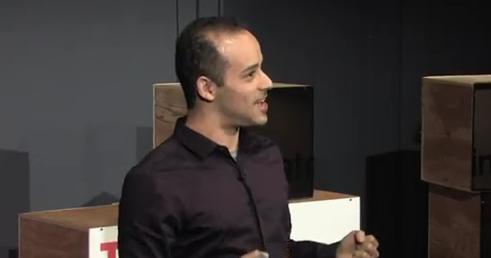
Jay Smooth, of Ill Doctrine, recent gave an excellent Tedx talk at Hampshire College about the difficulties of talking constructively about race and racism in the U.S. These conversations are tricky to navigate because they often devolve from discussions about structural inequalities and the consequences of certain positions or policies to individualistic arguments about whether a specific person is racist. As he points out, this backs people into corners. Because people are extremely defensive at anything they see as an accusation they are racist, there is little room to listen to someone who challenges a comment, and perhaps then acknowledge that a statement was hurtful, or based on incorrect information, or connects to larger cultural discourses and structural inequalities that we might want to examine critically.

It’s a great 11-minute video on how we might try to discuss race, and racism, constructively:

Also see Jay’s video on boundaries in mixed-race communities and Brother Ali talking about White rappers and the “n word.”

We now have evidence that media coverage of the Occupy Movement has increased after each clash with police.  Many of these clashes have resulted in photographs and videos that appear to show police acting violently against peaceful protesters.  To many this is an unjustified use of force by the government, one that makes the state look like the bad guy and the movement look like the good guy.

This very process — media coverage of peaceful activism and violent backlash by the state — contributed to the success of the Civil Rights Movement.  And it couldn’t have happened before TV.

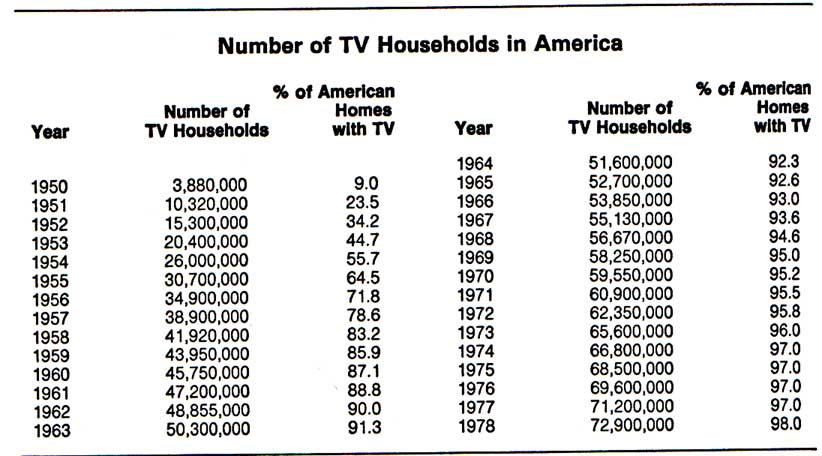
In 1950, only 9% of homes had a TV.  One year later, 24% of homes did.  And by 1963, when Martin Luther King told the world his dream, 91% of America could have tuned in.

(source)

The media frequently covered the protests positively, while the backlash was undeniably horrific.  So Americans sitting at home watching the TV could be simultaneously inspired by the activists and horrified by the establishment.  In the two videos below we see both sides of this coin.  In the first, a newscaster introduces and contextualizes the March on Washington before King begins his famous speech; in the second, we see news footage of a violent police attack on peaceful protesters in Selma, Alabama (trigger warning, also known as “Bloody Sunday”).

Television coverage of King’s speech:

Television coverage of the attack in Selma (trigger warning):

Ultimately, the success of the Civil Rights Movement must be credited to the people who gave their energy, heart, time, and lives to it. The invention of the television, though, and its introduction to so many homes at just the right moment in history, had an interesting role to play as well.

With this history in mind, it seems likely that aggressive responses to peaceful protests will likely raise support for Occupy.  And, with digital cameras, smart phones, youtube, facebook, twitter, and the like… the role of the media may be more important than ever.

Lisa Wade, PhD is an Associate Professor at Tulane University. She is the author of American Hookup, a book about college sexual culture; a textbook about gender; and a forthcoming introductory text: Terrible Magnificent Sociology. You can follow her on Twitter and Instagram.

The image below is an advertisement for Essure, a sterilization procedure for women. It vividly illustrates the heterosexual male gaze in the marketing of birth control: the female observes his leisure experience, while their children play in the background. She sits upright, supporting his head as he lays with his eyes closed. The male’s need to avoid “worrying about unplanned pregnancy”, so he can relax and enjoy a day in the park, takes priority, despite the fact that this procedure permanently modifies the female’s body.


The following video uploaded by Essure offers a more blatant effort to use male perspectives in their marketing:

Using male fears about having their scrotums operated on, the appeal of female sterilization over vasectomies is made clear. “Let’s face it: when it comes to their balls, guys just don’t have any… Essure: because you can only wait so long for him to man up.” While the narrator is addressing potential female consumers, the gaze is again fixed on the (unwanted) male experience of sterilization.  Her experience of the surgical and emotional process of sterilization is erased, meanwhile indulging men’s fears is used as justification for forcing women to take responsibility for birth control.

——————————
Dan Rose is an assistant professor of sociology at Chattanooga State Community College in Tennessee.  His research focuses on medical sociology and health inequalities in minority neighborhoods.
If you would like to write a post for Sociological Images, please see our Guidelines for Guest Bloggers.