Search results for embed

This commercial is good evidence that we still think nothing of being cruel towards people deemed “overweight”:

Via Copyranter.

Lisa Wade, PhD is an Associate Professor at Tulane University. She is the author of American Hookup, a book about college sexual culture; a textbook about gender; and a forthcoming introductory text: Terrible Magnificent Sociology. You can follow her on Twitter and Instagram.

In an earlier post we reviewed research by epidemiologists Richard Wilkinson and Kate Pickett showing that income inequality contributes to a whole host of negative outcomes, including higher rates of mental illness, drug use, obesity, infant death, imprisonment, and interpersonal trust.

In the four-minute video below, Kate Pickett argues that once societies develop the capacity to enable status-based consumption (as opposed to survival-oriented consumption),  status-consciousness among humans exacerbates inequality.  Meanwhile, being status-conscious in a highly unequal society creates stress, and all kinds of other negative outcomes, among those who are judged less-than.

See Dr. Pickett, also, on why raising the average national income in developed countries doesn’t make people happier or enable them to live longer. And see more about income inequality and national well-being at Equality Trust.

Lisa Wade, PhD is an Associate Professor at Tulane University. She is the author of American Hookup, a book about college sexual culture; a textbook about gender; and a forthcoming introductory text: Terrible Magnificent Sociology. You can follow her on Twitter and Instagram.
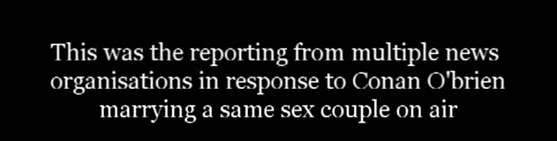
Back in November, Conan O’Brien officiated at the wedding of two gay men on his show. This received a decent bit of media coverage, it being the first time a same-sex couple was married on TV. My friend John McQuiston pointed out a great video showing the intros of many stations’ coverage of the story. John says CBS Newspath released a tease with the phrase “pushing the envelope,” and the phrase stuck. The clip illustrates the way that, despite the many media outlets available to us, norms of news reporting (and, according to John, general laziness) mean that we often hear the same message or framing of issues repeated over and over, reinforcing a particular understanding of events to the exclusion of other interpretations:

As examples of childhood socialization into cultural patterns of interaction, we’ve previously brought you baby preacher, baby worshipper, and two babies mimicking a conversation. Thanks to Shruti S., we now have another awesome example: a 2-year-old, Khaliyl Iloyi of London, who has learned the cadences of rapping:

You’re welcome.

Sara P. sent in a video from The Economist that highlight women’s economic opportunities worldwide. It is based on the results of an economic index ranking of 113 nations, focusing on issues such as workplace policies (for instance, access to paid maternity leave), education, access to the financial system, and the legal and social status of women  in the economy (such as the right to work and social attitudes about women working for pay). The index also attempts to differentiate between official policy and actual practice to provide a better idea of the actual economic environment facing women in each country. The analysis is necessarily limited by the inclusion of only 113 countries (especially for Oceania, where only Australia and New Zealand were included), but it’s a worthwhile watch for a general overview:

You can read the full report here.

According to Federal Parliament member Charlie Angus, leaders of the Attawapiskat First Nation have declared a state of emergency. Living conditions are so terrible on the reserve that members of the community are at significant risk of illness and death.  Many residents have no electricity, heat, or running water.  They are living in uninsulated tents and shacks.  Many of these residences are filled with black mold and prone to quick-spreading fires.  Some use buckets as bathrooms; with no facilities, they dump their sewage into the streets.

Angus writes:

When it comes to the misery, suffering and even the death of First Nations people, the federal and provincial governments have developed a staggering capacity for indifference.

Try to imagine this situation happening in anywhere else in this country. We all remember how the army was sent into Toronto when the mayor felt that citizens were being discomforted by a snowstorm. Compare that massive mobilization of resources with the disregard being shown for the families in Attawapiskat.

The government waited a month to respond, but has now accepted some responsibility for the health and welfare of the residents.  Attawapiskat leaders are now trying to raise awareness of the other First Nation communities in Northern Canada with similar conditions.

Lisa Wade, PhD is an Associate Professor at Tulane University. She is the author of American Hookup, a book about college sexual culture; a textbook about gender; and a forthcoming introductory text: Terrible Magnificent Sociology. You can follow her on Twitter and Instagram.

Cross-posted at Ms.

I thought it would be fun to have a round-up of examples of masculinizing the feminine — that is, attempts to sell items to men through repackaging and renaming, drawing on ridiculous stereotypes of masculinity to assure men that they can use these products without becoming girly.

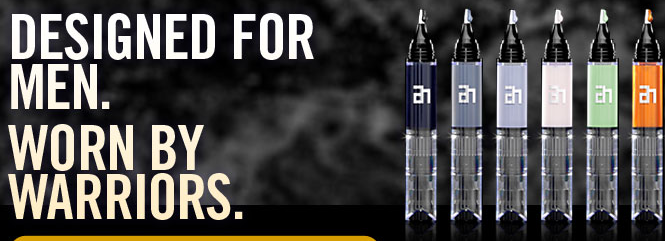
To start off, how might you sell nail polish to men? Call the brand Alphanail and associate the product with sex and warfare, of course, with, as submitter Gabriella says, “women as props and men as warriors”:

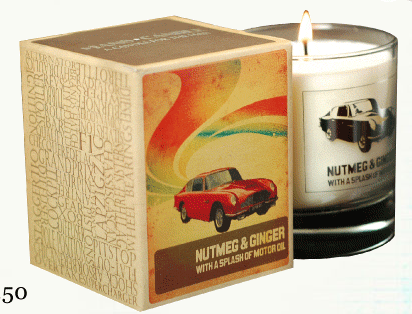
Clémentine C. noticed that Canova, a British company that sells candles, has a line of candles specifically for men, identifiable by the manly images and scents. While the other candles are given names like sweet pea or watermelon, the men’s versions have more detailed names, with allusions to “bringing out the dog in you,” “the sweet smell of success,” and “a splash of motor oil.” The Cassis & Fig with Added Danger candle  includes a silhouette of a woman behind a martini glass, reminiscent of a stripper pole:

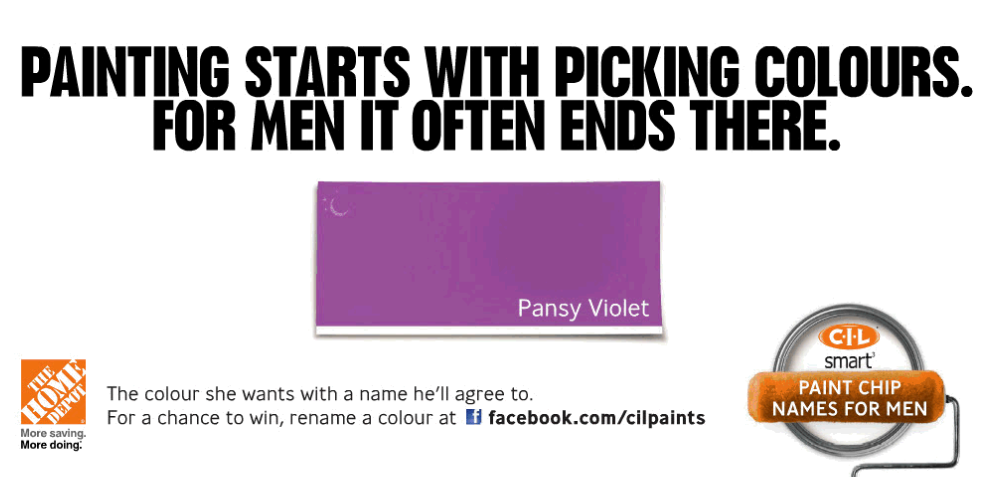
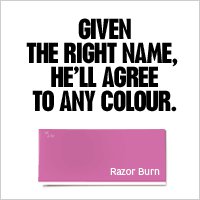
Jennifer W., Kirstie McC., Savannah G., Kristina K., Dmitriy T.M., and Scott C. informed us that CIL Paints, a Canadian company, is trying to masculinize paint colors. The website provides men with a range of colors for their “ultimate man caves.” Scott saw this ad for the line in Toronto’s Metro back in September:

What makes these colors masculine? A simple name change. The website helpfully translates the “real” names of their paints into man-speak:

According to a video created as part of the ad campaign, a quick name change instantaneously changes men’s perceptions, making them compliant with women’s wishes (“The colour she wants with a name he’ll agree to”):

Indeed, the central message is that men are incredibly stupid and easily duped; women just have to manipulate them a bit:

Now we’ve got the house painted; it’s time for some chores! Anjan G. let us know that appliance company Philips designed an iron just for men:

The man-friendly features on this “robust” iron “power tool for ironing,” described on the Philips website as the “Anodilium soleplate man iron,” include “more power, more steam, more performance” to give you “an endless excellent gliding experience.”

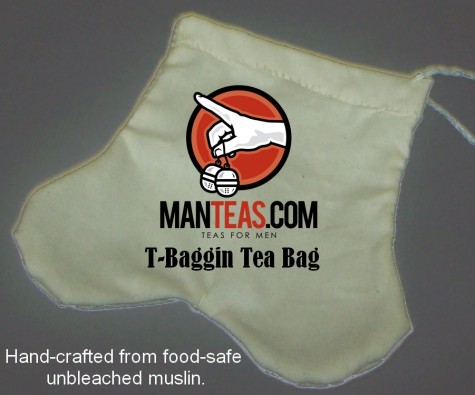
Now, let’s say that you’ve just ironed all your clothes with your ironing power tool, and now you want a little rest. Hmmm, you might think, I’d like a nice warm beverage, but I don’t want to appear girly. Thanks to Elisabeth M., we discovered that Man Teas has an answer for you, with their goal of making tea safe for men:

…most of the specialty teas out there have stuff like rosehips and lemon zest in them (what the hell is “zest” anyway?) and they are packaged and merchandised to appeal to women. What guy is going to pick up a box of Cozy Sleepytime Tea with a pajama’d teddy bear on it? Not this guy.

At least three different varieties of their teas are bacon-flavored. And to make sure every element of your tea-consuming experience is sufficiently manly, you can steep your tea is this manly T-Baggin Tea Bag:

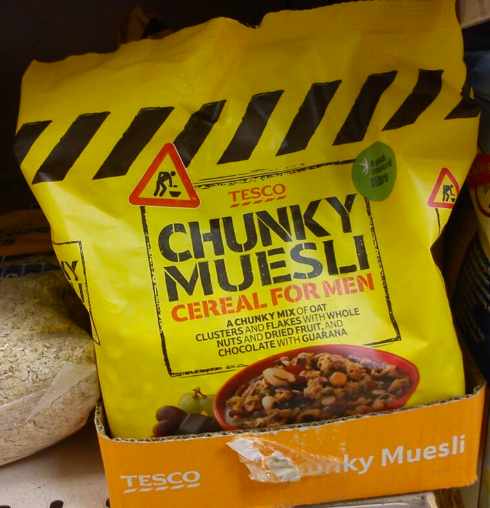
And finally, along with your tea, perhaps you’d like some healthy cereal, but you’re worried that health foods are associated with women. Well, don’t worry; Tesco sells Chunky Muesli, a “cereal for men.” It’s made safe for men with construction-zone packaging:

Thanks to Sophie K. for sending us the photo!

Gwen Sharp is an associate professor of sociology at Nevada State College. You can follow her on Twitter at @gwensharpnv.

Australian sparkling wine manufacturer Yellowglen has been running the Bubbly Girls campaign for about a decade in Australia. The brand’s self-proclaimed goal of the campaign is:

Yellowglen celebrates women everywhere.  We’re proud to be part of the celebration, and as such have asked three women who are living their dreams to be the Yellowglen Bubbly Girls.  Who are they?  They’re bright, beautiful girls who epitomise everything that we love about Australian women.

The marketing campaign actively employs a conflation of femininity and aspirational fantasy. The three women in the video were allegedly chosen because of “…the real life achievements of women and the female spirit.”

No evidence is given of any actual life achievements (i.e., experiences, career developments or highlights). Rather, the featured women talk about their dreams and desires to be famous by way of acting, music, or by spending their life travelling the world. No evidence is provided that they have even pursued these goals yet, let alone achieved anything worthy of note in these pursuits.

The rest of the campaign consists of the women modelling and drinking sparkling wine, sometimes making appearances at “fashionable” events such as the Melbourne Cup (a national Australian event worthy of it’s own post) as part of larger fashion-oriented campaign.

Thus, the campaign appears to re-enforce several patriarchal notions of femininity:

  • The genderization of “‘fun”: femininity, fashion, friends, social attention (and bubbles!).
  • Success is defined by fantasy; lofty and rather unattainable ambitions for careers based on appearances and social attention.
  • Celebration is “a day in the spotlight,” of pamper and attention; not the acknowledgement of tangible outcomes.

Has anyone seen a male-oriented campaign that ‘celebrates’ men in a similar fashion? I’m genuinely curious.

—————————

Nick Green studies Arts (Communications) at Monash University and Economics at University of New England, Australia, with particular interest in social economics. He performs in Heartbreak Club (a group that creates semi-satirical songs about male narcissism), writes about wine and loosely related topics at the Journal of Sparkling Shiraz, and is employed by an Australian media company.

If you would like to write a post for Sociological Images, please see our Guidelines for Guest Bloggers.