Search results for embed


A post for Love Your Body Day.

Krista, Debbie, and Diego sent in the following commercial for FreeScore. It nicely illustrates our bias against men who don’t live up to idealized standards of masculinity.  That is, men who are short, bald, and soft.

Like a bad credit score, men who aren’t young and handsome are a total drag. Klutzy, a potential serial killer, afraid to stand up for himself… his pain is our last laugh.  Disgusting.

Lisa Wade, PhD is an Associate Professor at Tulane University. She is the author of American Hookup, a book about college sexual culture; a textbook about gender; and a forthcoming introductory text: Terrible Magnificent Sociology. You can follow her on Twitter and Instagram.

Back in February I posted about this commercial for Dr. Pepper 10, which was then being introduced to the market:


Dr. Pepper is market-testing a new product, Dr. Pepper 10, which is a 10-calorie (per 12 ounces) soda aimed at men aged 25-34. The problem the company faces is how to market a diet product to men, given the association of dieting with femininity. Dr. Pepper has apparently decided to face this challenge head on and make it very, very clear who this product is and isn’t meant for. This commercial, sent to us by Sully R., uses over-the-top tropes from action movies to prove the soda’s macho cred, and practically yells that it isn’t for women:

Wait, did I say “practically”? I meant literally yells that it’s not for women. Just in case you didn’t get it.

—–

Now, Dr. Pepper is rolling out the product for real. Dave E., Dave W., David B., Rob W., Christopher D., Kathy W., Andrew D., and Emma H. all let us know that the full-scale ad campaign is out, and they are going all-out with the “no women” theme. Here’s the image from the Dr. Pepper 10 Facebook page:

There’s an app on the Facebook page which takes you to lists of requirements for being sufficiently manly; I didn’t go to it, as it required you to allow Dr. Pepper to access all your Facebook info and send you emails, but according to abc News, it includes tidbits like “Thou Shalt Not Pucker Up. Kissy faces are never manly” and “Thou Shalt Not Make a ‘Man-Gagement’ Album. That is all.”

It’s another example of over-the-top ridiculous masculinity presented with a wink and a nod that is supposed to reassure us all that we’re in on the joke, which somehow makes it less absurd that if you want one group of human adults to drink your product, you feel the need to scream from the rooftops that you’re doing your best to prevent another group of human adults from drinking it, so they won’t get symbolic cooties.

UPDATE: Dr. Pepper’s brand index fell among both men and women (but especially women) in the weeks after this campaign was lost.

Cross-posted at Love Isn’t Enough.


This six-minute video, uploaded to youtube by Sanjay Newton, does a wonderful job of explaining and illustrating the portrayal of masculinity in Disney movies.  It’s pretty troubling when laid out so simply.

Via Dr. Danielle Dirk’s blog for her Contemporary Sociological Theory class.

More on Disney: pickaninny slaves in Fantasia? yesthe happiest place on earth?the working poor at Disney worldhow Disney came to Times Squaremedia consolidation and Tinkerbellthe real Johnny Appleseedfallen princessesmodernizing the fairy taleracist Disney charactersinfantilizing adult women, advice for young girls from the little mermaidgendered Disney t-shirts for kidsdeconstructing Disney princesses, Disney makes over Minnie Mouseare the new Disney princesses feminist?, making light of sex slavery at Disneyland, Disney diet food for kidsrace and gender in Princess and the Frogsocializing girls into marriage, and…

…did you know that the very first political tv commercial was made by Disney?  I like Ike!

Lisa Wade, PhD is an Associate Professor at Tulane University. She is the author of American Hookup, a book about college sexual culture; a textbook about gender; and a forthcoming introductory text: Terrible Magnificent Sociology. You can follow her on Twitter and Instagram.

Social justice scholars and activists suspect the recent push by many states to require government issued photo identification at the polls is a de facto strategy to suppress voter turnout amongst the poor.

The work of Symbolic Interactionist Michael Schwalbe helps us understand how prejudices like these institutionalize themselves in our democracy.  Powerful elites always define themselves as intellectually and morally superior to lower class others.   In viewing themselves as the guardians of our republic, these elites view it their personal responsibility to protect our democracy from the undue and corrosive influence of the poor who are implicitly thought unworthy of democratic rights.  For example, elites argue the poor are likely to succumb to what congressional Republican Paul Ryan describes as “the good politics and rotten economics of class warfare.”  By constructing the poor as contaminating our democratic process, restraints on voting are justified and rationalized.

In a satirical critique of a 2006 New York Times editorial about how many other Western democracies have gone to great lengths to maximize voter turnout, comedian Stephen Colbert draws upon the supposed intellectual and moral superiority of the wealthy to explain why America should only encourage the rich to vote “because they must know something, they got all that money.”  Colbert argues that we should keep the disadvantaged from the polls “because the poor don’t have much to offer democracy.”  By revealing the class prejudices many hold about both the wealthy and the poor, Colbert uses satire to reveal the real logic driving changes in how we vote.

————————

Jason Eastman is an Assistant Professor of Sociology at Coastal Carolina University who researches how culture and identity influence social inequalities.

If you would like to write a post for Sociological Images, please see our Guidelines for Guest Bloggers.

Gay men and bisexual men still represent a disproportionate number of HIV cases in the United States (CDC).  In addition, African-American and Latino men are significantly more likely than white men to be diagnosed with HIV and die from AIDS-related illnesses.  Numerous HIV prevention campaigns are thus aimed at these populations.

It’s important to try to reduce the HIV among these populations, but we also need to think critically about how prevention strategies reinforce stigmatization.

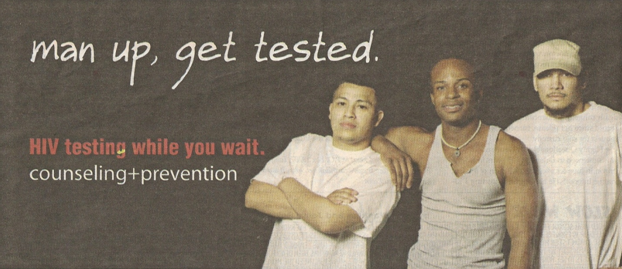
For example, this ad from a western Massachusetts clinic uses the phrase “man up, get tested” — taking care of yourself by getting tested for HIV is linked to your masculinity.  What’s interesting is that by including only men of color in the photo, the ad suggests that black and Latino men are particularly obsessed with their masculinity, more so, perhaps, than white men.  It also potentially reinforces stereotypes about black men as hyper-sexualized and Latino men as machismo.

Second, a New York City campaign released in late 2010 uses fear to reach young gay men who are often thought to be complacent about the consequences of HIV disease now that life-saving medications are widely available in the U.S. and people can live with the virus for decades.  Gay and bisexual men are encouraged to use condoms through a commercial that reminds viewers “it’s never just HIV” by featuring a close-up photo of anal cancer among other (potential) HIV/AIDS related illnesses.  The video was applauded for its frank depiction of risk in the face of public apathy about the dangers of HIV/AIDS while simultaneously condemned for sensationalizing and stigmatizing gay sex:

In the face of stark HIV/AIDS inequalities among gay men and people of color, it’s clear that new prevention strategies are needed.  At the same, however, we also need to think about how we reinforce damaging and stigmatizing ideas about race, gender, and sexuality.

——————————

Christie Barcelos is a doctoral student in Public Health/Community Health Education at the University of Massachusetts Amherst.

If you would like to write a post for Sociological Images, please see our Guidelines for Guest Bloggers.

(source)

Amanda Knox, an American exchange student, was convicted in 2009 of murdering her flatmate, Meredith Kercher.  In 2011, on appeal, her conviction was overturned.

At The Guardian this month, Ian Leslie discusses the way that Knox’s body language and facial expressions were used in arguments as to her guilt.  He quotes jury members, police officers, court watchers, and others making such arguments.  The lead investigator, Edgardo Giobbi, for example, was quoted saying:

We were able to establish guilt by closely observing the suspect’s psychological and behavioural reaction during the interrogation. We don’t need to rely on other kinds of investigation.

A bystander speculated: “Her eyes didn’t seem to show any sadness, and I remember wondering if she could have been involved.”  The head of the murder squad, Monica Napoleoni, discussed the video below, arguing that kissing wasn’t the kind of behavior an innocent person would engage in:

Leslie argues that the tendency to think we can read “someone else’s state of mind simply by looking at them” is a common social psychological tendency.  Describing the work of Emily Pronin, a psychologist at Princeton University, he explains:

…there is a fundamental asymmetry about the way two human beings relate to one another in person. When you meet someone, there are at least two things more prominent in your mind than in theirs – your thoughts, and their face. As a result we tend to judge others on what we see, and ourselves by what we feel. Pronin calls this “the illusion of asymmetric insight.”

Unfounded belief into the insight into others’ minds has been shown to hold experimentally.  Certainty that Knox was guilty, then, may very well have been born of an overconfidence in our ability to read the mental states of others.

Thanks to Matt Vidal for sending the link!

Lisa Wade, PhD is an Associate Professor at Tulane University. She is the author of American Hookup, a book about college sexual culture; a textbook about gender; and a forthcoming introductory text: Terrible Magnificent Sociology. You can follow her on Twitter and Instagram.

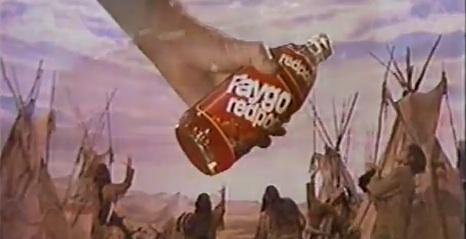
Andrew Francis D. sent in this 1970s commercial for Faygo soda that appropriates elements of Native American culture, presenting them as part of a ridiculous caricature (“Running Pudgy”?):

For other examples, see our posts on the stoic Indian in marketing, advertising with Eskimos, a parody of Native Americans in ads, confusing the Sioux with Robin Hood, Sambazon’s Warrior Up campaign, Levi’s brochure of “American Indian lore,” and appropriating Native cultures in fashion.

An April 2011 Gallup poll found that 29% of Americans thought that the U.S. economy was in a depression.  Another 26% thought it was only a recession.   This is scary since, according to the National Bureau of Economic Research, we have been in an economic expansion since June 2009.

Why would so many Americans feel this way you might ask.  Here is one reason.  According to recent Census Bureau data, during the recession, which lasted from December 2007 to June 2009, inflation-adjusted median household income fell by 3.2%.  Between June 2009 and June 2011, a period of economic expansion, inflation-adjusted median household income fell by 6.7%.   This decline is illustrated in the New York Times chart below.

1010-nat-incomeweb.jpg

I recently appeared on the Alliance for Democracy’s “Populist Dialogue” TV show to talk about our economic crisis and possible responses to it.  You can watch the show here or below.