Search results for embed

Dominant groups have the power to control representations of less-powerful groups.  They exert an out-of-proportion influence on their cultural portrayals.

We’ve previously featured objections to simplistic portrayals of the enormous continent of Africa, especially as a place that is primitive and hopelessly burdened by death, disease, poverty, corruption, and other problems.  Chimamanda Adichie, for example, objects to the “single story of Africa” and Binyavanga Wainaina tell us how not to write about Africa.  Elsewhere, we’ve illustrated how the bustling city of Nairobi is portrayed as a savanna with giraffes and elephants.

An organization called Mama Hope, sent in by Jennifer C., seeks to challenge this perception.  They want the world to think of Africa as a place of hope and possibility.  To this end, Mama Hope is producing videos that “…feature the shared traits that make us all human— the dancing, the singing, the laughter…”  They look like this:

The effort reminds me of the “Smiling Indians” and “More Than That” videos, sent in by Katrin and Anna W.  The first addressed the stereotype of the “stoic Indian,” while the second is designed to counterbalance the common portrayal of reservations as miserable places full of one-dimensional hopeless people (something we are certainly sometimes guilty of).

Smiling Indians:

More Than That…:

These videos are examples of the way that the democratizing power of new technologies (both the internet in general and the relatively easy ability to take video and edit) are offering marginalized peoples an opportunity to contest representations by dominant groups.

Lisa Wade, PhD is an Associate Professor at Tulane University. She is the author of American Hookup, a book about college sexual culture; a textbook about gender; and a forthcoming introductory text: Terrible Magnificent Sociology. You can follow her on Twitter and Instagram.

We’ve had a number of submissions of examples of gendering food, so I thought I’d post a few that illustrate connections between food and masculinity. Edd T. saw this commercial from New Zealand that presents wine as an insufficiently manly drink which all men should reject as a matter of course:

Even beer isn’t without risk, though; a man must choose carefully. Roger B. sent in several Miller Lite commercials that connect masculinity to drinking the right beer. Men in these ads are ridiculed for wearing tight jeans and singing the wrong songs at karaoke:

As Roger points out, “the female bartender is implied to have a masculinity that the man in the commercial doesn’t possess (due to her knowledge of beer and, presumably, her policing of masculinity), and…this is treated as part of the joke (as if a woman possessing more masculine traits were inherently absurd).”

So what can men eat and drink? Well, apparently fried chicken is so masculine it can even compensate for a pink sweater, according to this Australian KFC ad sent in by Katrin:

And anything that includes lots and lots and lots of food is inherently for men. Tyler R. saw a notice for a buffet on a BC Ferries vessel that travels between Victoria and Vancouver, British Columbia. Women apparently need to know about the ingredients and dishes. Men just need to know food is available, in unlimited quantities:


Gwen Sharp is an associate professor of sociology at Nevada State College. You can follow her on Twitter at @gwensharpnv.

Originally posted at In Transit and Racialicious.

I’m still trying to work my way through my discomfort and analyze exactly where my discomfort of this Sociological Images post is coming from, so if this critique seems a bit scattered, it’s because my thoughts about it, at the moment, are that way.

First: I agree with where the post is coming from, in that the disenfranchised rarely ever have a voice of their own in mainstream Western culture, are always portrayed as the Other, which is defined as everything that said mainstream Western culture isn’t (at best as something that props it up and provides an aesthetically pleasing contrast, at worst as something that must be exterminated). And this leads to remarkably similar cycles of dehumanization and disenfranchisement. As so many minority thinkers/activists have noted, manufactured binaries between the privileged West and everyone else, even seemingly positive ones, ultimately end up reinforcing destructive hierarchies.

Where I disagree with the poster is the framing, which I feel makes the post, in some ways, as reductive as what it’s critiquing. Because there are different contexts in which the above cycle/process of exotification occurs, and those contexts matter and shouldn’t be handwaved, even (and I would say especially) if you’re taking the pov of the white outsider and attempting to deconstruct it. Social justice discourse loses its meaning when it becomes divorced from one of power relations.

In this specific example, while making its comparison of India as a magical negro, the post fails to both note and appreciate the following bits of context:

That both the main white actress and the main desi actor in the film are British, with Dev Patel adopting an Indian accent and playing the part of a “native”. That all the featured Indian characters are coded as middle/upper class (the dress, able to speak fluent English, etc) and light skinned. That in many ways this is how India is actively marketed by its tourism sector (and also its government. Did a project once which involved collecting promo material from the Indian consul — I think in Chicago? — and it was quite hilariously illuminating), because they’ve judged that this type of pandering will bring in the tourist dollars.

And this exotification of India in the West has been happening since before the time of Columbus, and reducing said things to a “phenomenon in which a white character in a tv show or movie finds enlightenment…” seems rather glib. (Just because it appears in tvtropes does not mean TV created it!) And that’s not even getting into how most isms seem to inevitably become just like the racism that blacks (had) face(d) in the US.

I also thought it was telling how none of the links elaborating on the “magical negro” trope went to one of the many black writers who’ve done the major work of deconstructing and dissecting it, much less linking to desi writers talking about colonialism and othering.

So what my disagreement boils down to, I think, is this: that this is a discussion about the Othering/exotification of India in mainstream Western culture that succeeds in further marginalizing/disenfranchising desis and other minorities. It doesn’t consider that we might be among the audience for this post (much less making room in the conversation for us, much less acknowledging all the times we’ve already discussed this), and in the way it takes something that rose out of certain contexts, misidentifies said contexts while applying it to different ones with no mention of the consequences of the differences, makes it, again, similar to what it’s aiming to critique.

And it brings home the point that, for all its social justice aims, this is a blog for a specific group of white people, by a specific group of white people, with all the marginalizations that entails.

Another note: it is interesting to read the comments, to see all the places East/West binaries crop up. For example, this comment (which thankfully was critiqued):

So, this is probably why you’ll never find a movie about a Westerner in Latvia trying to find himself- “finding oneself” usually requires immersing oneself in a setting completely different from the everyday humdrum norm.

I do find India humdrum normy, actually. And infrastructure specifically designed to ape the west is increasingly common in cities, and you can always find people in the touristy parts who speak English and cater to Western tastes in a thousand and one ways. (Actually, you won’t need to find them, if you are white they will find you and you will not be able to escape them!) Latvia, I am assuming not so much?

I feel as if the manufactured differences that so many Westerners create for India, while completely missing the deeper and more significant ones, are part of the same binary that Fanon was talking about when he said: “The settler is all that is good and of value. The native is the negation of the settler’s value”. And a lot of the appeal of India, the reason for it not being “everyday humdrum normy”, is that it still gives middle class white Westerners who go there chances to personally experience the colonial British sahib lifestyle.

————————-

Colorblue blogs at In Transit.

Symbolic interactionism, one of the most common theoretical perspectives adopted by sociologists, explains human behavior through the meanings we place on objects or symbols in our environment. These symbols can be material objects, but they can also be words, gestures, actions, events, as well as people and groups. The symbols’ meanings are not innate. They are created and applied through human relations and interactions. In other words, they are socially constructed. Consequently, our behaviors and relationships change as meanings are altered. Some social conflict is the result of different groups defining objects differently.

This extends to human cognition, as a previous post on cultural differences in susceptibility to optical illusions demonstrated.  Another example involves how we hear animal sounds, illustrated in this clip from the television show “Family Guy.” In this segment, we see Stewie playing with a European see and say, a toy designed to teach animal noises. He is frustrated because the animals are said to make sounds that do not ring true to his ear.

For a list of the various sounds animals make in different parts of the world, see this compilation by Derek Abbott at The University of Adelaide.

————————

Deeb Kitchen is an assistant visiting professor at Drake University specializing social movements, the sociology of knowledge and poplar culture. He has done research on higher education, graduate labor unions, and the culture industry.

A while back, we featured a post by Mary Nell Trautner and Erin Hatton about the gap in depictions of men and women on Rolling Stone covers. Their study found that women on the cover are not just sexualized, but are generally hypersexualized, whereas men are generally not sexualized at all, and this gendered trend has grown over time.

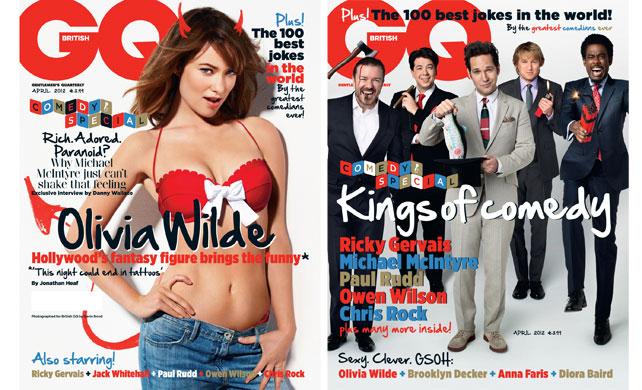
An anonymous reader sent in an example that highlights this pattern. The British version of GQ is putting out a comedy issue in April. The issue has two covers, one featuring actress Olivia Wilde (via):

The fully-dressed men are “kings of comedy,” while Wilde is a “fantasy figure.” Notice also that the cover on the right that the four female comedians at the bottom are introduced as “sexy.” While these women may be funny, it’s clearly essential that they be hot while being funny; comedic skills alone just won’t do.

GQ created a trailer featuring some of the comedians in the issue. The video consists of 17 male comedians. One woman does make it into the video; at 0:14, Wilde jiggles her boobs:

Because apparently none of those female comedians are worth including as representatives of comedy in the same manner as the men, but only in an explicitly sexualized manner.

Edward Bernays (1891-1995) is largely considered the founder of public relations (or “engineering consent,” as he called it) but is not known very well outside of the marketing and advertising fields. A nephew of Sigmund Freud, Bernays was the first to theorize that people could be made to want things they don’t need by appealing to unconscious desires (to be free, to be successful etc.). Bernays, and propaganda theorist Walter Lippman, were members of the U.S. Government’s Committee on Public Information (CPI), which successfully convinced formally isolationist Americans to support entrance into World War I. While propaganda was commonly thought of as a negative way of manipulating the masses that should be avoided, Bernays believed that it was necessary for the functioning of a society, as otherwise people would be overwhelmed with too many choices. In his words:

Modern propaganda is a consistent, enduring effort to create or shape events to influence the relations of the public to an enterprise, idea or group.

[Source: Bernays, Propaganda, 1928, p. 52; available here.]

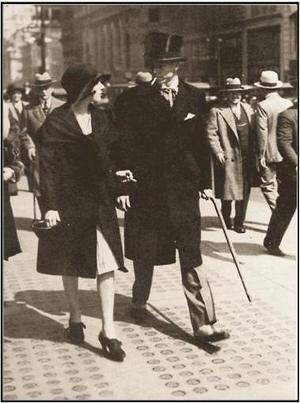
After WWI, Bernays was hired by the American Tobacco Company to encourage women to start smoking. While men smoked cigarettes, it was not publicly acceptable for women to smoke. Bernays staged a dramatic public display of women smoking during the Easter Day Parade in New York City. He then told the press to expect that women suffragists would light up “torches of freedom” during the parade to show they were equal to men. Like the “You’ve come a long way, baby” ads, this campaign commodified women’s progress and desire to be considered equal to men (relevant clip starts at 3:00):

“Cigarettes were a symbol of the penis and of male sexual power…Women would smoke because it was then that they’d have their own penises.”

Here are some of the news photographs of women smoking publicly during the Easter Parade:

[Photos via.]

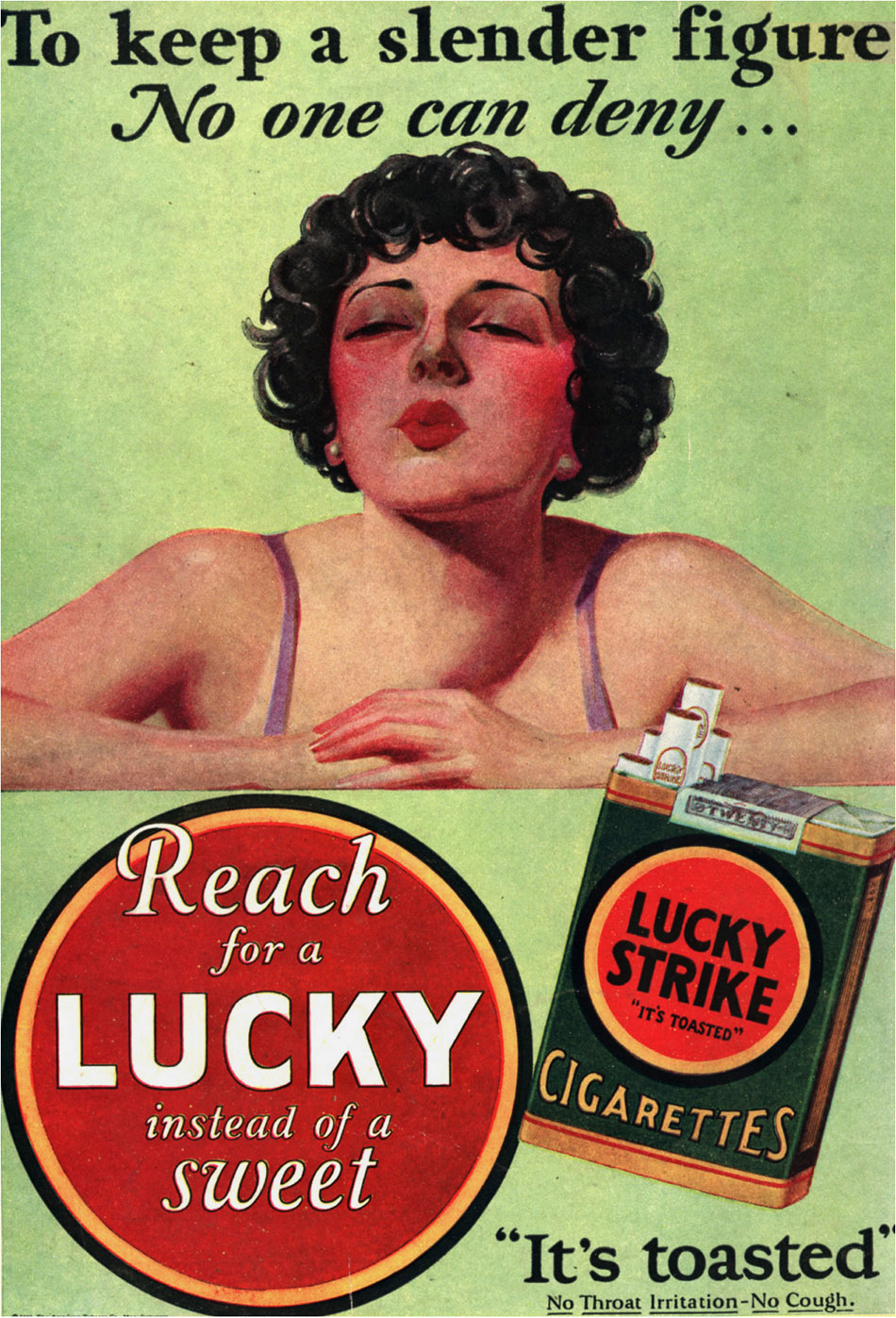
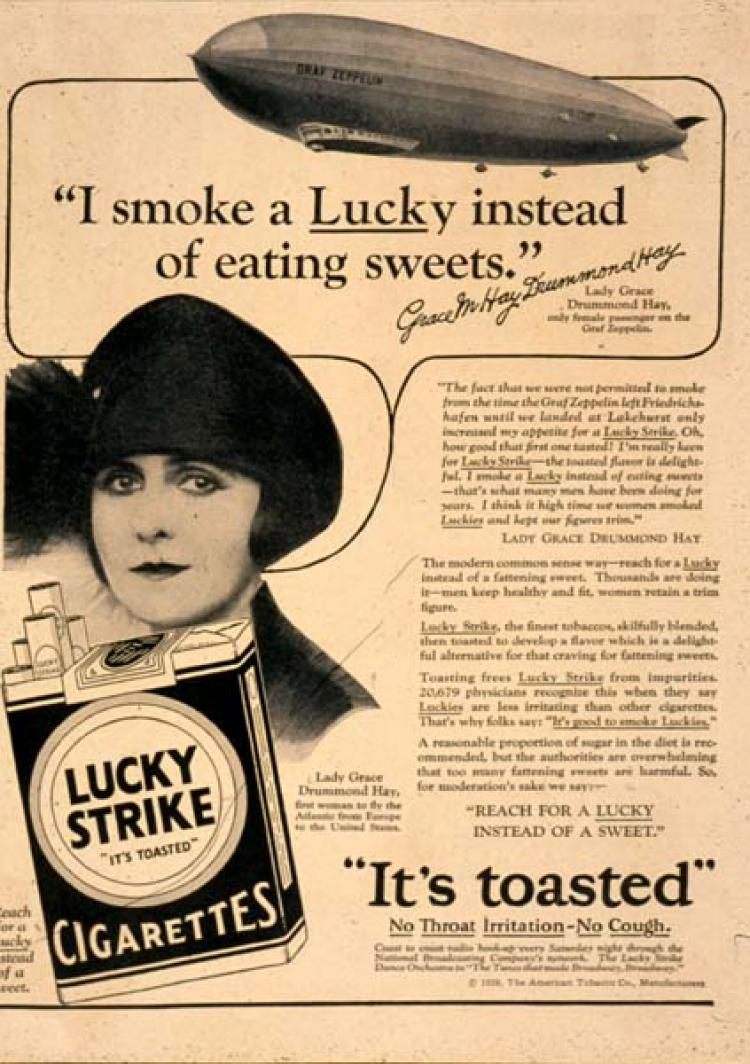
The campaign was considered successful as sales to women increased afterward. Cigarette companies followed Bernays’s lead and created ad campaigns that targeted women. Lucky Brand Cigarettes capitalized on recent fashions for skinny women by telling women to “Reach for a Lucky instead of a sweet”:

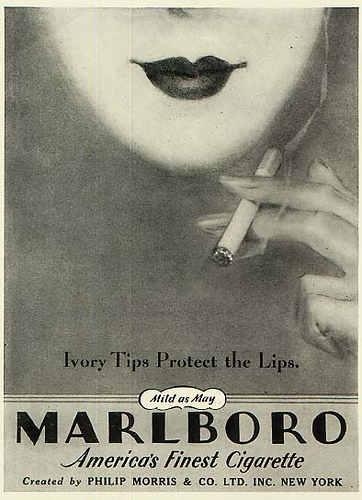
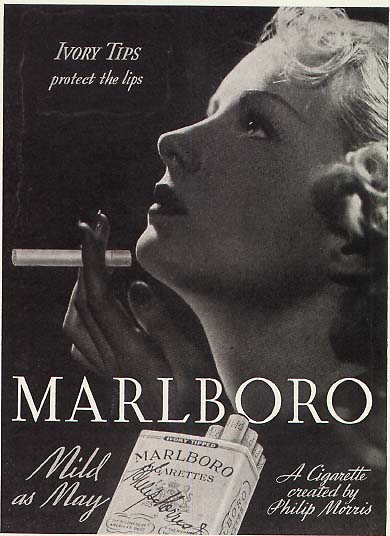
Marlboro, in stark contrast to the Marlboro Man ads we’re familiar with today, started the “Mild as May” campaign to encourage women to take up smoking cigarettes that were appropriately mild and easier to smoke:


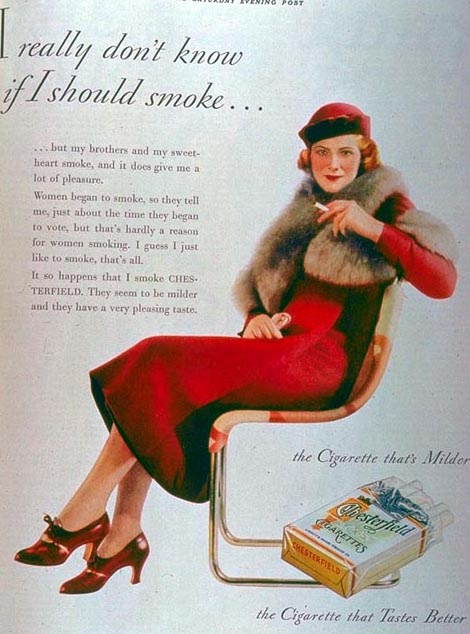
Chesterfield, in a 1930s ad, argued that “women started to smoke…just about the time they began to vote”:

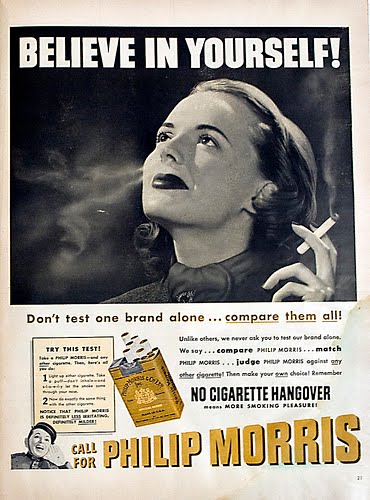
A later ad for Phillip Morris tells women to “Believe in yourself!”

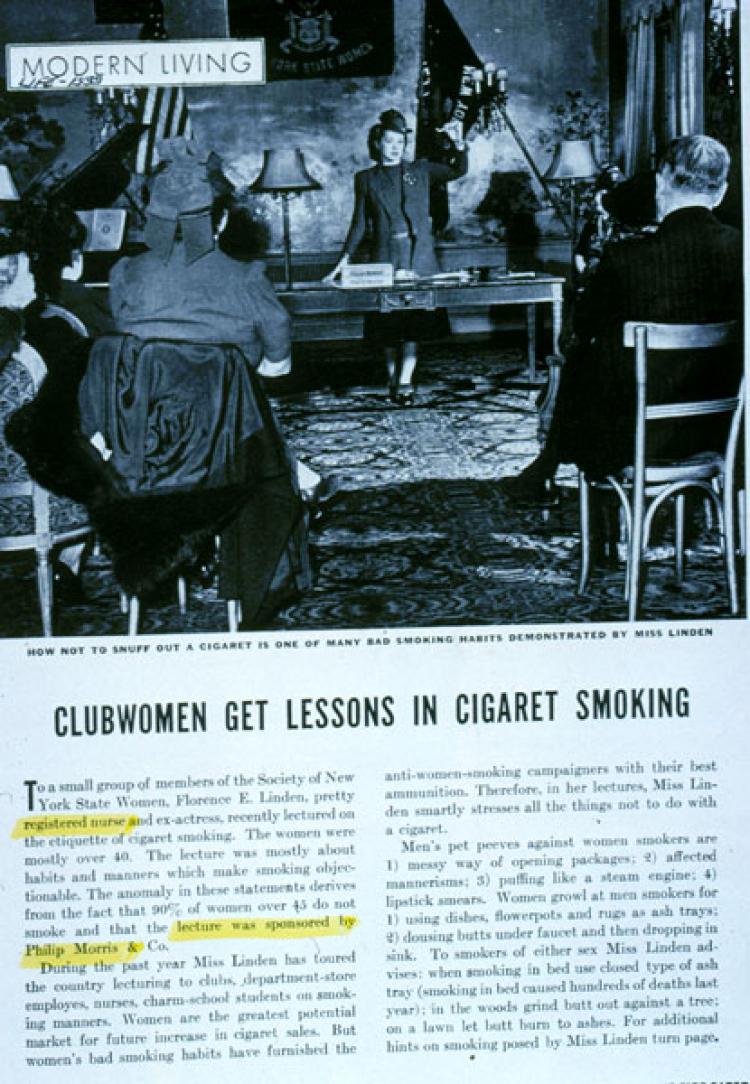
Cigarette makers also worked to teach women how to smoke properly. Ads often depicted women in the act of smoking. Some companies, like Philip Morris, even held smoking demonstrations for women:
[Via.]

The article describes how a “pretty registered nurse” is touring the country to teach women proper smoking etiquette. The article also lists “men’s pet peeves” and “women’s pet peeves” for men and women smokers. (Full text after the jump below.)

Together, these efforts to conflate smoking with freedom and make smoking acceptable for women created a new set of consumers and reinforced Bernays’s argument that demand could be created.

more...

In his book, Great American City, sociologist Robert Sampson argues that, while the effects of macro factors like poverty and political neglect on individual lives are well-documented, other local mechanisms matter too.  It’s important, then, to think about the constitution of neighborhoods.

Along these lines, he argues, even if a community is economically- and socially-marginalized, an existing neighborhood organizations can make a big difference.  He takes natural disasters as a case study.  A neighborhood organization can spread the news of an impending disaster, establish leadership, and organize assistance before, during, and after a crisis.  In this way, Sampson brings together micro, meso, and macro forces shaping the impact of disaster.

Lisa Wade, PhD is an Associate Professor at Tulane University. She is the author of American Hookup, a book about college sexual culture; a textbook about gender; and a forthcoming introductory text: Terrible Magnificent Sociology. You can follow her on Twitter and Instagram.

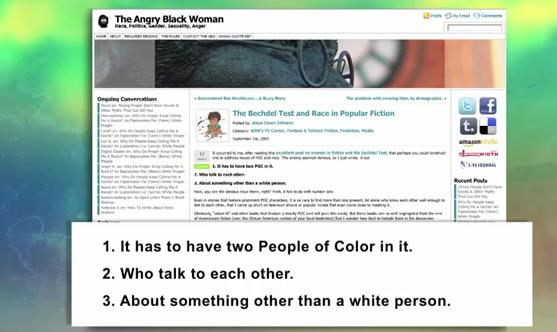
Yesterday I posted the results of an L.A. Times study on the demographics of the Academy voters who decide who receives Oscars. What about the movies they’ll be voting on this year? The always-awesome Anita Sarkeesian, of Feminist Frequency, produced a short video applying the Bechdel test — the simple measure of even minimal representation of women in film — to the 2012 Oscar nominees, as well as a racial version of the Bechdel test that looks at how non-Whites are included. The results are not encouraging: