Search results for embed

This photograph is of the Love Canal neighborhood in Niagara Falls, New York, where Hooker Chemical (now Occidental Petroleum Corporation) buried 21,000 tons of toxic, chemical waste:

In 1953, Hooker Chemical sold the land that they had been using for toxic waste disposal to the Niagara Falls School Board for $1. The sale deed contained warnings about the chemical waste and a disclaimer of liability. However, planners hastily built schools and homes on the contaminated land to accommodate the city’s growing postwar population. By the late 1970s, residents were reporting a litany of illnesses and birth defects. Scientists discovered high levels of carcinogens in the soil, groundwater, and air. The community mobilized to bring attention to the situation, and President Carter declared a federal health emergency in the area.
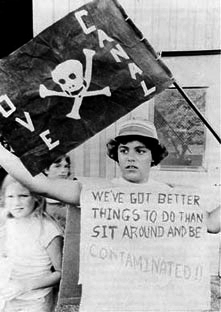
Elizabeth Blum, a professor of history at Troy University, has written about the environmental activism of Love Canal residents. Such activism, called “popular epidemiology,” attempts to link spikes in localized health issues to their origins. Despite such grassroots movements, though, the media tends to show little interest in the causes of cancer and greater interest in finding the cure.

The many “Stand Up to Cancer” ads, for example, urge people to donate money (or just use their credit card for purchases) to help fund the development of cancer treatments:

When media attention is focused on the causes of cancer, it usually takes an individualistic tone. Risk factors (smoking, poor diet, etc.) are blamed for various forms of cancer.

The thing is: there’s no money in prevention.

Mainstream media outlets have a vested interest in not exposing the causes of cancer.  The companies that pay to advertise on their channels, and often their parent companies or subsidiaries, often traffic in known carcinogens. Pharmaceutical companies, likewise, have a perverse incentive. Healthy people make them no money, neither do dead people; sick people though, they’re a goldmine.  Many organizations, including the multi-million dollar Susan G. Komen Foundation, are in the business of raising money “for the cure,” more so than prevention.

The politics of cancer, then suffer from the individualism characteristic of modern American and capitalist imperatives, leaving the causes of the cancer epidemic invisible and, accordingly, the unethical and illegal behavior of companies like Hooker Chemical.

Dan Rose is an assistant professor of sociology at Chattanooga State Community College in Tennessee.  His research focuses on medical sociology and health inequalities in minority neighborhoods.

Lisa Wade, PhD is an Associate Professor at Tulane University. She is the author of American Hookup, a book about college sexual culture; a textbook about gender; and a forthcoming introductory text: Terrible Magnificent Sociology. You can follow her on Twitter and Instagram.

In 1964, in Jacobellis v. Ohio, a case regarding an allegedly obscene film, Supreme Court Justice Stewart Potter Stewart famously wrote in his opinion,

I shall not today attempt further to define the kinds of material I understand to be embraced within that shorthand description [of hard-core pornography]…But I know it when I see it…

Of course, the problem is that not everyone has the same reaction to what they see. While the 1964 case specifically dealt with a film, and a judgment on whether it crossed the line from pornographic (legal) to obscene (not), similar arguments are common regarding what is appropriate on TV. The Federal Communications Commission may impose penalties, including large fines or revoking a broadcaster’s license, on networks that air “indecent or profane programming during certain hours.” Last month the Supreme Court agreed to hear a case regarding the FCC’s regulations and whether they violate free speech guarantees.

Dmitriy T.M. sent in a segment from The Daily Show that highlights some of the inconsistencies and contradictions in the FCC’s standards for prime time, and the seeming arbitrariness of decisions about what is “indecent”:

Marketers are happy to respond to and create insecurities.  Here’s one we haven’t covered before, shoes and inserts for men that covertly increase their height:

Borrowed from The Social Complex, a heightism blog. See also guest posts from The Social Complex introducing the concept of heightism as a gendered prejudice and discussing heightism (and other icky stuff) at Hooters.

Lisa Wade, PhD is an Associate Professor at Tulane University. She is the author of American Hookup, a book about college sexual culture; a textbook about gender; and a forthcoming introductory text: Terrible Magnificent Sociology. You can follow her on Twitter and Instagram.

One thing I love about sociology is the way it recognizes human creativity.  It acknowledges our ability to create meaning and invent practices.  Seeing the footage below, I couldn’t help but be amazed at the human ability to constantly innovate.

Via BoingBoing.

Lisa Wade, PhD is an Associate Professor at Tulane University. She is the author of American Hookup, a book about college sexual culture; a textbook about gender; and a forthcoming introductory text: Terrible Magnificent Sociology. You can follow her on Twitter and Instagram.

During half time of the 2012 Super Bowl, a commercial aired that represents a direct attack against unions and serves as an excellent demonstration of the use of ideology to promote false consciousness. The supposed union workers in the ad complain about unions taking such high union dues and state that they did not vote for the union, suggesting that they don’t want the union and that it does not represent their interests. The commercial’s narrator says “only 10% of people in unions today actually voted to join the union” and encourages people to support the Employee Rights Act, a bill that would make it much harder for workers to join unions and easier to de-certify existing ones (click here if the video isn’t embedding correctly):

The commercial was created by the anti-union Center for Union Facts, an astroturf organization founded by DC lobbyist Richard Berman and supported by big business interests. Astroturf organizations are advocacy groups promoting a political or corporate agenda but designed to make it appear like a grassroots movement. Note that one of the union “actors” in the video is played by Berman himself. These photos show Berman as he appears in the ad and in his normal attire as an anti-union lobbyist:

[Via Republic Report.]

Federal law requires that at least 50% of a company’s workforce vote in favor of the formation of a union, and most union members join unions formed years before, so it’s not surprising that many workers today weren’t involved in the votes that founded their unions. Furthermore, according to independent analysis by the Economic Policy Institute, laws like the Employee Rights Act hurt workers by leading to lower pensions; workers in unions actually have higher wages and health benefits because they can use their collective bargaining power to improve their working conditions.

In The German Ideology, Karl Marx argued that “The ideas of the ruling class are in every epoch the ruling ideas … The class which has the means of material production at its disposal, has control at the same time over the means of mental production.”  This ad demonstrates the use of ideology, or dominant ideas that help to perpetuate inequality. An advertisement (which cost about $3.5 million to air during the Super Bowl) produced by a large corporate-funded organization is meant to shape workers’ perception of unions in a negative light. With greater wealth (“the means of production”) and access to media (“the means of mental production”), they seek to discourage workers from joining unions, or even to leave those they are already members of, in hopes of making them easier to control. Ultimately, the goal is to convince workers to accept the ideology of the ruling class and act against their own class interests.

—————

Paul Dean is a PhD candidate in sociology at the University of Maryland. His research focuses on social inequality, including his dissertation which examines social responsibility movements that promote more socially responsible and sustainable business practices. He is also co-founder and co-editor of The Sociological Cinema.


By now, you’ve undoubtedly seen multiple examples of before-and-after photos that illustrated how re-touching is used to help celebrities and models meet those unrealistic beauty standards we see in the media (see our posts on Katy Perry, a parody Photoshop ad, pre-retouched Playboy pics (NSFW!), Jessica Alba, and Demi Moore and Kim Kardashian). Dolores R. sent in a video of a man emphasizing the other side of the equation — that is, how the “before” body in supplement ads can be manipulated to make the apparent transformation especially dramatic:

For the full collection, see our Re-Touching/Photoshop Pinterest board (NSFW).

Gwen Sharp is an associate professor of sociology at Nevada State College. You can follow her on Twitter at @gwensharpnv.

This is the official SocImages Election 2012 Sexism Watch.  We add content, as it arises, in reverse chronological order.

—————————

#9 Bachmann Pours Away Presidential Bid

How did we miss this one? Representative Michele Bachmann performed the comically gendered role of pouring water for all of the (male) Republican candidates and the (male) host at the start of the Republican Family Forum debate in Iowa this past November.

Some of the candidates seemed uncomfortable at this puzzling behavior, and the host joked, “I want to begin by thanking Representative Bachmann for taking care of the water for today’s event.” It’s possible that Bachmann only intended to pour water for the person sitting next to her, but was put on the spot when the host assumed she would pour water for everyone.

This event was hosted by CitizenLink, the political action arm of the uber-conservative Christian organization, Focus on the Family. CitizenLink describes itself as a “family advocacy organization that inspires men and women to live out biblical citizenship that transforms culture.” They promote traditional families as the “building block of society,” so it’s possible that Bachmann was strategically catering to an audience that is less supportive of women in “unconventional” roles.

Whether intentional or unintentional, Bachmann’s actions highlight the contradiction between traditional gender roles and conceptions of leadership.  And the lack of media focus on this incident illustrates how unremarkable it is for a woman to be in a service role in the company of men.  If Governor Rick Perry had gone around the table and dutifully poured water for all of the Republican primary contenders, it would have made the front page.

More Election 2012 Sexism Watch after the jump!

more...

I’ve been incredibly lucky to have the pleasure of giving public lectures on hook up culture at several colleges and universities.  I draw on my research in these talks, but I also always give a shout out to Paula England, a sociologist who has collected tens of thousands of surveys from students at dozens of schools.   My talk would be a shadow of itself if I couldn’t draw on her excellent work.  Accordingly, I’m pleased to be able to feature England giving a presentation about what she has discovered about hook up culture.  I suspect that you’ll be surprised, no matter who you are:

For more on hook up culture, see my 3-minute appearance on MTV Canada or my 40-minute talk at Franklin & Marshall College (slideshow and transcript if you’d rather read).

Lisa Wade, PhD is an Associate Professor at Tulane University. She is the author of American Hookup, a book about college sexual culture; a textbook about gender; and a forthcoming introductory text: Terrible Magnificent Sociology. You can follow her on Twitter and Instagram.