Search results for embed

U.S. Senator Susan Collins (R, Maine) and Representative Carolyn Maloney (D, New York) have both gone on record claiming that having more women employed in the Secret Service would prevent scandals like the one involving Colombian prostitutes.

In classic Daily Show form, Jon Stewart and his “correspondents” respond (thanks to Dmitriy T.M. for the link!):

Lisa Wade, PhD is an Associate Professor at Tulane University. She is the author of American Hookup, a book about college sexual culture; a textbook about gender; and a forthcoming introductory text: Terrible Magnificent Sociology. You can follow her on Twitter and Instagram.

Cross-posted at Brad’s Blog.

Here are a few commercials for the new MilkBite™ from Kraft. They play on stereotypes about mixed-race individuals.

[youtube]https://youtu.be/ffkDRynWAMw[/youtube]

Here is a transcription:

You didn’t think, did you? You, uh, didn’t think what life was going to be like for me — mom, dad — for your son.

In another commercial, the characters have the following conversation:

I just have a question. Your profile said you were milk.
Uh huh, yep, I am.
You just look like granola.
Granola, yeah, I know. I get that a lot. This was a mistake.
No, wait. Please don’t go. I’m kinda into it.

There are other spots on Kraft’s YouTube page, most playing on these same themes. The problem with a marketing campaign like this is that it trivializes the experience of people with multiple racial/ethnic identities who are still often met with derision and confusion. The first ad above perpetuates the self-fulfilling prophecy about “confused” identities. As a child, I remember family members telling me that they didn’t have a problem with interracial couples but worried about how others might react to their children.

In my classroom earlier this year, a young white woman expressed overt anger when I told the class that the 2010 2000 Census, for the first time, allowed individuals to check more than one racial category. “How can they do that?!!” she demanded to know. Living in a country with a president who had a black father and an white mother complicates all of this. Beyond the standard “post-racial America” narrative, Pres. Obama’s racial identity — even though he identifies only as black — means that people feel entitled to be dismissive of the problems that come with our increasingly complex constructions of race.

Anita Sarkeesian at Feminist Frequency points out that the marketers are likely fully aware of the inappropriate nature of these types of campaigns, and in fact, that is precisely why they launch them. They are seen as ironic, over-the-top, cynical, and tongue-in-cheek. It’s “they know that I know that they know” that it’s racist. It’s a virtual “wink and a nod.” Lisa Wade at SocImages points out that it’s a “no-one-will-ever-believe-we’re-serious” mindset. Sadly, not all people are in on the joke and will find their bigotry and ignorance reinforced, but the rest of us should know better than to perpetuate racism, even under the guise of humor.

————————

Bradley Koch is a sociologist at Georgia College. He is currently the co-director of the study abroad program based in Athens, Greece.  His research interests include religion, sexuality, higher education, and teaching and learning. In his free time, Brad enjoys making music and riding his road bike around rural Georgia.

A resolution to the matter described below was announced yesterday.  In order to preserve the religious memorial without violating the separation of church and state, the Park Service has agree to give the land it sits on to two private citizens who take care of the monument.  Problem solved?

———————

The Supreme Court is in the process of deciding whether a cross erected 75 years ago as a memorial to war veterans violates the constitutional separation between church and state. The cross sits on the Mojave National Preserve and, therefore, is on public land. After lower court rulings, the cross was covered in plywood.

In deliberations, Justice Scalia tried to argue that the cross is a neutral and universal symbol. He said:

It’s erected as a war memorial. I assume it is erected in honor of all of the war dead… What would you have them erect?… Some conglomerate of a cross, a Star of David, and you know, a Muslim half moon and star?

Faced with an argument that the cross is distinctly Christian, he said:

I don’t think you can leap from that to the conclusion that the only war dead that that cross honors are the Christian war dead. I think that’s an outrageous conclusion.

Scalia’s comments reveal a common phenonemon that we’ve discussed in terms of race and gender, but not yet religion.  As Jay Livingston pointed out at MontClair SocioBlog, one can only think of Christian symbols as non-specific if one thinks of Christianity as somehow normal, neutral, and for everyone.  In the U.S., because Christianity is the dominant religion, many people simply see it as default.  You’re Christian unless you’re something else.  Something else that marks you as different and specific, Christianity does not.

This is one way that dominance works.  It makes itself invisible.

UPDATE! Dmitriy T.M. pointed out that Steven Colbert addressed this issue on The Colbert Report back in 2009:

See our other posts on how whiteness and maleness are the characteristics we attribute to “person,” unless there are reasons to do otherwise, herehere, here, and here.

Lisa Wade, PhD is an Associate Professor at Tulane University. She is the author of American Hookup, a book about college sexual culture; a textbook about gender; and a forthcoming introductory text: Terrible Magnificent Sociology. You can follow her on Twitter and Instagram.

We’ve posted in the past about stereotypes about Africa. For instance, Binyavanga Wainaina’s video describes common tropes used when non-Africans write about Africa, while Chimamanda Adichie discusses the problem with the limited narratives we hear about African people and nations.

In another great example of challenging such stereotypes, Dolores sent us a video in which four young men highlight common portrayals of Africans — and specifically, African men — in movies. It’s really great:

Via Colorlines.

Last year we posted Anita Sarkeesian’s great discussion of the manic pixie dream girl trope.  The manic pixie is a female side character who, through her whimsical approach to life, “helps the male main character find himself, love life again, or overcome some obstacle.”  Think Natalie Portman in Garden State.

Anyhow, I came across a skit making fun of the trope by taking the manic pixie to its logical conclusion, titled “Welcome to the State Home for the Manic Pixie Dream Girl.”  Yep, it’s a state-run institution for the charming but totally helpless, perhaps-mentally-challenged not-so-dream girl.  I’m putting it up here because it’s quite funny, but I also like how it deconstructs a version of ideal femininity, revealing it to be rather impractical indeed.

Film by Natural Disastronauts. Found via BoingBoing.

Transcript, by Trellany J. Evans, after the jump:

more...

April 15th was World Art Day.  A museum in Stockholm, the Moderna Museet, celebrated with what appears to be a chocolate and red velvet cake in the likeness of a caricature of member of a generic African tribe.  The cake was designed by an artist, Makode Aj Linde, who wanted to draw attention to the practice of female genital cutting, which occurs in parts of Africa (and elsewhere).  Accordingly, the cake was in the shape of a woman’s shoulders, breasts, belly, and genitals; it was covered in black fondant.  The head was the artist himself, painted black with cartoon-ish eyes and mouth reminiscent of American minstrelsy. Neck coils tied it all together.

The Swedish minister of culture, Adelsohn Liljeroth, was asked to cut the cake.  Playing along with the “art,” she began at the clitoris.  After slicing herself a piece, she fed it to the artist (it’s unclear if that was planned or improvised).  Each reveler carved out more and more of the genitals, revealing brown and then red cake inside.  With each cut, the artist let out a yell and cried.  People attending the exhibit reportedly gawked and generally went along having a good time.

Kitimbwa Sabuni, a spokesperson for the National Afro-Swedish Association, called the cake a “racist caricature of a black woman” and criticized the event, writing:

The “participation [of the minister of culture], as she laughs, drinks, and eats cake, merely adds to the insult against people who suffer from racist taunts and against women affected by circumcision.”

The minister shrugged rhetorically, saying  “Art needs to be provocative.”  On his Facebook page, the artist was nonchalant, writing about the above photo: “This is After getting my vagaga mutilated by the minister of culture…”

I will go on the record saying that this is obviously racist, trivializes genital cutting, is wildly insensitive to women who have experienced cutting, and fails to accord any respect to members of communities that practice genital cutting.  It’s a shameful mockery.

————————

UPDATE: It occurred to me that it’s possible that the artist intended to trap a mostly white audience into participating in this obviously racist game, all with the intention of revealing that they would.  Sort of like Spike Lee’s Bamboozled, where the fictional African American tv writer, asked by his White boss to write something “Black,” wrote the most racist thing he could think of… only to discover that audiences loved it.  So perhaps the artist meant to provoke the same sort of horror that Bamboozled provokes in its real audience.  And that is provocative indeed.  But I’m guessing that this message will be lost on the vast majority of people at the same time it provides a satisfying opportunity to object to something obviously racist (as I did); meanwhile, more subtle discrimination and institutionalized racism remains un-examined.

————————

One of my main areas of serious academic research involves trying to understand how Westerners think about female genital cutting, and what motivates them to understand it in the way they do.  I must say, though, that I am at a loss to explain this.  My research on American perceptions of the practice (not Swedish, notably) suggests that we take the practice extremely seriously, framing it as (one of) the worst human rights abuses imaginable.  From this perspective, this approach to raising awareness — from the party-atmosphere symbolized by the cake to the almost comical and obviously fake protestations from the artist/actor — takes the issue far too frivolously for comfort.

Caricaturing Africans, however, and seeing them as lesser humans is also part of what drives American condemnation of genital cutting.  U.S. discourses often frame Africans as either ignorant or cruel.  We routinely dehumanize both women and men in these discourses.  They are seen more as objects of intervention than human beings.  Accordingly, it doesn’t surprise me too much that the (mostly White, Swedish) people viewing the performance felt enough distance from the practice of genital cutting to enjoy their cake.  Nor does it surprise me to hear at least some of them dismiss the concerns of the spokesperson for the National Afro-Swedish Association.

The video, in all its glory:

Thanks to Sharla F., Samira A., and an anonymous reader for sending in the tip to this story!

Lisa Wade, PhD is an Associate Professor at Tulane University. She is the author of American Hookup, a book about college sexual culture; a textbook about gender; and a forthcoming introductory text: Terrible Magnificent Sociology. You can follow her on Twitter and Instagram.

In my talk about the value of friendship, I discuss the ways that gender inequality makes it difficult for men and women to be friends with each other, for men to be friends with men, and for women to be friends with each other.  Regarding the latter, I argue that, in a society that values men and masculinity over women and femininity, everyone values men’s opinions more than women’s.  Inevitably, then, women are placed into competition with one another for attention from men.  Meanwhile, women’s opinions of them have less value and can’t substitute for men’s, so women can’t hold each other up; they must all turn to men for self-esteem.

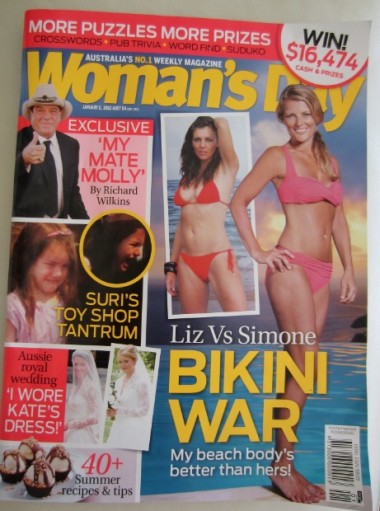
I’ve previously posted an amazing clip that illustrates this fantastically, from a show called Battle of the Bods.  The “Don’t Hate Me ‘Cause I’m Beautiful” trope is also part of this phenomenon.  Bryony W. sent in another example: a cover of Woman’s Day featuring a “bikini war.”  The cover implies complicity, including the supposed quotation, “My beach body’s better than hers!”

The cover reveals that agents of the media — in this case, whoever decides what stories to include at Women’s Day — actively try to pit women against one another.  This idea comes through loud and clear in this compilation of clips, sent to me by Veronica G.  Titled “Divas on Divas,” it features female pop stars being asked to comment about each other and being pushed to say mean things:

Here are some more examples.

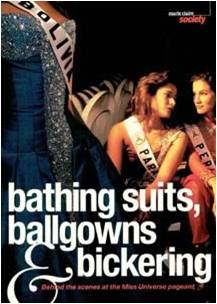
“Bathing Suits, Ballgowns, and Bickering,” a story in Marie Claire:

“Physicians Recommend It, Women Fight Over It”:

“90% Best Friend, 10% Bitter Enemy, 100% Genuine”:

Lisa Wade, PhD is an Associate Professor at Tulane University. She is the author of American Hookup, a book about college sexual culture; a textbook about gender; and a forthcoming introductory text: Terrible Magnificent Sociology. You can follow her on Twitter and Instagram.
Last month the Centers for Disease Control (CDC) released a series of graphic anti-smoking ads intended to “raise awareness of the human suffering caused by smoking and to encourage smokers to quit.”   The campaign, titled “Tips From Former Smokers,” depicts individuals who have experienced some of the potential effects of tobacco use, including stomas, stroke, lung removal, heart attack, limb amputations, and asthma.  For example, this ad features several former smokers who offer “tips” on how to live with a throat stoma (hole), such as “Crouch, don’t bend over—you don’t want to lose the food in your stomach”:

This ad shows Terrie, a throat cancer survivor, completing the morning routine she performs in order to maintain her appearance after losing her hair and teeth and having a tracheotomy:

Finally, this ad depicts several people who suffered a vascular disease brought on by smoking who had to have limbs amputated:

In addition to the whether these ads will be effective in persuading smokers to quit, we might ask whether fear and stigma are appropriate health promotion strategies.  Is it possible or ethical to scare people into changing their behaviors?  What are the implications of using stigmatized people to serve as a warning label to others?

What’s most striking about these ads is how they use and portray the human body.  Medical sociologist Deborah Lupton suggests that health promotion campaigns such as this one do not simply depict bodies but also produce them; that is, the ways we talk about and create images of certain bodies says something about who or what that body is and what it does. She argues that when the body is seen as uncontrolled, say, with holes or missing limbs, then the self is understood as undisciplined.  For these former smokers, their undisciplined selves resulted in their uncontrolled bodies. Lupton suggests that by producing the body as a site of contamination or catastrophe the rest of us can be kept in line by fear.

In these ads, a group of disabled people and cancer survivors are used as a warning for current smokers to quit.  The ads invite us to feel disgust at their bodies and fear at what could happen to our own.  In particular, Terrie’s ad invokes gendered beauty norms and prompts viewers to imagine themselves without traditional markers of attractiveness such a full head of hair.

Paying attention to how health promotion images use the body is one way to think more critically about bodies, well-being, and how to effectively promote healthy behaviors.

 —————

Christie Barcelos is a doctoral candidate in Public Health/Community Health Education at the University of Massachusetts Amherst.