Search results for embed

In this 8 1/2 minute talk, sent in by Dmitriy T.M., AJ Jacobs recounts his efforts to perfectly follow every single piece of health advice he encountered.

Lisa Wade, PhD is an Associate Professor at Tulane University. She is the author of American Hookup, a book about college sexual culture; a textbook about gender; and a forthcoming introductory text: Terrible Magnificent Sociology. You can follow her on Twitter and Instagram.

In “Portraying Tiger Woods: Characterizations of a ‘Black’ Athlete in a ‘White’ Sport,” Andrew Billings discusses how race plays a role in sports commentators’ evaluations of golfers, and particularly in how they describe and comment upon Tiger Woods. A content analysis of 37.5 hours of coverage of golf tournaments between April and August of 2001 by CBS, NBC, and ABC, during which 2,989 evaluative comments occurred, revealed patterns in how sportscasters described Tiger Woods compared to other golfers. When he was losing, Woods was more likely than other golfers in the same position to be described as lacking composure or concentration, of “self-destructing,” and of lacking control over his emotions. Overall, Billings found that the types of language other students have found to be applied to Black athletes were applied to Woods only when he was losing. When he was doing well, commentators did not significantly stereotype Woods.

The study is interesting in light of a video sent in by Jason Eastman. This Wall Street Journal segment discusses the results of a study that investigated how media depictions of college quarterbacks’ performances. A recent study published in the Academic of Management Journal found that media coverage rarely gave African American quarterbacks credit for leadership. When their teams do well, it is because of their natural athletic talent; when they do poorly, it is lack of leadership — blame not equally placed on White quarterbacks when their teams do poorly. So Blacks are blamed more for losses but get less credit for successes — an outcome of stereotyping that has disturbing implications for hiring and promotion in the workplace (sorry for the ad):

Full cites:

Andrew Billings. 2003. “Portraying Tiger Woods: Characterizations of a ‘Black’ Athlete in a ‘White’ Sport.” The Howard Journal of Communications 14: 29-37.

Andrew Carton and Ashleigh Shelby Rosette. 2011. “Explaining Bias against Black Leaders: Integrating Theory on Information Processing and Goal-Based Stereotyping.” Academy of Management Journal 54: 1141-1158.

Dr. Bethany Pope sent in a segment from a National Geographic show about animals’ sexual behavior. The clip is an amazingly gendered discussion, describing animals’ motivations and behaviors through the lens of what is considered normative masculine and feminine sexual behavior, the correct place of males and females in the social hierarchy, and the assumption that males and females are locked in a zero-sum game. The anthropomorphizing of other species begins at the outset, when we learn female hyenas want “more than equal rights, they want to beat males at their own game.”  In fact, “Africa’s plains are among the most macho places on earth…they’re testosterone-fueled battlefields,” filled with “swaggering” males. Bethany sums up the tone regarding hyenas, saying, “The documentary presents them as an abomination, usurping male gender roles.” Indeed, at about a minute in we learn that hyenas “seem mixed up.” A hyena “swaggers,” “confident” and “cocksure,” its penis swinging “low and proud.” But what’s this? The swaggering, cocksure hunter “has a secret”! That’s not a penis, it’s an enlarged clitoris; our hero is a she! Not only that, there’s not a penis anywhere to be found, as this is an all-female pack; “these female are some of the most masculine in the world — and they like to sniff each other an awful lot, too. Compounding the “confusion,” they have a “bulging” sac, like a scrotum. And not only are female hyenas masculinized, but the poor males are emasculated, reduced to being “subservient, servile, and scared.” It is rather stunning example of anthropomorphizing the natural world and applying gendered norms of sexuality to other species, and worth sitting through the full six minutes to get the full effect (the video might not be safe for some workplaces; there are a lot of lingering shots of penises and clitorises. A lot.):

Gwen Sharp is an associate professor of sociology at Nevada State College. You can follow her on Twitter at @gwensharpnv.

In an interesting article at Slate, Libby Copeland observes that Ron Paul has disproportionate support from young people and men.  Why?  She cites political scientists explaining that young people, on average, think in more black-and-white terms than older people:

…age and newness to politics predispose young voters to a less nuanced view of the political world. They’re less likely to take the long view, less likely to have patience, less likely to spin out the implications of their political theories.

Ron Paul does, indeed, articulate a straightforward ideology, especially compared to the other candidates.

Copeland doesn’t do as good of a job of explaining why men tend to like him more than women.  I wonder, though, if it maybe has something, just a little bit, to do with his branding.  Consider this ad:

This ad is a clear adoption of masculinity and a strong rejection of femininity (symbolized by the Shih-Tsu and its supposed weakness).  In this sense, his ad is centrally in the genre of ads designed to associate products with MEN, partly by the deliberate exclusion of women and mocking of anything feminine.

It seems to me that Paul has decided to double down on his appeal, focusing on the market that he thinks is most likely to support him, and throwing everyone else out along with the social programs.

Thanks to Letta and Alex for sending along the article and commercials!

Lisa Wade, PhD is an Associate Professor at Tulane University. She is the author of American Hookup, a book about college sexual culture; a textbook about gender; and a forthcoming introductory text: Terrible Magnificent Sociology. You can follow her on Twitter and Instagram.

Cross-posted at Montclair SocioBlog.

Mitt Romney’s capitalism has come under attack – from fellow Republicans, of all people.  They’re pummeling him for his work at Bain Capital, his private equity firm.  “Private equity” became the term of choice when “leveraged buyout” acquired a connotation of nastiness, probably because many LBOs were in fact nasty affairs (“hostile” takeovers).

Romney is tall and good-looking with a full head of hair.  He speaks with no noticeable regional accent.  Danny DeVito is a photo negative of all that.  But as Lawrence Garfield,* a.k.a. Larry the Liquidator in “Other People’s Money” DeVito does a much better job in making the case for what Mitt did at Bain Capital.**  (The original title for this post was “Defending Private Equity – the Short Version.”)

Bain sometimes made money by bankrupting the companies it took over.  That’s creative destruction for you – first the destruction, then creation.    As Larry the Liquidator puts it***:

 You invested in a business and this business is dead. Let’s have the intelligence, let’s have the decency to sign the death certificate, collect the insurance, and invest in something with a future. . .
Take the money. Invest it somewhere else. Maybe, maybe you’ll get lucky and it’ll be used productively. And if it is, you’ll create new jobs and provide a service for the economy and, God forbid, even make a few bucks for yourselves.

Romney’s critics talk about the people put out of work, the towns and communities eviscerated.  That’s where Garfield/Romney are on shakier ground.

“Ah, but we can’t,” goes the prayer. “We can’t because we have responsibility, a responsibility to our employees, to our community. What will happen to them?” I got two words for that – “Who cares?”

Larry the Liquidator is raising the issue of shareholders vs. stakeholders.  Stakeholders are all those people who are affected by a corporation.  To attract corporations, local governments sometimes offer goodies like tax breaks, regulation breaks, and even bagfuls of cash.  The localities defend these deals by saying that they will be good for the whole town, particularly for those who become employees or who sell goods and services to the corporation.  These people and the town generally will be stakeholders.  They all have a stake in the success of the corporation.

Corporations too often talk the stakeholder talk.  But when times get tough, they talk the shareholder talk – the talk that Larry does so well. And they walk the shareholder walk.  They walk out of town with the money from the sale of the company’s assets.

All this has implications for issues of trust, implications much too broad and deep for a simple blog post.  See this 1988 article by Andrei Schleifer and Larry Summers, “Breach of Trust in Hostile Takeovers.”

————————

* Romney is a Mormon.  Larry Garfield is of no specified religion, though we can assume he is not a Mormon.  In the original play, he was Larry Garfinkle. For Hollywood purposes he became Garfield, just as did actor John Garfinkle.

** Conservapedia, as I’m sure Drek knows, rated “Other People’s Money” as one of the twenty greatest conservative movies.

*** For a transcript of Larry’s speech go here.  The original stage play is by Jerry Sterner, the screenplay by Alvin (Three Spidermans) Sargent.  I don’t know how much credit each gets for this speech.

 Big hat tip to Ezra Klein for the material here.

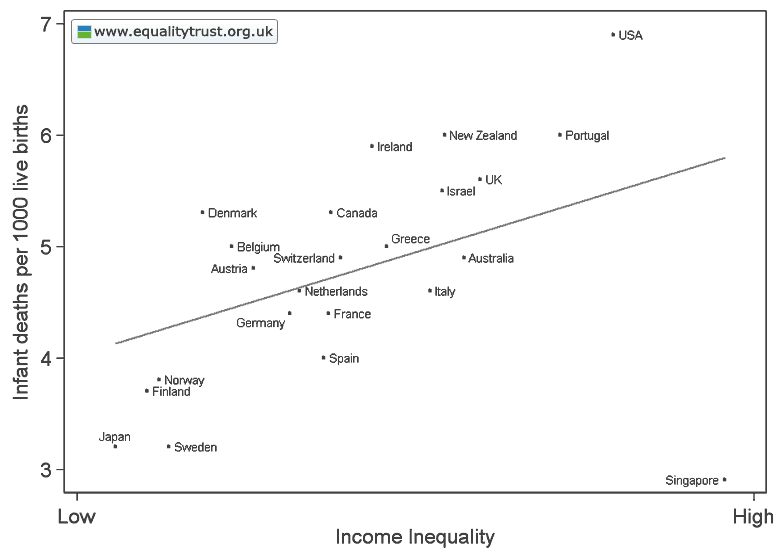
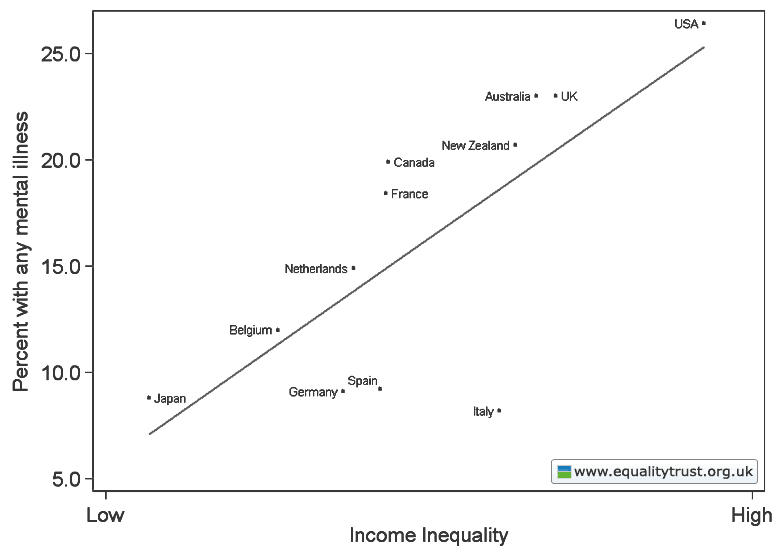
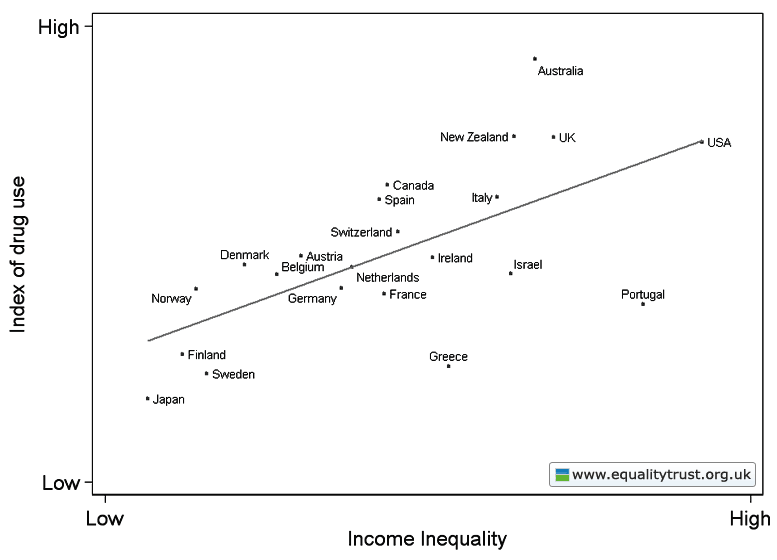
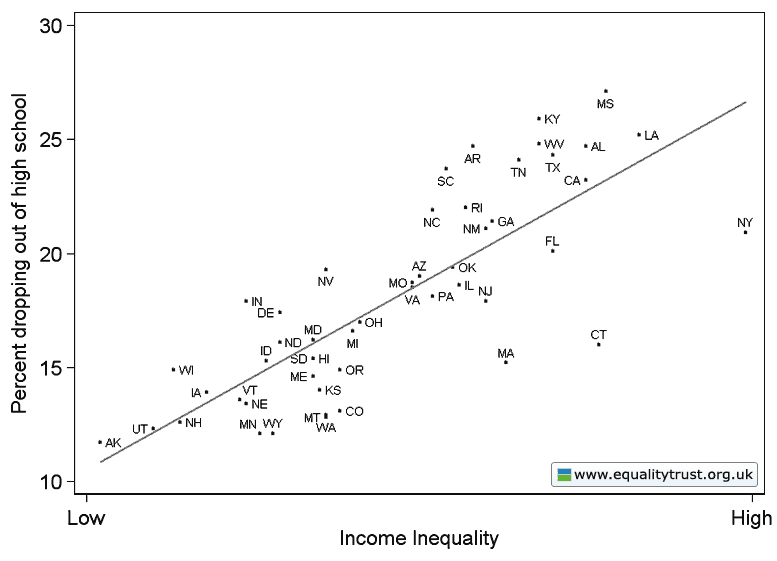
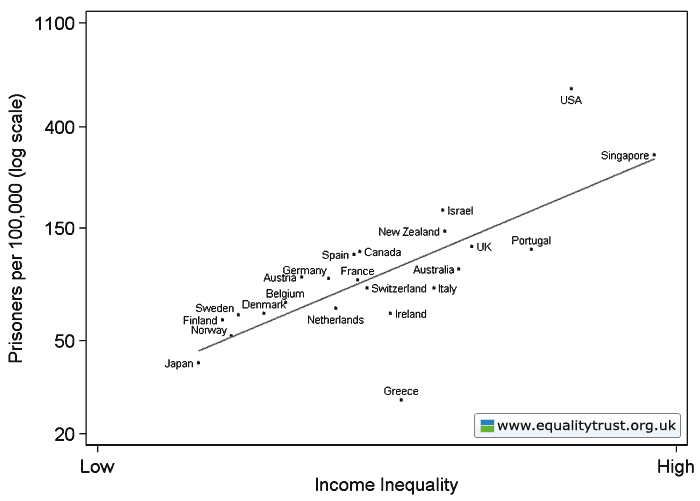
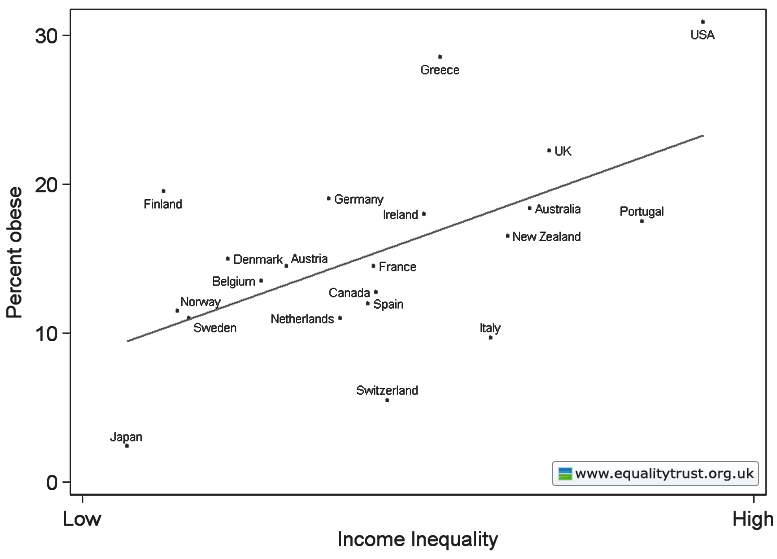
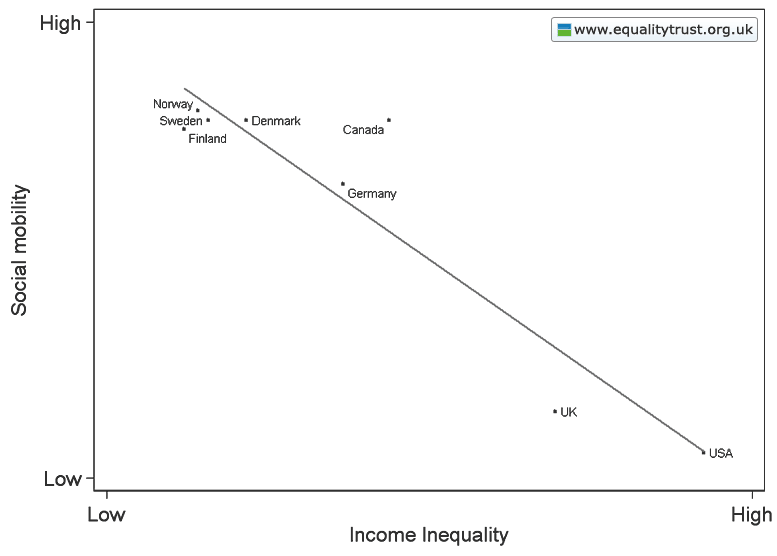
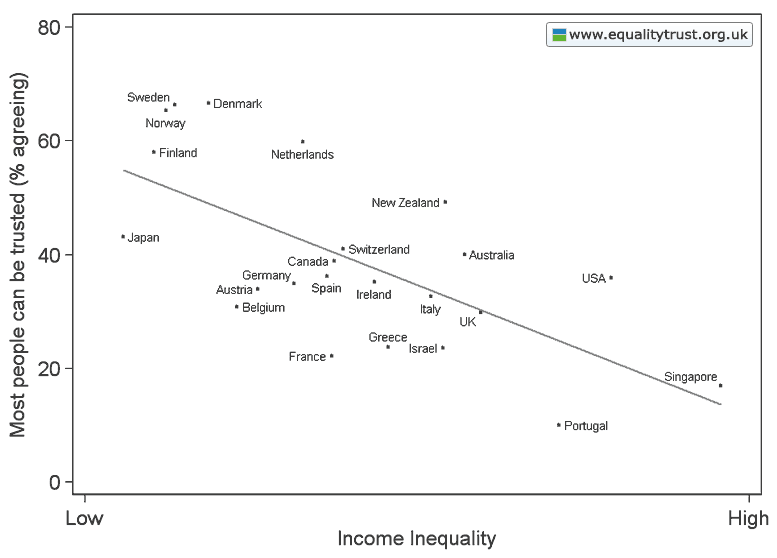
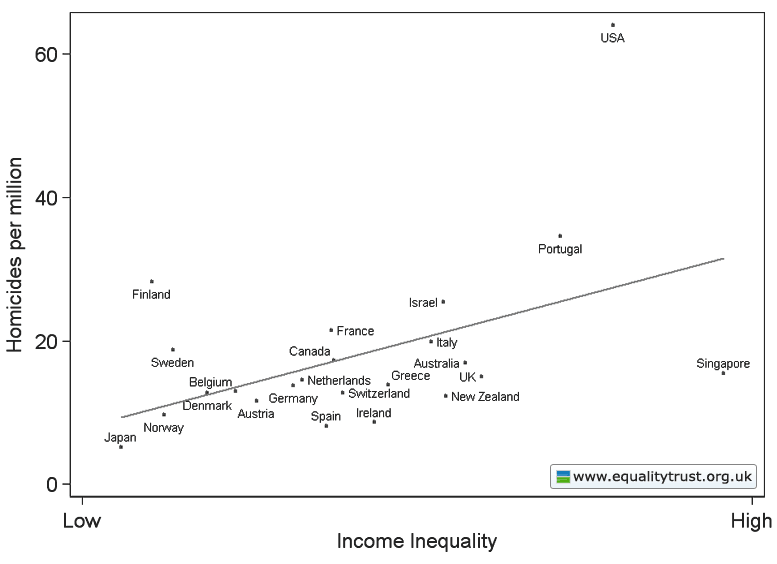
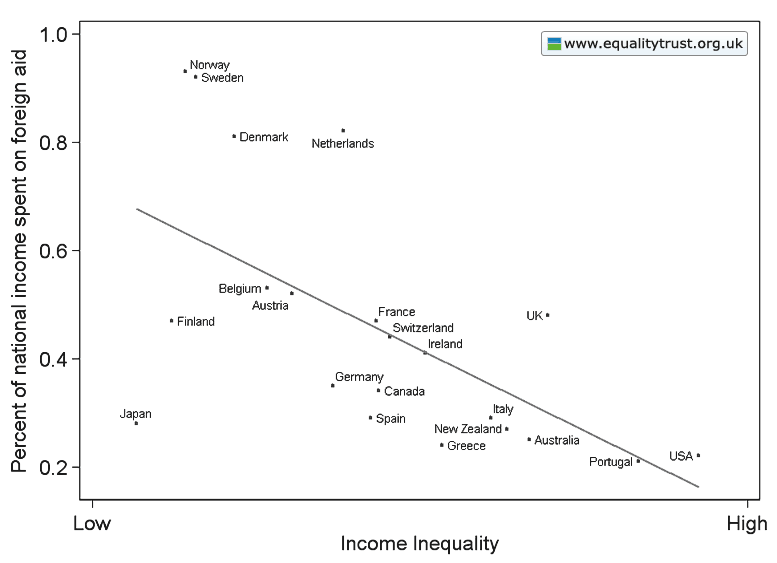
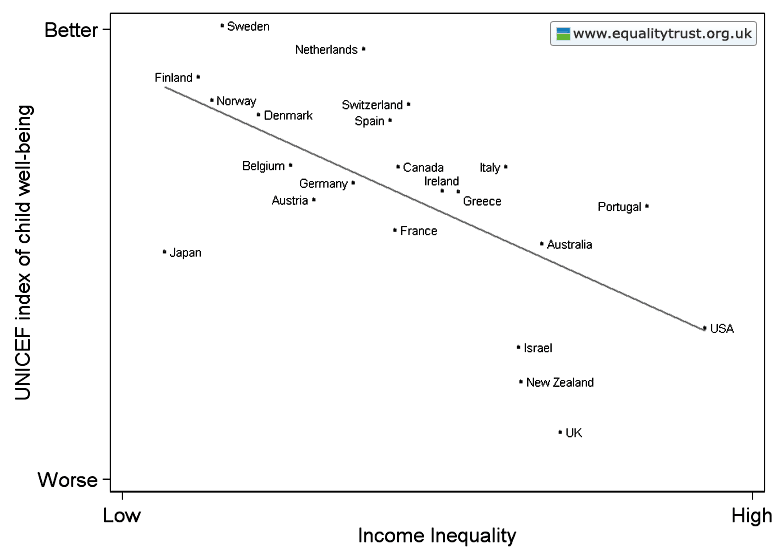
The mysterious SocProf, who writes The Global Sociology Blog, offered a nice review of Richard Wilkinson and Kate Pickett‘s book, The Spirit Level: Why More Equal Societies Almost Always Do Better.  Wilkinson and Pickett offer transnational research showing how, exactly, income inequality is related to bad outcomes on average.  In other words, as SocProf puts it, “…egalitarianism is not a bleeding heart’s wet dream but rather the only rational course of action in terms of public policy.”  The 11 graphs, available at the Equality Trust website, speak for themselves.

Societies with more income inequality have higher infant death rates than other societies:

Societies with more income inequality have higher rates of mental illness than other societies:

Societies with more income inequality have a higher incidence of drug use than other societies:

Societies with more income inequality have a higher high school drop out rate than other societies:

Societies with more income inequality imprison a larger proportion of their population than other societies:

Societies with more income inequality have a higher rate of obesity than other societies:

Individuals in societies with more income inequality are less likely to be in a different class than their parents compared to other societies:

Individuals in societies trust others less than people in other societies:

Societies with more income inequality have higher rates of homicide than other societies:

Societies with more income inequality give less in foreign aid than other societies:

Children in societies with more income inequality do less well than children in other societies:

The authors sum it up pretty simply: : “Th[e] dissatisfaction [measured in this data is] a cost which the rich impose on the rest of society.”

And they have a clear policy proposal relevant to the current economic crisis.

[This is] a clear warning for those who might want to place low public expenditure and taxation at the top of their priorities. If you fail to avoid high inequality, you will need more prison and more police. You will have to deal with higher rates of mental illness, drug abuse and every other kind of problems. If keeping taxes and benefits down leads to wider income differences, the need to deal with ensuing social ills may  force you to raise public expenditure to cope.

Readers Ana and Dmitriy T.M. sent in a TED talk of Richard Wilkinson discussing the relationship between income inequality and social problems:

Lisa Wade, PhD is an Associate Professor at Tulane University. She is the author of American Hookup, a book about college sexual culture; a textbook about gender; and a forthcoming introductory text: Terrible Magnificent Sociology. You can follow her on Twitter and Instagram.

Since outright hatred and discrimination of people because of their race is no longer socially acceptable in our post Civil-Rights era, many argue racism no longer exists.  But sociologists suggest that racism simply changed, becoming more implicit and indirect.

Eduardo Bonilla-Silva argues that the new racism entails individuals saying and doing things that perpetuate racial stereotypes and inequalities, but they do so in such a way that the offender is able to deny being explicitly racist.  One of the many types of new racist strategies Bonilla-Silva highlights is the use of racially charged code speak, or using indirect racial rhetoric and semantic moves to express an ideology that serves to reinforce white dominance over minorities.

The Daily Show’s Larry Wilmore illustrates the code speak implicit in presidential candidate Newt Gingrich’s suggestion that we combat poverty by hiring poor children to clean the restrooms at their schools.  In the clip below, Wilmore notes that “it’s 2011, and you can’t just call Black people lazy,” and then points out Gingrich’s racial code speak.  He notes Gingrich’s statement about “neighborhoods where they may not have that experience [of working]” is “code for inner-city, which is code for urban, which is code for Black.”   Gingrich’s statement about poor children having “no habit of showing up [to work] on Monday” is “code for shiftless, which is code for lazy, which is code for black.” Wilmore then plays more of Gingrich’s speech where the presidential candidate cites statistics about Black unemployment, thereby making his implicit racial assumptions explicit:

.
The clip also points out how racial ideology engages very different explanations for the causes of poverty depending on the race of those affected.  Wilmore notes, “when Black people are poor it’s their fault because they are lazy and on welfare, but down in poor Appalachia it’s not your fault; it’s China’s fault, or India’s fault, or all the money we’re spending on Black people on welfare.”

When John Stewart asks why this is important, Wilmore points out how the causes of poverty “matter to the solutions,” thereby pointing out Gingrich’s implicit prejudices of nonwhite inferiority with his proposal that Black poverty could be eliminated by hiring children to clean toilets (and Gingrich reaffirmed his support for this idea at a GOP primary debate last week, to wild crowd applause). Similarly, Rick Santorum is now defending himself after saying, “I don’t want to make black people’s lives better by giving them somebody else’s money,” ignoring the fact that most recipients of government aid are White and the vast majority of Blacks are employed and do pay taxes to support the social safety net citizens of all races use. In both cases, the message is clear: African Americans are deficient, with no work ethic, and the solution to poverty is entirely at the individual level, with no need for larger structural changes.

—————————-

Jason Eastman is an Assistant Professor of Sociology at Coastal Carolina University who researches how culture and identity influence social inequalities.

If you would like to write a post for Sociological Images, please see our Guidelines for Guest Bloggers.

“Hey look! Fox News, American Idol, and Monday Night Football had a threesome and it made a baby named the Southern Republican Presidential Debate!”

That was my first thought, anyway, as I watched my first Republican Primary debate of the season two nights ago. I was really surprised at the opening dramatization of the event on CNN.  If you don’t know what I’m talking about, you absolutely must watch the first few minutes of the video below (especially :40 to 2:30):

So, what do you think?  Does this smack of sensationalism to you?  Is this just what TV looks like these days?  Without being overly nostalgic, how does this compare to the mood of previous debates?  How might this framing of the debates affect how people think of the presidency, our government, the process?

Lisa Wade, PhD is an Associate Professor at Tulane University. She is the author of American Hookup, a book about college sexual culture; a textbook about gender; and a forthcoming introductory text: Terrible Magnificent Sociology. You can follow her on Twitter and Instagram.