Search results for The

Cross-posted at Kieran Healy’s blog.

The chart in “America is a Violent Country” has been getting a lot of circulation. Time to follow up with some more data. As several commentators at CT noted, the death rate from assault in the U.S. is not uniform within the country. Unfortunately, state-level and county-level mortality data are not easily available for the time period covered by the previous post — though they do exist, going back to the 1940s. What I have to hand is a decade’s worth of US mortality data courtesy of CDC WONDERcovering 1999 to 2009. I extracted the assault deaths according to the same criteria the OECD uses (for the time period in question, ICD-10 codes X85-Y09 and Y87.1). The estimates are adjusted to the 2000 U.S. population, which isn’t identical to the standard OECD adjustment. But the basic comparability should be OK, for our purposes.

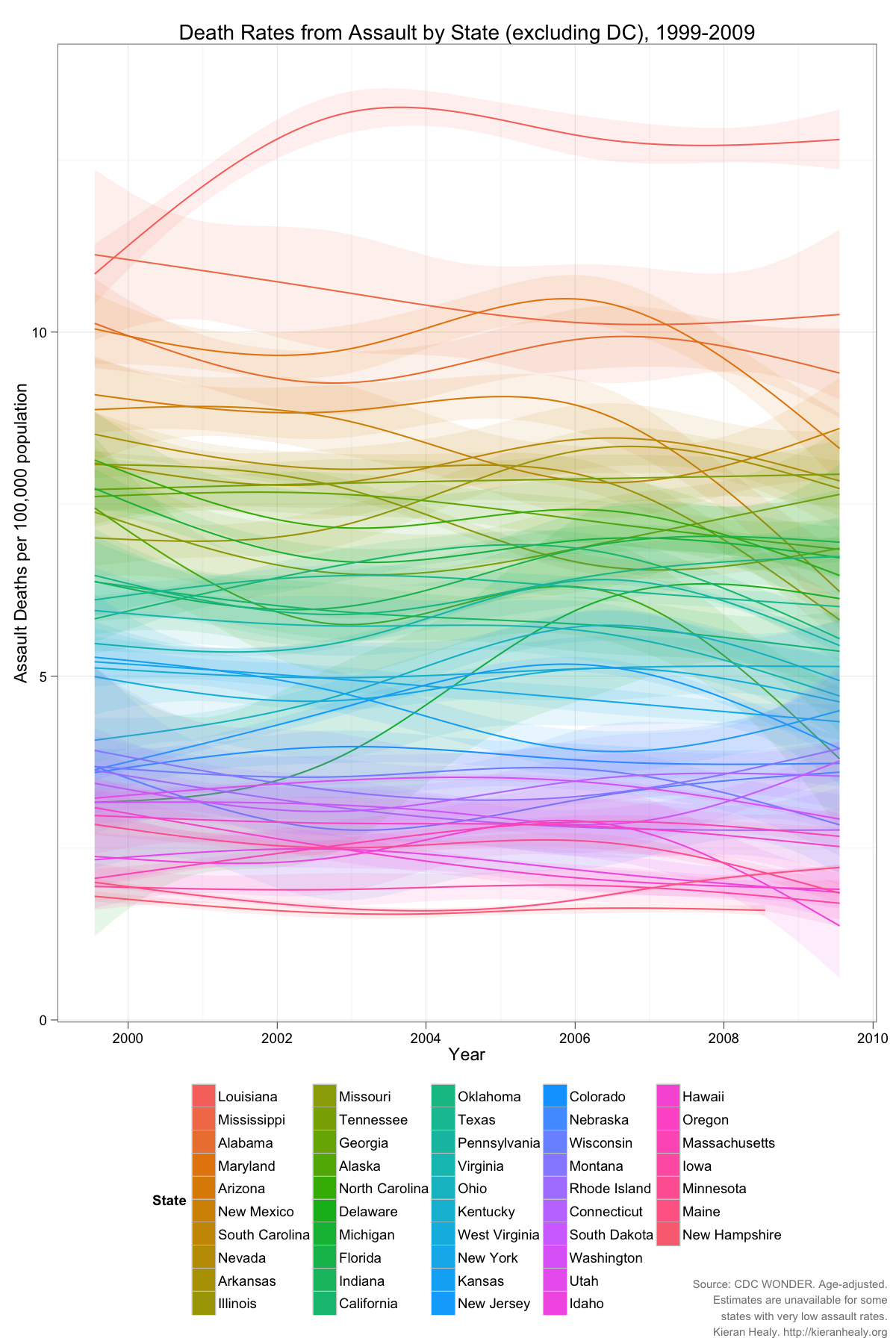
First, it’s well-known that there are strong regional differences in the assault death rate in the U.S. by state and region. Here’s what the patterns look like by state from 1999 to 2009 (click for a larger PNG or PDF):

This figure excludes the District of Columbia, which has a much higher death rate but is also a city. Also missing are a few states with small populations and low absolute numbers of assault deaths — Wyoming, North Dakota, Vermont — such that the CDC can’t generate reliable age-adjusted estimates for them. If you want a “small-multiple” view with each state shown separately from high to low, here you go.

The legend for the figure above arranges the states from high to low, reading top to bottom and left to right. Although it’s clear that geographical region isn’t everything, those tendencies are immediately apparent. Let’s look at them using the official census regions (click for a larger PNG or PDF):
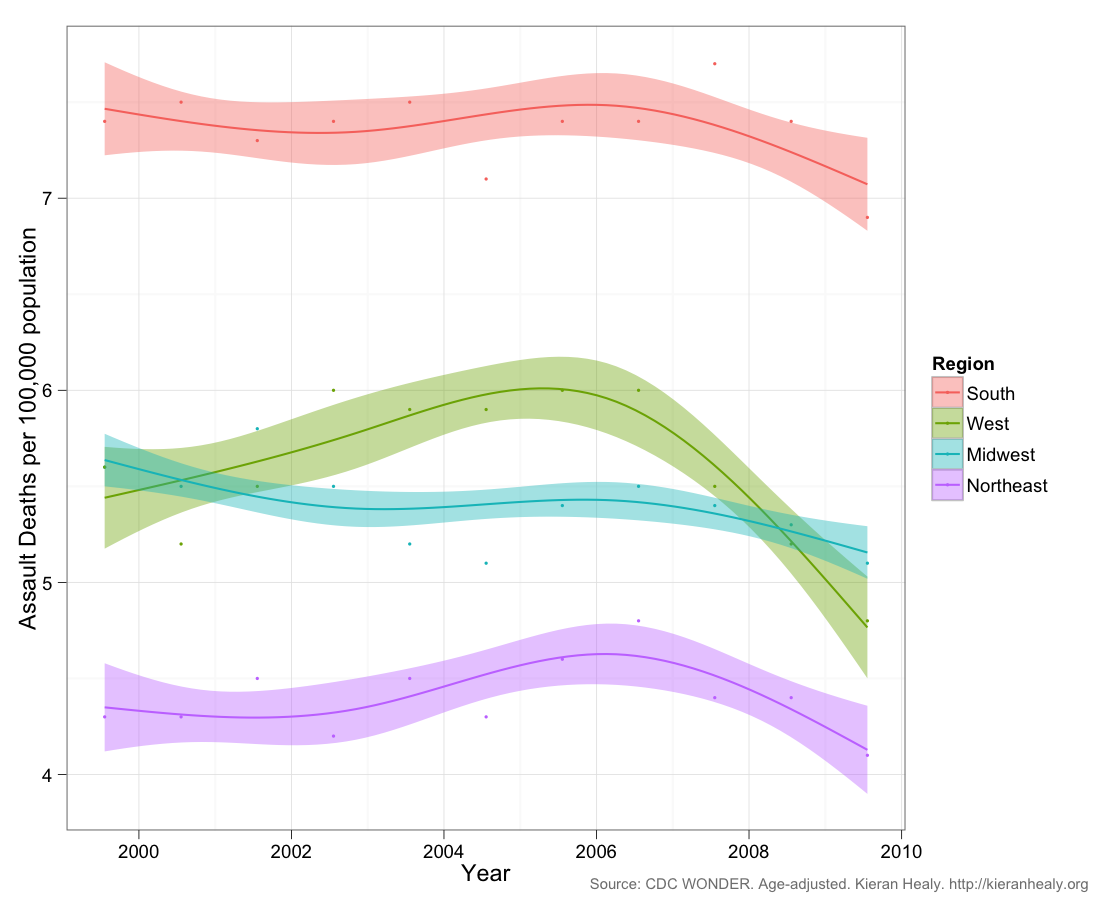
As is well known, the South is more violent than the rest of the country, by some distance. Given the earlier post, the natural thing to do is to put these regional trends into the cross-national comparison and see — for the decade we have, anyway — how these large U.S. regions would fare if they were OECD countries. Again, bear in mind that the age-adjustment is not quite comparable (click for a larger PNG or PDF):
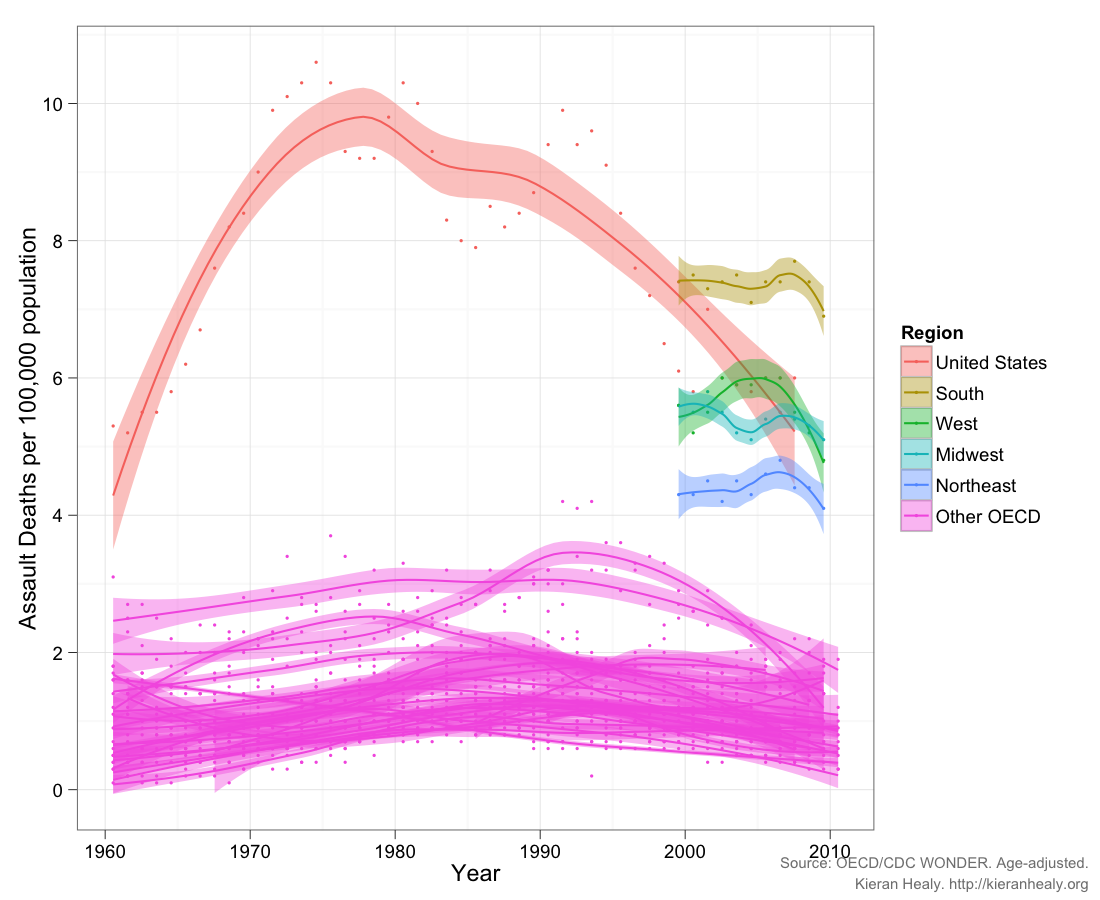
Despite their large differences, all of the U.S. regions have higher average rates of death from assault than any of the 24 OECD countries we looked at previously. The placid Northeast comes relatively close to the upper end of the most violent countries in our OECD group.

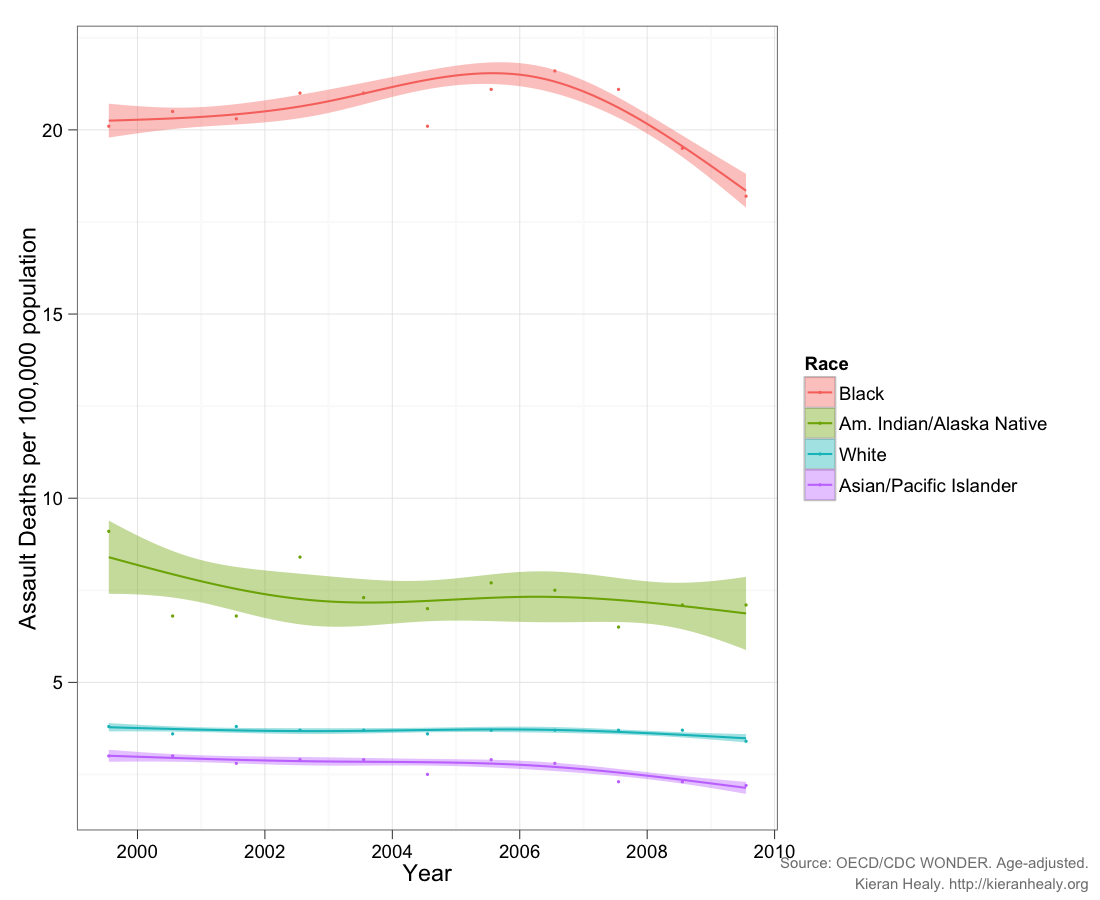
Finally, there’s the question of racial and ethic incidence of these deaths within the United States. Here are the decade’s trends broken out by the race of the victim, rather than by state or region (click for a larger PNG or PDF):

The story here is depressing. Blacks die from assault at more than three times the U.S. average, and between ten and twenty times OECD rates. In the 2000s the average rate of death from assault in the U.S. was about 5.7 per 100,000 but for whites it was 3.6 and for blacks it was over 20. Even 3.6 per 100,000 is still well above the OECD-24 average, which – if we exclude the U.S. – was about 1.1 deaths per 100,000 during the 2000s, with a maximum value of 2.9. An average value of 20 is just astronomical. And this is after a long period of decline in the death rate from assault.

—————————

Kieran Healy is a professor of sociology in the Kenan Institute for Ethics at Duke University.  His research is primary concerned with the moral order of a market society. You can follow him on twitter and at his blog.
Cross-posted at Guns, Rap, and Crime.

I have a heavy heart tonight.  My thoughts and prayers are with the families of Newtown.  The Newtown shooting is a terrible tragedy. It has reminded me of lessons learned while studying the families of murder victims.

For the past 2 years, I have been researching the everyday lives of families who lose someone in a murder.  This has been difficult — and often heartbreaking — research.  I have spent many nights thinking about how much I take my family, friends, and other people in my life for granted.   I think about the mothers, fathers, grandparents, aunts, uncles, and siblings whose first and last thoughts of each day are of the person they loved and lost. The things that I have seen and the stories that I have collected have left a deep and permanent mark on my soul.

Amongst the many thoughts swirling around in my head, I keep returning to a troubling “double standard” that we often taken for granted when shootings happen.

On one hand, the Newtown shooting reminds us that fatal violence can happen at anytime to anyone.  It is a painful reminder that life is precious and that it can be snapped away from us at any moment.  The Newtown shooting makes many of us feel an existential fall out. How could this happen?  Why did this have to happen?  And what does this mean for me?

For many of us, these shootings cut a little too close to home.  They happen in places to people who remind us of ourselves.  We begin to wonder: “Are we ever really safe?” “Will our children come home from school today?” “Will this happen at my favorite movie theater?”

In turn, these ideas shape how we feel about families who mourn in the wake of such tragedies.  We feel deep empathy, compassion, and sadness for families and victims in Newtown.  We talk about the victims here as innocent children who met a horrible death completely out of their hands.  We wonder how the families and friends of victims will cope with such a loss.

But, the same kinds of sympathy and compassion are often not extended to families who lose their children in street shootings every day.  These situations are treated very differently by the media, by our leaders, and by many of us.  We see these shootings as events that only happen to people who are caught up in the wrong crowd.  We assume that these victims — who are often children — must have been dealing drugs, in a gang, or doing something to meet such a horrible end.  Everyday violence in our inner-cities helps us hold onto a precious myth: Fatal violence only happens to people who bring it on themselves.  If we can believe this, or at least think it might be true, we can feel safe again.

How do we reconcile these conflicting responses to tragedy?

I’m here to tell you that many of our popular assumptions about the second group of victims are deeply problematic and misinformed.  Many of the people that I have followed over the years have been young men who were in the wrong place at the wrong time.  This is a powerful message that John Rich — a physician, scholar, and interventionist — teaches us in his powerful work on young black men’s experiences with trauma.

This is a theme that also resonates with my work:  One family I followed lost their youngest son in a street-style execution shooting.  The mother and two older brothers of the victim faced an unsympathetic and sometimes cruel world.  Newspaper articles talked about this case as an example of how families need to keep closer tabs on their children.  Local community leaders and church pastors used this event to denounce drugs in the community.  And, most hurtful of all, supervisors at the mother’s work filed complaints about her work productivity slipping after her son’s death.  When she told them that she was in the bathroom wailing over the loss of her youngest child — she was fired and released with severance.

This is only a small sample of the many tragedies that I followed in Philadelphia.  I hope that this underscores the need to rethink how we process and make sense of gun violence across the board.  The deep sympathy and pain that we all feel tonight for the victims of Newtown should be extended to families who lose sons, daughters, husbands, wives, grandparents, aunts, uncles, best friends, and siblings in our backyards everyday.

—————————

Jooyoung Lee is a professor of sociology at the University of Toronto. His research involves crime, gun violence, health, interaction, and culture.  You can follow him at his blog, Guns, Rap, Crime, and on twitter.

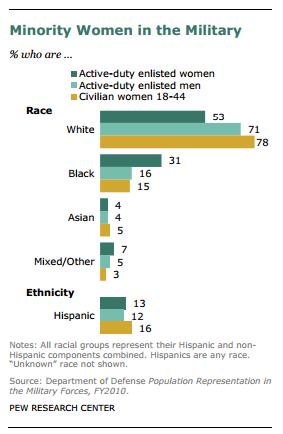
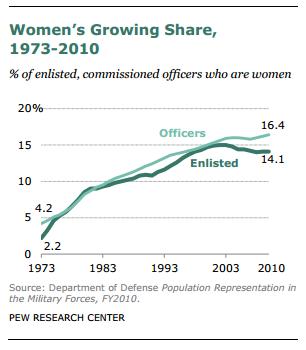
Pew Research Center reports that, as of 2010, women make up about 15% of enlisted soldiers and commissioned officers:

Not all types of women are entering the military at the same rate.  Nearly a third of women in the military are Black, about twice their proportion in the general population.  In contrast, about half are white, about 2/3rds their proportion among civilian women.

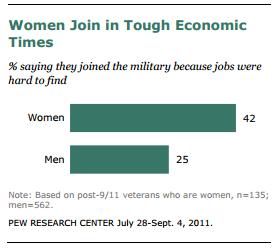
A larger proportion of women, compared to men, said that they joined the military because it was difficult to find a good civilian job:

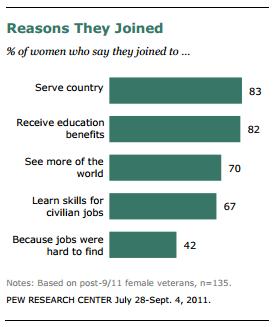
They were just as likely as men, however, to report other more common reasons for joining:

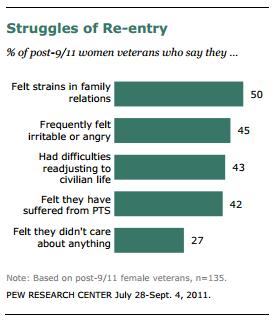
Interestingly, women reported high levels of strain re-entering the civilian population and the majority believe that the wars in Afghanistan and Iraq are not worth fighting:

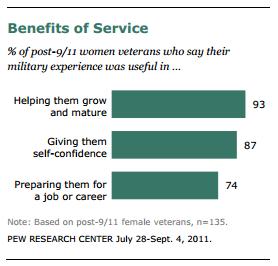
Nevertheless, a large majority felt that entering the military was good for their personal growth and career opportunities:

Lisa Wade, PhD is an Associate Professor at Tulane University. She is the author of American Hookup, a book about college sexual culture; a textbook about gender; and a forthcoming introductory text: Terrible Magnificent Sociology. You can follow her on Twitter and Instagram.

Cross-posted at The Huffington Post.In most densely-packed urban cities, one will be able to observe a disturbing phenomenon: wealthy people marching past the homeless, day in and day out.  Often, the residents of the street and the residents of the apartments recognize each other and even know each other’s routines.  And, yet, familiarity doesn’t breed concern.

Psychologists Lasana Harris and Susan Fiske were able to detect a neurological process behind the ability to get used to seeing others suffer. Using functional MRIs, they exposed individuals to images of the homeless.  These images tended to activate parts of the brain associated with disgust.  This, they argue, supports the idea that “extreme out-groups may be perceived as less than human…”  It is easy to overlook the suffering of the homeless, then, because we dehumanize them.

In an effort to disrupt this cognitive process, documentary film maker Goro Toshima has released a new film, Broken Doors.  The 36-minute documentary follows a young homeless couple in Los Angeles, Starr and Rico.  Not only does it put faces and names to an otherwise reviled and ignored population, the documentary shows viewers just how difficult it can be to survive on the streets and to get off.

Lisa Wade, PhD is an Associate Professor at Tulane University. She is the author of American Hookup, a book about college sexual culture; a textbook about gender; and a forthcoming introductory text: Terrible Magnificent Sociology. You can follow her on Twitter and Instagram.

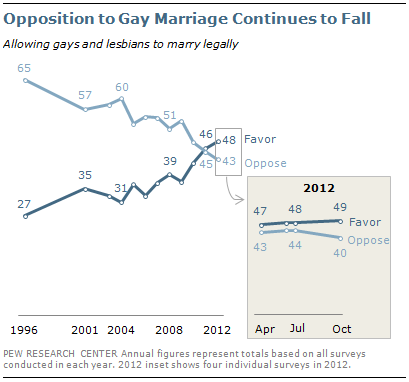
Over the past couple of years, the U.S. appears to have finally reached a tipping point regarding attitudes toward same-sex marriage. In polls from a variety of organizations over the last two years, more people supported same-sex marriage than opposed it, and in some polls an outright majority expressed support for marriage equality.

Data from the Pew Research Center poll provide more evidence for this fairly rapid shift in public attitudes:

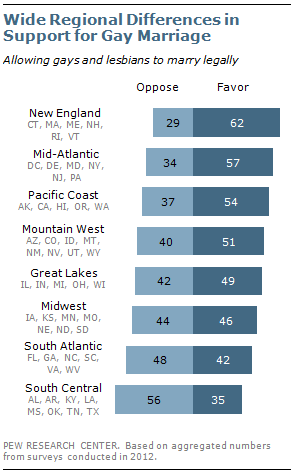
However, those attitudes vary widely by region. Looking more closely at the Pew data, we see that support is highest in New England, where over 60% of those surveyed in 2012 favored making same-sex marriages legal, but most regions of the U.S. now show more support than opposition. In fact, only in the South Atlantic and South Central states did more respondents oppose marriage equality than support it. The South Central region was least supportive, with 56% of respondents opposing same-sex marriage:

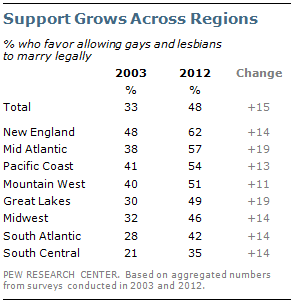
Support for same-sex marriage has grown in ever region over the past 10 years. A decade ago, supporting same-sex marriage was clearly a minority opinion across the U.S.:


As the Pew Center post points out, it’s not that attitudes in the South aren’t changing, but they’re only now approaching where the rest of the country was on the issue a decade ago.

Gwen Sharp is an associate professor of sociology at Nevada State College. You can follow her on Twitter at @gwensharpnv.

Cross-posted at Sociology Lens.

A number of researchers suggest that the marketing and advertising of Gardasil has been aimed at girls and women instead of boys and men. In this post I discuss two contradictory messages aimed at women through these advertisements.

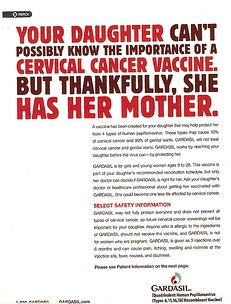
The first type of ad focused around the protection of young girls. The makers of Gardasil imply that being a good parent means vaccinating your daughter and therefore protecting her from cervical cancer (an observation also made here at Sociological Images). For example, one advertisement read, “How do you help your daughter become one less life affected by cervical cancer?” Another advertisement had a similar sentiment, stating “Your daughter can’t possibly know the importance of the cervical cancer vaccine, but thankfully, she has her mother” (source).

This narrative of protectionism is not surprising. In other contexts, like sex education debates, the discourse about adolescent sexuality, and in particular, girls’ sexuality, reveals a desire to protect their “innocence.”

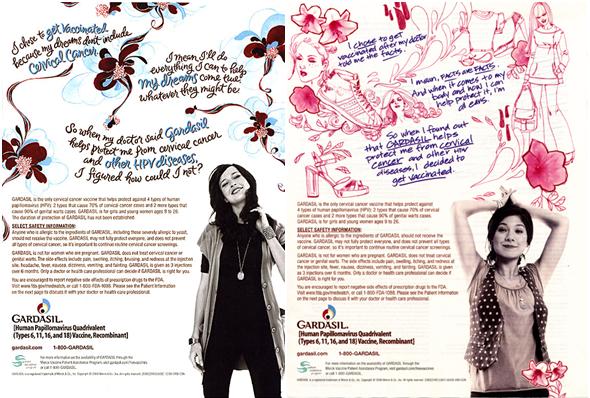
The other type of ad moves away from the narrative of protectionism and focuses on empowerment and choice. One ad stated, “I chose to get vaccinated after my doctor to me the facts” (source). Another ad read, “I chose to get vaccinated because my dreams don’t include cervical cancer” (source).

Instead of focusing on the ways in which girls and women can be protected, the ads suggest that girls and women need to protect themselves. It seems like the advertising department at Merck (the makers of Gardasil) recognize that they needed another strategy if they wanted to appeal to young women who feel empowered about their sex lives.

These two strategies are opposed to one another. One strategy suggests that girls and women need to be protected, while the other strategy relies on the ability of girls and women to be active and educated decision makers. Merck is tapping into two gendered narratives in order to sell to as many people as possible. This is, of course, the way that advertising works. But it does reveal the different, and sometimes contradictory, cultural ideas about women’s sexuality, ideas that advertisers will draw on in order to make a profit.

—————————

Cheryl Llewellyn is a Ph.D. candidate in sociology at Stony Brook University.  She writes for Sociology Lens, where you can read her post about the feminization of the Gardasil.

The following two charts taken from a Center for Economic Policy and Research Center study by John Schmitt and Janelle Jones highlight the distressed nature of the U.S. labor market and the need for raising the minimum wage and strengthening union organizing.

Schmitt and Jones define low wage work as that work paying $10.00 an hour or less in 2011 dollars.  As the charts show, low wage workers are far more educated and older in 2011 than in 1979.


Education and experience are not sufficient to ensure a living wage.

Not surprisingly, growing numbers of low wage workers at Walmart and at chain fast food restaurants have begun engaging in direct action for higher wages and better working conditions.   They deserve our support.

—————————

Martin Hart-Landsberg is a professor of Economics and Director of the Political Economy Program at Lewis and Clark College.  You can follow him at Reports from the Economic Front.

Cross-posted at Ms. and the Huffington Post.

I loathe to weigh in on the “war on men” conversation, but… alas.

While one can use both logic and data to poke gaping holes in Suzanne Venker’s argument that women need to surrender to their femininity and let men think that they’re in charge if they ever want to get married, I just want to point out one thing — one endlessly repeated thing — that she gets very, very wrong.

Venker claims that there has “been an explosion of brain research” that proves that men and women have different brains.  This research, she claims, shows that men are loners who like to hunt and build things and women are nurturers who like to talk and take care of people.

This false on two fronts.

First, she’s wrong about the brain research.  The books and articles claiming that there are “pink” and “blue” brains are not consistent with existing research.  (They are out there because people can make a lot of money by confirming other people’s biases.)

What does the research say?

It’s true that scientists have documented a number of small, average sex differences in brain anatomy, composition, and function, as well as differences in size and tissue ratios.  (Other differences — such as the size of the corpus callosum and lateralization, whether one sex uses one side of their brain more than the other — have proven to be wrong.)

So, scientists do find some differences, but they have largely failed to link these to differences in men’s and women’s observed emotions, cognition,  or behavior.  That is, we’ve found some differences, but we have no proof that they translate into anything. Moreover, new research suggests that differences we observe may be designed not to create differences between men and women, but to reduce them.  The brain may have two strategies for achieving the same outcome or one difference may compensate for another.  (For more, see Brain Gender by Melissa Hines.)

That’s one reason why Venker is wrong.

The second reason is even more damning.  Most of the research attempting to explain gender difference assumes that there differences to explain.   In fact, meta-analyses aimed at summarizing the literature on human sex differences and similarities in traits, personality, cognitive abilities, sexuality, temperament, and motor skills offer better evidence for similarity than difference.  On the vast majority of traits, men and women overlap tremendously.

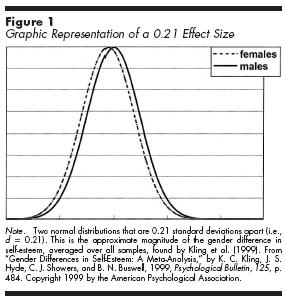
Janet Hyde, a pioneer in this area, did a meta-analysis of meta-analyses that combined the results of 7,084 separate studies. She found evidence for a large or very large difference on 8% of characteristics and evidence for medium-sized differences on 15%.  She found evidence for small differences on another 48%.  What does a small difference look like?  Here’s an example of a mid-range small difference (for self-esteem):

For the final 30% of characteristics, she found no evidence gender difference.  So, on 78% of characteristics, she found teensy differences or none at all.  Wow, “opposite sexes” indeed.

The truth is, men aren’t loners and women aren’t talkers. Venker assumes the stereotypes and counts on her readers to agree that they are true, but the data doesn’t back her up.

Two excellent books summarize the debates over gender and neuroscience.  Cordelia Fine’s Delusions of Gender is great for a beginner. She’s funny and you’ll learn a lot. Rebecca Jordan-Young’s Brain Storm is great for someone who wants and intermediate to advanced introduction to these issues.  Her book is downright brilliant.  I highly recommend both.

———————

Lisa Wade is a professor of sociology at Occidental College.  Feel free to take a look at her forthcoming article, “The New Science of Sex Difference.”  You can also follow her on Twitter and Facebook.