Search results for The

Along with “work/life balance” and other tired topics, an evergreen issue in the media remains the controversies surrounding breastfeeding.  Less than six months ago, Jamie Lynne Grumet lit up the blogosphere by posing for the cover of TIME Magazine while breastfeeding her standing toddler.  Outcry included pronouncements that the image was almost pornographic, psychologically damaging to her child, and exploitative of her white, twenty-something good looks.  The drama of the image worked as the magazine flew off shelves and was named one of the top ten most controversial covers by the New York Daily News.

Within the “lactivist” community there seemed to be double-edged concern — on one hand, glee that an image of a breastfeeding woman was so publicly displayed — on the other, anger that the image so clearly did not depict the intimacy and bonding between mother and child that they insist breastfeeding promotes.

Sensing an opportunity to “set the record straight” as well as launch their own uptick in cover attention, the nonprofit quarterly magazine Pathways to Family Wellness persuaded Grumet to pose for them, this time surrounded by her husband, adopted son, and cradling her nursing naked now 4-year-old child in her lap.  The inclusion of other family members changes the image from one of solo defiance to a message about her family system.  On the cover, Grumet still looks directly at the camera, not at her feeding child, but her glance is far from defiant.

Grumet agreed to pose again in order to send a different message about breastfeeding, one she preferred.  Grumet has said that this image portrays toddler breastfeeding more realistically, “incorporating the husband and siblings.” Yet, the multicultural family portrait has its own sense of staging.   The idyllic family pile-on seems hardly part of everyday life, much less every feeding.  Both images – part of the wider debate over breastfeeding — are carefully crafted to tell a particular story.

Some critics have mentioned that while Grumet’s intention may have been to reframe the image of breastfeeding, perhaps unwittingly again, she has contributed to the fanning of the flames around this issue. Others have accused her of “milking the moment.”   The breastfeeding support website KellyMom tracked down the three other mothers who were all photographed for the TIME cover. KellyMom interviewed them about their experiences during the shoot, then reaction to, and fallout from the cover.  Unfortunately, given the nature of the debate, individual women can often seem like pawns in these ever-intermittent media storms.

————————

Elline Lipkin, PhD, is a Research Scholar with UCLA’s Center for the Study of Women.  She is the author of Girls’ Studies and The Errant Thread, recipient of the Kore Press First Book Award for Poetry. She tweets at @girlsstudies.

I was finishing up my dissertation in 2006.  The Great Recession was still two years away.  Nevertheless, there was talk about it being a tough job market for newly-minted sociologists and, like most everybody in my shoes, I was scared sh*tless about getting a job.

It’s obvious now that I was extremely lucky to get out of grad school when I did.  A few years later the American Sociological Association (ASA) would report that the number of jobs for new PhDs fell 40% from ’06/’07 to ’08/’09 (sociologists have a job “season” that straddles the New Year).

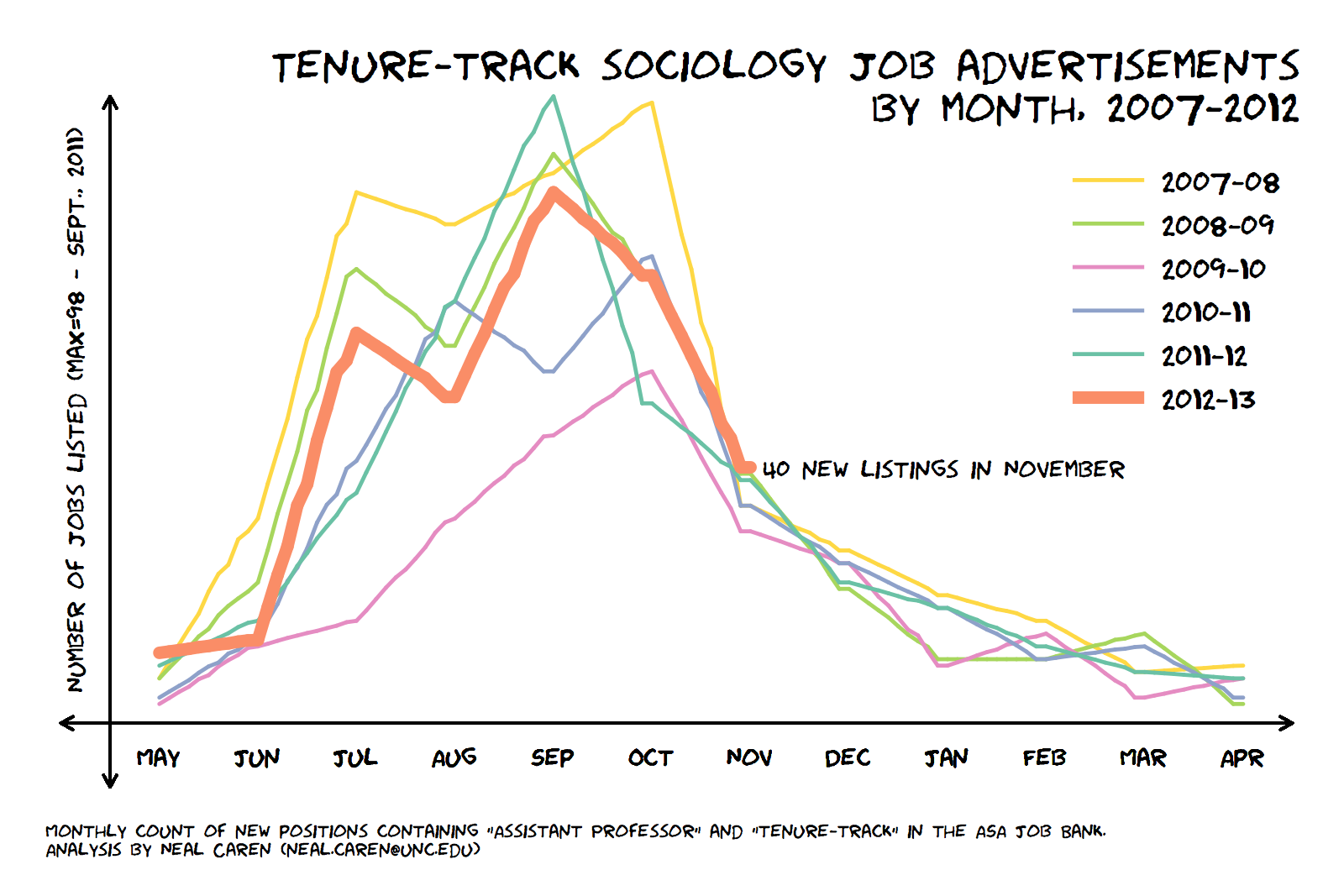
Neal Caren, a (gloriously employed) sociologist at UNC Chapel Hill, has been tracking the job market himself ever since.  His data, posted at Scatterplot, shows that the discipline has yet to recover from the Great Recession (if that’s the sole cause of the decline in job openings).  The yellow and green line represent the drop captured in the ASA report.  The purple line represents the devastating next year and the two blue-ish lines represent a slight recovery.

This year, however, the thick orange line, reveals that this year’s market is not signalling a recovery to the job market of my own debut.  It’s up 5% from last year, Caren explains,  15% from 2010, and “a whopping 73% from 2009.”  Extrapolating from the ASA data, we’re still down 33% from ’06/’07.

Lisa Wade, PhD is an Associate Professor at Tulane University. She is the author of American Hookup, a book about college sexual culture; a textbook about gender; and a forthcoming introductory text: Terrible Magnificent Sociology. You can follow her on Twitter and Instagram.

Cross-posted at Montclair Socioblog.

Try not to think about an Oldsmobile.

I’ve been thinking about Oldsmobile.  I mentioned it in passing in the previous post, and since then I’ve been wondering about “Not Your Father’s Oldsmobile” – the brand’s swan song.  Matthew Yglesias at Slate thinks that the campaign alienated the regular customers, the ones who bought a new Olds every few years, saying to them in effect, “You’re a geezer, an Oldster, and have been for a while – sans youth, sans sex, sans taste, sans everything except your crummy car.”

The tag that completed the famous set-up line was, “The new generation of Olds.”

The target of the campaign was to attract young car buyers, but it missed badly.  Why?  My guess is the futility of negation.  Saying what something is not doesn’t give people a clear picture of what that something actually is.  But that’s not the problem here.  The message was clear, especially with that tag about generations.

The problem is that direct negation can reinforce the idea you are trying to deny – as in the paradoxical command to not think about an elephant. “I am not a crook,” said Richard Nixon in his televised address about Watergate.  It’s his most remembered line, and when he spoke it, the TV screen might as well have had an overlay flashing the words “Game Over.”

If the denial contradicts general perceptions (i.e., the brand), people might not hear it at all, or worse, they might hear the opposite.  Ever since fact-checking went public in a big way a few years ago, we’ve seen corrections to the lies that politicians have told about one another.  But as Brendan Nyhan and Jason Reifler have shown, corrections can boomerang, especially when they clash with ideas the reader already has.

Can these false or unsubstantiated beliefs about politics be corrected? … Results indicate that corrections frequently fail to reduce misperceptions among the targeted ideological group. We also document several instances of a “backfire effect” in which corrections actually increase misperceptions among the group in question.

By insisting that they weren’t old after all, Oldsmobile might have done more harm than good.

—————————

Jay Livingston is the chair of the Sociology Department at Montclair State University.  You can follow him at Montclair SocioBlog or on Twitter.

Cross-posted at Cyborgology.

On Thursday Syria’s internet was shut down.

This is a serious situation with literal life and death implications.  Much of this story has yet to play out. Right now, I want to take a moment to explore one aspect of what this all means. Namely, I want to explore the question: why did the internet shut off now? To do so, I turn to Derrick Bell’s interest convergence theory.

Derrick Bell’s theory of interest convergence is a canonical statement on race relations. Bell famously argues that whites promote racial justice only when doing so converges with their own interests. The key example is the 1954 Brown V. Board of Education case, in which racial integration in schools served the larger U.S. message within the Cold War of human rights, freedom, and equality.

Although many scholars critique the strong version of Bell’s argument for its failure to incorporate agency among blacks, the root of the argument is quite useful in explaining power relations. In short, interest convergence theory tells us that the will of the powerful wades towards the direction of self-interest. When these interests converge with those of the less powerful, the less powerful are better able to achieve their will.

To a degree, I think this framework helps us understand the decision of the Syrian government to shut down communication channels. Syrian rebels utilized digital communication channels to both organize among themselves, and share their experiences — often in real time — with the outside world. This was instrumental in their cause both on the ground and internationally. The real question then, is why did the government maintain these channels for so long? This question is particularly blaring in light of extreme government atrocities, including mass killings of innocent citizens — including children. Moreover, why did the government decide to cut off these channels now?

Internet and communication blackouts are not unique among the Arab uprisings. Egypt and Libyan governments both shut down communication during their respective battles. The Syrian government, however, is unique in its deft use of digital technologies to quash protests, locate dissidents, and suppress the movement. In short, the interests of the powerful (i.e. the government) converged with the less powerful (i.e. the rebels). In addition to appearing somehow less oppressive to the international community, we see here a possible reason for maintaining Internet capabilities despite their strategic importance in the rebel movement.

However, we may speculate that the costs got too high for the government. We may speculate that in light a persistent rebel force, culminating in massive protests in Damascus — so large that the major airport had to be shut down — it no longer served governmental interests to maintain digital connectivity. The interests of the powerful and the less powerful no longer converged.

Certainly, there are other factors in play. This is a minuscule fraction of the story. With that said, this framework suggests that perhaps today’s act by the Syrian government was one of desperation. They were forced to give up a key oppressive resource (digital communication capabilities). This resource was no longer adequately effective for keep the uprising at bay. Now, they must all battle in the dark.

—————————

Jenny Davis is a PhD candidate in the Department of Sociology at Texas A&M University, where she studies the intersection of culture and identity. You can follow her twitter feed at @Jup83.

Cross-posted at Reports from the Economic Front.

With the election over, the news is now focused, somewhat hysterically, on the threat of the fiscal cliff.

The fiscal cliff refers to the fact that at the end of this calendar year several temporary tax cuts are scheduled to expire (including those that lowered rates on income and capital gains as well as payroll taxes) and early in the next year spending cuts are scheduled for military and non-military federal programs.  See here for details on the taxes and programs.

Most analysts agree that if tax rates rise and federal spending is cut the result will be a significant contraction in aggregate demand, pushing the U.S. economy into recession in 2013.

The U.S. economy is already losing steam.  GDP growth in the second half of 2009, which marked the start of the recovery, averaged 2.7% on an annualized basis.  GDP growth in 2010 was a lower 2.4%.  GDP growth in 2011 averaged a still lower 2.0%.  And growth in the first half of this year declined again, to an annualized rate of 1.8%.

With banks unwilling to loan, businesses unwilling to invest or hire, and government spending already on the decline, there can be little doubt that a further fiscal tightening will indeed mean recession.

So, assuming we don’t want to go over the fiscal cliff, what are our choices?

Both Republicans and Democrats face this moment in agreement that our national deficits and debt are out of control and must be reduced regardless of the consequences for overall economic activity.  What they disagree on is how best to achieve the reduction.  Most Republicans argue that we should renew the existing tax cuts and protect the military budget.  Deficit reduction should come from slashing the non-military discretionary portion of the budget, which, as Ethan Pollack explains, includes:

…safety net programs like housing vouchers and nutrition assistance for women and infants; most of the funding for the enforcement of consumer protection, environmental protection, and financial regulation; and practically all of the federal government’s civilian public investments, such as infrastructure, education, training, and research and development.

The table below shows the various programs/budgets that make up the non-security discretionary budget and their relative size.  The chart that follows shows how spending on this part of the budget is already under attack by both Democrats and Republicans.

Unfortunately, the Democrat’s response to the fiscal cliff is only marginally better than that of the Republicans.  President Obama also wants to shrink the deficit and national debt, but in “a more balanced way.”  He wants both tax increases and spending cuts.  He is on record seeking $4 trillion in deficit reduction over a ten year period, with a ratio of $2.50 in spending cuts for every $1 in new revenue.

The additional revenue in his plan will come from allowing tax cuts for the wealthy to expire, raising the tax rate on the top income tax bracket, and limiting the value of tax deductions.  While an important improvement, President Obama is also committed to significant cuts in non-military discretionary spending.  Although his cuts would not be as great as those advocated by the Republicans, reducing spending on most of the targeted programs makes little social or economic sense given current economic conditions.

So, how do we scale the fiscal cliff in a responsible way?

We need to start with the understanding that we do not face a serious national deficit or debt problem.  As Jamie Galbraith notes:

…is there a looming crisis of debt or deficits, such that sacrifices in general are necessary? No, there is not. Not in the short run — as almost everyone agrees. But also: not in the long run. What we have are computer projections, based on arbitrary — and in fact capricious — assumptions. But even the computer projections no longer show much of a crisis. CBO has adjusted its interest rate forecast, and even under its “alternative fiscal scenario” the debt/GDP ratio now stabilizes after a few years.

Actually, as the chart below shows, the deficit is already rapidly falling.  In fact, the decline in government spending over the last few years is likely one of the reasons why our economic growth is slowing so dramatically.

As Jed Graham points out:

From fiscal 2009 to fiscal 2012, the deficit shrank 3.1 percentage points, from 10.1% to 7.0% of GDP.  That’s just a bit faster than the 3.0 percentage point deficit improvement from 1995 to ’98, but at that point, the economy had everything going for it.

Other occasions when the federal deficit contracted by much more than 1 percentage point a year have coincided with recession. Some examples include 1937, 1960 and 1969.

In short, we do not face a serious problem of growing government deficits.  Rather the problem is one of too fast a reduction in the deficit in light of our slowing economy.

As to the challenge of the fiscal cliff — here we have to recognize, as Josh Bivens and Andrew Fieldhouse explain, that:

…the budget impact and the economic impact are not necessarily the same. Some policies that are expensive in budgetary terms have only modest economic impacts (for example, the 2001 and 2003 tax cuts aimed at high-income households are costly but do not have much economic impact). Conversely, other policies with small budgetary costs have big economic impacts (for example, extended unemployment insurance benefits).

In other words, we should indeed allow the temporary tax rate deductions for the wealthy to expire, on both income and capital gains taxes.  These deductions cost us dearly on the budget side without adding much on the economic side.  As shown here and here, the evidence is strong that the only thing produced by lowering taxes on the wealthy is greater income inequality.

Letting existing tax rates rise for individuals making over $200,000 and families making over $250,000 a year, raising the top income tax bracket for both couples and singles that make more than $388,350, and limiting tax deductions will generate close to $1.5 trillion dollars over ten years as highlighted below in a Wall Street Journal graphic .

However, in contrast to President Obama’s proposal, we should also support the planned $500 billion in cuts to the military budget.  We don’t need the new weapons and studies are clear that spending on the military (as well as tax cuts) is a poor way to generate jobs.  For example, the table below shows the employment effects of spending $1 billion on the military versus spending the same amount on education, health care, clean energy, or tax cuts.

defense.jpg

And, we should also oppose any cuts in our non-security discretionary budget. Instead, we should take at least half the savings from the higher tax revenues and military spending cuts — that would be a minimum of $1 trillion — and spend it on programs designed to boost our physical and social infrastructure.  Here I have in mind retrofitting buildings, improving our mass transit systems, increasing our development and use of safe and renewable energy sources like wind and solar, and expanding and strengthening our social services, including education, health care, libraries, and the like.

Our goal should be a strong and accountable public sector, good jobs for all, and healthy communities, not debt reduction.  The above policy begins to move us in the right direction.

—————————

Martin Hart-Landsberg is a professor of Economics and Director of the Political Economy Program at Lewis and Clark College.  You can follow him at Reports from the Economic Front.

Sociologists Arlie Hochschild and Anne Machung used “the second shift” to refer to the responsibilities of childcare and housework borne disproportionately by women, in addition to their paid labor.

A student in Will LaSuer’s class at the University of Akron noticed that a 5-Hour Energy ad explicitly references this idea of a second shift for women. A harried mom with an armful of groceries enters a home full of yelling kids. She talks about getting home from her first job to start her second job, and how worn out this can make her:

Of course, the ad doesn’t actually critique this arrangement or the organization of household duties. The second shift is taken for granted, an unavoidable burden. Consumption provides the answer: buy a product that gives you more energy so you can tackle that second job when you get home. Problem solved!

Gwen Sharp is an associate professor of sociology at Nevada State College. You can follow her on Twitter at @gwensharpnv.

Over at the Ms. blog, Rachel Kassenbrock posted an adorable video of two Capuchin monkeys given unequal rewards for the same task. The monkey who gets the lesser reward displays her displeasure, in no uncertain terms.

The research, described by primatologist Frans de Waal, has been reproduced in chimps, dogs, and birds. It reveals an inherent sense of fairness, suggesting that social justice may not be a silly fantasy, but quite natural indeed.

Lisa Wade, PhD is an Associate Professor at Tulane University. She is the author of American Hookup, a book about college sexual culture; a textbook about gender; and a forthcoming introductory text: Terrible Magnificent Sociology. You can follow her on Twitter and Instagram.

Over at the University of North Carolina at Chapel Hill, sociologist Neal Caren and a team of graduate students have worked up on image showing the locations of people signing secession petitions on the White House website in the wake of Obama’s reelection.

For context, here’s the text of one such petition, from Alaska:

ALLOW ALASKA TO SECEDE FROM A DYSFUNCTIONAL UNION.

As an American Veteran on behalf of the U.S. Constitution, the Republic, the Rule of Law, and equal justice for all freedom loving citizens of the United States of America hereby declare that the Federal Government allow Alaska to peacefully secede from a dysfunctional Union that is run by corrupt politicians who buy the votes of individuals who can no longer be seen as American citizens but rather, slaves to a tyrant. We who took the oath to protect and defend the Constitution of the United States of America against all enemies, foreign and domestic, now declare Washington D.C. to be the domestic enemy to the freedom and liberty of all Alaskans and indeed, 50% of the free citizens of the USA. Therefore, we declare our secession in support of the U.S. Constitution. LET MY PEOPLE GO!

Almost all states have an active petition now. Here’s the map of signers from around the country, shaded according to the proportion of each county’s residents who signed a secession petition. If you click on the image you go to the site, which allows you to hover over each county and see the counts:Neal Caren writes:

In total, we collected data on 702,092 signatures. Of these, we identified 248,936 unique combinations of names and places, suggesting that a large number of people were signing more than one petition. Approximately 90%, or 223,907, of these individuals provided valid city locations that we could locate with a U.S. county.

Using a first-name algorithm, they estimate that 62% of those signing are men.

Philip N. Cohen is a professor of sociology at the University of Maryland, College Park, and writes the blog Family Inequality. You can follow him on Twitter or Facebook.