Search results for The

Flashback Friday.

Sociologists are lucky to have amongst them a colleague who is doing excellent work on the modeling industry and, in doing so, offering us all a rare sophisticated glimpse into its economic and cultural logics. We’ve featured Ashley Mears‘ work twice in posts discussing the commodification of models’ bodies and the different logics of high end and commercial fashion.

In a post at Jezebel, Mears exposes the Model Search. Purportedly an opportunity for model hopefuls to be discovered, Mears argues that it functions primarily as a networking opportunity for agents, who booze and schmooze it up with each other, while being alternatively bored and disgusted by the girls and women who pay to be there.

“Over a few days,” Mears explains:

…thousands arrived to impress representatives from over 100 international modeling and talent agencies. In the modeling showcase alone, over 500 people ages 13-25 strutted down an elevated runway constructed in the hotel’s ballroom, alongside which rows of agents sat and watched.

2013 International Model and Talent Search; photo by AJ Batac.

But the agents are not particularly interested in scouting.  In shadowing them during the event, Mears finds that they “actually find it all rather boring and tasteless.”  Pathetic, too.

Mears explains:

The saddest thing at a model search contest is not the sight of girls performing womanhood defined as display object. Nor is it their exceedingly slim chances to ever be the real deal. What’s really sad is the state of the agents: they sit with arms folded, yawning regularly, checking their BlackBerrys. After a solid two hours, Allie has seen over 300 contestants. She’s recorded just eight numbers for callbacks.

Meanwhile, agents ridicule the wannabe runway, from the “hooker heels” to the outfit choices. About their physiques, [one agent recounts,] “I’ve never seen so many out of shape bodies.”

While model hopefuls are trading sometimes thousands of dollars for a 30-second walk down the runway, the agents are biding their time until they can head to the hotel bar to “…gossip, network, and commence the delicate work of negotiating the global trade in models…” One agent explains:

To be honest it’s just a networking event. The girls, most of them don’t even have the right measurements. For most of them, today is going to be a wake-up call.

Indeed, networking is the real point of the event.  The girls and women who come with dreams of being a model are largely, and unwittingly, emptying their pockets to subsidize the schmooze.

To add insult to injury, what many of the aspiring models don’t know is that, for “…$5,000 cheaper, any hopeful can walk into an agency’s ‘Open Call’ for an evaluation.”

I encourage you to read Mears’ much longer exposé at Jezebel.

Originally posted in 2010.

Lisa Wade, PhD is an Associate Professor at Tulane University. She is the author of American Hookup, a book about college sexual culture; a textbook about gender; and a forthcoming introductory text: Terrible Magnificent Sociology. You can follow her on Twitter and Instagram.
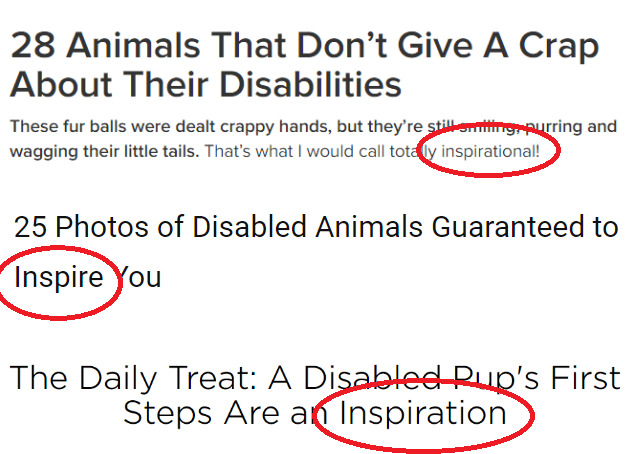
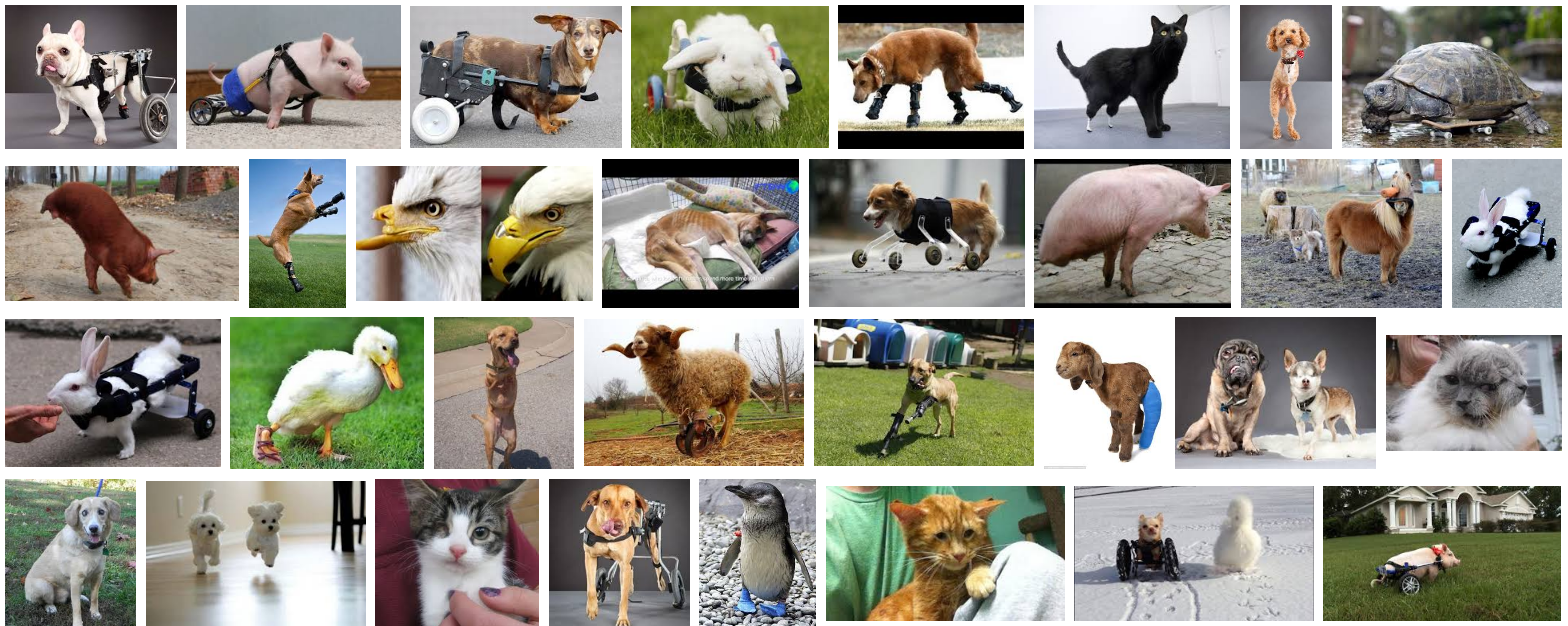
The term “inspiration porn” was coined by disability activist Stella Young. Aimed at able-bodied viewers, inspiration porn features people with disabilities who appear happy or are doing things, alongside an encouraging message. She explains:

Inspiration porn is an image of a person with a disability, often a kid, doing something completely ordinary — like playing, or talking, or running, or drawing a picture, or hitting a tennis ball — carrying a caption like “your excuse is invalid” or “before you quit, try.”

Or, the famous one: “The only disability is a bad attitude.”

She called it porn quite deliberately, arguing that inspiration porn is like sexual porn in that the images “objectify one group of people for the benefit of another group of people.”

And, as with sexual porn, it sometimes involves animals.

At Disability Intersections, Anna Hamilton suggests that inspiration porn involving animals is another step removed from recognizing the full humanity of people with disabilities. These “inspiring” stories, she argues, “provide a way for nondisabled people to talk about and engage with disability in a facile way.”

Disability isn’t just othered; it’s cute, adorable, fuzzy.

Hamilton continues:

If one is constantly gawking and aww-ing over pictures and stories about animals with disabilities, then they don’t have to spend time thinking about actual disabled people, or the ableism against disabled humans that still exists.

When featuring animals, accommodation is no longer the least a society can do: a basic acknowledgement that human beings in all forms deserve access to their societies. Instead, it’s over-the-top, idiosyncratic and rare, even excessive in its generosity. To find inspiration in a turtle who has been fitted with a tiny skateboard, for example, is to frame accommodation as something one does out of the goodness of one’s heart, not a human and civil right.

Inspiration porn others and objectifies people with disabilities. When featuring animals, it dehumanizes them, too.

Lisa Wade, PhD is an Associate Professor at Tulane University. She is the author of American Hookup, a book about college sexual culture; a textbook about gender; and a forthcoming introductory text: Terrible Magnificent Sociology. You can follow her on Twitter and Instagram.
“Fake news” has emerged as a substantial problem for democracy. The circulation of false narratives, lies, and conspiracy theories on self-described “alternative news” sites undercuts the knowledge voters rely on to make political decisions. Sometimes the spread of this misinformation is deliberate, spread by hate groups, foreign governments, or individuals bent on harming the US.

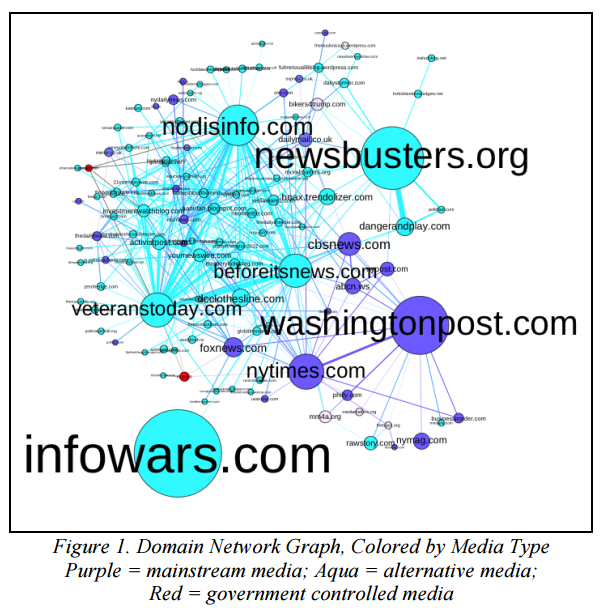
A new study offers information as to the content, connectedness, and use of these websites. Information scholar Kate Starbird performed a network analysis of twitter users responding to mass shootings. These users denied the mainstream narrative about the shooting (arguing, for example, that the real story was being hidden from the public or that the shooting never happened at all). Since most of the fake news sites cross-promote conspiracy theories across the board, focusing on this one type of story was sufficient for mapping the networks. Here is some of what she found:

  • The sites do not share a political point of view. They are dominated by the far right, but they also include the far left, hate groups, nationalists, and Russian propaganda sites. They did strongly overlap in being anti-globalist, anti-science, and anti-mainstream media.

  • Fake news sites are highly repetitive, spreading the same conspiracies and lies, often re-posting identical content on multiple sites.
  • Users, then, aren’t necessarily being careless or undisciplined in their information gathering. They often tweet overlapping content from several different fake news sites, suggesting that they are obeying a hallmark of media literacy: seeking out multiple sources. You can see the dense network created by this use of multiple data sources in the upper left.

  • One of the main conspiracy stories promulgated by fake news sites is that the real news is fake.
  • Believing this, Twitter users who share links to fake news sites often also share links to traditional news outlets (see the connections in the network to the Washington Post, for example), but they do so primarily as evidence that their false belief was true. When the New York Times reports the mainstream story about the mass shooting, for instance, it is argued to be proof of a cover up. This is consistent with the backfire effect: exposure to facts tends to strengthen belief in misinformation rather than undermine it.

In an interview with the Seattle Times, Starbird expresses distress at her findings. “I used to be a techno-utopian,” she explained, but she is now deeply worried about the “menace of unreality.” Emerging research suggests that believing in one conspiracy theory is a risk factor for believing in another. Individuals drawn to these sites out of a concern with the safety of vaccines, for example, may come out with a belief in a Clinton-backed pedophilia ring, a global order controlled by Jews, and an aversion to the only cure for misinformation: truth. “There really is an information war for your mind,” Starbird concluded. “And we’re losing it.”

Lisa Wade, PhD is an Associate Professor at Tulane University. She is the author of American Hookup, a book about college sexual culture; a textbook about gender; and a forthcoming introductory text: Terrible Magnificent Sociology. You can follow her on Twitter and Instagram.

Originally posted at Role Reboot.

Why is it that we associate revealing our bodies with liberation and covering it up with oppression?

Sixteen-year-old Je’Nan Hayes of Maryland recently had to sit out a basketball game because she wears a hijab (headscarf), and according to a rarely enforced rule, was required to provide prior documentation that she did so for religious reasons, even though she had played 24 games so far without an objection.

Meanwhile, Nike is facing backlash online for its Pro Hijab—a one-piece headscarf made of lightweight and breathable mesh—designed for those Muslim female athletes who wish to cover their heads.

What is it about the hijab that elicits such negative responses?

Critics of the Pro Hijab assert that a hijab is a tool of oppression. One Twitter user wrote: “#Nike cashing in on the subjugation, domination, and oppression of women.” Yet another tweeted: “@Nike has decided to capitalize off Islamic patriarchy by putting their brand on a chastity helmet.”

These critics fail to consider that Nike’s Pro Hijab, meant for athletes, is marketed to a group of women, who by virtue of their involvement in professional sports, are a group who are already defying gender expectations and norms. Not all Muslim women wear a headscarf, but those who do, why should they be constrained in their ambitions simply because of a scarf? In fact, for many women, the headscarf can be liberating as it allows them to focus on something other than their appearance.

In my work as a sociology professor and as editor of two books about embodiment, culture and globalization, I see the real and more urgent questions as: Why is it that we associate revealing our bodies with liberation and covering it up with oppression? And, how does this kind of thinking hide the real sources of oppression and liberation from us?

But, very importantly, if our concern about the Nike Pro Hijab (or any hijab) is truly with women’s oppression or subjugation, then why not address the issue of female athletes being overly sexualized in the media? Some of the first images of Lindsey Vonn to show up in a Google search are of her in a bikini or less. The same is true for Danika Patrick. There is nothing inherently wrong with a bikini. But if we want to truly address a culture of oppression, why not start with the effect of such images on young girls, or on the athletes themselves? Plenty of research has shown that while images of women playing sports make young girls feel positively, images of scantily dressed women (even when they are athletes), make them feel much worse about themselves and their bodies.

Even elite female athletes themselves struggle with their body image since having an athlete’s body (read: muscular and strong) is often seen to be at odds with a “feminine” body (read: small and delicate). Maria Sharapova, who was adored for her feminine body, famously revealed, “I always want to be skinnier with less cellulite. I think that’s every girl’s wish.” Serena Williams, on the other hand, who has been mocked for having muscular arms and a strong physique has spoken out about the toll this has taken on her and openly discusses her long journey toward accepting her body. But many other female athletes continue to battle with their body image, being forced to choose between athleticism and femininity.

In light of the struggles that many women—athletes and non-athletes—face; struggles that are compounded by the overt sexualization of women and girls in this culture, why are we so convinced women athletes who wish to cover their heads are oppressed? Instead, our indignation should be directed at the increasing rates of body image disorders in girls as young as 9 or 10. We should all be angry when young girls and women believe their worth is defined by how their bodies look and not what their bodies can accomplish. And we should all be sad when even the most talented female athletes continue to be scrutinized for what their bodies look like and not what they have accomplished.

In that sense, the focus on Nike’s Pro Hijab isn’t all that different—the women who want to compete wearing a hijab are also being judged for what they wear and not what they have to offer as athletes. Perhaps we should consider that what might be making us uncomfortable about them is that they refuse to give in to the cultural demands of sexualization of female athletes.

Nike’s Pro Hijab is not a tool of subjugation any more than a tennis uniform is. If we are truly interested in addressing oppression of female athletes, we need to look at the larger cultural norms that make it acceptable for female athletes to be judged on their appearance rather than their ability and that tell female athletes, in no uncertain terms, they need to choose between femininity and athleticism.

Afshan Jafar is an associate professor of sociology at Connecticut College and a Public Voices fellow with the OpEd Project. She is the author of Women’s NGOs in Pakistan, and the co-editor for Bodies without Borders and Global Beauty, Local Bodies.

Knowledge production is a collective endeavor. Individuals get named as authors of studies and on the covers of books and journal articles. But little knowledge is produced in such a vacuum that it can actually be attributed to only those whose names are associated with the final product. Bruce Holsinger, a literary scholar at the University of Virginia, came up with an interesting way of calling attention to some of women’s invisible labor in this process–typing their husbands’ manuscripts.

Holsinger noted a collection of notes written by husbands to their wives thanking them for typing the entirety of their manuscripts (dissertations, books, articles, etc.), but not actually explicitly naming them in the acknowledgement. It started with five tweets and a hashtag: #ThanksForTyping.

Typing a manuscript is a tremendous task – particularly when revisions require re-typing everything (typewriters, not computers). And, though they are thanked here, it’s a paltry bit of gratitude when you compare it with the task for which they are being acknowledged. They’re anonymous, their labor is invisible, but they are responsible for the transmitting men’s scholarship into words.

Needless to say, the hashtag prompted a search that uncovered some of the worst offenders. The acknowledgements all share a few things in common: they are directed at wives, do not name them (though often name and thank others alongside), and they are thanked for this enormous task (and sometimes a collection of others along with it). Here are a few of the worst offenders:


Indeed, typing was one of those tasks for which women were granted access to and in which women were offered formal training. Though, some of these are notes of gratitude to wives who have received education far beyond typing. And many of the acknowledgements above hint that more than mere transcription was often offered – these unnamed women were also offering ideas, playing critical roles in one of the most challenging elements of scientific inquiry and discovery – presenting just what has been discovered and why it matters.

One user on twitter suggested examining it in Google’s ngram tool to see how often “thanks to my wife who,” “thanks to my wife for” and the equivalents adding “husband” have appeared in books. The use of each phrase doesn’t mean the women were not named, but it follows what appears to be a standard practice in many of the examples above – the norm of thanking your wife for typing your work, but not naming her in the process.

Of course, these are only examples of anonymous women contributing to knowledge production through typing. Women’s contributions toward all manner of social, cultural, political, and economic life have been systemically erased, under-credited, or made anonymous.  Each year Mother Jones shares a list of things invented by women for which men received credit (here’s last year’s list).

Knowledge requires work to be produced. Books don’t fall out of people’s heads ready-formed. And the organization of new ideas into written form is treated as a perfunctory task in many of the acknowledgements above–menial labor that people with “more important” things to do ought to avoid if they can. The anonymous notes of gratitude perform a kind of “work” for these authors beyond expressing thanks for an arduous task–these notes also help frame that work as less important than it often is.

Tristan Bridges, PhD is a professor at the University of California, Santa Barbara. He is the co-editor of Exploring Masculinities: Identity, Inequality, Inequality, and Change with C.J. Pascoe and studies gender and sexual identity and inequality. You can follow him on Twitter here. Tristan also blogs regularly at Inequality by (Interior) Design.

Originally posted at Inequality by (Interior) Design.

One of my favorite sociologists is Bill Watterson. He’s not read in most sociology classrooms, but he has a sociological eye and a great talent for laying bare the structure of the world around us and the ways that we as individuals must navigate that structure—some with fewer obstacles than others. Unlike most sociologists, Watterson does this without inventing new jargon (or much new jargon), or relying on overly dense theoretical claims. He doesn’t call our attention to demographic trends (often) or seek to find and explain low p values.

Rather, Watterson presents the world from the perspective of a young boy who is both tremendously influenced by–and desires to have a tremendous influence on–the world around him. The boy’s name is Calvin, and I put a picture of him (often in the company of his stuffed tiger, Hobbes) on almost every syllabus I write. Watterson is the artist behind the iconic comic strip, “Calvin and Hobbes,” and he firmly believed in his art form. I’m convinced that if you can’t find a Calvin and Hobbes cartoon to put on your syllabus for a sociology course, there’s a good chance you’re not teaching sociology.

The questions and perspectives of children are significant to sociologists because children offer us an amazing presentation of how much is learned, and how we come to take what we’ve learned for granted. In many ways, this is at the heart of the ethnographic project: to uncover both what is taken for granted and why this might matter. Using the charm and wit of a megalomaniacal young boy, Watterson challenges us on issues of gender inequality, sexual socialization, religious identity and ideology, racism, classism, ageism, deviance, the logic of capitalism, globalization, education, academic inquiry, philosophy, postmodernism, family forms and functions, the social construction of childhood, environmentalism, and more.

Watterson depicts the world from Calvin’s perspective. He manages to illustrate both how odd this perspective appears to others around him (his parents, teachers, peers, even Hobbes) as well as the tenacity with which Calvin clings to his unique view of the world despite the fact that it often fails to accord with reality. Indeed, Calvin ritualistically comes into conflict with his social obligations as a child (school, chores, social etiquette, and norms of deference and respect, etc.) and the diverse roles he plays as a social actor (both real and imaginary). Calvin is a wonderful example of the human capacity to play with social “roles” and within the social institutions that frame and structure our lives.

Quite simply, Calvin often simply refuses to play the social roles assigned to him, or, somewhat more mildly, he refuses to play those roles in precisely the way they were designed to be played. And in that way, Calvin helps to illustrate just how social our behavior is.  Social behavior is based on a series of structured negotiations with the world around us. This doesn’t have to mean that we can act however we please—Calvin is continually bumping into social sanctions for his antics. But neither does it mean that we only act in ways that were structurally predetermined. The world around us is a collective project, one in which we have a stake. We play a role in both social reproduction and change.

Understanding the ways in which our experiences, identities, opportunities, and more are structured by the world around us is a central feature of sociological learning. Calvin is one way I ask students to consider these ideas. Kai Erikson put it this way in an essay on sociological writing:

Most sociologists think of their discipline as an approach as well as a subject matter, a perspective as well as a body of knowledge. What distinguishes us from other observers of the human scene is the manner in which we look out at the world—the way our eyes are focused, the way our minds are tuned, the way our intellectual reflexes are set. Sociologists peer out at the same landscapes as historians or poets or philosophers, but we select different details out of those scenes to attend closely, and we sort those details in different ways. So it is not only what sociologists see but the way they look that gives the field its special distinction. (here)

Calvin is a great example of the significance of “breaching” social norms. Breaches tell us something important about what we take for granted, and if your sociological imagination is well-oiled, you can often learn something about the “how” and the “why” as well. A great deal of the social organization goes into the production of our experiences, identities, and opportunities is subtly disguised by these “whys” (or what are sometimes called “accounts”). Calvin’s incessant questioning of authority and social norms illuminates the social forces that guide our accounts surrounding a great deal of social life–subtly, but unmistakably, asking us to consider what we taken for granted, how we manage to do so, as well as why. This is a feature of some of the best sociological work—a feature that is dramatized in childhood.

In Erikson’s treatise on sociological writing, he concludes with a wonderful description of an interaction between Mark Twain and a “wily old riverboat pilot.” Researching life on the Mississippi, Twain noticed that the riverboat pilot deftly swerves and changes course down the river, dodging unseen objects below the water’s surface in an attempt to move smoothly down the river. Twain asks the pilot what he’s noticing on the water’s surface to make these decisions and adjustments. The riverboat pilot is unable to explain, offering a sort of “I know it when I see it” explanation (interviewers know this explanation well). The pilot’s eyes had become so skilled in this navigation that he didn’t need to concern himself with how he knew what he knew. But both he and Twain were confident that he knew it. Over the course of their interactions, Twain gradually comes to learn more about what exactly the riverboat pilot is able to see and how he uses it to move through the water unhindered. This, explains Erikson, is the project of good sociology—“to combine the eyes of a river pilot with the voice of Mark Twain.”

Through Calvin, Watterson accomplishes just this. Calvin offers us a glimpse of wonderful array of sociological ideas and perspectives in an accessible way. Watterson has a way of seamlessly calling our attention to the taken for granted throughout social life and his images and ideas are a great introduction to sociological thinking. I like to think that Calvin’s life, perspectives, antics, and waywardness help students call the systems of social inequality and the world around them into question, learning to see sociologically. Calvin is a great tool to help students recognize that they can question the unquestionable, to learn to problematize issues that might lack the formal status of “problems” in the first place. Watterson used Calvin to help all of us learn to see the ordinary as extraordinary–a worthy task for any sociology course.

Tristan Bridges, PhD is a professor at the University of California, Santa Barbara. He is the co-editor of Exploring Masculinities: Identity, Inequality, Inequality, and Change with C.J. Pascoe and studies gender and sexual identity and inequality. You can follow him on Twitter here. Tristan also blogs regularly at Inequality by (Interior) Design.

Where you grow up is consequential. It plays a critical role in shaping who you are likely to become. Where you live affects your future earnings, how much education you’re likely to receive, how long you live, and much more.

Sociologists who study this are interested in the concentrated accumulations of specific types and qualities of capital (economic, cultural, social) found in abundance in certain locations, less in more, and virtually absent in some. And, as inequalities intersect with one another, marginalization tends to pile up. For instance, those areas of the U.S. that are disproportionately Black and Latino are also areas struggling economically (see Dustin A. Cable’s racial dot map of the U.S.). Similarly, those areas of the country with the least upward mobility are also areas with some of the highest proportions of households of people of color. And, perhaps not shockingly (although it should be), schools in these areas receive fewer resources and have lower outcomes for students.

How much education you receive is, in part, a result of where you grow up. Think about it: you’re be more likely to end up with at least a bachelor’s degree if you grow up in an area where almost everyone is at least college educated. It’s not a requirement, but it’s more likely. And, if you do and go on to live in a similar community and have children, your kids will benefit from you carrying on that cycle as well. Of course, this system of advantages works in reverse for communities with lower levels of educational attainment.

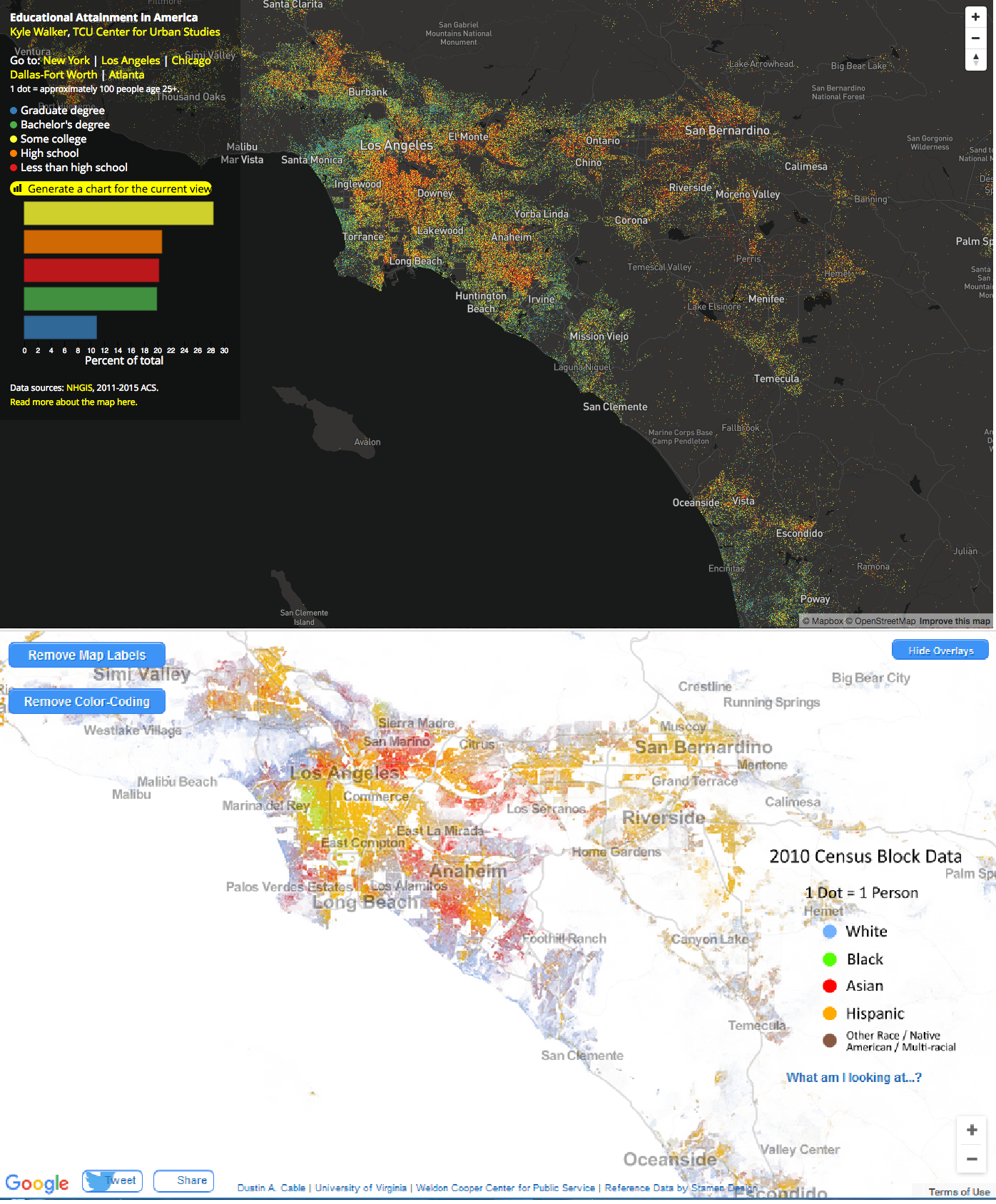
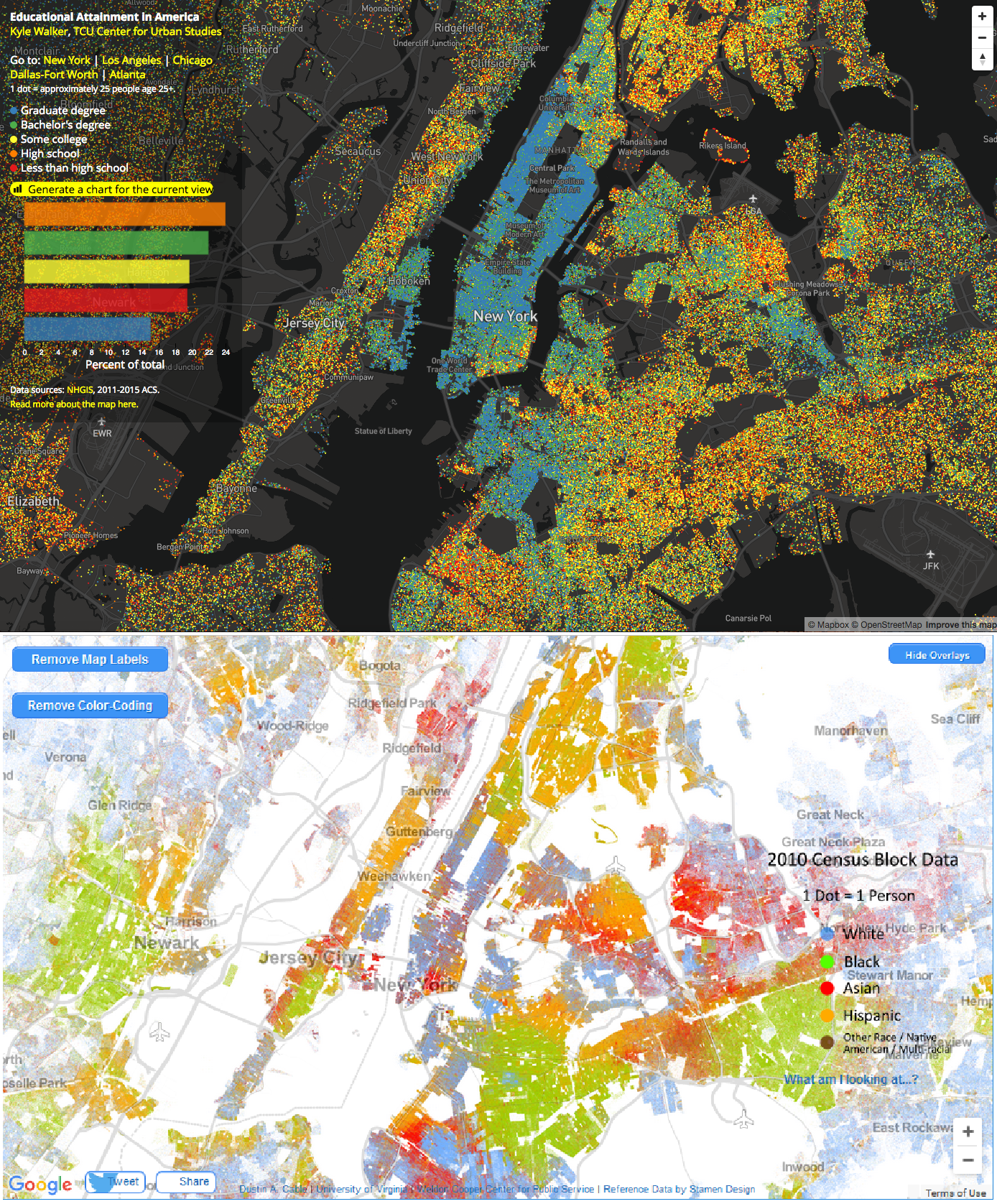
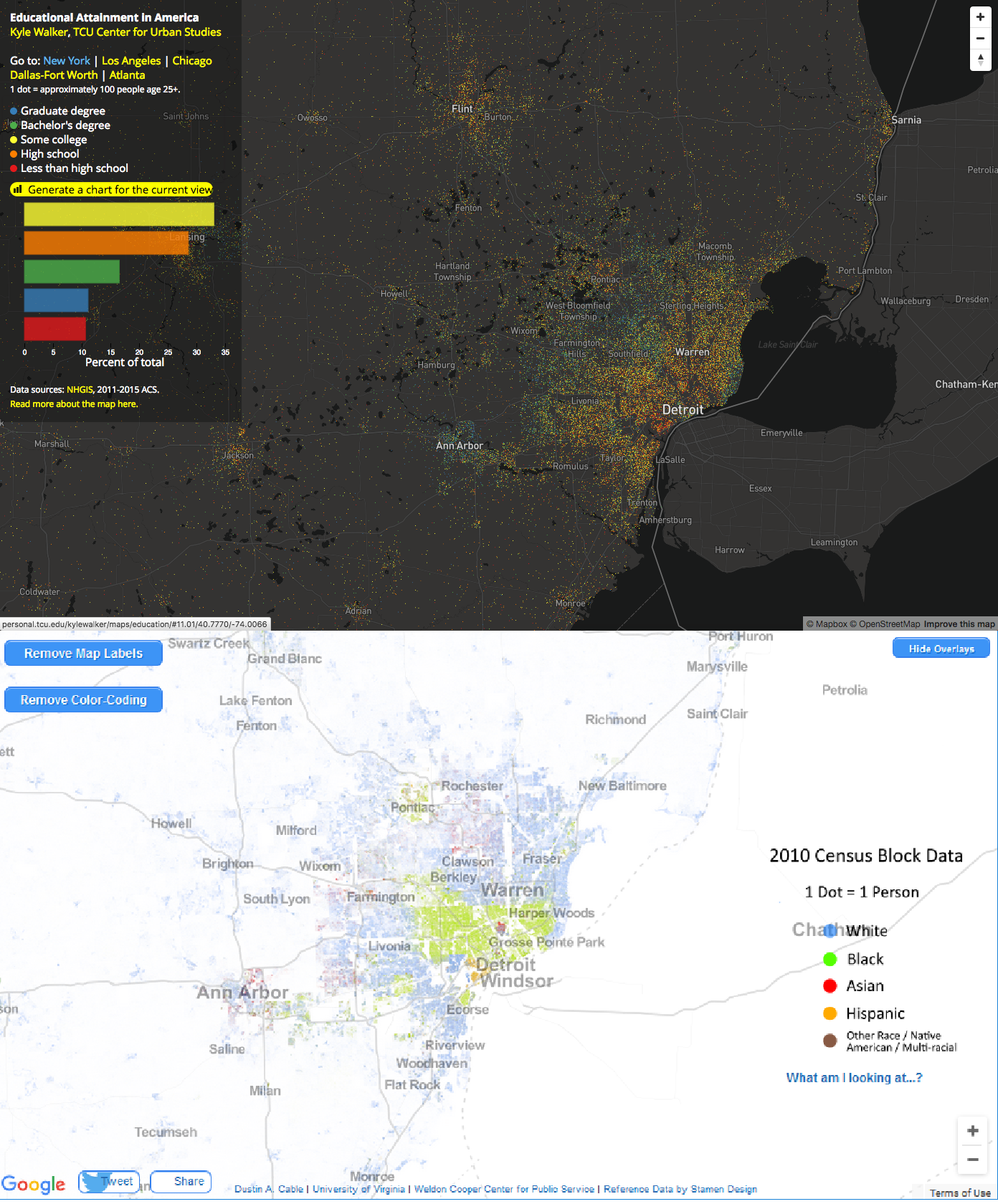
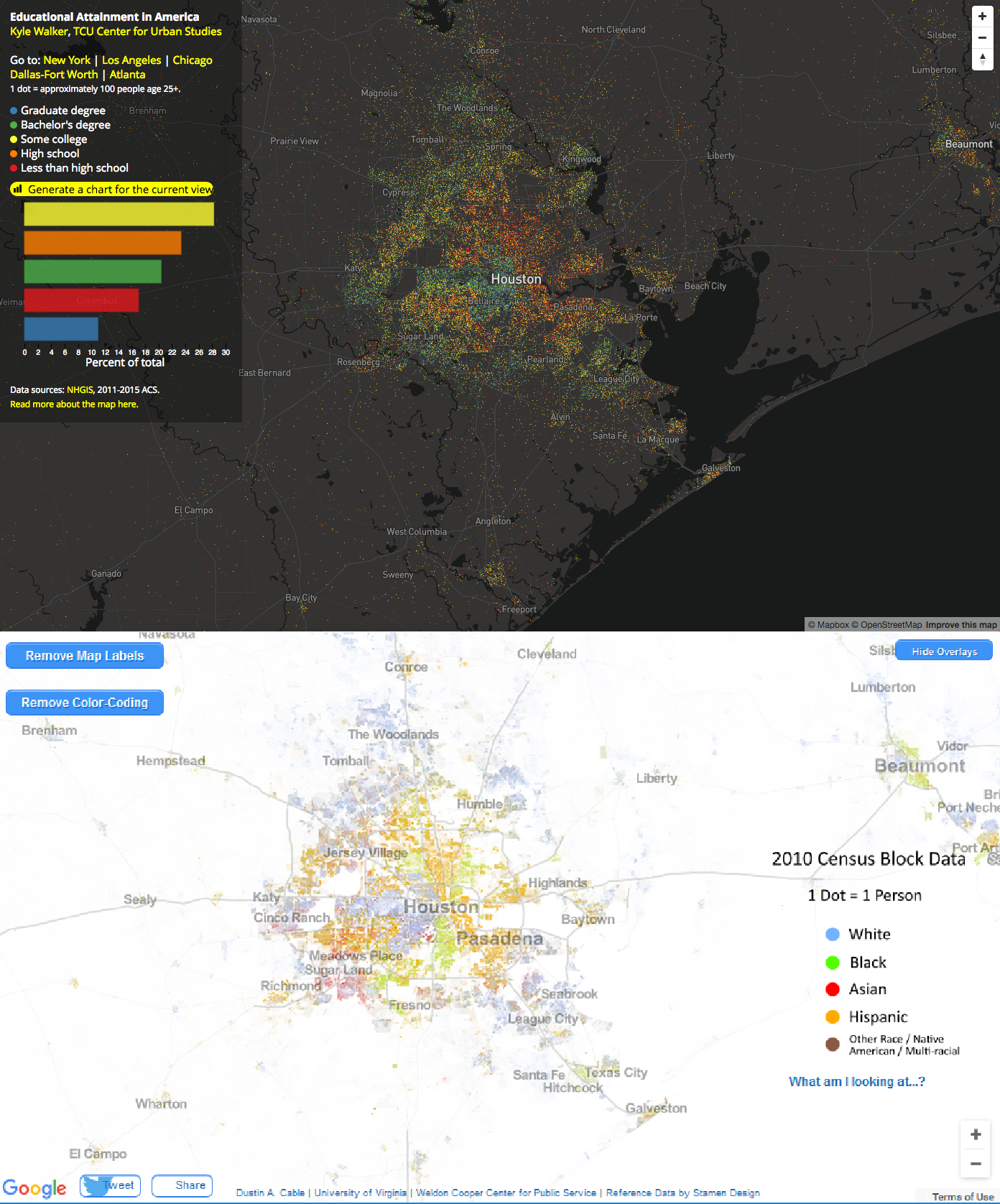
Recently, a geography professor, Kyle Walker, mapped educational attainment in the U.S. Inspired by Cable’s map of racial segregation, Walker visualizes educational inequality in the U.S. from a bird’s eye view. And when we compare Walker’s map of educational attainment to Cable’s map of racial segregation, you can see how inequalities tend to accumulate.

Below, I’ve displayed paired images of a selection of U.S. cities using both maps. In each image, the top map illustrates educational attainment and the bottom visualizes race.

  • On Walker’s map of educational attainment (top images in each pair), the colors indicate: less than high schoolhigh schoolsome collegebachelor’s degree, and graduate degree.
  • On Cable’s map of racial segregation (bottom images in each pair), the colors indicate: White, Black, Hispanic, Asian, and Other Race/Native American/Multi-Racial

So, one way of comparing the images below is to look at how the blue areas compare on each map of the same region.  

Below, you can see San Francisco, Berkeley, and San Jose, California in the same frame using Walker’s map of educational attainment (top) over Cable’s racial dot map (bottom).See how people are segregated by educational attainment (top image) and race (bottom image) in Chicago, Illinois:
Los Angeles, California:
New York City:
Detroit, Michigan:
Houston, Texas:
Compare regions of the U.S. examining Walker’s map with Cable’s racial dot map, you can see how racial and educational inequality intersect. While I only visualized cities above for comparison on both maps, if you examine Walker’s map of educational attainment, two broad trends with respect to segregation by educational attainment are easily visible:

  • Urban/rural divide–people with bachelors and graduate degrees tend to be clustered in cities and metropolitan areas.
  • Racial and economic inequalities–within metropolitan areas, you can see educational achievement segregation that both reflects and reinforces racial and economic segregation within the area (this is what you see above).

And, as research has shown, the levels of parents’ educational attainment within an area impacts the educational performances of the children living in that area as well. That’s how social reproduction happens. Sociologists are interested in how inequalities are passed on to subsequent generations. And it is sometimes hard to notice in your daily life because, as you can see above, we’re segregated from one another (by race, education, class, and more). And this segregation is one way interlocking inequalities persist.

Tristan Bridges, PhD is a professor at the University of California, Santa Barbara. He is the co-editor of Exploring Masculinities: Identity, Inequality, Inequality, and Change with C.J. Pascoe and studies gender and sexual identity and inequality. You can follow him on Twitter here. Tristan also blogs regularly at Inequality by (Interior) Design.

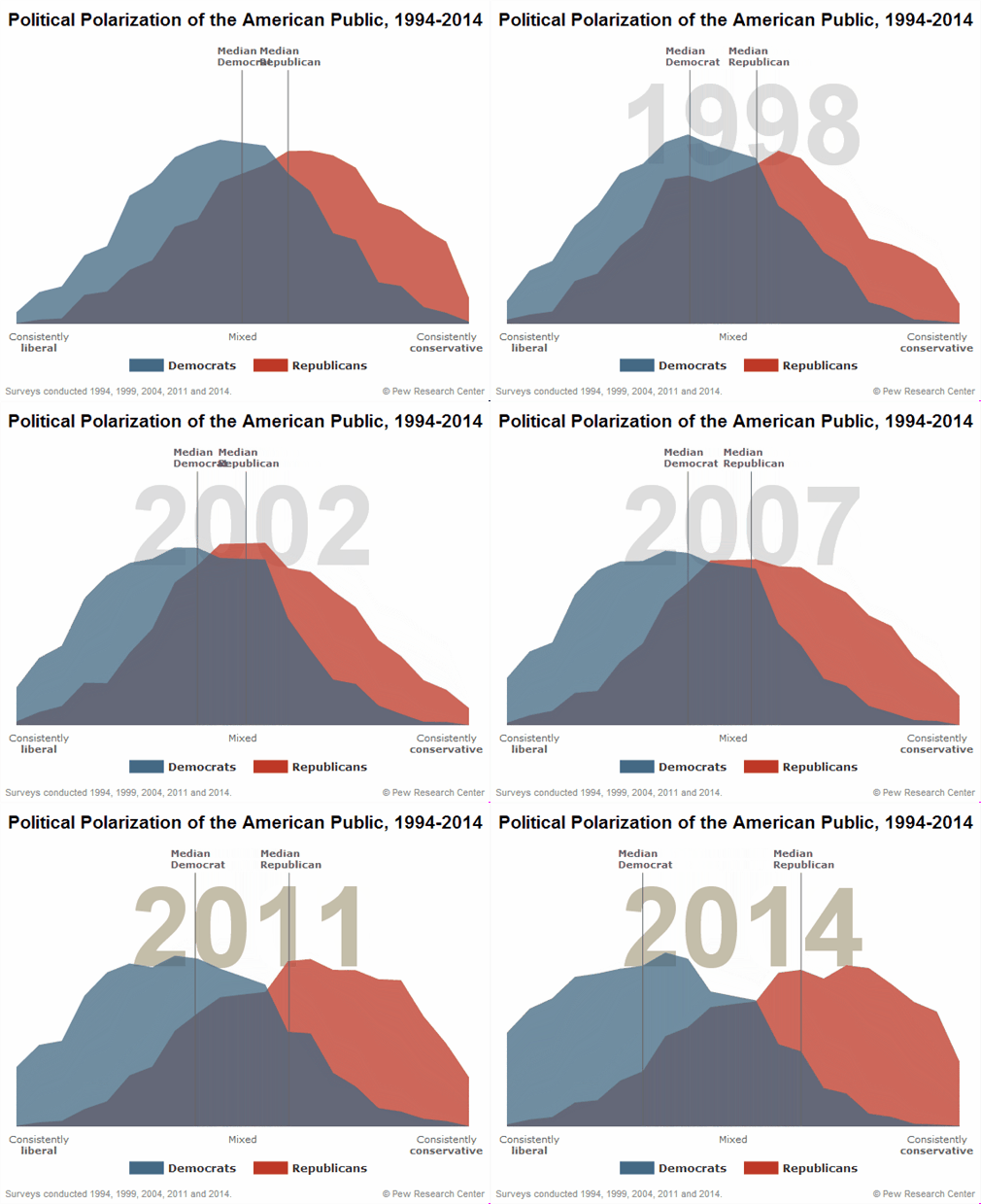
Democrats and Republicans are deeply divided. By definition, political parties have differences of opinion. But these divisions have widened. Twenty years ago, your opinions on political issues did not line up the way we have come to expect them. Today, when you find you share an opinion with someone about systemic racism, you’re more likely to have like minds about environmental policies, welfare reform, and how they feel about the poor, gay and lesbian people, immigrants and immigration, and much more. In other words, Democrats and Republicans have become more ideologically consistent in recent history.

A recent Pew Report reported that in 1994, 64% of Republicans were more conservative than the median Democrat on a political values scale. By 2014, 92% of Republicans were more conservative than the median Democrat. Democrats have become more consistently liberal in their political values and Republicans have become more consistently conservative. And this has led to increasing political polarization (see HERE and HERE for smart posts on this process by Lisa Wade and Gwen Sharpe). You can see political polarization happening below.

You might think ideological commitments naturally come in groupings. But there are lots of illogical pairings without natural connections. Why, for instance, should how you feel about school vouchers be related to how you feel about global warming, whether police officers use excessive force against Black Americans, or whether displays of military strength are the best method of ensuring peace?  The four issues are completely separate. But, if your Facebook feed looks anything like mine, knowing someone’s opinion about any one of these issues gives you enough information to feel reasonably confident predicting their opinions about the other three. That’s what ideological consistency looks like.

Consider how this process affects understandings of important systems of social inequality that structure American society. Discrimination is an issue that sociologists have studied in great detail. We know that discrimination exists and plays a fundamental role in the reproduction of all manner of social inequalities. But, people have opinions about various forms of discrimination as well—even if they’re unsupported by research or data. And while you might guess that many Americans’ opinions about one form of discrimination will be predictive of their opinions about other forms, there’s not necessarily a logical reason for that to be true. But it is.

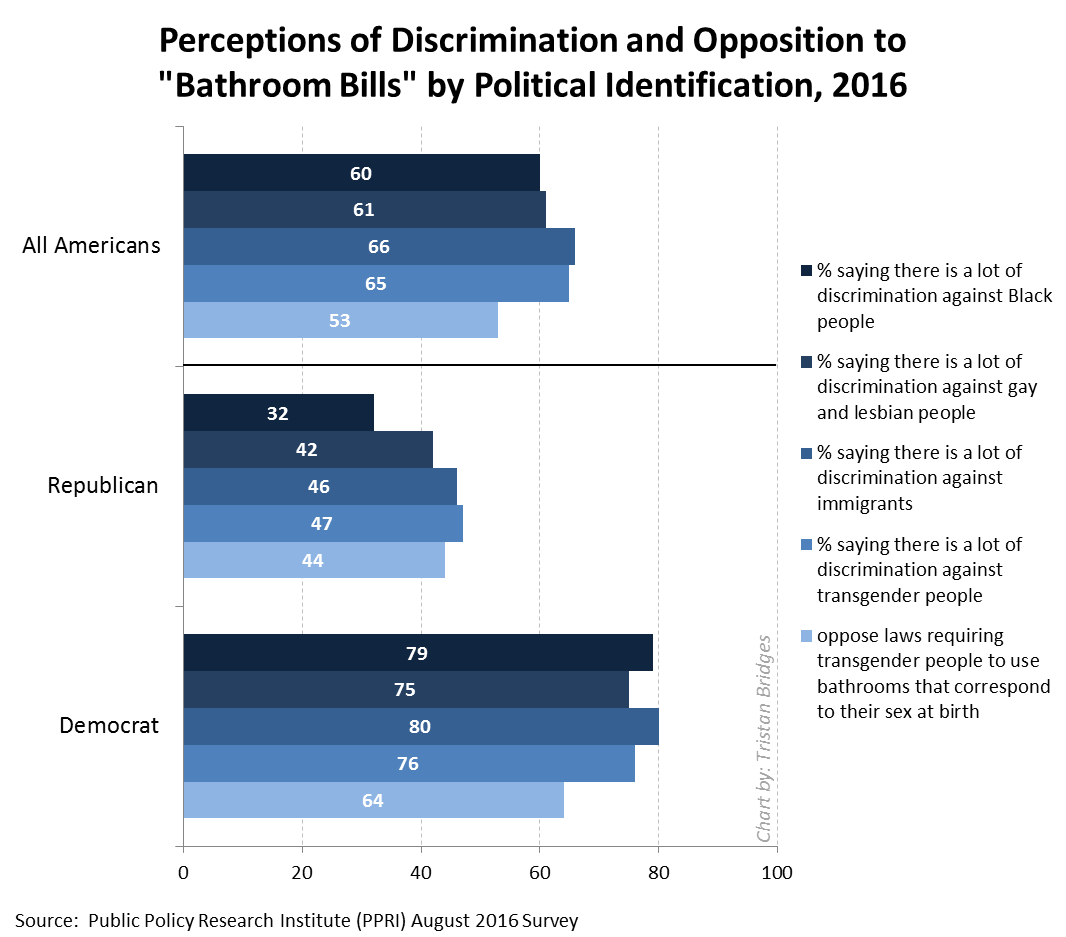
The following chart visualizes the proportions of Americans who say there is “a lot of discrimination” against Black people, gay and lesbian people, immigrants, transgender people, as well as the proportions of Americans who oppose laws requiring transgender people to use bathrooms that correspond to their sex at birth. And you can see how Americans identifying as Democrat and Republican compare.

The majority of Americans understand that social inequalities exist and that discrimination against socially marginalized groups is still a serious problem. By that, I mean that more than half of Americans believe these things to be true. And data support their beliefs. But look at the differences between Democrats’ and Republicans’ opinions about important forms of discrimination in U.S. society. The gap is huge. While just less than 1 in 3 Republicans feels that there is a lot of discrimination against Black people in the U.S., almost 8 in 10 Democrats support that statement. That’s what political polarization looks like. And Pew found that the trend is even more exaggerated among voters.

Republicans and Democrats are not just divided about whether and what to do about forms of social inequality. They’re divided about whether these inequalities exist. And that is an enormous problem.

Tristan Bridges, PhD is a professor at the University of California, Santa Barbara. He is the co-editor of Exploring Masculinities: Identity, Inequality, Inequality, and Change with C.J. Pascoe and studies gender and sexual identity and inequality. You can follow him on Twitter here. Tristan also blogs regularly at Inequality by (Interior) Design.