Search results for The

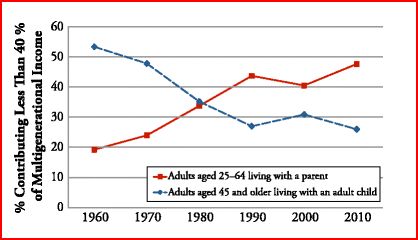
Repeatedly at SocImages, we’ve offered data showing that the middle class is shrinking.  The rich are getting richer, while a rising percentage of Americans are having trouble making ends meet.  One measure of this is the number of households that include both adults and their adult children.  About 12% of 25 to 44-year-olds lived with their parents in 1960, that dropped to 9% by 1980 and, in 2010, topped out at 17%.  Almost one-in-five adults were living with their parents at the turn of this decade.

There are two scenarios, here, however.  One indicates the decreasing financial well-being of the elderly: parents move in with their children because they can’t afford to live alone, perhaps after retirement.  The other indicates the decreasing financial well-being of young and mid-life adults: children are moving in with their parents because they can’t get a good start to life.

It turns out that the first scenario is actually on the decrease, while the latter is on the increase.  The rise in co-residence is a consequence of the failure of our economy to integrate young people into jobs that pay a living wage.  Literally, a growing number of Americans — both young people and those in mid-life — can’t afford to leave the nest.  And, no, this didn’t start with the recession, it started in the ’80s.
1

We’ve done a decent job trying to ensure that the elderly don’t live in poverty, it’s time to start working on making sure the rest of America doesn’t either.

Thanks to @toddgorman for the link!  Cross-posted at Pacific Standard and The Huffington Post.

Lisa Wade, PhD is an Associate Professor at Tulane University. She is the author of American Hookup, a book about college sexual culture; a textbook about gender; and a forthcoming introductory text: Terrible Magnificent Sociology. You can follow her on Twitter and Instagram.
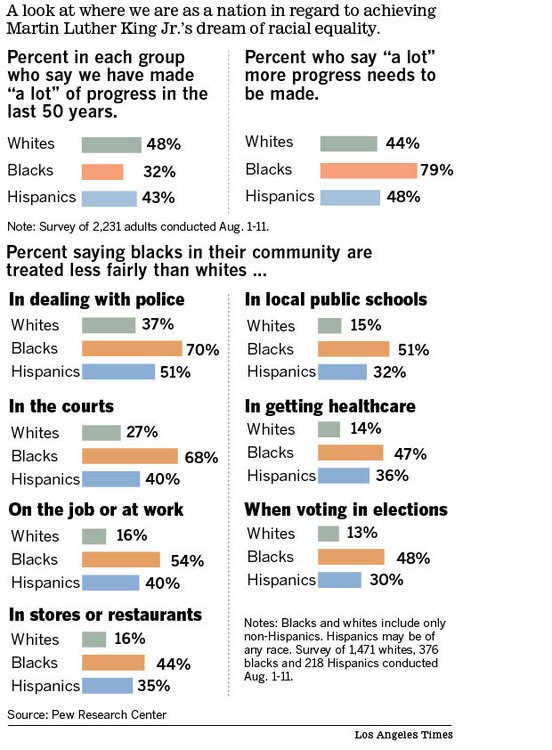
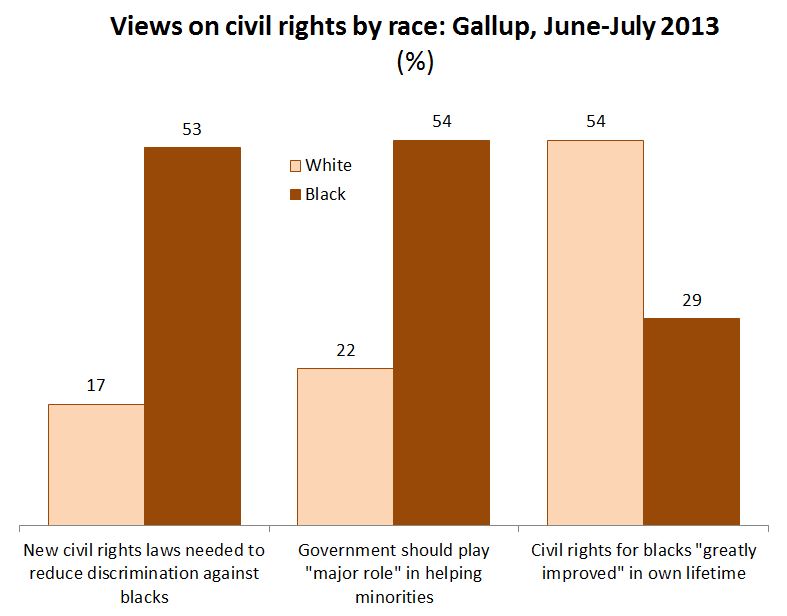
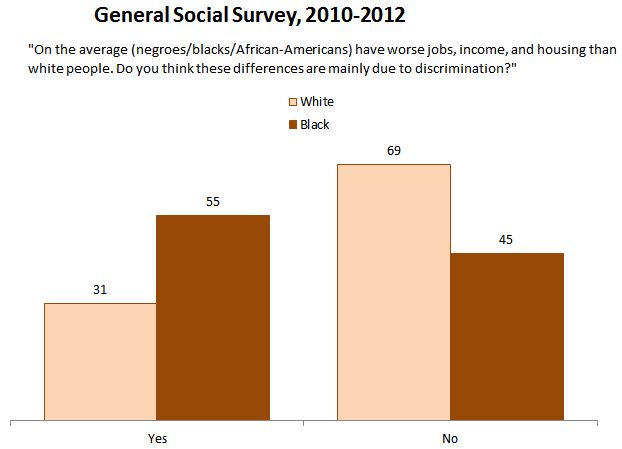
Last week sociologist Philip Cohen, who blogs at Family Inequality, attended the 50th anniversary of the March on Washington.  He noted that the crowd was primarily Black; you can see participants in his photoset here.  Are White people unenthusiastic about Civil Rights?  Perhaps.  There is evidence, in any case, that they are less likely than Black Americans to think that ongoing activism is necessary.  Cohen offers the results of a series of polls.

Pew Research Data published in the Los Angeles Times reveals that Black people are less likely than White people to think we’ve made  a lot of progress in the last 50 years.  They are also substantially more likely to believe that Blacks are treated less fairly than Whites in a wide range of circumstances:

1

Gallup poll confirms that Black Americans are less likely than Whites to feel that race-related rights are “greatly improved.”  It also reveals that they are more than twice as likely to endorse new civil rights laws and government intervention to assure non-discrimination.

2

Finally, the General Social Survey asks whether the fact that Blacks are worse off than Whites is due to mainly to discrimination or because of some other cause.  More than half of Blacks and a third of Whites say “yes, it’s discrimination.”

3

These data reveal that plenty of White Americans are concerned with racial equality, believe we have a long way to go, and support working to improve the treatment of Black Americans. There are also plenty of Black Americans that think things aren’t so bad. Nonetheless, there is a significant and persistent racial gap between the two groups.

Cross-posted at Pacific Standard.

Lisa Wade, PhD is an Associate Professor at Tulane University. She is the author of American Hookup, a book about college sexual culture; a textbook about gender; and a forthcoming introductory text: Terrible Magnificent Sociology. You can follow her on Twitter and Instagram.
The Miley Cyrus performance at the VMAs has received quite the reaction.  She appears to have shocked celebs as well as the media, and has even been blasted by a group of angry parents. The Internet outrage over her performance has spawned multiple offshoots, including a backlash against people slut-shaming Miley, as well as criticisms about her appropriation and exploitation of black culture.

What has been largely been missing from the conversation (with a few notable exceptions) is the lack of outrage at the 36-year-old man who ground up on Miley’s 20-year-old ass while singing his summer megahit rape culture anthem.

Far fewer people are expressing concern about the catchy song in which a husband and father outlines with complete confidence his ability to infer when “good girls” “want it.”  The same guy who, when discussing the lyrics to his song, tells an interviewer:

Even very good girls have a little bad side. You just have to know how to pull it out of them.

The guy who boasts that he based his hit song on the time-honored masculine performance of hollering at bitches:

We started acting like we were two old men on a porch hollering at girls like, ‘Hey, where you going, girl? Come over here!’ That’s why, in the video, we’re doing all these old men dances. It was great.

That does sound pretty great, Robin.

Overall, the 2013 VMA debacle provides a painfully accurate example of the sexual double standard we have for women and men.  A woman who performs sexuality (for whatever reason) is to be castigated, while a man who engages in the exact same performance (and who has unabashedly doubled down on his support for the rape myth that no means yes) hardly raises an eyebrow.

Brett Wheeler is a part-time psychology professor who is pursuing a PhD in positive psychology. His research interests include human sexuality, humor, and how these variables contribute to well-being.

August 29th is the anniversary of the day that Hurricane Katrina devastated the Gulf Coast and side-swiped New Orleans, breaching the levees.  These posts are from our archives:

Was Hurricane Katrina a “Natural” Disaster?

Racism and Neglect

Disaster and Discourse

Devastation and Rebuilding

Lisa Wade, PhD is an Associate Professor at Tulane University. She is the author of American Hookup, a book about college sexual culture; a textbook about gender; and a forthcoming introductory text: Terrible Magnificent Sociology. You can follow her on Twitter and Instagram.
In graduate school at the University of Wisconsin-Madison, I proctored law school exams to earn extra money.  At the end of one exam, while I was collecting the final papers, I overheard two students discussing their answers on an essay question about sentencing.  One said to the other: “I gave the rich guy a lesser sentence because I figured, since he had such a cushy life, it would take less punishment to get through to him.”  There’s your next crop of lawyers, I thought, doling out the prison sentences to the poor and letting the rich off with a slap on the wrist.

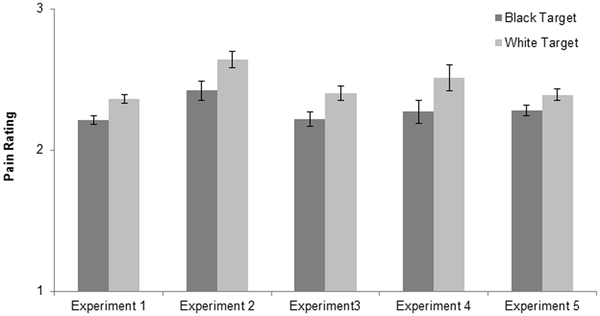
Well, it turns out that there is a well-documented psychological phenomenon behind what I’d overheard.  Morten B. sent along an essay by Jason Silverstein in which he reviews the literature on the racial empathy gap.  All things being equal, if you show a person an imagine of a dark- and a light-skinned person being harmed, they will most likely react more strongly to the latter.  Studies have found evidence of this using both self-report and measures of brain activity.  Notably, both Black and White people  respond similarly.

Here are the results of six studies using self-report; in the first four, the relationship between race and how much pain subjects attributed to the target was statistically significant:

1

What’s going on?

Silverstein explains that this isn’t necessarily about racial animosity or even identification with one’s own group (remember that both Black and White people show this response). Instead, it appears to be related to the perception that Black people have already had to cope with a great deal of pain — from racism, poverty, poor health, etc — and, as a result, have a greater pain threshold.  In other words, they are less sensitive to pain because they’ve been hardened.

Efforts to parse out whether this effect is due to race specifically or perceptions of whether a person has lived a hard life suggest that it might be primarily the latter.  But, as Silverstein points out, we tend to homogenize the Black population and assume that all Black people face adversity.  So, whether the phenomenon is caused by race or status gets pretty muddy pretty fast.

In any case, this is perfectly in line with the soon-to-be-lawyer I overheard at Wisconsin.  He gave the “hardened criminal” a harsher sentence than the person convicted of a white-collar crime because he believed that a greater degree of suffering was required to make an impact.  That was just a hypothetical case, but Silverstein reviews research that shows that the racial empathy gap has real world consequences: undertreatment of pain (even in children) and, yes, harsher sentences for African Americans convicted of crimes.

Cross-posted at Racialicious and Pacific Standard.

Lisa Wade, PhD is an Associate Professor at Tulane University. She is the author of American Hookup, a book about college sexual culture; a textbook about gender; and a forthcoming introductory text: Terrible Magnificent Sociology. You can follow her on Twitter and Instagram.

In the late 1990s, I turned down my publisher’s offer to do a third edition of my criminology textbook.  It wasn’t just that editions one and two had failed to make me a man of wealth and fame.  But it was clear that crime had changed greatly.  Rates of murder and robbery had fallen by nearly 50%; property crimes like car theft and burglary were also much lower.  Anybody writing an honest and relevant book about crime would have a lot of explaining to do.  And that would be a lot of work.

I politely declined the publisher’s offer.  They didn’t seem too upset.

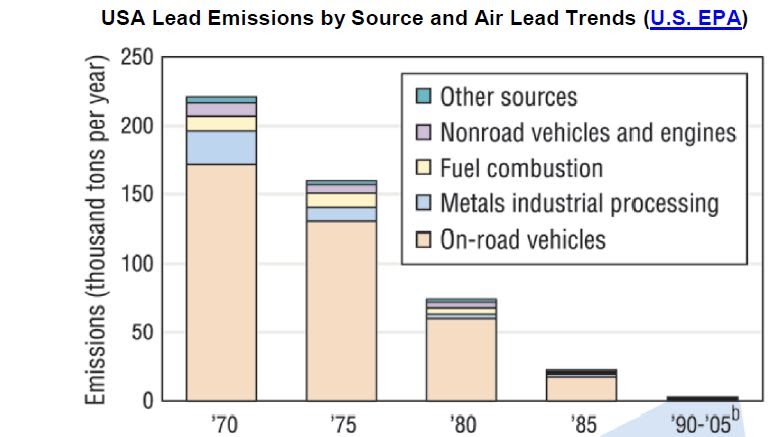
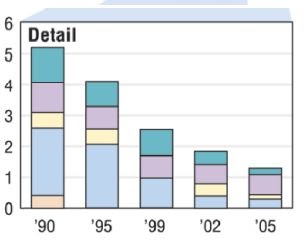
If I had undertaken the project, I probably would have relied heavily on the research articles in The Crime Drop in America, edited by Al Blumstein and Joel Wallman. They rounded up the usual suspects – the solid economy, new police strategies, the incarceration boom, the stabilization of drug markets, anti-gun policies.  But we all missed something important – lead.  Children exposed to high levels of lead in early childhood are more likely to have lower IQs, higher levels of aggression, and lower impulse-control.  All those factors point to crime when children reach their teens if not earlier.

Lead had long been suspected as a toxin, and even before World War I many countries acted to ban or reduce lead in paint and gasoline.  But the U.S., thanks to the anti-regulatory efforts of the industries and support from anti-regulation, pro-business politicians, did not undertake serious lead reduction until the 1970s.

Kevin Drum at Mother Jones has been writing about lead and crime. Because race differences on both variables are so great, it’s useful to look at Blacks and Whites separately.  In the late 1970s, 15% of Black children under age three had dangerously high rates of lead in their blood (30 mcg/dl or higher). Among Whites, that rate was only 2.5%.  By 1990, even with a lower criterion level of 25 mcg/dl, those rates had fallen to 1.4% and 0.4%, respectively.

1 2

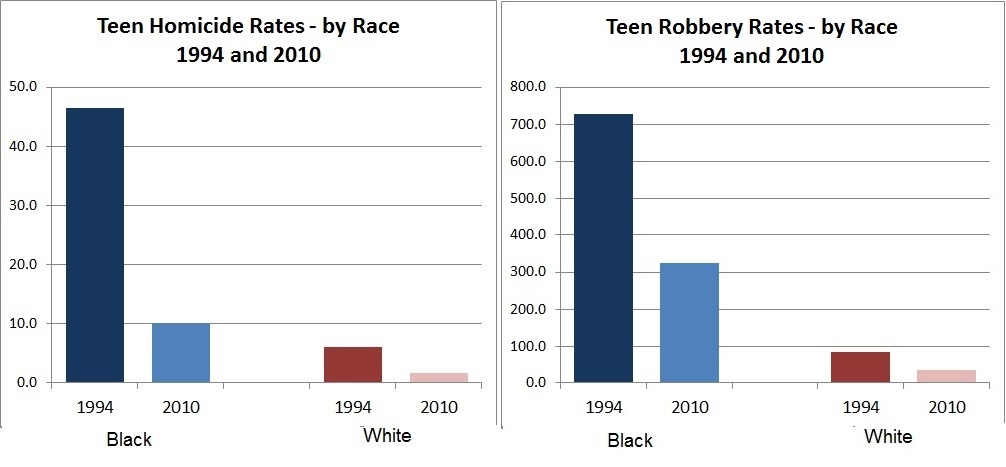
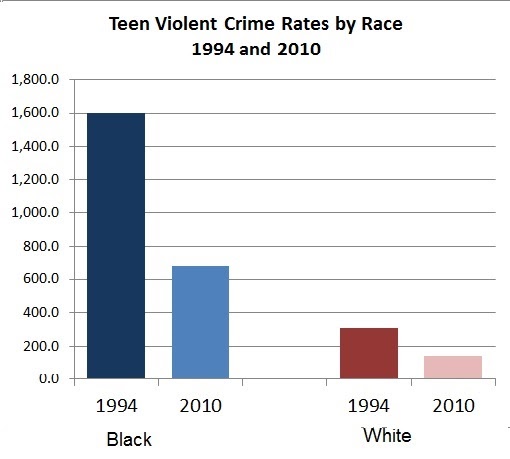
The huge reduction in lead was matched – years later when those children were old enough to commit crimes – with a reduction in crime. (note that the graphs show rates of arrest, which may somewhat exaggerate Black rates of offending):


3

4

Much of the research pointing to lead as an important cause of crime looks at geographical areas rather than individuals.  A study might compare cities, measuring changes in lead emissions and changes in violent crime 20 years later.  But studies that follow individuals have found the same thing.  Kids with higher blood levels of lead have higher rates of crime.  The lead-crime hypothesis is fairly recent, and the evidence is not conclusive.  But my best guess is that further research will confirm the idea that getting the lead out was, and will remain, an important crime-reduction policy.

Kevin Drum also emphasizes race differences.  And here the evidence is less solid:

[A]rrest rates for violent crime have fallen much faster among black juveniles than among white juveniles…  black juvenile crime rates fell further than white juvenile crime rates because they had been artificially elevated by lead exposure at a much higher rate.

But that  depends on how you intepret the data. As the graphs of arrests show, the percentage reductions are roughly similar across races.  Among Black youths, the arrest rates for all violent crime fell from 1600 per 100,000 to less than 700 – a 57% reduction.  For Whites the reduction was from 307 to 140 or 54%. But in absolute numbers, because Black rates of criminality were so much higher, the reduction seems all the more impressive. In that sense, those rates “fell further.”

Arrest rates for Blacks are still double those of Whites for property crimes, five times higher for homicide, and nine times higher for robbery.  Lead may be a factor in those differences.  Remember the lag time between childhood lead exposure and later crime. Twenty years ago, high blood levels of lead among children 1-5 years were three times as high for Blacks as for Whites.

Cross-posted at Montclair SocioBlog.

Jay Livingston is the chair of the Sociology Department at Montclair State University. You can follow him at Montclair SocioBlog or on Twitter.

Thanks to @colleeneliza for tweeting us this great example of the centering of masculinity as “normal” and the othering of women.  Notice that Home Depot is offering “Do-It-Yourself” workshops and special workshops for women and kids (screenshot taken 8/18/13):

Screenshot_1

This is just one more example of the way in which men are regarded as people and women as a special kind of person. Like kids, in this case, needing special treatment.  We’ve got lots of them.

Lisa Wade, PhD is an Associate Professor at Tulane University. She is the author of American Hookup, a book about college sexual culture; a textbook about gender; and a forthcoming introductory text: Terrible Magnificent Sociology. You can follow her on Twitter and Instagram.
New interest in the virgjinesha inspires us to re-post our coverage from 2012.

Rigid gender roles often inspire creative solutions.  Families in Afghanistan, for example, when they have all girls, often pick a daughter to pretend to be a boy until puberty.  The child can then run errands, get a job, and chaperone “his” sisters in public (all things girls aren’t allowed to do).  The transition is sudden and doesn’t involve relocation, so the entire community knows that the child is a girl.  They just pretend nothing at all strange is going on.  In fact, it’s not strange.  It happens quite routinely.

A similar phenomenon emerged in Albania in the 1400s.  Inter-group warfare had left a dearth of men in many communities.  Since rights and responsibilities were strongly sex-typed, some families needed a “man” to accomplish certain things like buy land and pass down wealth.

In response, some girls became “virgjinesha,” or sworn virgins. A sworn virgin was a socially-recognized man for the rest of “his” life (so long as the oath was kept).  Many girls would take the oath after their father died.

There are only about forty sworn virgins left; as women were granted more and more rights, fewer and fewer girls felt the need to adopt a male identity for themselves or their families.

Some of the remaining virgjinesha were featured in a New York Times slideshow.  Quotes from two individuals:

After becoming a man, Qamile Stema [below] said she could leave the house and chop wood with other men. She also carried a gun. At wedding parties, she sat with men. When she talked to women, she recalled, they recoiled in shyness.

Qamile Stema said she would die a virgin. Had she married, she joked, it would have been to a traditional Albanian woman. “I guess you could say I was partly a woman and partly a man, but of course I never did everything a man does,” she said. “I liked my life as a man. I have no regrets.”

Photographer Jill Peters has also captured images of sworn virgins.

Lisa Wade, PhD is an Associate Professor at Tulane University. She is the author of American Hookup, a book about college sexual culture; a textbook about gender; and a forthcoming introductory text: Terrible Magnificent Sociology. You can follow her on Twitter and Instagram.